Zero Trust Architecture for Enterprises: Building a Secure Access Model
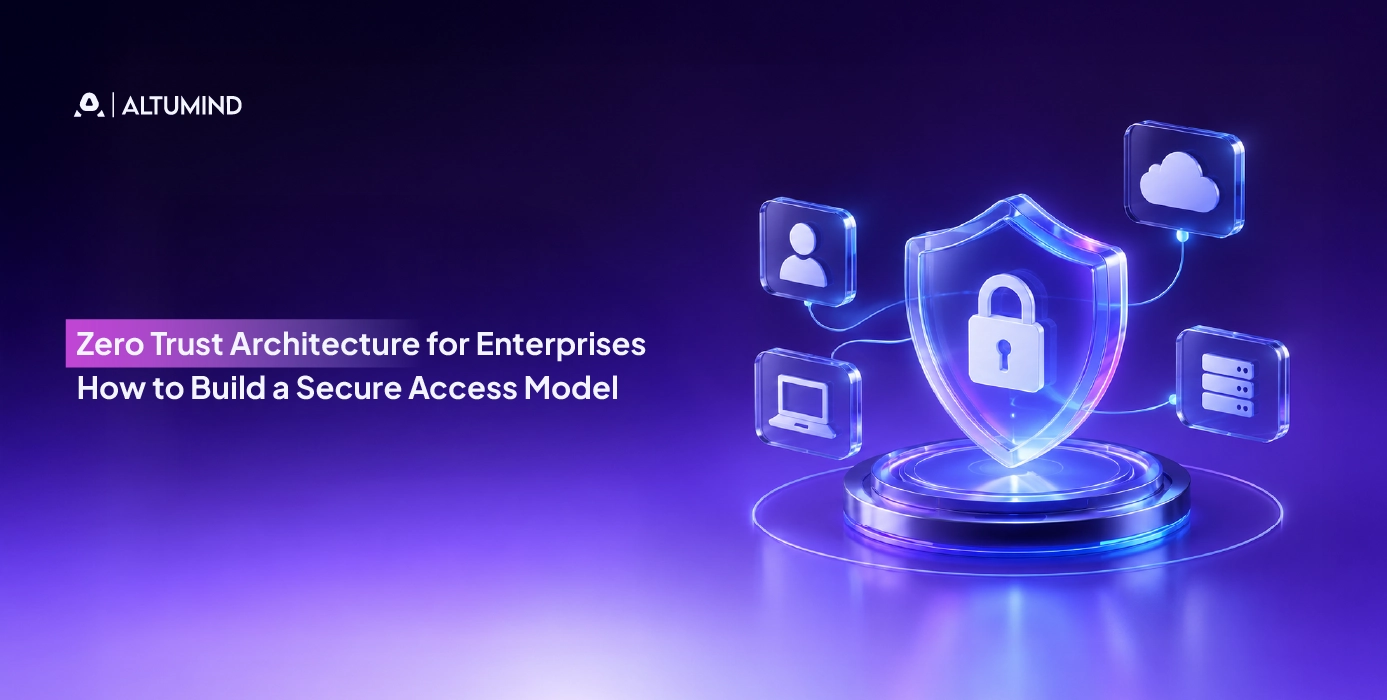
Table of Contents
- Introduction
- Why Enterprises Are Adopting Zero Trust Architecture
- What Zero Trust Architecture Looks Like in an Enterprise
- How Identity and Access Management Supports Zero Trust
- Key Considerations for Building Zero Trust Architecture
- Implementing Zero Trust Without Disrupting Operations
- How Zero Trust Supports Retail, Commerce, and Customer Platforms
- Commonly Overlooked Areas in Zero Trust Implementation
- Conclusion
Today’s enterprise landscape spans cloud services, SaaS platforms, remote teams, third-party systems, APIs, mobile devices, and legacy applications. As this environment grows, network location alone is no longer enough to determine access.
Enterprise leaders should prioritize:
- • Identity and access across employees, partners, applications, and machines.
- • Security controls across cloud, on-premises, and hybrid environments.
- • Business continuity and user experience.
- • Governance, monitoring, and operational ownership.
Altumind works across AI, cloud, data, software engineering, QA, and enterprise applications, with a focus on practical applications of these technologies in enterprise environments. This article explains how organizations can design and roll out Zero Trust architecture while keeping security aligned with business operations.
Why Enterprises Are Adopting Zero Trust Architecture
Enterprises are moving to Zero Trust because their technology environments no longer exist within one corporate network. Employees work remotely, applications run across multiple clouds, suppliers need controlled access, and customer platforms depend on external services.
Perimeter defenses still matter, but network location alone provides too little context for reliable access decisions.
Several enterprise trends are driving this change:
| Enterprise change | Access consideration |
|---|---|
| Hybrid work | Users need controlled access from different locations and devices. |
| Cloud adoption | Resources operate beyond traditional network boundaries. |
| SaaS applications | Business information resides across multiple platforms. |
| APIs and integrations | Systems communicate across application boundaries. |
| Third-party ecosystems | Suppliers and partners need defined resource access. |
| Digital commerce | Customer-facing systems connect multiple applications and services. |
Zero Trust responds by evaluating identity, device context, resource sensitivity, policy, and session conditions for each request.
Organizations also often underestimate non-human identities. Service accounts, applications, APIs, automated workflows, and machines can access business resources without a person initiating each request.
Zero Trust is therefore an identity, application, infrastructure, and operations discipline—not merely a network security initiative.
What Zero Trust Architecture Looks Like in an Enterprise
Zero Trust architecture brings identities, devices, applications, networks, data, policies, and monitoring into one coordinated access model. Instead of granting broad trust after authentication, it determines whether each request should reach a particular resource.
At the enterprise level, the architecture should answer these questions:
- • Who or what is requesting access?
- • What resource is being requested?
- • What is the business purpose of the request?
- • Is the identity authorized?
- • Is the device or application permitted?
- • What policy applies?
- • What level of access is appropriate?
- • What monitoring is required after access is granted?
For example, authentication may confirm an employee’s identity before access to a finance application, but authorization should also reflect the employee’s role, device, requested resource, and required privilege.
The same principle applies to external parties and applications. A supplier might access a procurement portal but not internal employee systems; an application might call one API while remaining blocked from unrelated services.
This resource-specific model aligns security controls with real enterprise workflows.
It is equally important during cloud modernization. Microservices, APIs, serverless components, containers, data platforms, and third-party services require policies based on how components communicate—not simply where they are hosted.
How Identity and Access Management Supports Zero Trust
Identity and access management forms the foundation of Zero Trust decisions about who or what can use enterprise resources. Its scope extends beyond employees to privileged users, contractors, suppliers, applications, service accounts, and machines.
A mature identity model should consider:
- • Authentication strength.
- • User roles and attributes.
- • Device context.
- • Privileged access.
- • Session duration.
- • Application sensitivity.
- • Resource sensitivity.
- • Access history.
- • Business requirements.
Least privilege is central to this model: users should receive only the permissions required for their responsibilities, not broad access based solely on department membership.
Identity lifecycle management must also connect to business systems. Role changes should trigger permission updates, and access should be reviewed or removed when a contractor’s engagement ends.
This creates practical value through clearer ownership, fewer manual decisions, and closer alignment between workforce changes and technology permissions.
Machine identities require the same level of governance. Automated services can accumulate permissions when teams build integrations independently. Assigning owners and conducting regular reviews helps remove unnecessary access and simplify management.
Key Considerations for Building Zero Trust Architecture
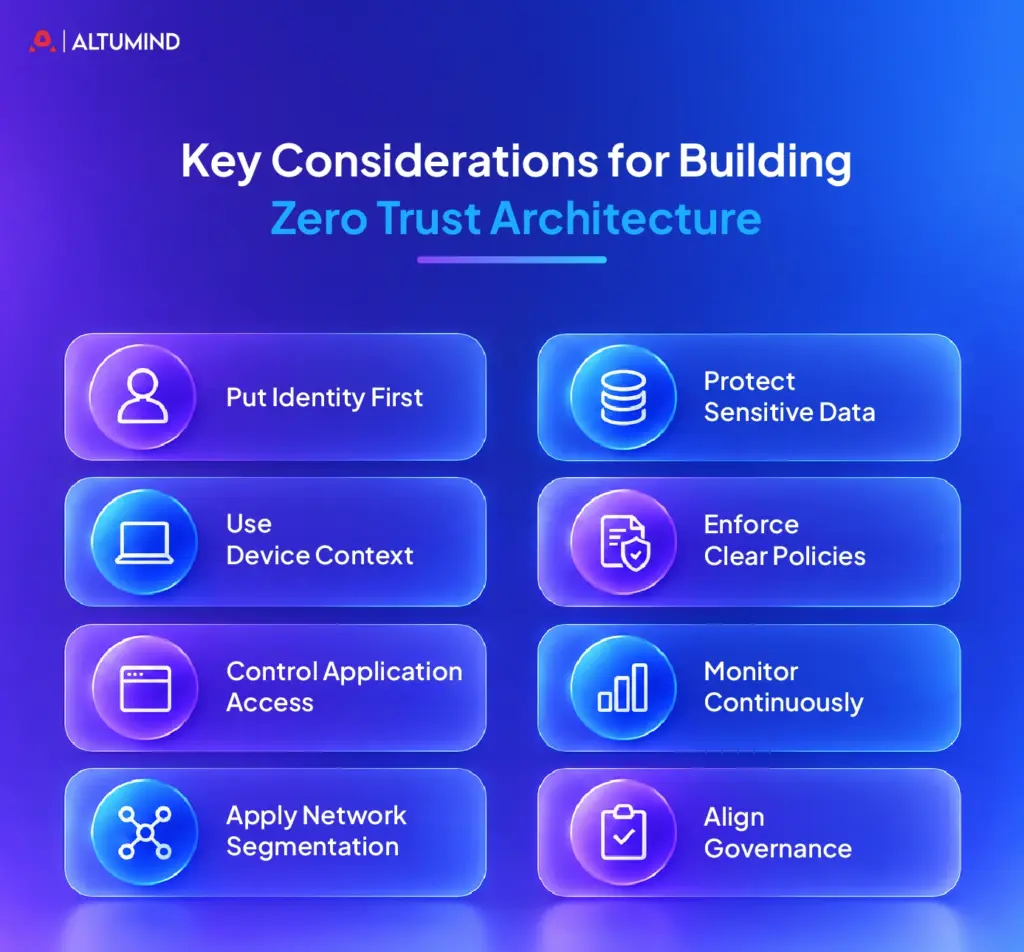
A practical Zero Trust architecture spans eight connected areas. Enterprises should address these areas as an interconnected model because weaknesses in one area can undermine the broader access framework.
1. Put Identity First
Identity should anchor access decisions. Enterprises need visibility into workforce identities, privileged accounts, third-party users, applications, service accounts, and machines.
The key question is not merely whether an identity is authenticated, but whether it should access a particular resource under current conditions.
2. Use Device Context
Device information adds context to access decisions, including ownership, configuration, operating-system status, security controls, and organizational requirements.
This context is especially important when employees work across offices, homes, customer sites, and travel environments.
3. Control Application Access
As applications increasingly communicate through APIs and distributed services, access controls must cover service and application identities as well as human users.
In cloud-native environments, this approach enables precise service-to-service permissions and reduces unnecessary communication paths.
4. Apply Network Segmentation
Network segmentation remains useful within Zero Trust architecture, particularly for sensitive environments and workloads.
However, segmentation should support broader access policies rather than become the only basis for trust. Identity, application context, resource sensitivity, and policy should also contribute to access decisions.
5. Protect Sensitive Data
Data access should reflect business sensitivity. Customer information, financial records, intellectual property, employee information, and operational data may require different controls.
Enterprises should therefore connect data classification with access policies rather than applying identical permissions across all information.
6. Enforce Clear Policies
Policies need to be specific enough to support real business requirements and practical enough for technology teams to maintain.
A policy should establish who can access a resource, under what conditions, for what purpose, and with what level of privilege.
Business and data owners should participate in this process because they understand the operational reason behind many access requirements.
7. Monitor Continuously
Zero Trust does not stop at authentication. Enterprises need visibility into access activity, policy decisions, exceptions, and unusual behavior.
Monitoring can help security and operations teams investigate events and identify areas where policies may need refinement.
8. Align Governance
Governance connects technical controls with business requirements, compliance obligations, application ownership, data responsibilities, and risk management.
Without clear ownership, enterprises can accumulate access policies that are individually reasonable but difficult to maintain as systems and organizational structures change.
Implementing Zero Trust Without Disrupting Operations
Zero Trust works best as a phased enterprise program rather than a one-time deployment. Start with the current environment, business priorities, and applications that require stronger controls.
1. Assess the Current Environment
Start by mapping identities, applications, devices, data, integrations, privileged accounts, and existing access policies.
A cybersecurity risk assessment can help establish priorities by examining existing controls, technology dependencies, business processes, and areas requiring additional attention.
2. Prioritize Sensitive Resources
Identify applications and resources where stronger access controls have a clear business purpose. These may include privileged administration systems, financial applications, customer data platforms, or important operational systems.
3. Establish Identity Controls
Strengthen authentication, role management, privileged access, identity lifecycle processes, and machine identity management.
4. Pilot Selected Workflows
Test policies with a defined group of users, applications, and resources before expanding them across the enterprise.
Pilots also expose overlooked dependencies—for example, an application may rely on an integration account omitted from the initial assessment.
5. Integrate Security With Applications
Connect access policies with cloud platforms, APIs, applications, endpoint controls, and existing security technologies.
This is particularly important during application modernization. Security controls should become part of the architecture rather than a separate layer added after development.
6. Measure Operational Impact
Track policy exceptions, access friction, administrative effort, application availability, and support requests alongside security metrics.
User experience is often underestimated. If policies repeatedly interrupt legitimate workflows, users may seek workarounds. Testing controls against real business processes helps identify friction before wider deployment.
Security validation should also form part of the implementation cycle. Penetration testing services can help assess application and system exposure, while automated testing can validate security-related functionality during development.
AI-powered QA can also support continuous delivery. Enterprises assessing the role of AI in reducing software testing time can consider how intelligent testing fits alongside security validation, regression testing, and broader quality processes.
How Zero Trust Supports Retail, Commerce, and Customer Platforms
Retail and commerce environments require access controls across employees, stores, suppliers, applications, customer platforms, inventory systems, APIs, and other connected services.
A retail organization may need separate access policies for:
- • Store employees.
- • Corporate employees.
- • Suppliers.
- • Logistics partners.
- • Application administrators.
- • Customer-facing applications.
- • Inventory systems.
- • Commerce platforms.
The goal is not to enforce the same controls everywhere. Access should match each resource’s purpose and sensitivity.
For example, a store employee may need access to inventory functions but not administrative settings. A supplier may need access to specific procurement workflows without access to unrelated internal systems. An application may need to retrieve inventory information without gaining broader database permissions.
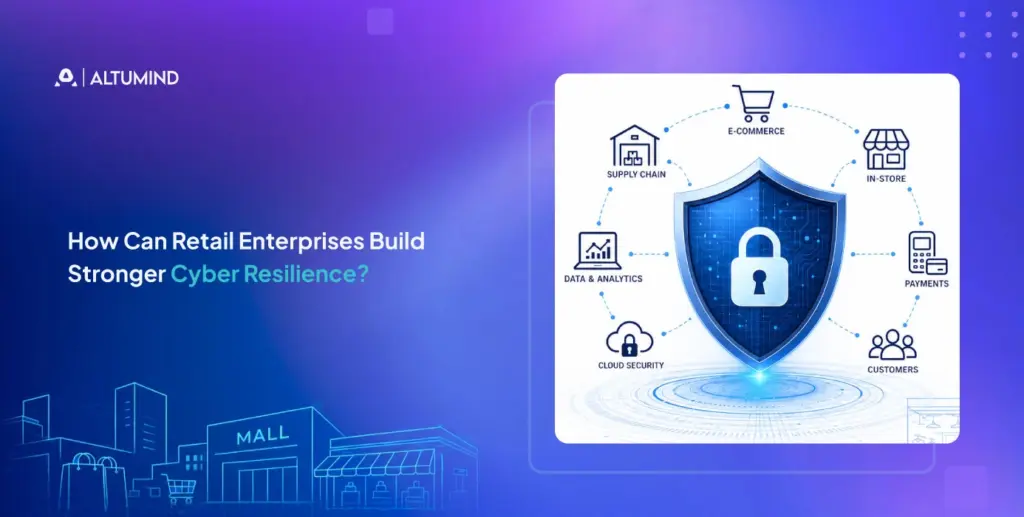
This makes Zero Trust relevant to broader retail security planning. Organizations working on building stronger cyber resilience for retail businesses can consider identity, application access, data protection, monitoring, and third-party access as connected parts of the operating model.
The same principle applies in healthcare, where patient systems, clinical applications, administrative platforms, providers, and external services can have different access requirements. Understanding the cybersecurity needs of healthcare highlights why access policies should reflect data sensitivity, user responsibilities, and operational workflows.
Commonly Overlooked Areas in Zero Trust Implementation
Organizations often underestimate the operating model required to sustain Zero Trust.
- • Legacy application constraints: Older applications may not support modern authentication or granular authorization. Enterprises may need integration layers, application modernization, or compensating controls.
- • Service accounts: Automated processes can hold permissions for long periods. These identities need owners, lifecycle controls, and periodic reviews.
- • Policy ownership: Security teams may implement policies, while business teams understand the operational reason behind them. Both groups need to participate in policy design.
- • Third-party access: Suppliers and partners often require limited access for defined periods. Their permissions should have clear owners and review schedules.
- • User experience: Additional authentication or restrictive policies can affect legitimate workflows. Security requirements should be tested against actual business processes.
- • Measurement: Deployment alone does not demonstrate operational value. Enterprises need metrics that show whether access governance, administrative efficiency, and visibility are improving.
Another area that deserves attention is data access. Analytics environments can bring together information from ERP systems, CRM platforms, applications, IoT sources, and third-party systems. Access controls therefore need to extend into data pipelines, analytics platforms, dashboards, and machine learning environments.
Conclusion
Zero Trust is not simply a security technology choice; it is a framework for governing access across identities, applications, systems, and data. Successful adoption must account for legacy dependencies, user experience, third parties, machine identities, governance, and measurable operational results.
For enterprises modernizing their technology environment, the right approach connects security architecture with cloud, applications, data, and business workflows. Altumind’s cybersecurity services bring these areas together as part of broader enterprise technology and digital transformation initiatives, helping organizations plan security around the way their systems actually operate.

Author
Practice Head, Cybersecurity
Sujatha is a cybersecurity consultant and strategic advisor who helps global enterprises secure their digital assets, maintain compliance, and build resilient infrastructure.
Armed with an MBA with Cybersecurity, a CISM certification, and extensive experience across the UK and APAC regions, she specializes in protecting complex banking and financial services environments. By combining a strong technical background with IT Service Management (ITSM) expertise, Sujatha seamlessly integrates robust security frameworks into business operations, translating complex risks into clear, strategic corporate outcomes.
Table of Contents
- Introduction
- Why Enterprises Are Adopting Zero Trust Architecture
- What Zero Trust Architecture Looks Like in an Enterprise
- How Identity and Access Management Supports Zero Trust
- Key Considerations for Building Zero Trust Architecture
- Implementing Zero Trust Without Disrupting Operations
- How Zero Trust Supports Retail, Commerce, and Customer Platforms
- Commonly Overlooked Areas in Zero Trust Implementation
- Conclusion