Penetration Testing Services: A Strategic Approach to Risk Validation
Table of Contents
- Introduction
- What Is Penetration Testing in Software Testing
- Why Penetration Testing Has Become a Board-Level Priority
- Types of Penetration Testing Services
- Process of Penetration Testing
- Penetration Testing as a Service: A Shift in Delivery Model
- The Role of AI in Penetration Testing
- Choosing the Right Penetration Testing Partner
- Conclusion
Most security breaches share a common characteristic. They exploit vulnerabilities that existed long before the attack, often ones that could have been identified through proper testing. Organizations that delay penetration testing are not avoiding risk; they are postponing discovery of risk that already exists.
Decision makers increasingly recognize that penetration testing services have moved from optional security exercises to baseline business requirements. Customers ask about security testing during procurement. Insurers require coverage. Regulators expect documented evidence of it.
Common gaps that leave organizations exposed include:
- Treating penetration testing as a once-a-year compliance checkbox rather than an ongoing practice.
- Misunderstanding the scope of penetration testing in software testing and its distinction from automated scanning is a common gap that leaves organizations vulnerable.
- Selecting testing providers based on cost alone without evaluating methodology or expertise.
- Failing to incorporate testing findings into development and remediation workflows is a common mistake.
- Overlooking the impact of AI on both attack methods and defensive testing capabilities is a significant oversight.
This guide examines what penetration testing in software testing involves and how penetration testing as a service has transformed security validation.
What Is Penetration Testing in Software Testing
Penetration testing in software testing is a controlled, simulated attack on systems, applications, or networks. The goal is to identify exploitable vulnerabilities before real attackers find them.
This practice sits within the broader software testing discipline but serves a distinct purpose. Functional testing confirms that software works as intended. Penetration testing confirms whether software can be bypassed, manipulated, or accessed without authorization.
| Aspect | Functional Testing | Penetration Testing |
|---|---|---|
| Primary goal | Verify features work correctly | Identify exploitable security gaps |
| Approach | Confirms expected behavior | Attempts to break expected behavior |
| Tester mindset | User perspective | Attacker perspective |
| Output | Bug reports | Vulnerability and risk reports |
Testing teams examine multiple layers of an organization’s technology stack. This includes web applications, mobile platforms, internal networks, cloud configurations, and application programming interfaces. Each layer carries distinct risks that require different testing techniques.
The outcome of penetration testing is a structured report. This report ranks vulnerabilities by severity, explains potential business impact, and provides remediation guidance that technical teams can act on directly.
Why Penetration Testing Has Become a Board-Level Priority
Cybersecurity has moved from an IT department concern to a board-level governance topic. Penetration testing services sit at the center of this shift because they produce evidence, not assumptions, about organizational risk.
1. Regulatory Requirements Have Expanded
Standards including PCI DSS, SOC 2, ISO 27001, and HIPAA either require or strongly recommend regular testing as part of compliance evidence. Organizations operating across multiple jurisdictions often face overlapping requirements that make testing a continuous obligation rather than a one-time event.
2. Cyber Insurance Now Depends on Testing Evidence
Underwriters increasingly request penetration testing reports before issuing or renewing policies. Organizations without recent documentation face higher premiums, reduced coverage limits, or denial of coverage entirely. Cyber insurance requirements have become a significant driver of testing adoption.
3. Customer Due Diligence Has Intensified
B2B security questionnaires routinely reference penetration testing frequency and scope before contracts get signed. Enterprise buyers increasingly expect documented evidence of security controls and testing practices.
4. Breach Costs Extend Well Beyond Remediation
Regulatory penalties, customer attrition, and reputational repair all compound when vulnerabilities surface through an attack rather than a test. The cost difference between fixing an issue proactively and responding to it after exploitation is substantial.
5. Board Reporting Now Includes Security Posture
Leadership teams want documented evidence of testing programs, not verbal assurances from technical teams. Penetration testing reports provide the kind of concrete artifact that supports governance conversations at the executive level.
Organizations approaching new product launches benefit from building security validation into their planning from the outset. This connects directly to broader efforts around mitigating risk at every stage of the digital product development lifecycle, where security testing becomes one checkpoint among several rather than an afterthought.
Types of Penetration Testing Services
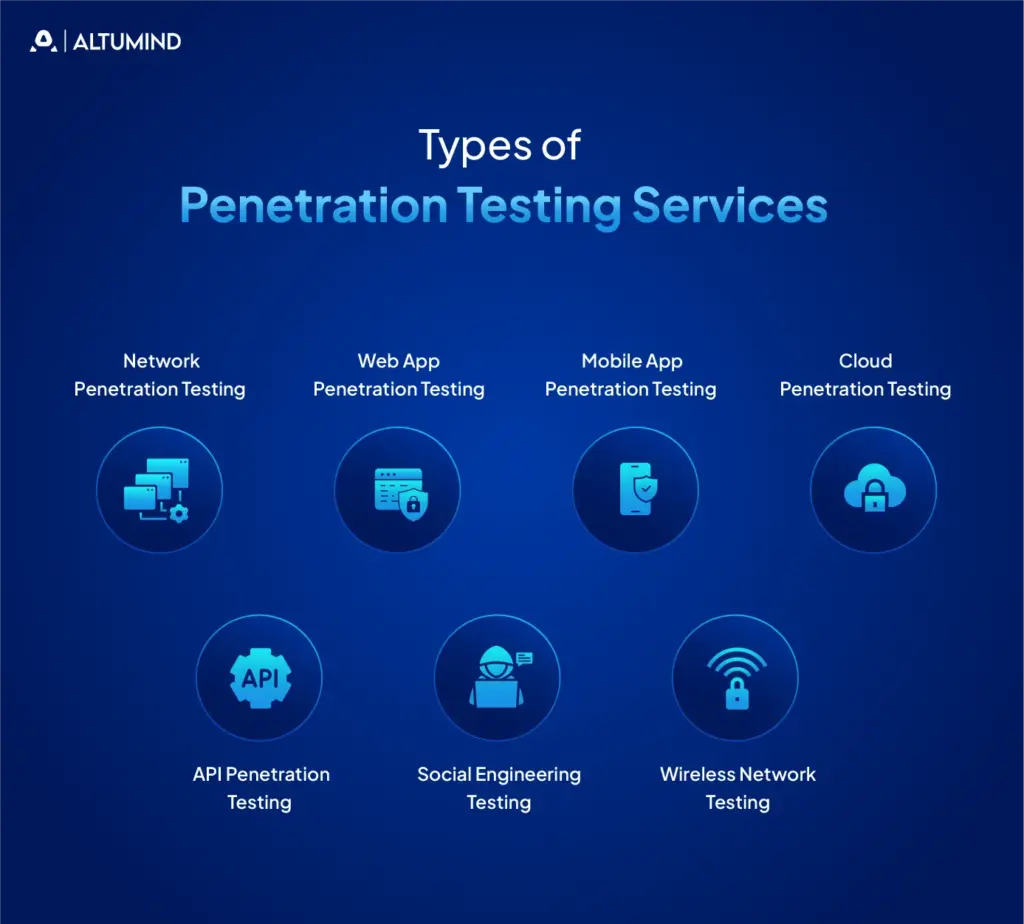
Different testing types address different parts of the technology environment. Most organizations require a combination based on their infrastructure and risk profile.
1. Network Penetration Testing
Network penetration testing examines internal and external network infrastructure. Testers look for misconfigured firewalls, weak segmentation, and outdated systems that could allow unauthorized access. External testing simulates an outside attacker, while internal testing assumes an attacker has already gained network access.
2. Web App Penetration Testing
Web application penetration testing focuses on websites and web platforms. Common findings include injection flaws, broken authentication, and improper access controls that expose sensitive data. This testing type is particularly important for any organization operating customer-facing portals or transactional websites.
3. Mobile App Penetration Testing
Mobile application penetration testing addresses iOS and Android apps specifically. Testers evaluate local data storage, API communications, and how the app handles device-level permissions. This testing identifies risks that exist only because of how mobile platforms handle data differently from web environments.
4. Cloud Penetration Testing
Cloud penetration testing assesses configurations within AWS, Azure, and Google Cloud environments. Misconfigured storage permissions and overly permissive identity roles are among the most frequent issues found. As organizations shift more infrastructure to cloud platforms, this testing type has become a core requirement.
5. API Penetration Testing
API penetration testing examines the interfaces connecting applications and services. As organizations build more integrations, APIs have become a frequent target for attackers seeking direct access to backend systems. Testers focus on authentication mechanisms, data exposure, and rate-limiting controls.
6. Social Engineering Testing
Social engineering testing evaluates how employees respond to phishing, pretexting, and manipulation attempts. Technical defenses cannot fully compensate for human error, making this testing type a necessary complement to technical assessments.
7.Wireless Network Testing
Wireless network testing examines Wi-Fi infrastructure for weak encryption protocols, rogue access points, and authentication weaknesses. These issues can provide attackers an entry point into otherwise well-secured networks, particularly in office environments with significant foot traffic.
Process of Penetration Testing
A structured process distinguishes professional penetration testing from automated scanning. Understanding each phase helps organizations prepare effectively and interpret results with confidence.
1. Planning and Scoping
The process begins with defining testing objectives, scope, and rules of engagement. Organizations specify which systems testers can access and any restrictions on testing methods. Clear scoping prevents disruption to production systems and aligns testing with business priorities.
2. Reconnaissance and Discovery
Testers gather information about target systems through passive and active reconnaissance. This includes identifying technologies in use, mapping network architecture, and locating potential entry points an attacker might pursue. Discovery activities establish the attack surface available to a potential adversary.
3. Vulnerability Identification
Testers use automated tools and manual techniques to identify potential vulnerabilities. Automated tools efficiently surface known issues, while experienced testers identify logic flaws and complex vulnerabilities that tools typically miss. This combination produces more comprehensive results than either approach alone.
4. Exploitation and Validation
Testers attempt to exploit identified vulnerabilities to confirm their existence and assess potential impact. This phase distinguishes theoretical risks from genuinely exploitable weaknesses, giving organizations a realistic picture of actual risk rather than hypothetical concerns.
5. Reporting and Documentation
Testers compile findings into comprehensive reports. These documents include executive summaries, technical details, risk ratings, and remediation guidance. Quality reports translate technical findings into business language, enabling leadership to make informed decisions about security investments.
6. Remediation Support and Retesting
Many penetration testing services include support during remediation efforts. Retesting confirms that identified vulnerabilities have been properly addressed, giving organizations documented assurance that fixes were implemented correctly and completely.
Penetration Testing as a Service: A Shift in Delivery Mode
Penetration testing as a service represents a structural change in how security testing is delivered and consumed. Rather than a single annual engagement, organizations access ongoing testing through a subscription or retainer relationship.
1.Continuous Testing AlignsWithContinuous Deployment
Organizations releasing software frequently need security validation that keeps pace with that cadence. Annual testing cycles cannot account for vulnerabilities introduced between assessments, while continuous models close that gap.
2. Costs Become Predictable Across the Year
Subscription-based testing replaces large, infrequent invoices with manageable recurring expenses. This predictability makes security testing easier to budget and justify as an operational cost rather than a periodic capital expense.
3. Familiarity With the Environment Improves Over Time
Testing teams that work with the same environment repeatedly develop deeper context about its architecture and history. This familiarity often leads to faster turnaround times and more relevant findings in later engagements.
4. Specialized Expertise Becomes More Accessible
Service-based models give organizations access to diverse skill sets across network, application, cloud, and mobile testing without the cost of building large internal security teams.
5. Findings Integrate Into Existing Workflows
Testing conducted on an ongoing basis fits more naturally into development and quality processes. Teams that already rely on established QA services find it straightforward to extend that same operational rhythm to include security testing as a parallel function.
Many organizations also prefer working with a managed cybersecurity partner that can combine ongoing penetration testing, infrastructure monitoring, remediation guidance, and security operations into a unified long-term security strategy. Organizations following a defined SaaS product development roadmap particularly benefit from this model. Security validation can be scheduled around major releases and feature milestones, ensuring new functionality is tested before it reaches customers.
The Role of AI in Penetration Testing
Artificial intelligence is changing penetration testing from both directions. It strengthens what defensive testing teams can accomplish while also expanding what attackers are capable of.
1. AI Improves Risk-Based Prioritization
AI-driven tools analyze large volumes of network traffic, code, and system configurations to identify patterns associated with known vulnerability classes. This allows testing teams to focus manual effort on the vulnerabilities most likely to cause significant harm.
2. Report Generation Becomes More Efficient
Natural language processing tools assist testers in translating technical findings into clearer business-facing language. This reduces the time between testing completion and delivery of an actionable report to leadership.
3. Pattern Recognition Reveals Recurring Weaknesses
AI tools can analyze findings across an organization’s entire application portfolio, identifying recurring weaknesses that might otherwise appear as isolated issues in individual reports.
4. Threat Intelligence Becomes More Relevant
AI systems trained on current threat data help testing scopes reflect attack techniques currently being used against similar organizations, keeping assessments aligned with real-world risk rather than outdated threat models.
5. Attackers Use AI to Scale Their Efforts
On the offensive side, attackers increasingly use AI to craft more convincing phishing content, automate reconnaissance, and identify vulnerabilities at scale. This raises the bar for defensive testing, requiring providers to understand AI-enabled attack techniques as part of their methodology. In our experience, the most critical findings are often misconfigurations and access-control weaknesses that emerge as environments evolve.
6. Human Expertise Remains the Deciding Factor
AI tools accelerate certain tasks, but the judgment required to interpret findings, understand business context, and identify novel attack paths still depends on experienced professionals. Organizations evaluating their broader technology strategy as part of digital product development for business leaders should treat AI-enhanced security testing as one component of a wider conversation about how AI reshapes both opportunity and risk.
Choosing the Right Penetration Testing Partner
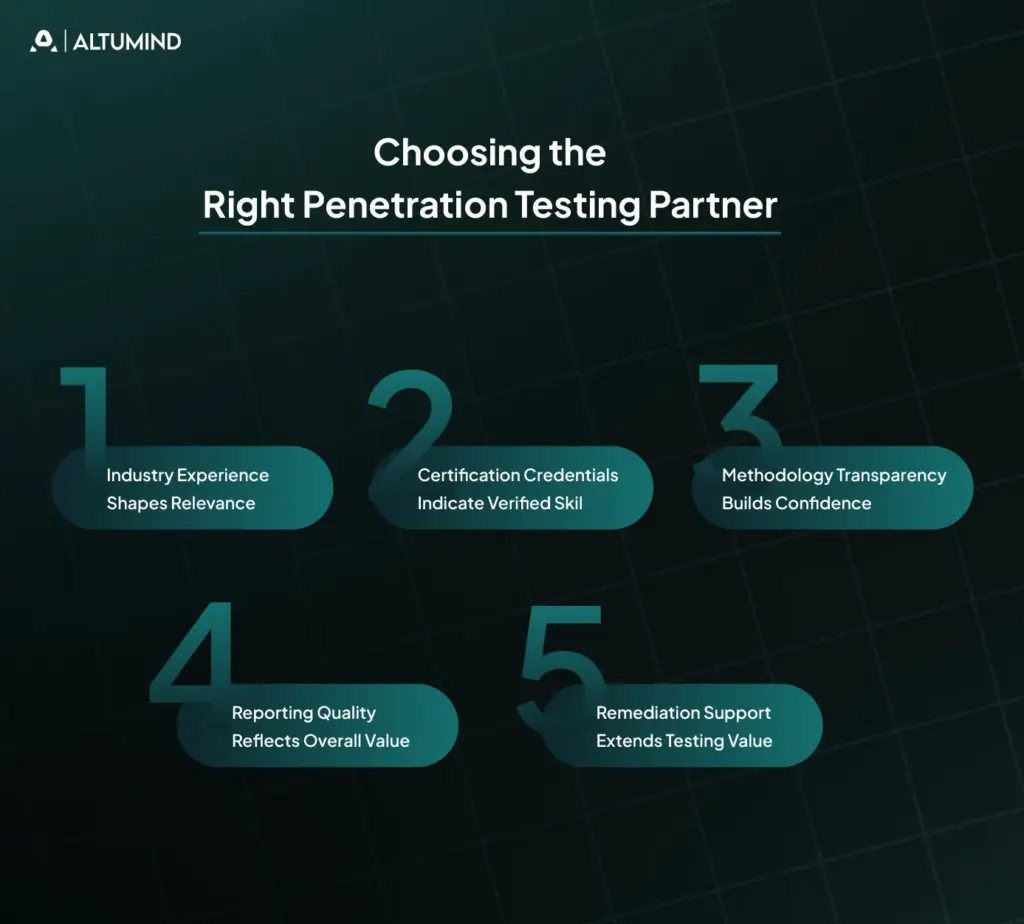
The right testing partner becomes a long-term security ally rather than a vendor delivering a single report. Several factors distinguish strong partners from providers offering testing as a commodity service.
1. Industry Experience Shapes Relevance
Regulatory requirements and common vulnerability patterns vary significantly across sectors. A provider familiar with healthcare compliance brings different value than one focused primarily on financial services or retail environments.
2. Certification Credentials Indicate Verified Skill
Certifications such as OSCP, CEH, and CISSP indicate that testers have demonstrated technical competency through recognized, rigorous assessment processes. These credentials provide a baseline for evaluating testing team quality.
3. Methodology Transparency Builds Confidence
Providers who clearly explain their approach, including tools used and testing techniques applied, allow organizations to understand exactly what will be tested and how. This transparency supports informed evaluation of results.
4. Reporting Quality Reflects Overall Value
Sample reports reveal how providers communicate findings. Strong reports balance technical accuracy with business clarity, serving both engineering teams and executive stakeholders without requiring translation.
5. Remediation Support Extends Testing Value
Providers who help validate fixes accelerate the path from finding to resolution. This support distinguishes partners focused on improving security outcomes from those focused solely on delivering a report.
Organizations evaluating development partners more broadly may find it useful to review how firms featured among top app development companies in NYC incorporate security testing into their delivery model. Many established development partners now treat security validation as a standard part of their service offering rather than an optional add-on.
Organizations must recognize the value of partnering with the right managed service provider (MSP). Doing so allows them to fully realize the benefits of managed IT services, as regular penetration testing strengthens the overall security framework. By aligning infrastructure management with continuous security validation, businesses can build a more comprehensive and proactive security operating model rather than managing these functions in isolation.
Conclusion
Penetration testing services have shifted from periodic compliance exercises to continuous, strategic components of enterprise security. Understanding what penetration testing in software testing involves is essential for evaluating application security risks. Penetration testing as a service has also transformed traditional delivery models, helping decision-makers assess their current security posture more effectively.
AI is reshaping this space from both sides, giving defensive teams new efficiency while expanding the capabilities available to attackers. Organizations that treat testing as an ongoing practice, supported by the right partner and integrated into development workflows, build security postures that withstand scrutiny from customers, regulators, and insurers alike.
Turn security into a business advantage with Altumind’s QA services, penetration testing, and managed infrastructure expertise. Our team helps you continuously validate your defenses, uncover hidden vulnerabilities, and reduce exposure across your technology ecosystem. Get in touch to build a robust security testing program that safeguards your business, supports compliance, and keeps growth on track.
Table of Contents
- Introduction
- What Is Penetration Testing in Software Testing
- Why Penetration Testing Has Become a Board-Level Priority
- Types of Penetration Testing Services
- Process of Penetration Testing
- Penetration Testing as a Service: A Shift in Delivery Model
- The Role of AI in Penetration Testing
- Choosing the Right Penetration Testing Partner
- Conclusion