How AI-Powered UX Personalization Creates Better Enterprise Customer Experiences
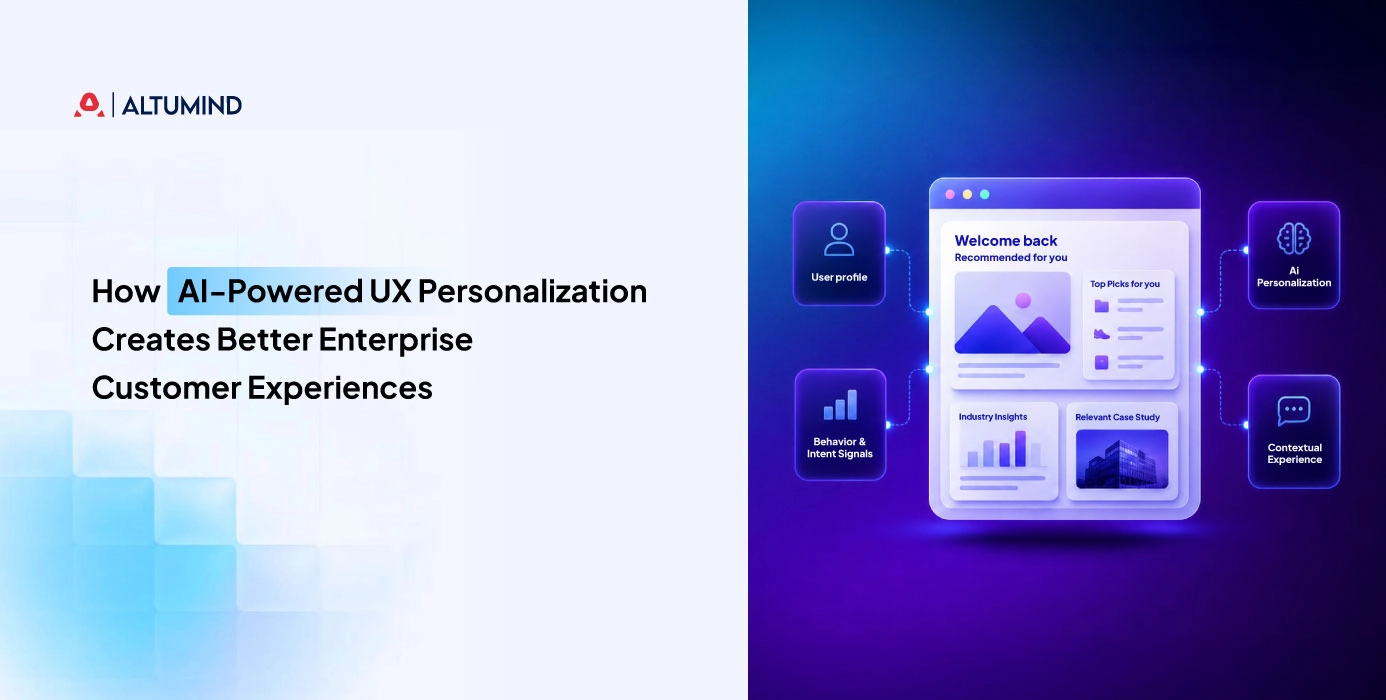
Table of Contents
- Introduction
- How Does AI-Powered UX Personalization Improve Enterprise Customer Experiences?
- Traditional Personalization vs. AI-Powered UX Personalization
- Why Is Traditional Personalization No Longer Enough for Enterprise Applications?
- What Should Enterprises Consider Before Implementing AI-Powered UX Personalization?
- How Can AI-Powered UX Personalization Be Applied Across Enterprise Industries?
- How Can Enterprises Measure the Business Value of AI-Powered UX Personalization?
- What Challenges Can Affect Enterprise AI UX Personalization Initiatives?
- When Should Enterprises Invest in AI-Powered UX Personalization?
- Conclusion
Enterprise customers expect digital experiences that recognize their intent, reduce unnecessary steps, and deliver relevant information at the right moment. Meeting these expectations becomes more complex as organizations manage multiple digital channels, diverse customer journeys, and growing volumes of data.
AI-powered UX personalization helps enterprises move beyond static experiences by adapting interactions based on customer behavior and real-time context. The result is a more intuitive experience that supports both customer satisfaction and business objectives.
Before adopting AI-powered personalization, enterprise leaders typically consider:
- • How customer data is managed across systems.
- • Privacy and governance requirements.
- • Integration with existing technology investments.
- • Measurable business outcomes and ROI.
With more than 10 years of experience in digital transformation, Altumind helps organizations build digital experiences that are scalable, practical, and aligned with business goals. In this blog, we’ll discuss how AI-powered UX personalization improves enterprise customer experiences, why it has become a strategic priority, and what organizations should evaluate before implementation.
How Does AI-Powered UX Personalization Improve Enterprise Customer Experiences?
AI-powered UX personalization improves enterprise digital journeys by delivering interactions that adapt to individual user behavior instead of relying on predefined rules. It combines customer data, behavioral signals, and AI models to present the most relevant experience at the right time across websites, applications, customer portals, and other digital channels.
For enterprise organizations, this means personalization becomes an ongoing capability rather than a one-time configuration.
1. Understands Customer Context
Every digital interaction provides valuable signals about what a customer is trying to achieve.
AI can evaluate information such as the following:
- • Browsing behavior.
- • Previous interactions.
- • Purchase history.
- • Device type.
- • Geographic location.
- • Time of interaction.
- • Preferred digital channels.
Instead of treating every visitor within the same customer segment alike, AI responds to the context of each interaction. This allows enterprises to provide experiences that are more relevant without increasing manual effort.
2. Supports Better Decision-Making
Enterprise customer journeys rarely follow a straight path.
A customer may research a solution on a mobile device, continue the evaluation through email, interact with a customer portal, and complete a transaction from a desktop application.
AI-powered personalization connects these touchpoints to create a more consistent experience across the entire journey rather than optimizing isolated interactions.
A practical consideration that is often underestimated is that journey-level personalization delivers greater business value than page-level personalization. Optimizing individual screens may improve isolated metrics, but connecting every stage of the customer journey creates a more meaningful and consistent experience.
3. Improves Customer and Employee Experiences
AI personalization is often associated with marketing, but its impact extends much further.
Enterprise organizations use it to improve:
- • Customer portals.
- • Self-service applications.
- • Employee dashboards.
- • Knowledge bases.
- • Digital onboarding.
- • Support experiences.
For example, an employee using an ERP platform may see role-specific dashboards and frequently used workflows, while a customer accessing a support portal receives personalized knowledge articles based on previous interactions. Both experiences reduce unnecessary effort and make digital interactions more efficient.
Traditional Personalization vs. AI-Powered UX Personalization
| Traditional Personalization | AI-Powered UX Personalization |
|---|---|
| Uses predefined rules | Learns continuously from user behavior |
| Focuses on audience segments | Responds to individual user context |
| Requires manual updates | Continuously refines experiences |
| Limited to specific channels | Supports omnichannel experiences |
| Uses historical data | Uses real-time and historical signals |
| Delivers static experiences | Creates dynamic, adaptive experiences |
Why Is Traditional Personalization No Longer Enough for Enterprise Applications?
Traditional personalization introduced tailored digital experiences through predefined rules and audience segmentation. While these approaches remain useful for specific scenarios, they are often difficult to scale across today’s enterprise digital ecosystems.
Customers now expect consistent experiences across websites, mobile applications, customer portals, support platforms, and connected services. Their needs also change depending on context, making static personalization increasingly difficult to maintain.
1. Enterprise Data Has Become More Distributed
Multiple systems, including CRM platforms, ERP applications, marketing tools, analytics solutions, and customer support software, often spread customer information.
Without a connected view of this data, personalization decisions rely on incomplete information.
What many organizations miss is that the quality of personalization depends more on data readiness than on AI model sophistication. Even advanced AI models produce limited value when customer data is fragmented or inconsistent.
Building a reliable data foundation is often one of the most important steps before introducing AI UX personalization at scale.
2. Customer Expectations Continue to Evolve
Modern customers expect digital experiences to adapt as their needs change.
They value experiences that:
- • Reduce repetitive actions.
- • Surface relevant information quickly.
- • Maintain consistency across channels.
- • Respect privacy and user preferences.
Meeting these expectations requires more than predefined rules. It requires systems that continuously learn from customer interactions while balancing business goals, usability, and governance.
For organizations also looking to strengthen how their digital experiences are understood by AI-powered search platforms, initiatives around personalization often complement broader strategies to improve brand visibility in AI results by making content and experiences more contextually relevant.
Traditional personalization laid the foundation for tailored digital experiences. However, enterprise organizations seeking long-term value increasingly require AI-driven approaches that adapt alongside changing customer behavior, business priorities, and digital ecosystems.
What Should Enterprises Consider Before Implementing AI-Powered UX Personalization?
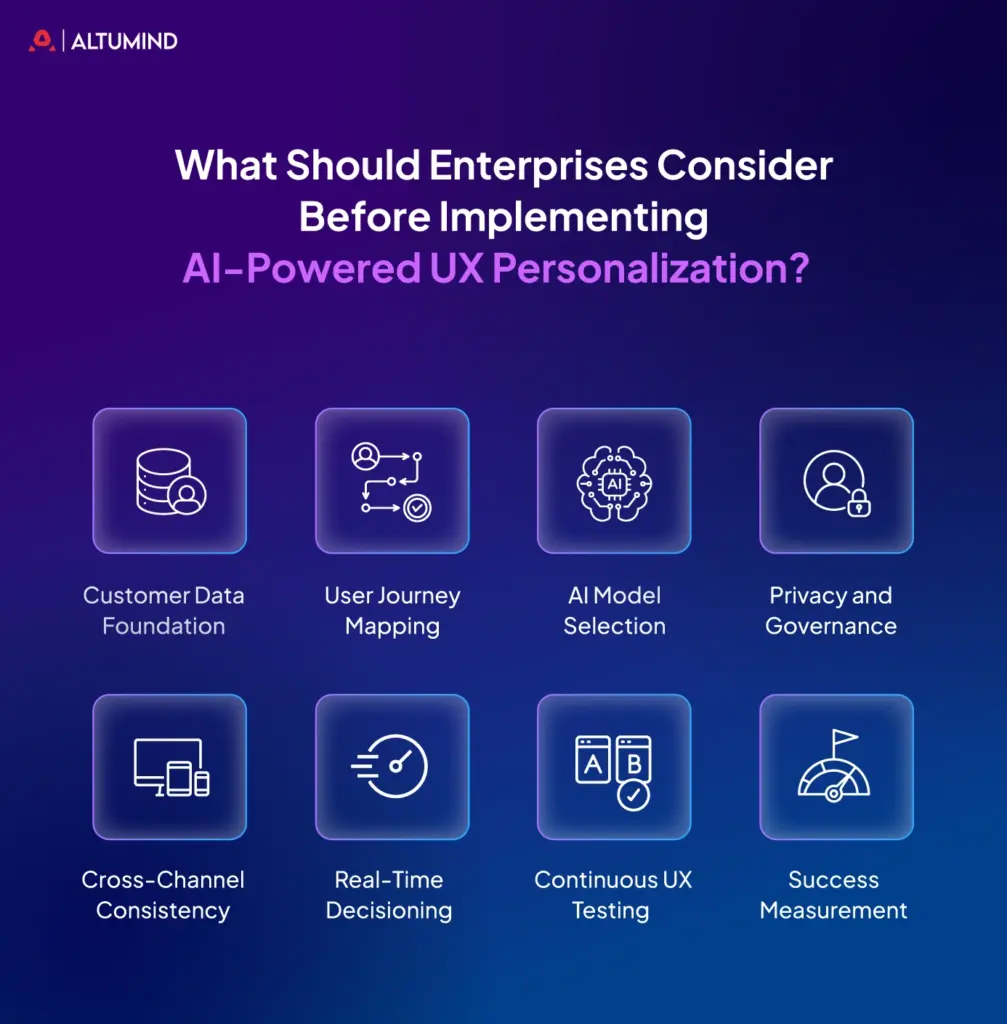
Long before deploying the first AI model, organizations must lay the groundwork for successful AI-powered UX personalization. It requires a clear understanding of customer journeys, reliable data, governance, and collaboration across business and technology teams.
Organizations that treat personalization as a long-term capability rather than a standalone project are better positioned to create consistent customer experiences and measurable business outcomes.
1. Customer Data Foundation
Every personalization initiative depends on the quality of customer data.
Customer information often resides across CRM platforms, ERP systems, analytics tools, marketing automation platforms, and customer support applications. Bringing these data sources together creates a more complete view of customer behavior and intent.
Without this foundation, AI models make decisions based on incomplete information, reducing the relevance of personalized experiences.
2. User Journey Mapping
Effective personalization focuses on the complete customer journey rather than isolated touchpoints.
Mapping user journeys helps organizations understand how customers move across channels, where they encounter friction, and which interactions influence decision-making.
Before introducing AI, many organizations conduct a UX assessment to identify usability gaps and improvement opportunities. Resources such as a structured UX audit template provide a structured approach to evaluating digital experiences before personalization strategies are introduced.
3. AI Model Selection
Different business objectives require different AI capabilities.
For example:
- • Predictive models anticipate customer intent.
- • Natural language processing supports conversational experiences.
- • Recommendation models improve product and content suggestions.
- • Machine learning models continuously refine personalization based on user behavior.
Selecting the right model depends on business goals, available data, and operational complexity rather than choosing the most advanced technology.
4. Privacy and Governance
AI personalization relies on customer data, making governance a business priority.
Organizations should establish clear policies for:
- • Customer consent.
- • Data access.
- • Model transparency.
- • Regulatory compliance.
- • Human oversight.
One of the most common planning gaps is treating governance as a post-deployment activity instead of a core implementation requirement. Defining governance early helps organizations make consistent AI decisions while maintaining customer trust and regulatory compliance.
5. Cross-Channel Consistency
Customers rarely interact with a business through a single platform.
A personalized experience should remain consistent whether customers engage through a website, mobile application, customer portal, or customer support channel.
Disconnected personalization strategies often create inconsistent experiences that increase user effort instead of reducing it.
6. Real-Time Decisioning
Customer behavior changes continuously.
Real-time AI enables enterprises to respond to changing intent as interactions happen instead of relying only on historical behavior.
Examples include:
- • Personalizing support content.
- • Adapting navigation based on user goals.
- • Presenting relevant offers based on current activity.
- • Updating recommendations during a browsing session.
The ability to respond in real time makes personalization more relevant without requiring frequent manual updates.
7. Continuous UX Testing
Personalization strategies should evolve alongside customer behavior.
Regular UX testing helps organizations evaluate whether personalized experiences continue to support user expectations and business objectives.
Combining AI with QA services allows enterprises to validate functionality, usability, accessibility, and performance before personalization changes reach production environments.
Organizations comparing evaluation methods may also find value in understanding heuristic evaluation along with UX audits, particularly when planning continuous experience improvements.
8. Success Measurement
AI-powered UX personalization should be measured against business outcomes, not only engagement metrics.
A balanced measurement framework includes the following:
| Customer Metrics | Business Metrics | Operational Metrics |
|---|---|---|
| Customer satisfaction | Customer retention | Model performance |
| Task completion rate | Revenue per customer | Response time |
| Self-service adoption | Digital adoption | Deployment frequency |
| Session quality | Customer lifetime value | System reliability |
Tracking these metrics helps organizations refine personalization strategies while demonstrating measurable business value.
In our experience delivering enterprise digital transformation initiatives, organizations achieve stronger personalization outcomes when UX strategy, governance, data readiness, and AI capabilities evolve together rather than evolving as separate initiatives. This integrated approach creates a stronger foundation for scalable, consistent, and measurable user interactions.
How Can AI-Powered UX Personalization Be Applied Across Enterprise Industries?
AI-powered UX personalization delivers value across industries because every organization aims to provide digital experiences that are relevant, efficient, and aligned with user expectations. While implementation approaches differ, the objective remains consistent: helping users complete tasks with less effort and greater confidence.
| Industry | Personalization Focus |
|---|---|
| Healthcare | Patient portals, appointment journeys, educational content |
| Banking & Financial Services | Financial insights, onboarding, self-service experiences |
| Retail & E-commerce | Product recommendations, promotions, loyalty experiences |
| Manufacturing | Dealer portals, service documentation, customer support |
| SaaS Platforms | Feature adoption, onboarding, contextual guidance |
| Logistics & Supply Chain | Shipment visibility, customer dashboards, service updates |
Organizations improving experiences in their digital healthcare solutions rely on UX design to align digital workflows with user needs and operational processes, improving efficiency.
How Can Enterprises Measure the Business Value of AI-Powered UX Personalization?
The success of AI-powered UX personalization extends beyond higher click-through rates or increased website engagement. Enterprise leaders typically evaluate how personalization contributes to customer satisfaction, operational efficiency, and long-term business growth.
Key areas to monitor include:
- • Digital adoption rates.
- • Self-service completion.
- • Average resolution time.
- • Customer lifetime value.
- • Employee productivity.
- • Operational efficiency.
- • Customer retention and loyalty.
Clear success metrics provide direction for every stage of a personalization initiative. When business, UX, data, and technology teams agree on measurable outcomes from the outset, decision-making becomes more consistent throughout implementation.
Long-term success depends on more than deploying AI solutions. As AI initiatives expand, organizations rely on AI automation service providers to deliver the scalable infrastructure, continuous optimization, and operational support needed to keep AI-powered experiences effective.
What Challenges Can Affect Enterprise AI UX Personalization Initiatives?
Most personalization initiatives do not face challenges because of AI technology alone. The more common barriers involve organizational alignment, data readiness, governance, and change management.
Some of the most common considerations include:
- • Legacy platform integration.
- • Privacy and compliance requirements.
- • Measuring long-term business outcomes.
- • Inconsistent customer data across enterprise systems.
- • Maintaining personalization as customer behavior evolves.
- • Undefined ownership between business and technology teams.
Addressing these factors early helps organizations build personalization strategies that remain practical, scalable, and aligned with enterprise objectives.
When Should Enterprises Invest in AI-Powered UX Personalization?
Organizations should consider AI-powered UX personalization when existing personalization approaches become difficult to scale or when customer experiences span multiple digital channels.
Indicators include:
- • Growing digital product portfolios.
- • Expanding customer data sources.
- • Greater demand for self-service experiences.
- • Increasing customer interactions across channels.
- • Business goals centered on improving customer engagement and operational efficiency.
Rather than viewing personalization as a standalone initiative, enterprises benefit most when it becomes part of a broader digital transformation strategy.
Conclusion
Creating meaningful enterprise customer experiences requires more than implementing AI. It calls for a thoughtful approach that combines quality data, user-centered design, governance, and continuous optimization. When these elements work together, AI-powered UX personalization becomes a strategic capability that improves both customer interactions and business outcomes.
With over a decade of experience in digital transformation, Altumind helps enterprises build intelligent digital experiences that balance innovation with practical implementation. If you’re planning to introduce or refine AI-powered personalization, our UI/UX services can help create user experiences that are intuitive, scalable, and aligned with your business goals. Connect with our team to discuss the next step in your personalization journey.
Table of Contents
- Introduction
- How Does AI-Powered UX Personalization Improve Enterprise Customer Experiences?
- Traditional Personalization vs. AI-Powered UX Personalization
- Why Is Traditional Personalization No Longer Enough for Enterprise Applications?
- What Should Enterprises Consider Before Implementing AI-Powered UX Personalization?
- How Can AI-Powered UX Personalization Be Applied Across Enterprise Industries?
- How Can Enterprises Measure the Business Value of AI-Powered UX Personalization?
- What Challenges Can Affect Enterprise AI UX Personalization Initiatives?
- When Should Enterprises Invest in AI-Powered UX Personalization?
- Conclusion