How to Choose the Right UX Design Agency for Your Business
Table of Contents
- Introduction
- Why Does Choosing the Right UX Design Agency Matter?
- What Should You Look for in a UX Design Agency?
- What Should You Consider When Choosing a UX Design Agency?
- How Can a UX Design Agency Create Measurable Business Value?
- How Does UX Design Support Retail and Commerce Experiences?
- What Questions Should You Ask Before Hiring a UX Design Agency?
- Conclusion
Choosing a UX design agency is more than simply finding a team that can make visually appealing screens. For enterprise business, the right partner needs to understand users, business processes, technology constraints, accessibility, and the outcomes a digital product needs to deliver.
Before choosing a UX design company, a business owner must consider aspects like the following:
- • Business and user goals.
- • The company’s research and design process.
- • Relevant industry and product knowledge.
- • Test and validation capabilities.
- • Technology & integration knowledge.
- • Connecting design choices to business results.
Altumind combines experience design with behavioral insights, prototyping, testing, AI, and enterprise technology. This article examines the key factors that businesses should consider when hiring a UX design agency.
Why Does Choosing the Right UX Design Agency Matter?
The right UI/UX design agency bridges user needs, business goals, technical realities, and measurable results. A structured design process helps organizations make informed product decisions before committing significant development resources.
UX can mean much more than visual design for enterprise organizations. It could affect:
- • How quickly employees move through workflows.
- • Ease in locating products/services for customers.
- • How consistent cross-channel experiences are.
- • Confidence of users in engaging with complex systems.
- • The ability of digital products to serve business processes.
Organizations can underestimate the cost of designing around unvalidated assumptions. A visually polished interface delivers limited value when the underlying workflow does not reflect how users perform their tasks.
A good UX design company will ask questions before they offer solutions. Who uses the app? What are they trying to get from that? Where do they experience friction? What are the business rules behind the workflow? What technical limitations should we be aware of?
These questions provide a more solid foundation for design decisions and reduce the chance of solving the wrong problem.
What Should You Look for in a UX Design Agency?
Look for a UX design agency that combines research, design, technology understanding, testing, and business thinking rather than treating UX as an isolated visual activity.
The evaluation should cover both capabilities and working approaches. A portfolio can show what a company has designed, but it does not always show how the team reached those decisions or how the work performed after launch.
When reviewing a UX design company, look for evidence of:
- • Research and discovery methods.
- • User and stakeholder involvement.
- • Wireframing and prototyping.
- • Usability testing.
- • Accessibility practices.
- • Design systems.
- • Technology collaboration.
- • Industry knowledge.
- • Post-launch improvement.
Our experience design approach starts with understanding how people use digital products. We take into account user feedback, data, prototyping, and testing to improve the experience, with a focus on UI/UX, CX, accessibility, personalization, and omnichannel journeys.
What Should You Consider When Choosing a UX Design Agency?
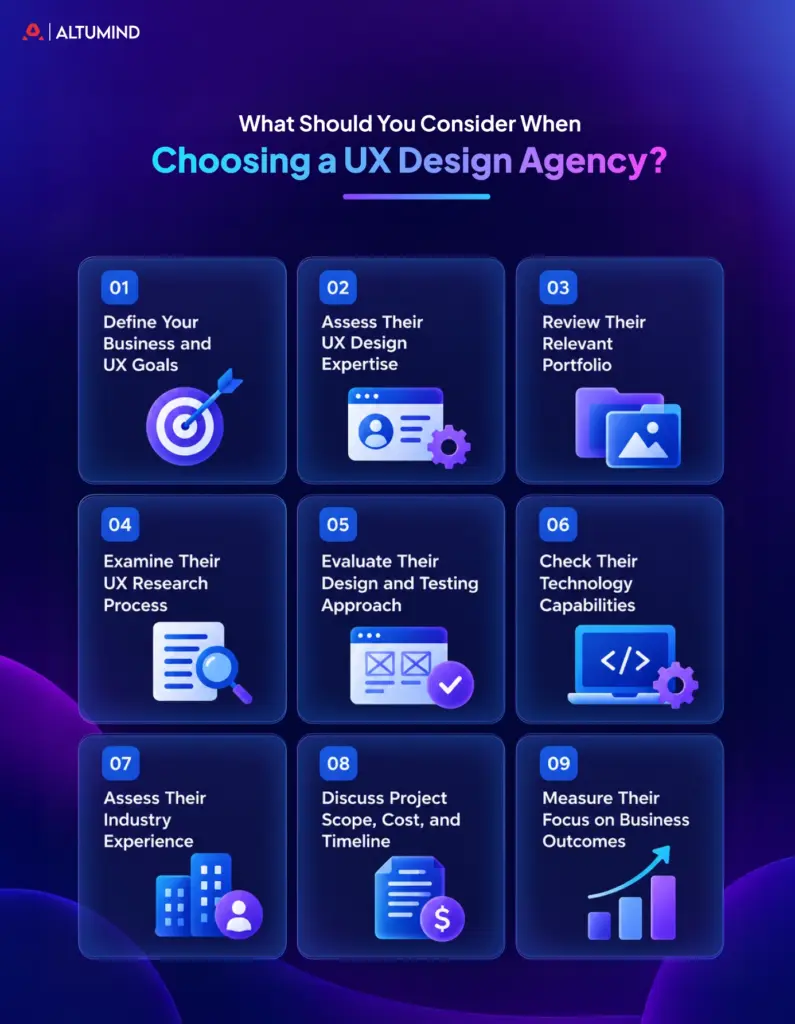
A structured evaluation makes it easier to compare potential UX design company partners on factors that directly affect project quality and business value.
1. Define Your Business and UX Goals
Start by defining what the experience needs to accomplish.
Business objectives may include increasing digital adoption, simplifying employee workflows, improving e-commerce conversion, modernizing legacy applications, reducing support requests, or creating more consistent customer journeys.
Start with measurable objectives that connect user needs to business priorities. For example, if customers struggle to complete a purchase, the UX objective could focus on reducing unnecessary steps, improving product information, simplifying checkout, or making key actions easier to find.
Stakeholder alignment also matters. Product, technology, operations, marketing, customer service, and executive teams may have different expectations from the same product. Bringing these perspectives together early gives the design team a clearer decision framework.
2. Assess Their UX Design Expertise
Look beyond visual quality and assess the agency’s approach to design decisions. A capable team should be able to explain why a particular interaction, information architecture, workflow, or interface pattern fits the users and business context.
Relevant capabilities include:
- • UX research.
- • Information architecture.
- • Interaction design.
- • Prototyping.
- • Usability testing.
- • Accessibility.
- • Design systems.
- • CX strategy.
For larger organizations, experience across complex applications also matters. Enterprise products often involve permissions, multiple user roles, integrations, data dependencies, compliance requirements, and established workflows.
The company should be comfortable working with these constraints instead of treating them as problems to address after design is complete.
3. Review Their Relevant Portfolio
A portfolio is more informative when the evaluation considers the reasoning behind the work rather than only the final interface.
Relevant portfolio comparisons can include:
- • Industry.
- • User types.
- • Product complexity.
- • Business model.
- • Technology environment.
- • Digital maturity.
The agency should be able to explain the problem, research performed, design decisions, testing approach, and resulting outcomes.
This helps distinguish presentation-focused portfolios from evidence of actual UX problem-solving.
For example, a retail organization may need a company that understands product discovery, category structures, search, checkout, account management, inventory visibility, and omnichannel journeys. Those requirements differ significantly from the UX needs of an internal enterprise application.
4. Examine Their UX Research Process
Research provides designers evidence about what users actually need instead of relying entirely on stakeholder assumptions.
Depending on the project, research can include interviews, surveys, usability studies, behavioral data analysis, journey mapping, competitive analysis, and prototype testing.
The evaluation should consider:
- • Who participates in research?
- • How are users selected?
- • How are findings documented?
- • How do findings influence design decisions?
- • How does the team validate assumptions?
Altumind’s design process begins with understanding business goals, target users, and requirements before moving into ideation, prototyping, design, testing, and continuous improvement.
Research should not become a separate phase that produces a report and then disappears. Its findings should influence the product decisions that follow.
5. Evaluate Their Design and Testing Approach
Ask how the UX Design Agency moves forward from:
Research > User flows > Wireframes > Prototypes > Visual design > Testing > Iteration.
Testing methods should reflect the product, user groups, and complexity of the workflows being evaluated. For instance, an e-commerce experience that’s exposed to customers may require task-based usability testing, whereas an enterprise application might need workflow validation with employees who do complex tasks on a daily basis.
Testing must include accessibility, responsive behavior, content, navigation, error states, permissions, and edge cases.
Behavioral data can provide useful evidence during evaluation. High early-exit rates, incomplete tasks, or repeated interaction failures can help teams identify areas of friction before committing resources to redesign or development.
6. Check Their Technology Capabilities
UX does not exist separately from technology.
Design decisions can affect APIs, front-end architecture, CMS capabilities, authentication, personalization, analytics, performance, and integrations. The design team should understand these dependencies early.
Ask whether the UX design agency can collaborate effectively with:
- • Product teams
- • Developers
- • Enterprise architects
- • Data teams
- • QA teams
- • Marketing teams
- • Business stakeholders
This matters especially when the project involves AI, personalization, ERP systems, e-commerce platforms, CRM systems, or legacy applications.
7. Assess Their Industry Experience
Industry knowledge can help a company understand the context around a product, but it should work alongside direct user research.
For retail and commerce, the evaluation should include experience with:
- • Product discovery.
- • Search and filtering.
- • Personalized recommendations.
- • Cart and checkout.
- • Customer accounts.
- • Omnichannel experiences.
- • Inventory-related journeys.
- • Post-purchase experiences.
Altumind works across digital commerce and retail environments, including enterprise procurement workflows and e-commerce experiences. Its digital product capabilities also cover personalized journeys, headless commerce, and omnichannel storefronts.
8. Discuss Project Scope, Cost, and Timeline
Cost should be evaluated alongside scope.
Two UX projects can have very different budgets because one may require only interface design while another requires research, service design, prototypes, testing, accessibility work, design systems, development collaboration, and ongoing optimization.
Before comparing proposals, clarify:
- • Project objectives.
- • Deliverables.
- • Research requirements.
- • Number of platforms.
- • Number of user groups.
- • Design system requirements.
- • Testing requirements.
- • Development collaboration.
- • Revision cycles.
- • Post-launch support.
Each agency should clearly explain the assumptions and deliverables that influence its estimate.
A low initial estimate can become difficult to compare with another proposal if the deliverables, research depth, testing, or support model differ substantially.
9. Measure Their Focus on Business Outcomes
The final question is whether the UX design agency can connect UX decisions to outcomes that matter to the business.
Possible measures include:
| UX Area | Business Measure |
|---|---|
| Navigation | Task completion rate. |
| Checkout | Conversion rate. |
| Enterprise workflows | Time to complete tasks. |
| Product adoption | Active usage. |
| Self-service | Support request volume. |
| Search | Search success rate. |
| Accessibility | Successful task completion across user groups. |
| Personalization | Engagement or repeat purchase behavior. |
Not every UX project should use the same metrics. The measurement framework should reflect the product’s purpose.
For an enterprise application, productivity and adoption may matter more than page-level conversion. For e-commerce, search success, checkout completion, repeat purchases, and customer engagement may carry more weight.
A strong engagement establishes these measures before design decisions become final, making it easier to assess whether the work produced meaningful business value.
How Can a UX Design Agency Create Measurable Business Value?
A UX design agency creates business value when design decisions improve the way customers, employees, or partners interact with a product.
That value can appear through:
- • Faster task completion.
- • Higher product adoption.
- • Better customer engagement.
- • Lower interaction friction.
- • Improved conversion.
- • Reduced support requirements.
- • More consistent experiences.
- • Better accessibility.
- • Stronger digital product usability.
At Altumind, experience design connects human-centered design with behavioral science, AI, technology, prototyping, testing, and business objectives. The focus is on experiences that support measurable outcomes rather than aesthetics alone.
UX value can also start before the interface is designed. Clearer requirements, validated workflows, and early testing can help teams avoid investing heavily in functionality that users do not need or cannot use effectively.
Human-centered design should be a priority for e-commerce businesses because it keeps customer needs, behaviors, and expectations at the center of the digital experience.
How Does UX Design Support Retail and Commerce Experiences?
Retail UX should bridge customer expectations and operational realities. The discovery, evaluation, purchase, account management, and post-purchase interactions experience should remain intuitive and consistent across relevant channels.
E-commerce businesses can evaluate the experience through the perspective of the customer, not just the part of the interface, by focusing on human-centered design.
Personalization can also be a factor when supported by relevant data and clear customer value. AI-powered UX personalization enables businesses to consider how behavioral signals, preferences, and context can influence digital experiences without compromising the ability for interactions to be understood by the user.
Another important factor is search. As search behavior evolves, users increasingly expect that digital experiences understand intent rather than simply matching exact words.
For commerce organizations, these UX decisions can impact conversion, engagement, customer retention, and operational efficiency. It’s therefore important to choose a company that understands the customer experience and the systems that support it.
What Questions Should You Ask Before Hiring a UX Design Agency?
During the agency evaluation process, organizations should ask questions that reveal how the UX design agency works rather than simply what services it sells.
Consider asking:
- What happens after launch?
- How do you approach accessibility?
- Which business metrics should we track?
- Who will work directly on our project?
- How do you validate design decisions?
- What research will happen before design begins?
- How do you handle complex enterprise workflows?
- How do you involve our product and technology teams?
- How will you learn about our users and business workflows?
The answers can reveal whether the company treats UX as a visual deliverable or as part of a broader product and business strategy.
For organizations that also need ongoing technology operations after product delivery, managed IT support can complement a broader digital delivery model. Similarly, digital strategy services can help connect experience priorities with wider transformation objectives.
Conclusion
Choosing a UX design agency should come down to more than portfolio aesthetics or project pricing. The right partner should understand users, the business model, technology environment, industry context, and measurable objectives.
The right evaluation process considers research, design expertise, testing, accessibility, technology capabilities, industry experience, scope, and business outcomes. These factors help turn UX from a visual exercise into a meaningful part of digital product strategy.
Altumind brings experience design together with AI, data, engineering, cloud, and enterprise technology. For organizations assessing their next experience initiative, our UI UX services support projects from strategy and research through design, testing, and continuous improvement.

Author
Experience Design Practice Lead
Saurabh Sharma is the Experience Design Practice Lead at Altumind, specializing in UI/UX, user-centered design, and digital experience strategy.
He focuses on creating intuitive digital experiences and exploring how AI-powered personalization can make interactions more relevant, accessible, and engaging for users.
Table of Contents
- Introduction
- Why Does Choosing the Right UX Design Agency Matter?
- What Should You Look for in a UX Design Agency?
- What Should You Consider When Choosing a UX Design Agency?
- How Can a UX Design Agency Create Measurable Business Value?
- How Does UX Design Support Retail and Commerce Experiences?
- What Questions Should You Ask Before Hiring a UX Design Agency?
- Conclusion