Human-Centered Design for E-commerce: How UX Design Drives Business Value
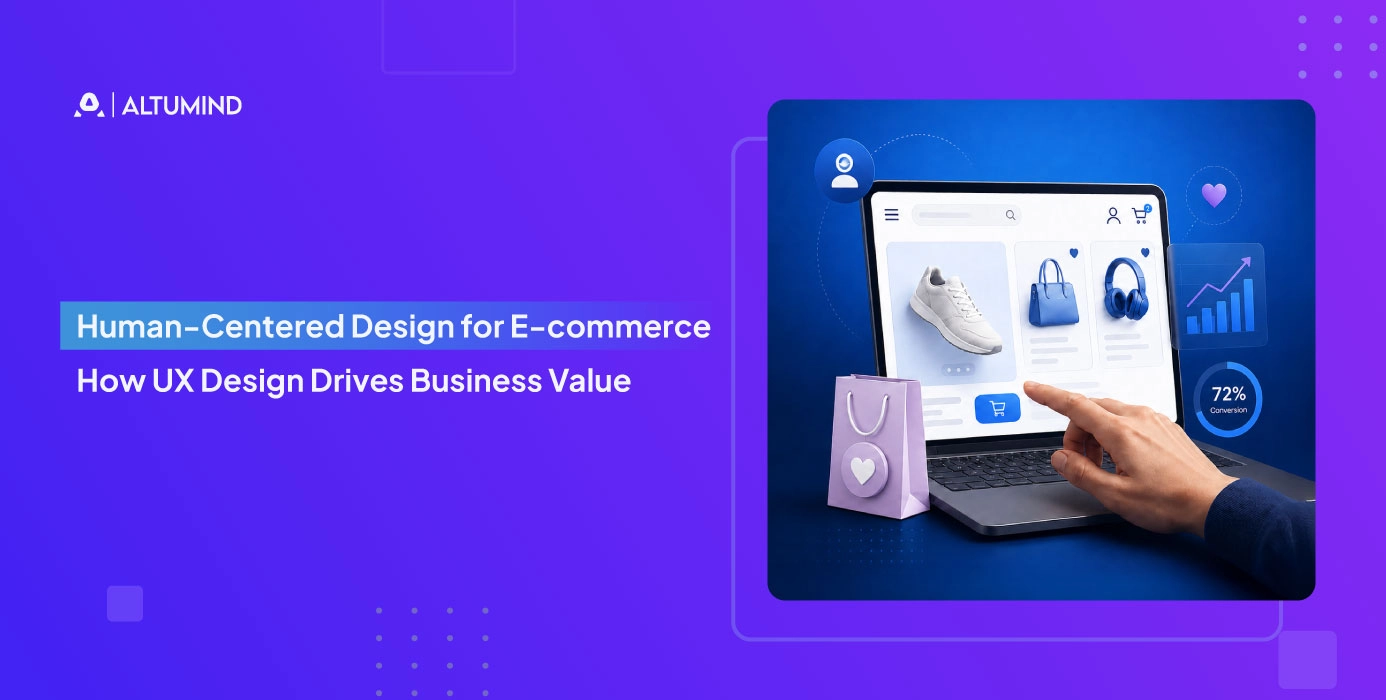
Table of Contents
- Introduction
- Why Human-Centered Design Is Essential for E-commerce
- How Can Customer Journey Mapping Improve E-commerce UX?
- What Should Enterprise Retailers Prioritize in E-commerce UX Design?
- How Can UX Decisions Create Measurable Business Value?
- When Should E-commerce UX Become a Broader Technology Initiative?
- How Should Enterprises Build a Human-Centered E-commerce Process?
- Conclusion
A good e-commerce experience is more than simply having pretty interfaces. Customers want clear product information, relevant options, an easy checkout process, and the assurance that what customers are seeing online is what the business can actually deliver.
Therefore, experience design for enterprise retailers is closely linked to technology, operations, and commercial performance. When evaluating an e-commerce experience, business leaders should:
- • Assess what percentage of the journey reflects genuine customer intent.
- • Evaluate whether checkout creates unnecessary friction.
- • Determine whether UX decisions are linked to measurable business outcomes.
- • Check whether product, pricing, and inventory information remains consistent.
- • Consider whether the underlying technology can reliably support the intended customer experience.
At Altumind, we bring together experience in design, engineering, AI, data, and enterprise technology to address human-centered design for e-commerce. We have more than 10 years’ transformation experience and are passionate about creating digital experiences that work for customers and deliver real business outcomes. Keep reading to learn how UX design drives business value.
Why Human-Centered Design Is Essential for E-commerce
Human-centered design is important because a customer experiences an e-commerce business as a total experience, not as a collection of individual screens. Search, product discovery, comparison, checkout, delivery, returns, and support all impact how the brand is perceived by the customer.
For enterprise e-commerce teams, the design process should begin with customer intent and business objectives. A customer who is seeking a particular replacement product might require accurate specifications and compatibility information.
Another customer may care more about reviews, delivery time, or financing options. The interface should reflect those differences, not give everyone the same experience. This is also where business value becomes important.
A smoother journey can lead to greater engagement, higher purchase completion, fewer support interactions, and stronger repeat engagement. The precise outcome varies based on the problem being solved and the way the business measures it. Altumind’s experience design practice combines UI, UX, CX, behavioral insights, accessibility, personalization, and data-driven testing.
How Can Customer Journey Mapping Improve E-commerce UX?
Customer journey mapping e-commerce teams use should show more than customer touchpoints. It should connect each interaction with the information, technology, people, and business process behind it.
A practical e-commerce journey can be mapped across five stages:
- • Discovery: Customers need relevant search results, categories, and product choices.
- • Evaluation: Customers need enough information to compare products with confidence.
- • Purchase: Customers need transparent pricing, delivery information, payment options, and a simple checkout.
- • Fulfillment: Customers need accurate order and delivery updates.
- • Post-purchase: Customers need accessible support, returns, account services, and a consistent experience that encourages future engagement.
| Journey stage | UX consideration | Business consideration |
|---|---|---|
| Discovery | Search, navigation, product relevance | Product engagement |
| Evaluation | Specifications, reviews, availability | Purchase confidence |
| Checkout | Forms, payments, delivery clarity | Completion rate |
| Fulfillment | Tracking and notifications | Support workload |
| Post-purchase | Returns, service, account experience | Retention and loyalty |
What many organizations overlook is the role of exceptions. A journey map should account for payment failures, unavailable products, changed delivery dates, returns, order modifications, and customer support requests. These situations often expose the connection between UX and operational systems.
For example, a customer may see an item as available but receive a different message after checkout. The visible problem is a poor experience, but the underlying issue may involve inventory synchronization or order management.
That distinction matters because redesigning the interface will not solve every experience problem.
What Should Enterprise Retailers Prioritize in E-commerce UX Design?
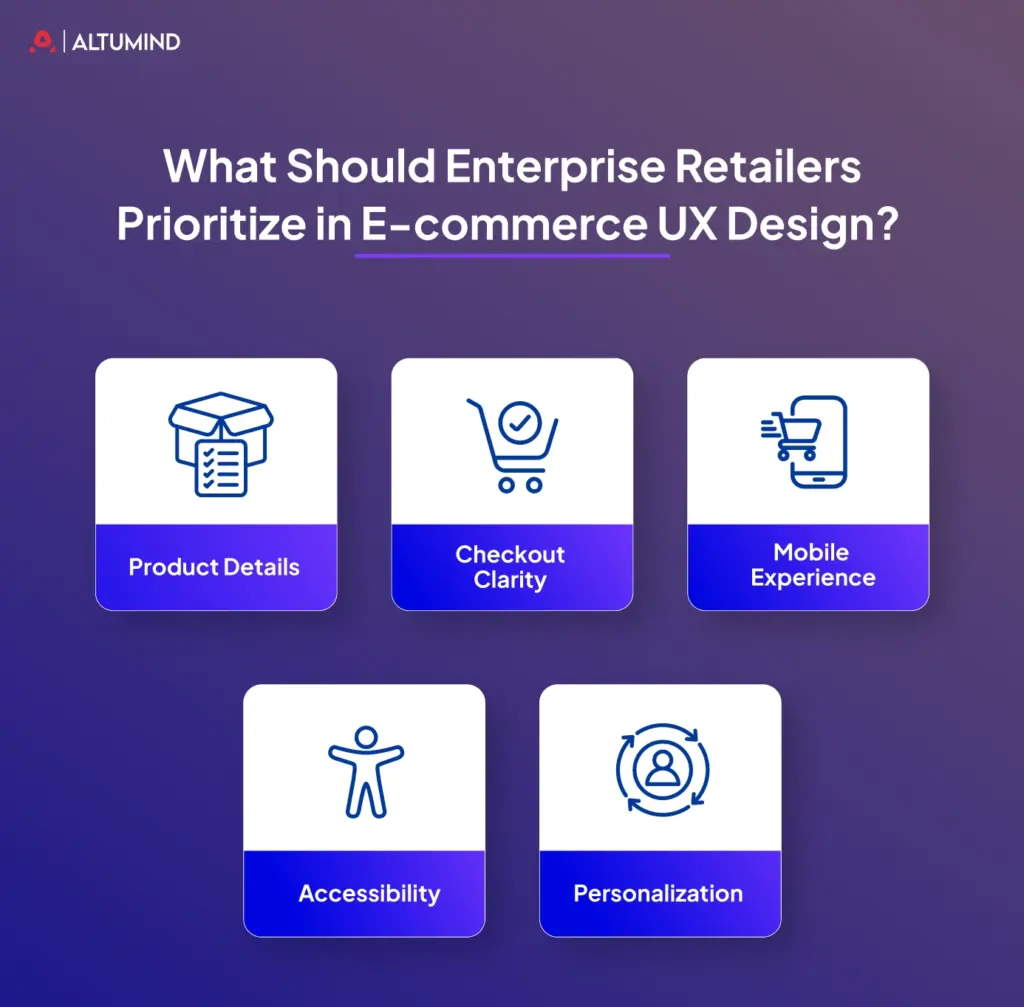
Enterprise retailers need to focus on clarity, relevance, accessibility, trust, and operational consistency before layering in complex features. Good e-commerce UX design helps customers make decisions while providing the business with a reliable foundation for growth.
1. Product Details
Customers need the information on product pages at the point of decision. Product specifications, pricing, availability, delivery information, reviews, and return policies should be easy to find at the point of decision.
2. Checkout Clarity
Checkout should not require unnecessary fields and should clearly explain costs, delivery, payment, and account requirements. Teams also need to test for transaction failures or customers making changes.
3. Mobile Experience
Give mobile UX the same strategic attention you give to desktop. Navigation, filters, product comparison, forms, and checkout must be functional on smaller screens and in different usage contexts.
4. Accessibility
Accessibility shouldn’t be a final fix; it should be part of design and testing. Keyboard interaction, readable content, focus states, form feedback, and responsive behavior all affect the experience.
5.Personalization
Personalization should be based on relevant customer behavior and context. AI may assist with recommendations and adaptive experiences but should not substitute clear product information or good experience design.
Altumind applies AI across recommendation engines, behavioral analytics, customer insights, and personalized digital journeys to support more relevant and measurable customer experiences.
For example, AI-powered UX personalization can become useful when an organization has the necessary customer data, clear use cases, and appropriate governance. The technology should support the customer’s decision rather than simply add more personalized elements to the interface.
How Can UX Decisions Create Measurable Business Value?
UX decisions drive measurable business value when teams can connect a customer behavior to a business metric. Organizations can measure whether a redesign results in a change in a commercially relevant behavior, rather than just whether it looks better.
Consider a product page that receives a lot of traffic but has a poor conversion to add to cart. The solution might not involve a visual redesign. Customers may not know the product specs, delivery details, compatibility info, or price clarity.
Similarly, if customers add products to carts but do not complete checkout, teams should pinpoint the specific friction, rather than assuming checkout as a whole needs to be replaced.
A UX audit can help identify experience issues that may contribute to lost revenue when those issues are assessed in relation to customer behavior and commercial outcomes. Understanding the relationship between UX issues and lost revenue can help teams frame UX priorities in business terms.
The same principle applies to cart abandonment. Addressing unexpected costs, complicated checkout steps, weak product confidence, or unclear delivery information can be more valuable than adding another interface feature. Altumind’s practical work on strategies to reduce cart abandonment and boost revenue reflects this broader view of the purchase journey.
When Should E-commerce UX Become a Broader Technology Initiative?
E-commerce UX should become a broader technology initiative when customer-facing problems originate in data, integration, architecture, or operational processes. A storefront cannot provide a consistent experience if the systems behind it provide inconsistent information.
Enterprise teams should look closely at:
- • Product information management.
- • Inventory and order management.
- • ERP and CRM integration.
- • Payment services.
- • Customer data.
- • Analytics and behavioral tracking.
- • Fulfillment and returns workflows.
Altumind’s digital product development capabilities include e-commerce platforms, ERP integration, headless and composable architectures, personalized journeys, real-time inventory, and AI-driven recommendations. This enables customer experience initiatives to connect with the technology and operational systems behind them
This broader view is also relevant when considering Merxflo in retail and commerce contexts. Its commerce-oriented functionality makes it relevant to discussions where the customer experience needs to connect with broader commerce operations rather than operate as an isolated storefront.
A practical consideration that is often underestimated is the cost of maintaining consistency across systems. Every new channel, integration, personalization rule, or commerce feature adds another dependency that teams need to monitor and test.
How Should Enterprises Build a Human-Centered E-commerce Process?
Enterprises should treat UX as a continuous business process rather than a project that ends when a new interface goes live. Research, design, engineering, testing, measurement, and improvement should work together.
A practical cycle is
Research → Map → Prioritize → Prototype → Test → Build → Measure → Improve
The priority should remain the business problem.
If research shows that customers cannot compare products effectively, the team should address information architecture and product data. If testing reveals checkout friction, the team should examine both the interface and the payment or order systems behind it.
QA also belongs in this process. Enterprise commerce experiences need functional, performance, security, compatibility, and integration testing across devices and user journeys. Altumind provides QA services that cover areas such as automation, security, performance, functional testing, and QA consulting.
When multiple experience, technology, and operational priorities compete for investment, digital strategy services can help connect customer needs with technology priorities and measurable business outcomes. Altumind’s strategy practice covers digital experience, modernization, audits, prototyping, and technology planning.
Conclusion
Human-centered design for e-commerce works best when customer needs and business realities are considered together.
Effective e-commerce UX design goes beyond visual improvements by connecting customer journeys with product data, technology, operations, and measurable commercial outcomes.
Altumind brings more than 10 years of digital transformation experience across experience design, AI, data, engineering, and digital commerce.
For enterprises assessing or modernizing their customer experience, UI/UX services can provide a practical foundation for creating experiences that are easier for customers to use and easier for businesses to measure.
Table of Contents
- Introduction
- Why Human-Centered Design Is Essential for E-commerce
- How Can Customer Journey Mapping Improve E-commerce UX?
- What Should Enterprise Retailers Prioritize in E-commerce UX Design?
- How Can UX Decisions Create Measurable Business Value?
- When Should E-commerce UX Become a Broader Technology Initiative?
- How Should Enterprises Build a Human-Centered E-commerce Process?
- Conclusion