How to Choose a Digital Product Development Company That Delivers Business Value
Choosing a digital product development partner is a business decision as much as a technology decision. The company you select can influence product quality, operating costs, customer experience, scalability, and how quickly your investment begins producing measurable value.
Before making a decision, enterprise leaders should consider:
- • The partner’s understanding of business objectives.
- • Product strategy, UX, engineering, and integration capabilities.
- • Quality, security, and compliance requirements.
- • Ownership, communication, and post-launch responsibilities.
- • Whether development should remain in-house or involve an external partner.
For businesses evaluating how to choose a digital product development company, the strongest approach is to assess the complete product lifecycle rather than comparing development rates alone.
With more than 10 years of experience in digital transformation, Altumind works across product strategy, experience design, software engineering, QA, cloud, AI, data, and enterprise integration. This article outlines the key factors enterprise leaders should consider when evaluating a development partner.
How Should You Compare In-House Development with an External Partner?
The choice between hiring an in-house development team and an experienced company should depend on the capabilities the product requires, the organization’s internal resources, and its preferred long-term operating model.
Hiring an in-house team provides direct control and strong knowledge of internal processes. However, building a complete product team may require expertise across product management, UX, architecture, development, QA, cloud, security, and data.
An external development partner can provide access to broader capabilities without requiring the organization to build every function internally.
| Factor | Hire In-House Team | External Development Partner |
|---|---|---|
| Product knowledge | Strong internal context | Requires onboarding |
| Specialized expertise | Depends on existing team | Broader specialist access |
| Team scaling | Requires hiring or reassignment | More flexible |
| Product ownership | Direct | Defined contractually |
| Technology breadth | Based on internal skills | Can span multiple disciplines |
| Long-term support | Internal responsibility | Can be shared or managed |
A hybrid approach can also work well. Internal teams can retain product ownership and business knowledge while an external company handles specialized engineering, UX, QA, cloud, or integration requirements.
What many organizations overlook is the cost of capability gaps. A company may have capable developers but still need specialists in cybersecurity, enterprise integration, product design, or automation. The right question is therefore not simply, “Should we outsource?” It is, “Which capabilities should remain internal, and which should come from a development partner?”
What Should You Evaluate When Choosing a Digital Product Development Company?
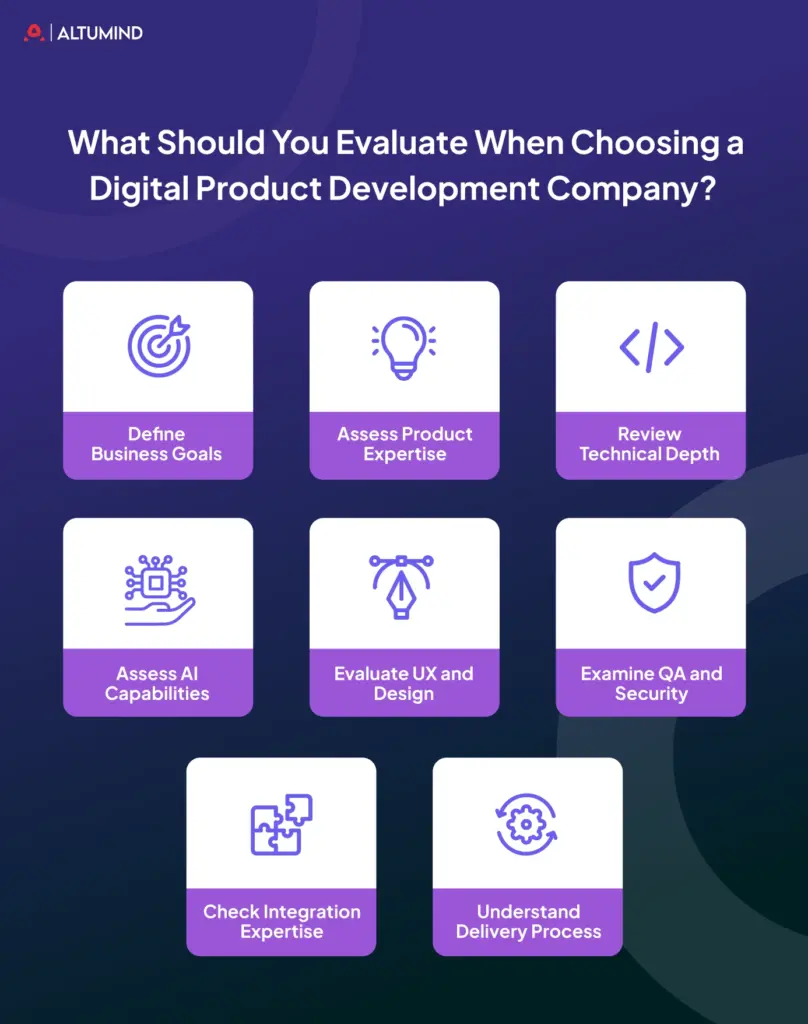
A strong development partner should connect technical decisions to business objectives. The following seven factors provide a practical framework for evaluating potential companies.
1. Define Business Objectives
Start with the business outcome rather than focusing directly on the technology stack.
A development partner must grasp the product’s intended goals. That could include generating new revenue, improving customer retention, reducing manual work, improving service delivery, or giving employees better access to business information.
Before discussions begin, define:
- • The business problem.
- • Target users.
- • Important workflows.
- • Success metrics.
- • Key product constraints.
- • Expected business outcomes.
This information gives the development company context for making technical and product recommendations.
For business leaders investing in digital product development, the central question should be whether the proposed product can create measurable value, not simply whether the development team can deliver the requested features.
2. Assess Product and Industry Expertise
Product development requires more than coding skills. The partner should understand how business requirements become product requirements and how those requirements change during development.
Ask potential partners:
- • How do you validate requirements?
- • Who participates in product planning?
- • How do you prioritize features?
- • How do you handle changing requirements?
- • How do you identify unnecessary complexity?
Reviewing previous work can help, yet you need to look beyond screenshots and project names. Assess the problems the team solved, the complexity involved, the technologies used, and whether the company has experience with products like yours.
Practical experience matters because enterprise products often involve multiple stakeholders, legacy systems, regulatory requirements, and established workflows.
3. Review Technical and Engineering Depth
The right technical partner should recommend architecture based on product requirements rather than promote a fixed technology stack.
Review capabilities across:
- • Application architecture.
- • APIs and integrations.
- • Cloud infrastructure.
- • Databases and data architecture.
- • Security.
- • Performance.
- • Scalability.
- • Third-party systems.
When assessing custom software development, inquire how the team plans for maintainability as the product grows. A solution that works for an initial release may require significant changes when usage, data volume, integrations, or business requirements increase.
A practical consideration that is often underestimated is technical debt. Inquire how architecture decisions will be documented and how the team will manage technical debt after launch.
4. Assess AI Capabilities
AI is increasingly relevant when digital products rely on personalization, predictive insights, recommendations, intelligent workflows, or automated decision support. When evaluating a development partner, assess whether the team can identify suitable AI use cases and integrate them responsibly into the broader product architecture.
Ask whether the partner can address the following:
- • AI use-case identification.
- • Data and system integration.
- • Privacy and security.
- • Human oversight.
- • AI performance monitoring.
A practical consideration that is often underestimated is whether the product’s existing data, workflows, and architecture can support the proposed AI capabilities. A capable partner should also know where AI automation can add practical value by reducing repetitive work across document processing, customer interactions, workflow routing, and information-intensive processes.
The development partner should connect AI capabilities to measurable business outcomes while addressing data quality, security, governance, and human oversight. This helps businesses assess whether AI serves a genuine product need rather than treating it as an isolated feature.
5. Evaluate UX and Product Design
Product quality goes beyond technical performance. Users should be able to complete important tasks efficiently and understand how the product supports their work.
Assess whether the development company provides comprehensive UI/UX support covering:
- • User research.
- • User journeys.
- • Information architecture.
- • Prototyping.
- • Interface design.
- • Usability testing.
- • Accessibility.
Enterprise products often serve different user groups. An employee workflow, customer portal, administrator console, and executive dashboard may require different design decisions. A capable partner should connect UX decisions to actual workflows and business objectives, ensuring the final product is practical, intuitive, and aligned with how users interact with it.
6. Examine QA and Security Practices
QA should be integrated throughout development rather than treated as a final checkpoint. A strong partner should have a structured QA and testing approach that supports product quality from requirements and development through release.
Ask how the partner handles:
- • Functional testing.
- • Regression testing.
- • Performance testing.
- • Test automation.
- • Accessibility testing.
- • Integration testing.
For products that handle customer, employee, financial, or operational data, security needs equal attention. Ask how the company approaches application security, access controls, vulnerability management, secure development practices, and security testing.
For products that require ongoing security assessment and protection, specialized cybersecurity services may also be required beyond standard development practices.
Altumind’s documented delivery approach includes QA and testing within the broader product lifecycle, combining automation, security frameworks, performance analytics, and continuous improvement.
7. Check Enterprise Integration Capability
Most enterprise products need to communicate with other systems.
These may include ERP platforms, CRM systems, payment systems, identity providers, analytics platforms, internal databases, and third-party applications.
Ask how the development company approaches:
- • API architecture.
- • Authentication.
- • Data synchronization.
- • Integration monitoring.
- • Error handling.
- • Data consistency.
- • Third-party dependencies.
Integration problems can create manual reconciliation, duplicate records, workflow delays, and additional maintenance costs.
A development partner should therefore consider the product as part of the organization’s technology environment, not as an isolated application.
8. Understand the Delivery Process
A reliable delivery process should make responsibilities, milestones, decisions, testing, and communication clear.
Ask:
- • Who owns requirements?
- • How are issues escalated?
- • How are releases planned?
- • How often will progress be reviewed?
- • How are scope changes handled?
- • How are technical decisions documented?
The goal is not to select a company because it uses a particular methodology. The goal is to understand whether its delivery process gives business stakeholders sufficient visibility and control.
Clear documentation also becomes valuable when internal teams need to maintain or extend the product later.
Conclusion
Knowing how to choose a digital product development company requires more than comparing portfolios, technology stacks, or development costs. Enterprise leaders should assess business understanding, product expertise, engineering, UX, QA, cybersecurity, integrations, delivery practices, ownership, and post-launch support as connected parts of one decision.
Altumind brings years of experience helping businesses turn complex technology requirements into practical digital products built around real business goals. If you are evaluating digital product development services, speak with our team to discuss your product vision, technical requirements, and business priorities and identify the right approach for your next digital product.