How Enterprise App Development Helps Eliminate Hidden Operational Bottlenecks
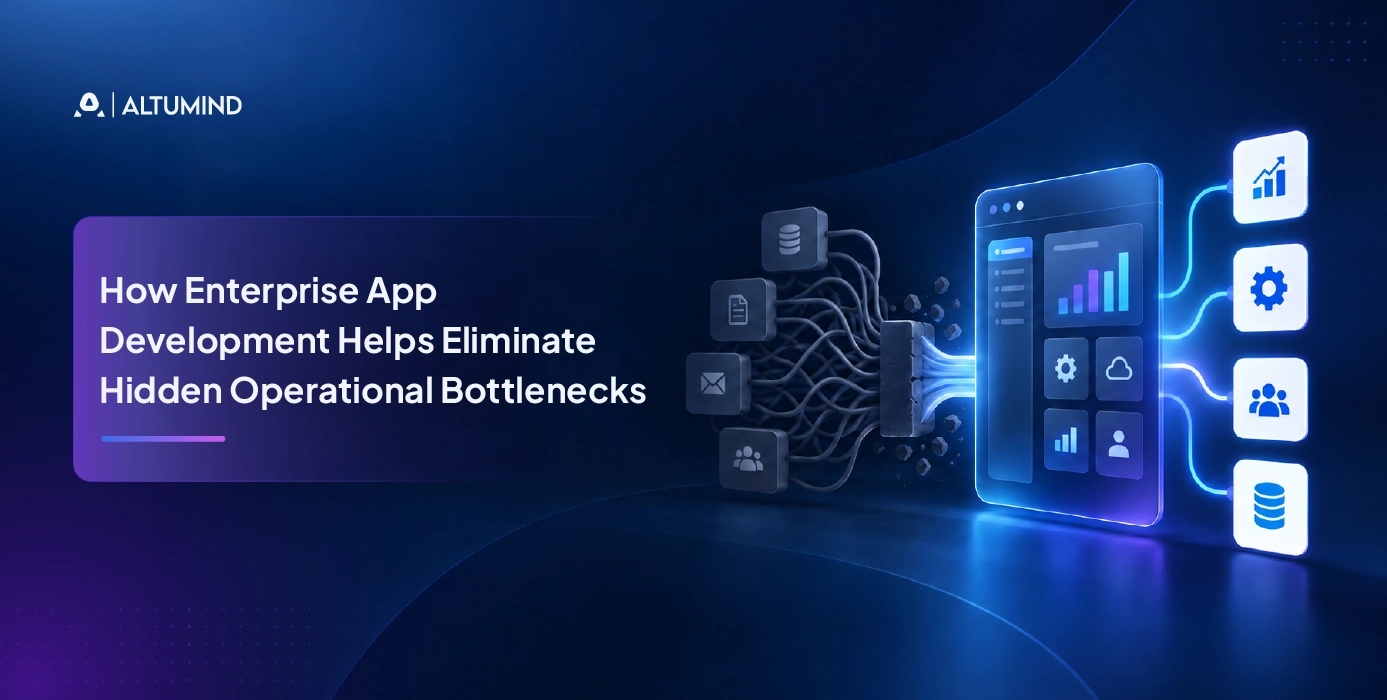
Table of Contents
- Introduction
- Why Do Operational Bottlenecks Persist Despite Enterprise App Development?
- What Hidden Operational Bottlenecks Should Businesses Address First?
- How Can Enterprise App Development Address These Bottlenecks?
- What Do Businesses Often Overlook When Building Enterprise Applications?
- What Factors Should Businesses Evaluate Before Investing in Enterprise App Development?
- How Should Businesses Measure the ROI of Enterprise App Development?
- When Should a Business Consider Custom Enterprise Applications?
- Conclusion
A delayed purchase approval, a duplicate customer record, or a report that takes two days to generate may seem like a minor annoyance. But these small delays can impact operating costs, customer service, and the speed of business decisions across the organization.
Even if a company invests in digital devices, the software often only addresses individual tasks, not the process that connects them.
Enterprise app development helps businesses close these gaps by linking systems, streamlining workflows, and improving access to operational data. The process should begin by identifying where workflows break down and what causes those delays before selecting an appropriate technology solution.
Business leaders need to ask themselves three questions:
- • What are the time-consuming repetitive tasks that don’t provide meaningful value?
- • Where do employees rely on manual workarounds to integrate systems?
- • What delays have a measurable effect on cost, service, or productivity?
This article examines how businesses can identify hidden operational bottlenecks, select practical application solutions, avoid common implementation mistakes, and measure the results.
Why Do Operational Bottlenecks Persist Despite Enterprise App Development?
Operational bottlenecks persist when businesses digitize individual tasks but leave the underlying process unchanged. An application might speed up data entry, for example, while requests still wait days for approval.
Consider a sales team that records customer details in a CRM while finance enters the same information into an ERP system. Both teams use digital tools, but duplicate work and inconsistent records remain.
Common causes include:
- • Disconnected systems: Employees transfer information manually between applications.
- • Unclear responsibilities: Requests stall because no one knows who should approve or resolve them.
- • Limited visibility: Managers cannot see where work is delayed.
- • Poor user adoption: Employees return to spreadsheets when applications do not fit their daily tasks.
- • Incomplete requirements: Development teams build features without understanding the actual business problem.
Before investing in another application, businesses should review how work passes between people, departments, and systems. This helps determine whether they need process changes, integration, automation, or custom development.
What Hidden Operational Bottlenecks Should Businesses Address First?
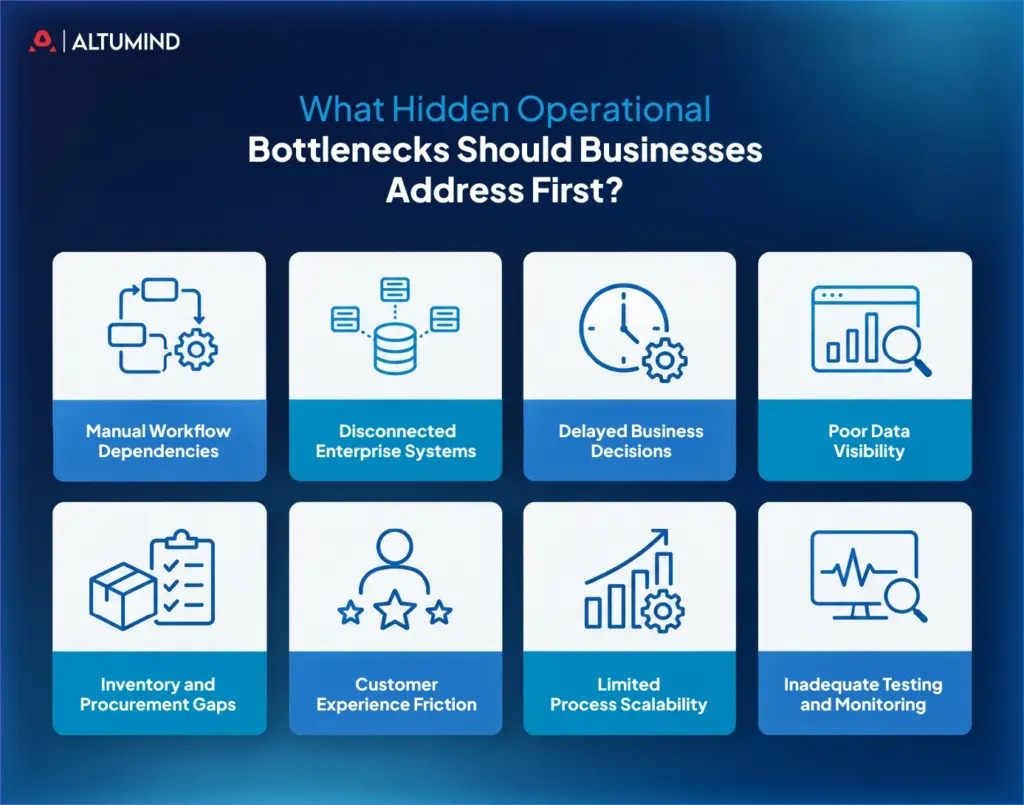
Businesses should focus on prioritizing bottlenecks by the impact on operations, frequency, and cost of resolution. The most visible problem is not the most expensive. A short task performed repeatedly may consume more resources over time than a larger issue that occurs infrequently.
1. Manual Workflow Dependencies
Many business processes rely on employees forwarding emails, reviewing spreadsheets, or reminding colleagues to get routine work done. These manual activities often persist because the end-to-end workflow has not been mapped and assessed.
Workflow automation can route requests, assign tasks, send reminders, and log status changes. Determine where approvals are not required and steps that are redundant before automating. Otherwise the application may replicate the existing delays in a digital form.
2. Disconnected Enterprise Systems
When CRM, ERP, finance, and operational systems hold separate records, employees spend time reconciling information. System integration can reduce duplicate entry and make shared information available across applications.
Before connecting systems, decide which one owns each important data field. Otherwise, integration can spread incorrect information instead of resolving it.
3. Delayed Business Decisions
Reports provide limited operational value when they reach managers after the opportunity to act has passed. For example, a weekly inventory report may show no shortage until after sales teams have signed off on orders that the business cannot immediately fill.
Connected dashboards can improve operational visibility, but their value depends on the relevance of the information presented. Leaders need clearly defined thresholds, assigned response owners, and agreed actions for addressing exceptions.
4. Poor Data Visibility
Departments sometimes calculate the same metric differently. For example, finance and operations may use different definitions of a completed order, producing reports that do not agree.
Set shared business metrics before building reports. Document the data source, calculation, and responsible owner for each important measure.
5. Inventory and Procurement Gaps
Procurement delays can arise when purchase requests, approval records, supplier information, and inventory data sit in separate systems. A connected application can show teams which requests need approval, which orders remain open, and where action is overdue.
Businesses should also account for incomplete requests, supplier changes, and stalled approvals. Clear exception handling helps employees resolve these issues without chasing updates across multiple channels.
6. Customer Experience Friction
Customers feel the effects of internal inefficiencies when they receive delayed responses, repeat information, or encounter inconsistent service. Giving employees access to customer history and current request status can reduce these problems.
User-centered design also matters. If employees struggle to complete basic tasks, they may avoid the system or develop workarounds. Altumind’s UI/UX services can support interfaces designed around actual user needs and business workflows.
7. Limited Process Scalability
Processes that work for small teams may become inefficient as transaction volumes, user numbers, and operational complexity increase. Manual checks that were manageable at first can become a source of delays, while poorly planned integrations can cause performance problems.
A scalable architecture should account for expected growth, system capacity, permissions, and failure recovery. Businesses don’t have to build every future feature in advance, but they shouldn’t make choices that will make the growth they expect to happen unnecessarily expensive.
8. Inadequate Testing and Monitoring
Applications can fail when real users, large data volumes, and connected systems interact. Testing should cover business rules, permissions, complete workflows, and integration failures, not just whether individual features work.
Teams should also test changes to existing features and monitor errors after launch. A clear process for reporting, prioritizing, and resolving defects helps prevent recurring issues.
How Can Enterprise App Development Address These Bottlenecks?
Enterprise app development addresses operational problems when application features match the way a business works. The process should begin with a defined business need, not a predetermined list of features.
A practical approach includes five steps:
- Map the workflow: Record the steps, handoffs, approvals, and recurring delays.
- Measure current performance: Establish baseline processing times, error rates, and manual effort.
- Set a clear target: Decide what needs to improve and how success will be measured.
- Choose the right solution: Compare existing software, configuration, integration, and custom development.
- Test with real scenarios: Check complete workflows and collect feedback before expanding the rollout.
The solution should fit the problem. A business may not need a new application if its existing platform can support the required process with a few changes.
| Business problem | Potential solution | What to measure |
|---|---|---|
| Repeated manual entry | Data integration and validation | Duplicate records and correction time |
| Slow approvals | Automated routing | Approval time |
| Delayed reporting | Connected dashboards | Report preparation time |
| Inconsistent customer records | Shared data rules | Record accuracy |
| Recurring workflow errors | Validation and exception alerts | Error and rework rates |
| Poor process visibility | Role-based reporting | Time to identify delays |
When existing platforms cannot support important workflows or integration requirements, custom software development may offer a better fit.
What Do Businesses Often Overlook When Building Enterprise Applications?
Businesses often concentrate on features and launch dates while overlooking data quality, employee adoption, unusual scenarios, and ongoing maintenance. These issues can create additional work even when the application functions as intended.
- • Data quality: Duplicate, outdated, or conflicting records can undermine a new application. Review data before migration and assign responsibility for keeping it accurate.
- • Exception handling: Not every request follows the standard process. Missing information, unavailable approvers, and failed integrations need clear resolution paths.
- • Employee adoption: An application will struggle if it adds steps without solving a genuine problem. Involve employees during requirements gathering and testing, then assess whether they can complete their work effectively.
- • Integration recovery: Connected systems can experience outages or incomplete transactions. Plan for error alerts, retries, reconciliation, and recovery before deployment.
- • Ongoing costs: Development is only part of the expense. Businesses also need to account for infrastructure, licenses, security updates, support, and future changes.
Running legacy and new processes in parallel can create temporary costs and additional administrative effort during migration. If employees must update both systems during a long transition, errors and workload can increase. Set a clear migration plan and define when the old process will end.
A digital transformation roadmap can help businesses sequence application projects, assign responsibilities, and plan budgets around wider operational priorities.
What Factors Should Businesses Evaluate Before Investing in Enterprise App Development?
Before approving a project, business leaders should establish what problem the application will solve, whether existing tools can address it, and what the solution will cost to operate over time.
Consider these factors:
- • Business impact: Which process needs improvement, and who will benefit?
- • Technical compatibility: Can the application connect with existing ERP, CRM, and operational systems?
- • Security: What access controls, audit records, and data protections are required?
- • Scalability: Can the system support expected users, transactions, and integrations?
- • Usability: Can employees complete important tasks without unnecessary steps?
- • Maintenance: Who will manage updates and resolve technical issues?
- • Implementation risk: Would a pilot or phased rollout reduce disruption?
Custom development is not always the right answer. Existing software may suit common business processes, while custom applications may be more appropriate when standard products cannot support essential requirements without costly workarounds.
Businesses should also assess AI based on the task it needs to perform. Predictive analytics may help identify demand patterns or operational risks when reliable data is available. Altumind’s predictive data and analytics services relate to this area.
For businesses reviewing data-driven pricing decisions, AI price optimization is another practical approach that should be considered.
How Should Businesses Measure the ROI of Enterprise App Development?
Businesses should compare operational performance before and after implementation. The most useful measures depend on the problem being addressed, but they should reflect actual changes rather than assumed benefits.
Track measures such as:
- • Processing time: How long does the task take from start to completion?
- • Manual effort: How much employee time does the workflow require?
- • Error rates: How often do employees correct records or repeat work?
- • Service performance: Are response times or completion rates improving?
- • Adoption: Are employees using the intended workflow successfully?
- • Total cost: What are the development, integration, operating, and maintenance expenses?
For example, after automating purchase approvals, a business could compare average approval time, the number of requests awaiting action, and the time employees spend checking status. These figures show whether the change has reduced delays and administrative effort.
Businesses should distinguish between time saved and money saved. Reducing the time required for a task creates capacity, but financial savings depend on how the organization uses that capacity. It might handle more work with the same team, reduce overtime, or shorten customer waiting times.
Review the results after launch and investigate gaps between expected and actual performance. If delays remain, the cause may lie in approval policies, data quality, or employee adoption rather than the application itself.
When Should a Business Consider Custom Enterprise Applications?
A business should consider custom enterprise applications when existing products cannot support essential workflows, integrations, or operating requirements at a reasonable cost.
Custom development may be appropriate when:
- • Several systems must work together through a specialized process.
- • Standard software requires repeated manual workarounds.
- • Business rules or access requirements are highly specific.
- • Existing tools create persistent delays or data inconsistencies.
- • Available products cannot support a necessary capability.
However, custom development also creates responsibility for maintenance, security updates, and future improvements. Compare these costs with the effort required to configure or integrate existing software.
Start by documenting the business problem, identifying the employees affected, and setting clear measures of success. Then choose the approach that fits the organization’s requirements, budget, and existing systems.
Conclusion
Hidden operational bottlenecks often stem from disconnected systems, manual handoffs, inconsistent data, or outdated processes. Adding another application will not solve these problems without addressing their root causes.
Enterprise app development helps businesses connect systems, automate repetitive tasks, improve visibility, and support faster decisions. Success depends on identifying the right problem, choosing a suitable solution, and planning for integration, security, employee adoption, and ongoing maintenance.
Altumind helps organizations develop digital solutions that align with operational requirements and business objectives. Our digital product development capabilities support the design and development of applications that connect workflows, improve operational visibility, and address specific business challenges. Get in touch with us to discuss your business requirements and explore solutions aligned with your operational goals.

Author
Founder & CEO
Bhargava Ghatty is the Founder and CEO of Altumind, leading the company’s vision at the intersection of AI, technology, and digital transformation.
He brings a strategic perspective to enterprise transformation, innovation, and the practical adoption of emerging technologies, with a focus on helping businesses translate technology investments into meaningful and sustainable business outcomes.
Table of Contents
- Introduction
- Why Do Operational Bottlenecks Persist Despite Enterprise App Development?
- What Hidden Operational Bottlenecks Should Businesses Address First?
- How Can Enterprise App Development Address These Bottlenecks?
- What Do Businesses Often Overlook When Building Enterprise Applications?
- What Factors Should Businesses Evaluate Before Investing in Enterprise App Development?
- How Should Businesses Measure the ROI of Enterprise App Development?
- When Should a Business Consider Custom Enterprise Applications?
- Conclusion