AI-Driven Code Optimization: Accelerating Enterprise Software Performance with Intelligent Engineering
Table of Contents
- Introduction
- Why AI-Driven Code Optimization Matters
- Understanding AI-Driven Code Optimization
- The Business Value of AI-Driven Code Optimization
- Where AI-Driven Code Optimization Creates Business Value
- AI Technologies Powering Intelligent Code Optimization
- Integrating AI into Enterprise Development Workflows
- Connecting Code Quality with Digital Experience
- AI-Driven Optimization in Custom Software Development
- AI Optimization as Part of Enterprise Automation
- Measuring the Business Impact of AI-Driven Code Optimization
- Best Practices for Successful Implementation
- Conclusion
Enterprise software is at the center of modern business growth, digital transformation, and customer experience. As organizations continue investing in intelligent technologies, engineering leaders are investigating how to build high-performing software while improving development efficiency, scalability, and long-term maintainability.
AI-driven code optimization is helping engineering organizations improve software quality, accelerate product delivery, reduce technical debt, and support long-term scalability. Organizations are increasingly adopting AI-powered code optimization to:
- Build scalable software platforms that support future growth.
- Accelerate software delivery while maintaining engineering excellence.
- Strengthen software security and governance throughout development.
- Improve long-term maintainability through consistent engineering practices.
- Enhance developer productivity with intelligent, context-aware recommendations.
- Improve application performance across cloud-native and distributed environments.
- Enable engineering teams to focus on innovation and strategic business initiatives.
Rather than replacing software developers, AI complements engineering expertise by providing continuous intelligence that enables better technical decisions, higher software quality, and more efficient development workflows.
In this article, we’ll explore how AI-driven code optimization is helping enterprise organizations improve software quality, accelerate delivery, and build intelligent digital products that create sustainable business value.
Why AI-Driven Code Optimization Matters
Software has evolved into a strategic business asset. Every application, platform, and digital product contributes to customer experience, operational efficiency, and competitive differentiation.
As enterprise applications continue growing in complexity, organizations require development practices that improve both engineering quality and business agility. AI-driven code optimization provides continuous intelligence that helps engineering teams deliver high-quality software while supporting innovation at scale.
For enterprise leaders, the value extends beyond just writing better code. AI-powered optimization contributes to measurable business outcomes by helping organizations:
1. Accelerate Digital Innovation
Development teams can deliver new capabilities more efficiently while maintaining engineering quality, enabling organizations to respond to evolving market opportunities with greater confidence.
2. Improve Delivery Efficiency
Developers receive intelligent recommendations throughout development, allowing them to focus on designing innovative solutions instead of spending unnecessary time reviewing routine implementation details.
3. Strengthen Software Quality
Continuous analysis encourages consistent engineering standards that improve software reliability, maintainability, and long-term scalability.
4. Support Enterprise Governance
Organizations establish consistent development practices across multiple teams, technology stacks, and software portfolios while maintaining alignment with internal engineering standards.
5. Enable Sustainable Growth
As software ecosystems expand, AI helps organizations maintain engineering consistency without increasing operational complexity.
AI-driven code optimization enables engineering organizations to create software that not only performs efficiently today but also remains adaptable as business requirements evolve.
Understanding AI-Driven Code Optimization
AI-driven code optimization uses machine learning and smart code analysis to look at source code and suggest changes that improve performance, make it easier to maintain, enhance security, and boost software quality during the entire development process.
Unlike traditional static analysis tools that primarily evaluate predefined rules, modern AI systems understand software architecture, coding context, framework conventions, and implementation patterns. This allows recommendations to align with both engineering best practices and the specific needs of each application.
By combining intelligent automation with engineering expertise, organizations create development environments where quality becomes a continuous process rather than a final checkpoint.
1. How AI Understands Modern Software
Modern enterprise applications consist of interconnected services, APIs, cloud infrastructure, databases, and distributed systems that continuously exchange information.
AI evaluates these relationships holistically instead of analyzing individual files in isolation.
Intelligent code optimization considers multiple dimensions simultaneously, including:
- Software architecture
- Component dependencies
- Data access patterns
- Infrastructure utilization
- Performance characteristics
- Security considerations
- Maintainability
- Engineering best practices
This broader understanding allows AI to recommend improvements that strengthen the overall software ecosystem rather than focusing solely on isolated code enhancements.
2. Learning from Enterprise Software Patterns
One of the greatest advantages of AI is its ability to recognize software engineering patterns across diverse development environments.
Modern machine learning models continuously learn from extensive codebases, enabling them to identify approaches that consistently improve software quality, scalability, and maintainability.
As a result, recommendations become increasingly:
- Context-aware
- Architecture-aware
- Framework-specific
- Language-aware
- Performance-oriented
- Business-aligned
Instead of applying generic rules, AI provides recommendations that reflect the unique characteristics of enterprise software environments.
3. Continuous Intelligence Throughout the Development Lifecycle
Traditional software optimization often occurs during scheduled reviews or late-stage testing.
AI introduces continuous intelligence throughout every phase of software development.
Engineering teams receive recommendations while:
- Writing code.
- Reviewing pull requests.
- Performing code reviews.
- Preparing software for deployment.
- Running Continuous Integration (CI) pipelines.
This continuous feedback encourages consistent engineering practices while making optimization a natural part of everyday software development.
The result is a development process where quality, maintainability, and performance improve continuously instead of relying on isolated review cycles.
The Business Value of AI-Driven Code Optimization
For enterprise organizations, software optimization is far more than a technical initiative. It represents a strategic capability that supports innovation, operational excellence, customer experience, and long-term business growth.
When AI becomes an integral part of software engineering, organizations establish development practices that improve both technology outcomes and business performance.
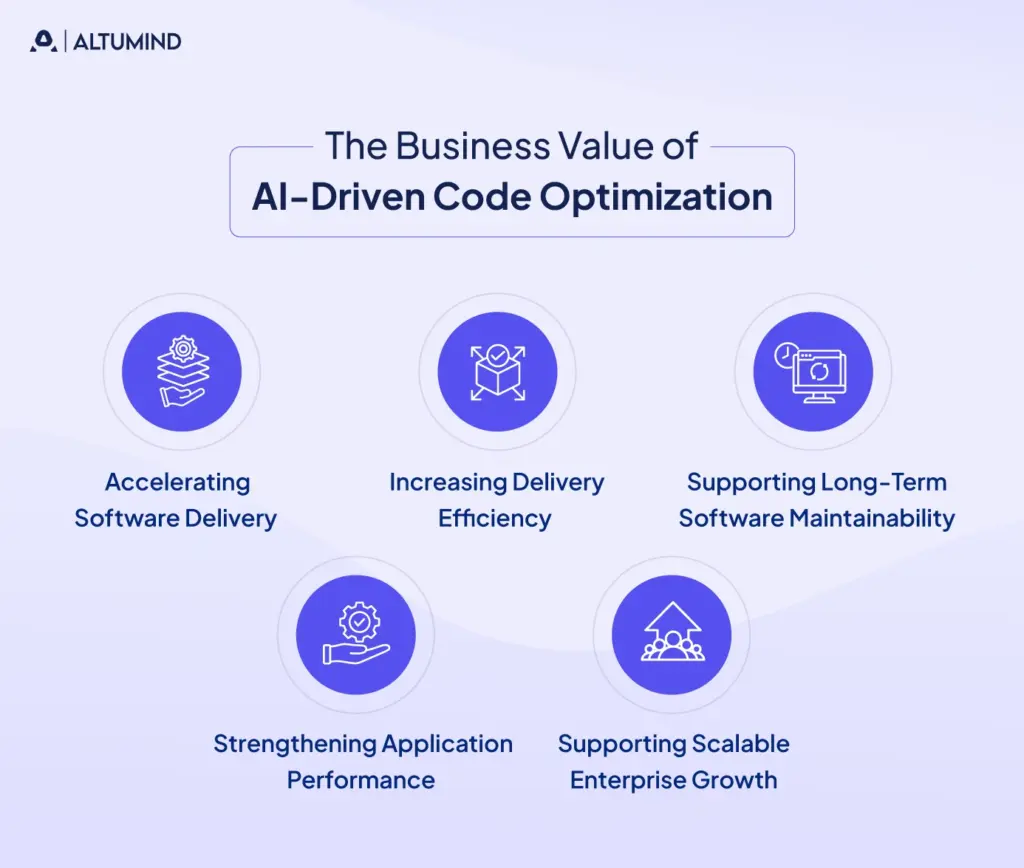
1. Accelerating Software Delivery
Development velocity directly influences how quickly organizations can introduce new digital capabilities.
AI-driven optimization streamlines engineering workflows by providing intelligent recommendations throughout development, enabling teams to build, review, and refine software more efficiently.
The result is a development lifecycle that enables organizations to shorten time-to-market, accelerate product releases, respond more quickly to changing customer needs, capitalize on emerging market opportunities, and generate business value sooner without compromising engineering quality.
2. Increasing Delivery Efficiency
Engineering talent creates the highest value when focused on innovation, architecture, and solving complex business challenges.
AI supports developers by automating routine code analysis and providing intelligent recommendations that improve implementation quality without interrupting development workflows.
This increases engineering capacity without proportionally increasing headcount, allowing organizations to deliver more strategic initiatives while improving development efficiency and resource utilization.
3. Supporting Long-Term Software Maintainability
Enterprise software continues evolving throughout its lifecycle.
Applications designed with maintainability in mind are easier to enhance, modernize, integrate, and scale as business requirements change.
AI encourages consistent engineering practices that improve readability, modularity, documentation, and architectural alignment, making future development more efficient.
Over time, these practices reduce technical debt, simplify future enhancements, lower ongoing maintenance costs, and improve the organization’s ability to modernize software without major architectural disruption. This creates a more sustainable software foundation that supports long-term business growth.
Organizations investing in long-term software initiatives often realize even greater value when intelligent optimization is embedded into custom software development from the earliest stages of architecture and engineering rather than being introduced later in the lifecycle.
4. Strengthening Application Performance
Application performance influences customer satisfaction, operational efficiency, and infrastructure utilization.
AI analyzes execution patterns, resource consumption, architectural decisions, and data flows to recommend improvements that enhance application responsiveness while supporting scalable enterprise environments.
Better-performing applications improve customer satisfaction, reduce infrastructure inefficiencies, strengthen employee productivity, and create more reliable digital experiences across the business.
5. Supporting Scalable Enterprise Growth
As software portfolios expand across multiple teams, maintaining engineering consistency becomes increasingly important.
AI provides standardized intelligence across projects, development teams, and technology stacks, helping organizations establish repeatable engineering practices that support sustainable growth.
This allows organizations to scale software delivery across products, business units, and markets while maintaining governance, reducing operational risk, and controlling engineering complexity.
Where AI-Driven Code Optimization Creates Business Value
AI-powered optimization delivers measurable value across multiple dimensions of enterprise software engineering.
1. Application Performance and Resource Efficiency
AI continuously evaluates software execution patterns to identify opportunities that improve overall application efficiency.
Common areas include:
- Algorithm optimization
- Database query optimization
- Memory utilization
- Intelligent caching strategies
- Resource management
- Cloud infrastructure optimization
Together, these improvements contribute to responsive applications that continue performing efficiently as business demands evolve.
2. Software Security and Governance
Modern software engineering requires security to be integrated throughout the development lifecycle.
AI supports secure software development by continuously analyzing implementation patterns and identifying opportunities to strengthen engineering practices before software reaches production.
For organizations operating within regulated industries, software optimization is often part of a broader governance strategy. Understanding the broader influence of AI in compliance across industries provides additional perspective on building secure, scalable, and compliant enterprise software.
3. Code Quality and Long-Term Maintainability
High-quality software creates long-term business value by making future development faster, more predictable, and easier to manage.
AI helps engineering teams continuously improve:
- Code readability
- Architectural consistency
- Component organization
- Reusability
- Documentation quality
- Engineering standards
These improvements strengthen collaboration across engineering teams while supporting future modernization initiatives.
4. Building a Culture of Continuous Engineering Excellence
The greatest value of AI-driven optimization extends beyond individual recommendations.
Organizations establish a culture where software quality, intelligent automation, and continuous improvement become embedded throughout engineering.
Rather than treating optimization as a one-time initiative, AI enables continuous learning that strengthens software quality throughout the entire development lifecycle.
AI Technologies Powering Intelligent Code Optimization
Modern AI platforms integrate directly into software engineering workflows, enabling continuous optimization without disrupting established development practices. Instead of operating as standalone tools, AI capabilities are becoming an integral part of the software development lifecycle.
1. Intelligent Code Assistance
AI-powered development assistants provide contextual recommendations while developers write code, helping improve implementation quality, consistency, and productivity.
These capabilities include:
- Intelligent code completion.
- Best practice suggestions.
- Framework-specific guidance.
- Context-aware coding recommendations.
- Improved coding consistency across development teams.
By delivering real-time assistance, AI helps engineering teams maintain quality while accelerating software development.
2. Automated Code Reviews
Code reviews remain an essential part of enterprise software development.
AI enhances this process by automatically reviewing code for opportunities related to:
- Performance optimization.
- Software quality.
- Maintainability.
- Security best practices.
- Engineering consistency.
This enables engineering leaders to focus peer reviews on architecture, business logic, and solution design while AI assists with routine analysis.
3. Predictive Software Intelligence
Beyond identifying existing improvement opportunities, AI recognizes implementation patterns that may influence future scalability, maintainability, and application performance.
Predictive analysis enables organizations to make informed engineering decisions earlier in the development lifecycle, contributing to more resilient and scalable software.
Organizations can further strengthen these capabilities by integrating predictive data analytics services to anticipate performance trends, optimize resource allocation, and support more informed engineering and business decisions.
4. Intelligent Refactoring and Modernization
Enterprise software continuously evolves to support changing business priorities.
AI assists modernization initiatives by identifying opportunities to improve application architecture, simplify implementations, and align software with modern engineering practices.
For organizations modernizing legacy platforms, AI supports a structured approach to software evolution while preserving long-term maintainability.
Integrating AI into Enterprise Development Workflows
The greatest value of AI-driven code optimization comes from integrating intelligence into everyday software engineering rather than treating optimization as a separate activity.
1. Development Environment Integration
Embedding AI directly within development environments allows engineers to receive contextual recommendations without interrupting their workflow.
This creates a more efficient development experience while encouraging continuous adoption of engineering best practices.
2. Version Control Integration
AI can be incorporated into version control workflows, enabling intelligent analysis before code is committed or merged.
By providing recommendations during pull requests and repository reviews, organizations establish consistent engineering standards across multiple teams and projects.
3. Continuous Integration and Continuous Delivery
AI-driven analysis naturally complements modern CI/CD pipelines.
As software progresses through testing and deployment stages, AI continuously evaluates quality, performance, maintainability, and security, providing engineering teams with actionable insights before production releases. When combined with QA services, organizations can identify defects earlier, improve release quality, and deliver reliable software with greater confidence.
This supports faster software delivery while maintaining confidence in engineering quality.
4. Enhancing Engineering Collaboration
AI strengthens collaboration by providing consistent recommendations across engineering teams, reducing variability in implementation approaches while promoting shared development standards.
Combined with experienced engineering leadership, AI creates an environment where continuous improvement becomes part of everyday software development.
Connecting Code Quality with Digital Experience
Exceptional software is measured not only by engineering excellence but also by the experience it delivers to customers, partners, and employees.
Efficient, reliable, and scalable applications contribute directly to seamless digital experiences, enabling organizations to strengthen customer engagement and business performance.
While AI-driven code optimization enhances backend engineering, combining it with UI/UX services helps organizations create intuitive, accessible, and engaging digital experiences that improve customer satisfaction and adoption. Conducting regular UX audits alongside software optimization initiatives provides valuable insights into creating intuitive digital products that support long-term customer satisfaction.
AI-Driven Optimization in Custom Software Development
Organizations investing in custom software development gain the greatest value when intelligent optimization becomes part of the engineering strategy from the beginning.
Rather than introducing optimization after deployment, AI supports architectural decisions, engineering consistency, and software quality throughout design, development, testing, and ongoing enhancement.
This approach enables organizations to build scalable applications that remain adaptable as technology and business priorities evolve.
AI Optimization as Part of Enterprise Automation
AI-driven code optimization becomes even more valuable when integrated into broader enterprise automation initiatives.
Organizations adopting AI automation services are increasingly embedding intelligent capabilities across software engineering, operational workflows, and business processes to improve efficiency and accelerate digital transformation.
Combining software optimization with intelligent automation enables organizations to establish connected digital ecosystems that continuously improve both engineering outcomes and business performance.
Measuring the Business Impact of AI-Driven Code Optimization
Successful AI adoption should be evaluated through meaningful business outcomes rather than technical improvements alone.
Enterprise organizations often assess the value of AI-driven optimization across several strategic areas.
1. Engineering Productivity
Evaluate how AI supports faster collaboration, consistent engineering practices, and more efficient software delivery.
2. Software Quality
Monitor improvements in maintainability, architectural consistency, and long-term application health.
3. Application Performance
Assess how optimized software contributes to responsive digital experiences and efficient resource utilization.
4. Business Agility
Measure how intelligent engineering practices support innovation, modernization, and the ability to deliver new digital capabilities with confidence.
By aligning engineering improvements with broader business objectives, organizations maximize the long-term value of AI-driven software optimization.
Best Practices for Successful Implementation
Organizations that realize the greatest value from AI-driven code optimization typically adopt a structured and strategic approach.
1. Begin with High-Impact Initiatives
Prioritize applications and software platforms where optimization can deliver the greatest long-term business value.
2. Establish Engineering Standards
Define consistent development principles that AI can reinforce across projects, teams, and technology environments.
3. Combine AI with Human Expertise
AI enhances engineering decision-making while experienced developers provide architectural insight, business context, and strategic direction.
4. Encourage Continuous Learning
Empower engineering teams to understand the recommendations provided by AI, enabling continuous improvement across software development practices.
5. Continuously Refine Optimization Strategies
Regularly evaluate engineering outcomes to ensure AI recommendations remain aligned with evolving business priorities and technology objectives.
Conclusion
AI-driven code optimization is reshaping enterprise software engineering by combining intelligent automation with human expertise. It enables organizations to improve software quality, accelerate development, strengthen governance, and build scalable digital solutions that support long-term business growth.
When integrated into a broader digital engineering strategy, AI-driven optimization becomes more than a development capability. It becomes a foundation for continuous innovation, operational excellence, and sustainable competitive advantage.
Explore how Altumind’s digital product development services help organizations design, build, optimize, and scale future-ready digital solutions powered by AI, modern engineering practices, and customer-centric innovation.
Ready to build smarter solutions for your business? Partner with us to transform software engineering with AI-driven development, intelligent automation, and scalable digital product innovation that creates measurable business value.
Table of Contents
- Introduction
- Why AI-Driven Code Optimization Matters
- Understanding AI-Driven Code Optimization
- The Business Value of AI-Driven Code Optimization
- Where AI-Driven Code Optimization Creates Business Value
- AI Technologies Powering Intelligent Code Optimization
- Integrating AI into Enterprise Development Workflows
- Connecting Code Quality with Digital Experience
- AI-Driven Optimization in Custom Software Development
- AI Optimization as Part of Enterprise Automation
- Measuring the Business Impact of AI-Driven Code Optimization
- Best Practices for Successful Implementation
- Conclusion