How to Plan AI Chatbot Development for Enterprise Applications: A Decision Framework
Table of Contents
- Introduction
- Why Is Planning the Most Overlooked Stage of AI Chatbot Development?
- How Can Enterprises Build AI Chatbots That Fit Into Existing Business Operations?
- Common Mistakes That Slow Enterprise AI Chatbot Projects
- How Can Retrieval-Augmented Generation Improve Enterprise Chatbots?
- Should Enterprises Build Custom AI Chatbots Or Use Existing Platforms?
- How Does AI Chatbot Development Support Digital Transformation?
- What Questions Should Enterprise Leaders Ask Before Starting AI Chatbot Development?
- Why Work With An Experienced AI Development Partner?
- Conclusion
Enterprise AI has moved from experimentation to business execution. Organizations are investing in conversational AI to improve customer service, support employees, simplify internal operations, and make enterprise knowledge easier to access.
Yet, successful AI chatbot development rarely begins with choosing a language model or comparing platforms. It begins with making the right business decisions.
Before moving forward, enterprise leaders often need answers to questions such as:
- Which business problem should the chatbot solve first?
- How will the chatbot integrate with existing business systems?
- What governance and security standards should be established?
- Which metrics will demonstrate business value after deployment?
- Is our enterprise knowledge ready to support AI-driven conversations?
With over 10 years of experience helping organizations modernize their technology ecosystems, Altumind has noticed that well-planned AI initiatives consistently outperform projects driven primarily by technology choices. This decision framework highlights the important planning steps needed to create AI chatbots that are scalable, secure, and aligned with business goals.
Why Is Planning the Most Overlooked Stage of AI Chatbot Development?
Many organizations begin evaluating AI chatbot platforms before defining what they expect the chatbot to achieve. While technology choices are important, they become meaningful only after business priorities are clearly established.
Projects that begin with business objectives typically have a clearer implementation roadmap, better stakeholder alignment, and measurable success criteria.
1. Start with Business Outcomes
Every chatbot should solve a clearly defined business problem.
Examples include:
- Improving customer support response times.
- Simplifying employee self-service.
- Assisting sales teams with product information.
- Automating repetitive internal requests.
- Improving knowledge accessibility.
A clear business objective influences every technical decision that follows, including integrations, security requirements, conversational design, and performance measurement. The same principle applies to enterprise modernization initiatives, where a structured technology strategy helps organizations prioritize investments based on business value rather than individual technologies. Altumind’s digital strategy services follow this planning-first approach to support long-term transformation.
2. Prioritize One Use Case
One of the most common planning mistakes is trying to support every department from the first release.
Instead, organizations should:
- Identify one high-impact business process.
- Validate chatbot performance.
- Gather user feedback.
- Expand capabilities in phases.
This phased approach reduces implementation complexity while providing measurable business outcomes early in the project.
3. Align Business and Technology Teams
Successful AI initiatives require collaboration across multiple functions.
| Stakeholder | Primary Responsibility |
|---|---|
| Business Leaders | Define business goals and expected outcomes. |
| IT Teams | Design technical architecture and integrations. |
| Security Teams | Review compliance, identity management, and access controls. |
| Operations Teams | Standardize workflows and support adoption. |
Planning becomes significantly more effective when these stakeholders agree on priorities before development begins.
How Can Enterprises Build AI Chatbots That Fit Into Existing Business Operations?
Developing an enterprise AI chatbot is only the beginning. The long-term value of AI chatbot development depends on how effectively the solution fits into existing business operations, supports employees and customers, and adapts as organizational requirements change.
Organizations that treat conversational AI as an evolving business capability, rather than a standalone technology initiative, are more likely to achieve measurable operational improvements.
1. Integrate Enterprise Systems
Enterprise chatbots become significantly more valuable when they can retrieve information and perform actions across business systems instead of operating in isolation.
Common integration points include:
- Customer Relationship Management (CRM) platforms.
- Enterprise Resource Planning (ERP) systems.
- Human Resource Management Systems (HRMS).
- Knowledge repositories.
- Helpdesk applications.
- Collaboration platforms such as Microsoft Teams and Slack.
Instead of connecting every enterprise application during the initial rollout, organizations should prioritize integrations that directly support the primary business objective. This phased approach simplifies implementation while creating opportunities to expand functionality over time.
Organizations planning broader digital initiatives should also understand how digital product development aligns technology investments with long-term business objectives.
2. Protect Business Data
Enterprise AI chatbots frequently access confidential business information. Protecting that information requires security planning before deployment rather than after implementation.
Organizations should establish the following:
- Role-based access controls.
- Secure authentication.
- Encryption for sensitive data.
- Audit logging.
- Permission-based information retrieval.
A practical consideration that is often underestimated is reviewing permissions across connected enterprise systems. If access controls are inconsistent before integration, the chatbot may inherit those inconsistencies. Reviewing existing permissions creates a stronger security foundation before conversational AI is introduced.
3. Design User Experience
Even the most technically capable chatbot depends on user adoption.
Employees and customers expect conversations to feel natural, concise, and relevant. Responses should provide useful information without overwhelming users with unnecessary detail. Investing in UI/UX services also helps create intuitive conversational experiences that encourage adoption and improve user satisfaction.
Organizations can improve adoption by:
- Defining supported use cases.
- Offering clear response options.
- Providing seamless human handoffs.
- Reviewing failed conversations.
- Continuously refining conversational flows.
Conversational AI should also complement the overall digital experience. Organizations evaluating broader usability improvements should understand why users leave within seconds and user experience influences engagement across digital platforms.
4. EstablishAI Governance
Governance helps enterprise AI remain aligned with business objectives as policies, products, and organizational priorities evolve.
An effective governance model should define ownership across the following:
| Team | Responsibility |
|---|---|
| Business | Reviews knowledge and business policies. |
| IT | Maintains integrations and platform performance. |
| Security | Manages access controls and compliance. |
| Operations | Reviews user feedback and process improvements. |
What many organizations overlook is that governance should evolve alongside the chatbot. Regular reviews of prompts, enterprise knowledge, integrations, and AI performance help maintain accuracy while supporting changing business requirements.
5. Measure Business Impact
Enterprise leaders should evaluate chatbot performance through business outcomes rather than conversation volume alone.
| KPI | Business Value |
|---|---|
| First-contact resolution | Measures operational efficiency. |
| User adoption | Reflects acceptance across target users. |
| Process completion | Tracks workflow automation success. |
| Customer or employee satisfaction | Evaluates interaction quality. |
| Knowledge reuse | Indicates effective use of enterprise information. |
Performance reviews should combine operational metrics with user feedback. Together, they provide a clearer understanding of how conversational AI contributes to productivity, service quality, and process improvements.
6. Plan Future Growth
Enterprise AI initiatives rarely end after the first deployment.
As organizations gain confidence, conversational AI often expands into customer service, HR, finance, procurement, sales, and IT operations. Planing for this growth early reduces future redesign efforts and creates a more consistent enterprise AI strategy.
Future planning should include:
- Additional enterprise integrations.
- Workflow automation opportunities.
- AI agents for task execution.
- Governance expansion.
- Continuous knowledge improvement.
Organizations extending conversational AI capabilities may also evaluate AI wrappers for enterprise AI interactions and AI automation services to connect conversational AI with broader automation initiatives.
Common Mistakes That Slow Enterprise AI Chatbot Projects
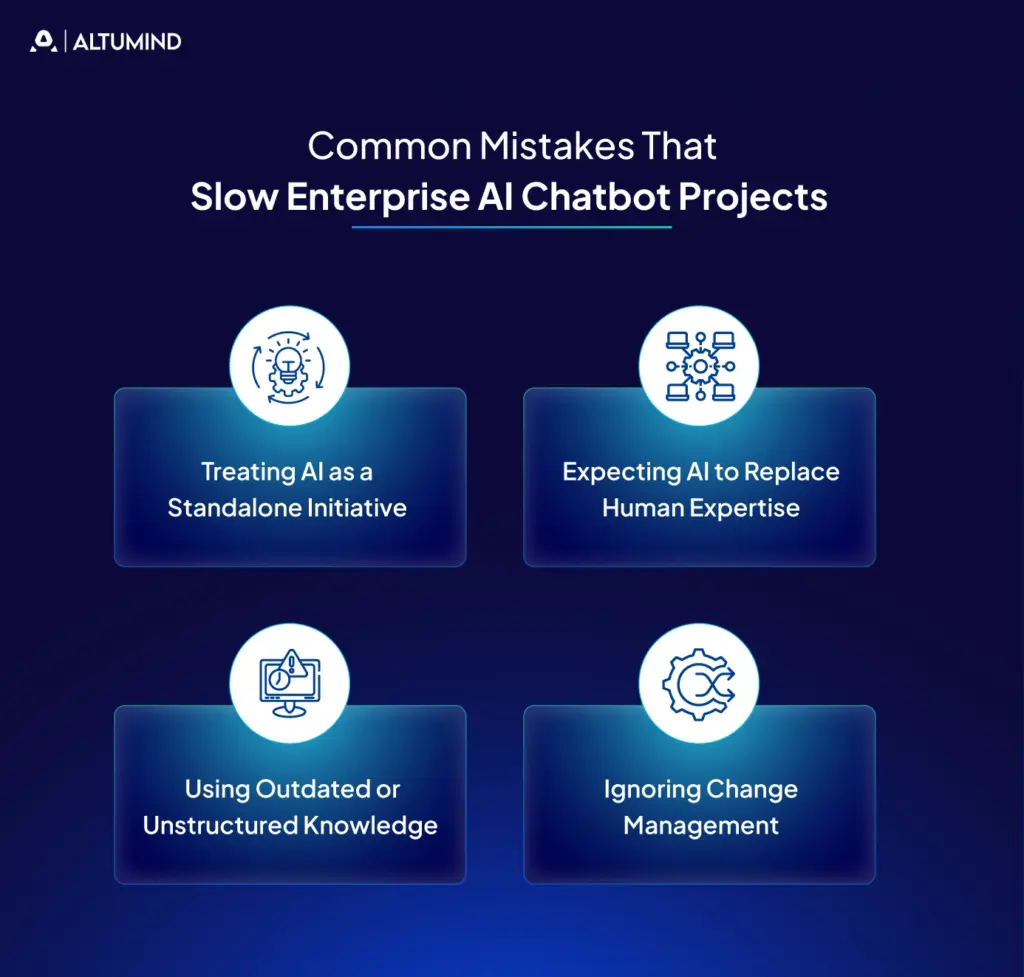
Many AI chatbot projects encounter challenges long before the technology becomes the problem. In most cases, delays happen because planning decisions were rushed or important business considerations were overlooked.
Understanding these common mistakes early helps organizations reduce implementation risks and improve long-term outcomes.
1. Treating AI as a Standalone Initiative
Enterprise AI performs best when it becomes part of the broader business ecosystem rather than an isolated technology project.
A chatbot introduced without considering existing workflows often creates duplicate processes instead of simplifying them. Employees may continue using existing methods while the chatbot remains underutilized.
Successful implementations position conversational AI as an extension of existing operations by connecting it with business applications, internal knowledge, approval workflows, and customer support processes.
2. Expecting AI to Replace Human Expertise
Enterprise chatbots can automate repetitive interactions and surface relevant information quickly, but they cannot replace professional judgment in every situation.
Complex customer cases, policy exceptions, strategic decisions, and sensitive conversations still require human involvement.
The most effective chatbot strategies define clear escalation paths where AI manages routine requests while experienced staff handle situations requiring deeper expertise.
This balance improves efficiency without compromising customer experience or operational quality.
3. Using Outdated or Unstructured Knowledge
The quality of chatbot responses depends heavily on the quality of enterprise knowledge.
Many organizations discover that documentation has accumulated over several years across multiple locations, including:
- Internal wikis.
- Shared drives.
- PDF documents.
- Product manuals.
- Email archives.
- Department-specific knowledge bases.
When information is inconsistent or outdated, the chatbot may deliver conflicting responses.
Before development begins, organizations should review:
- Knowledge accuracy.
- Content ownership.
- Update processes.
- Document version control.
- Information accessibility.
A structured knowledge management strategy often delivers long-term value beyond the chatbot itself.
4. Ignoring Change Management
Technology adoption depends as much on people as it does on software.
Employees need confidence that conversational AI supports their work rather than replacing it.
Organizations can improve adoption by:
- Explaining business objectives clearly.
- Providing practical demonstrations.
- Offering user training.
- Gathering employee feedback.
- Refining the chatbot based on real usage.
When employees understand how AI reduces repetitive work, adoption typically improves significantly.
How Can Retrieval-Augmented Generation Improve Enterprise Chatbots?
Large language models possess extensive general knowledge, but enterprise conversations usually depend on company-specific information.
This is where Retrieval-Augmented Generation (RAG) has become an important architectural approach.
Instead of relying entirely on what the language model already knows, RAG allows the chatbot to retrieve relevant information from enterprise knowledge sources before generating a response. Organizations that strengthen this knowledge repositories often complement chatbot initiatives with predictive data and analytics services to improve data quality, governance, and enterprise insights.
A typical workflow involves:
- User submits a question.
- Relevant enterprise documents are retrieved.
- The language model generates a response using retrieved information.
- The user receives a contextual, organization-specific answer.
This approach offers several advantages:
- More accurate responses.
- Reduced hallucinations.
- Easier knowledge updates.
- Improved governance.
- Better use of internal documentation.
Because enterprise content changes regularly, retrieval-based architectures often provide greater flexibility than relying solely on model retraining.
Organizations planning enterprise AI solutions increasingly evaluate RAG as part of their long-term AI architecture because it allows knowledge repositories to evolve without rebuilding the entire chatbot solution.
Should Enterprises Build Custom AI Chatbots Or Use Existing Platforms?
There is no universal answer. The right approach depends on business complexity, integration requirements, governance expectations, and future scalability.
Existing AI Platforms
Commercial chatbot platforms generally offer:
- Faster implementation.
- Lower initial investment.
- Pre-built integrations.
- Managed infrastructure.
- Built-in security capabilities.
These solutions often work well for organizations with standardized requirements and straightforward conversational workflows.
Custom AI Chatbot Development
Custom development becomes more attractive when organizations require the following:
- Complex enterprise integrations.
- Industry-specific workflows.
- Advanced AI orchestration.
- Proprietary business logic.
- Custom user experiences.
- Unique compliance requirements.
Although custom development usually involves greater upfront planning, it provides considerably more flexibility as business requirements evolve. Comprehensive QA services are equally important for validating integrations, conversational accuracy, security, and overall performance before enterprise deployment.
Organizations planning broader enterprise modernization frequently evaluate custom AI development alongside application modernization and digital transformation initiatives to maintain architectural consistency across the technology landscape.
How Does AI Chatbot Development Support Digital Transformation?
Enterprise chatbots are becoming part of wider digital transformation strategies rather than isolated customer support tools.
As organizations modernize operations, conversational AI increasingly serves as a unified interface across multiple business systems.
Instead of asking employees to learn numerous applications, chatbots can provide a single conversational entry point for completing everyday tasks.
Examples include:
- Retrieving HR policies.
- Checking leave balances.
- Creating IT support tickets.
- Accessing customer information.
- Reviewing procurement status.
- Finding internal documentation.
- Launching workflow approvals.
This conversational layer simplifies user interactions while allowing existing enterprise systems to continue operating behind the scenes.
Over time, organizations often extend chatbot capabilities into workflow automation, predictive recommendations, and AI agents capable of completing more sophisticated business activities.
What Questions Should Enterprise Leaders Ask Before Starting AI Chatbot Development?
Before committing to an implementation roadmap, leadership teams should validate that planning decisions support both immediate business priorities and long-term organizational goals.
Useful questions include:
- What business metrics will define project success?
- What processes should remain human-led?
- How will knowledge be reviewed and maintained?
- Can the architecture support future AI expansion?
- How will security, governance, and compliance be managed?
- How will employees and customers interact with the chatbot?
- Which business problem delivers the highest return if automated first?
- Which existing systems should the chatbot integrate with initially?
- Is our enterprise knowledge accurate enough to support AI conversations?
- Does the implementation align with our broader digital transformation strategy?
Answering these questions early creates a stronger foundation than selecting technology based solely on feature comparisons.
Why Work With An Experienced AI Development Partner?
Enterprise AI chatbot development involves considerably more than deploying a conversational interface.
Successful implementations require expertise across:
- Enterprise architecture.
- AI solution design.
- System integration.
- Security.
- User experience.
- Knowledge management.
- Data governance.
- Change management.
- Continuous optimization.
An experienced development partner helps organizations connect these disciplines into a practical implementation roadmap. As AI chatbot deployments grow across the enterprise, many organizations also rely on managed IT services to support ongoing monitoring, maintenance, and operational continuity.
Rather than focusing exclusively on chatbot technology, experienced teams evaluate how conversational AI fits within broader enterprise operations and future technology investments.
This planning-first approach reduces implementation risk while creating solutions that remain scalable as organizational requirements continue to evolve.
Conclusion
Enterprise AI chatbot development delivers the greatest value when it begins with business strategy rather than technology selection. Organizations that define clear business objectives, prepare enterprise knowledge, establish governance, prioritize integrations, and measure meaningful business outcomes create a strong foundation for long-term success.
Conversational AI continues to evolve from answering questions to supporting enterprise workflows, improving productivity, and simplifying access to business knowledge. As adoption grows, scalable planning becomes increasingly important for maintaining security, accuracy, and operational consistency.
With more than 10 years of experience delivering enterprise technology solutions, Altumind helps organizations build AI chatbot solutions that align with business priorities and long-term digital transformation goals. If you’re planning your next AI initiative, explore Altumind’s digital product development services or connect with our team to discuss a solution tailored to your business needs.
Table of Contents
- Introduction
- Why Is Planning the Most Overlooked Stage of AI Chatbot Development?
- How Can Enterprises Build AI Chatbots That Fit Into Existing Business Operations?
- Common Mistakes That Slow Enterprise AI Chatbot Projects
- How Can Retrieval-Augmented Generation Improve Enterprise Chatbots?
- Should Enterprises Build Custom AI Chatbots Or Use Existing Platforms?
- How Does AI Chatbot Development Support Digital Transformation?
- What Questions Should Enterprise Leaders Ask Before Starting AI Chatbot Development?
- Why Work With An Experienced AI Development Partner?
- Conclusion