Custom Software Development: From Business Need to Production-Ready Solution
Table of Contents
- Introduction
- What Is Custom Software Development
- Custom vs. Off-the-Shelf Software
- The Custom Software Development Process
- Types of Custom Software Development
- Industry Expertise Drives Better Software Outcomes
- The Role of AI in Custom Software Development
- Choosing a Custom Software Development Company
- Common Challenges and How to Manage Them
- Conclusion
Off-the-shelf software solves generic problems. Custom software development addresses your specific needs. As organizations grow more complex, the gap between what standard platforms offer and what businesses actually need widens considerably.
Decision makers evaluating custom development often face the same set of questions. How long will it take? What will it cost? How do we reduce risk during the build? Which partner has the right experience for our industry?
These questions deserve clear, practical answers rather than sales-oriented reassurances. The right custom software development company brings technical depth, a structured delivery process, and genuine domain expertise to every engagement.
Gaps that often lead organizations toward custom development include:
- Existing platforms that cannot support unique business workflows or processes.
- Integration limitations that prevent systems from sharing data effectively.
- Licensing costs increase disproportionately relative to the value received from commercial platforms.
- Competitive requirements that demand differentiated digital capabilities.
- Compliance obligations that generic platforms cannot fully address.
Keep reading as we examine the full custom software development lifecycle, the role of AI in modern development, industry specific considerations, and how to select a development partner aligned with long-term business objectives.
What Is Custom Software Development
Custom software development is the process of designing, building, testing, and deploying software solutions built specifically for an organization’s requirements. Unlike commercial off-the-shelf products designed for broad audiences, custom solutions address particular workflows, data structures, and business rules that generic platforms cannot accommodate.
The scope of custom development varies considerably. Some organizations commission standalone applications serving a single function. Others undertake complex platform builds integrating with multiple existing systems across departments. Both fall under the custom software umbrella because the defining characteristic is specificity, not scale.
Custom software development serves organizations across every industry. The common thread is a business need that existing products cannot address adequately, either because the requirement is too specialized, too complex, or too strategically sensitive to delegate to a third-party platform.
| Factor | Custom Software | Off-the-Shelf Software |
|---|---|---|
| Fit to requirements | Built to specification | Requires process adaptation |
| Initial investment | Higher upfront cost | Lower initial cost |
| Long-term cost | No recurring vendor licensing fees | Recurring licensing fees |
| Competitive advantage | Proprietary capability | Available to all competitors |
| Scalability | Designed for your growth | Constrained by vendor roadmap |
| Integration | Built around your systems | Limited to vendor integrations |
Custom vs. Off-the-Shelf Software
The decision between custom development and commercial software is not simply a cost comparison. It involves evaluating strategic fit, long-term flexibility, and the degree to which available products actually address core business requirements.
When Off-the-Shelf Software Works Well
Commercial platforms serve organizations well when requirements align closely with what the product offers. Standard accounting, HR, and communication tools work effectively for most organizations because those functions follow established patterns across industries.
Off-the-shelf software also makes sense when speed of deployment matters more than perfect fit, when budget constraints make custom development difficult to justify, or when the function in question is not a source of competitive differentiation.
When Custom Development Becomes the Right Choice
Custom software development becomes the appropriate path when workflows are genuinely unique, when commercial products require significant workarounds that reduce rather than improve efficiency, or when integration requirements exceed what available products support.
Organizations with proprietary processes, specialized compliance obligations, or competitive strategies built around operational differentiation frequently discover that commercial products constrain rather than support their objectives. Custom development removes those constraints.
The decision also involves a long-term perspective. Organizations that grow significantly often discover that licensing costs on commercial software scale faster than value delivered, while custom software carries no per-user or per-module fees once built.
The Custom Software Development Process
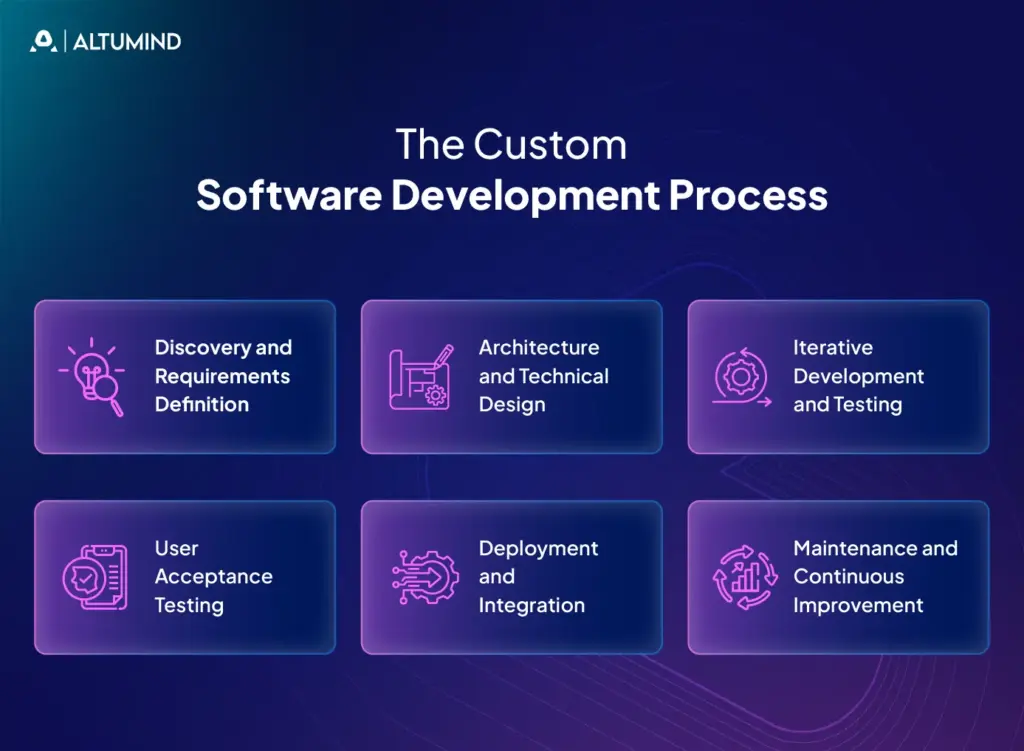
A well-structured development process reduces risk, maintains alignment between technical delivery and business objectives, and produces software that works correctly from the first production deployment. Understanding each phase helps decision makers engage more effectively with development partners.
1. Discovery and Requirements Definition
Every custom software engagement begins with a thorough discovery phase. Development teams work with stakeholders to document business requirements, map existing workflows, identify integration points, and establish success criteria before any design work begins.
Discovery is where the most important decisions get made. Requirements defined clearly at this stage prevent costly changes during development. Requirements left vague at this stage become sources of misalignment later.
Product discovery is a formal discipline within this phase, one that involves structured research into user needs, technical constraints, and business goals before committing to a development approach.
2. Architecture and Technical Design
Once requirements are documented, technical architects design the system structure. This includes selecting technology frameworks, defining data models, planning integration patterns, and establishing security and compliance controls.
Architecture decisions made during this phase shape the software’s ability to scale, perform, and evolve over time. Organizations should expect their development partner to explain architectural recommendations in business terms, not just technical ones. Effective digital product development for business leaders always includes architecture decisions that non-technical stakeholders can evaluate and validate.
3. Iterative Development and Testing
Custom software development teams typically work in iterative cycles, delivering working software in stages rather than as a single completed product at the end of a long timeline. Each iteration includes development, testing, and review before the next cycle begins.
This approach surfaces issues early when they are least expensive to address. It also allows business stakeholders to validate that the software being built matches their expectations before the full system is complete.
4. User Acceptance Testing
Before deployment, intended users test the software against real business scenarios. This phase confirms that the system performs correctly in conditions that reflect actual use, not just test environments.
User acceptance testing frequently reveals usability issues that technical testing does not catch. Involving end users at this stage improves adoption outcomes after deployment.
5. Deployment and Integration
Deployment moves software from development environments into production. For custom software integrated with existing systems, this phase requires careful coordination to avoid disrupting ongoing operations.
Integration testing confirms that data flows correctly between the new software and connected systems. This validation step is particularly important for organizations with complex technology environments.
6. Maintenance and Continuous Improvement
Custom software requires ongoing maintenance after deployment. This includes security updates, performance optimization, and feature enhancements as business requirements evolve.
Organizations that plan for post-deployment maintenance from the outset manage this phase more effectively than those who treat deployment as the end of the engagement. A structured approach to mitigating risk at every stage of the digital product development lifecycle includes maintenance planning as a core component.
Types of Custom Software Development
Custom development encompasses a broad range of solution types. Understanding the categories helps organizations identify which type aligns with their specific need.
1. Web Application Development
Custom web applications run in browsers and serve users across devices without requiring local installation. They range from internal business tools to customer-facing platforms handling complex transactions.
Web applications built on modern frameworks offer high performance, strong security, and straightforward deployment across distributed teams and customer bases.
2. Mobile Application Development
Custom mobile applications deliver functionality on iOS and Android devices. Organizations build custom mobile apps when they need to extend business capabilities to field teams, serve customers through native device experiences, or leverage device features like cameras, GPS, or biometric authentication.
Cross-platform development frameworks allow organizations to build applications that run on both major mobile platforms from a single codebase, reducing development cost without sacrificing user experience.
3. Enterprise Software Development
Enterprise software addresses complex business operations at organizational scale. This includes ERP systems, supply chain platforms, workflow automation tools, and internal management systems serving large user populations with diverse roles and permissions.
Enterprise custom software often involves deep integration with existing systems, complex data models, and sophisticated access control requirements. Development timelines and investment levels reflect that complexity.
4. SaaS Product Development
Some organizations build custom software not for internal use but as products they sell to customers. Software as a Service products require additional considerations around multi-tenancy, subscription billing, and continuous delivery that internal tools do not.
Organizations pursuing this path benefit from following a structured SaaS product development roadmap that addresses the full lifecycle from initial validation through scaled customer acquisition and retention.
5. API and Integration Development
Custom APIs and integration layers connect systems that were not designed to communicate with each other. As organizations accumulate multiple platforms over time, integration development becomes a significant category of custom software work.
Well-designed integration layers improve data quality, reduce manual data entry, and enable process automation across previously disconnected systems.
Industry Expertise Drives Better Software Outcomes
Custom software delivers the greatest value when it reflects the realities of a specific industry. Every sector operates with unique workflows, compliance requirements, customer expectations, and operational challenges that generic software rarely addresses effectively.
For example, healthcare organizations must balance patient care, regulatory compliance, interoperability, and data security. Altumind’s experience building Clinexia, a healthcare management platform, demonstrates how industry-focused solutions can streamline appointment scheduling, consultations, prescriptions, and clinic operations while supporting the needs of healthcare professionals.
The same principle applies across other sectors. Retail businesses often require real-time inventory visibility and omnichannel experiences. Financial organizations prioritize security, auditability, and transaction accuracy. Manufacturing companies depend on production monitoring, supply chain visibility, and operational efficiency. Custom software succeeds when it is built around these industry-specific requirements rather than forcing organizations to adapt their processes to the limitations of off-the-shelf platforms.
While requirements vary across industries, several factors consistently determine whether a custom software initiative delivers long-term value. Organizations should evaluate these considerations early in the planning process to reduce risk, improve adoption, and support future scalability.
1.Regulatory and Compliance Requirements
Compliance obligations differ across industries, but they influence how software is designed, deployed, and maintained. Building these requirements into the solution from the outset helps organizations avoid costly modifications later.
2.Workflow and Process Alignment
Every business operates through processes that have evolved over time. Successful custom software supports and improves those workflows rather than forcing teams to change established ways of working.
3.Integration and Interoperability
Modern organizations rely on multiple systems to manage operations. Custom software should connect seamlessly with existing platforms to create a consistent flow of information across the business.
4.Security and Data Protection
As organizations collect and manage larger volumes of data, security becomes a critical consideration. Strong access controls, encryption, monitoring, and governance practices help protect sensitive information and maintain trust.
The Role of AI in Custom Software Development
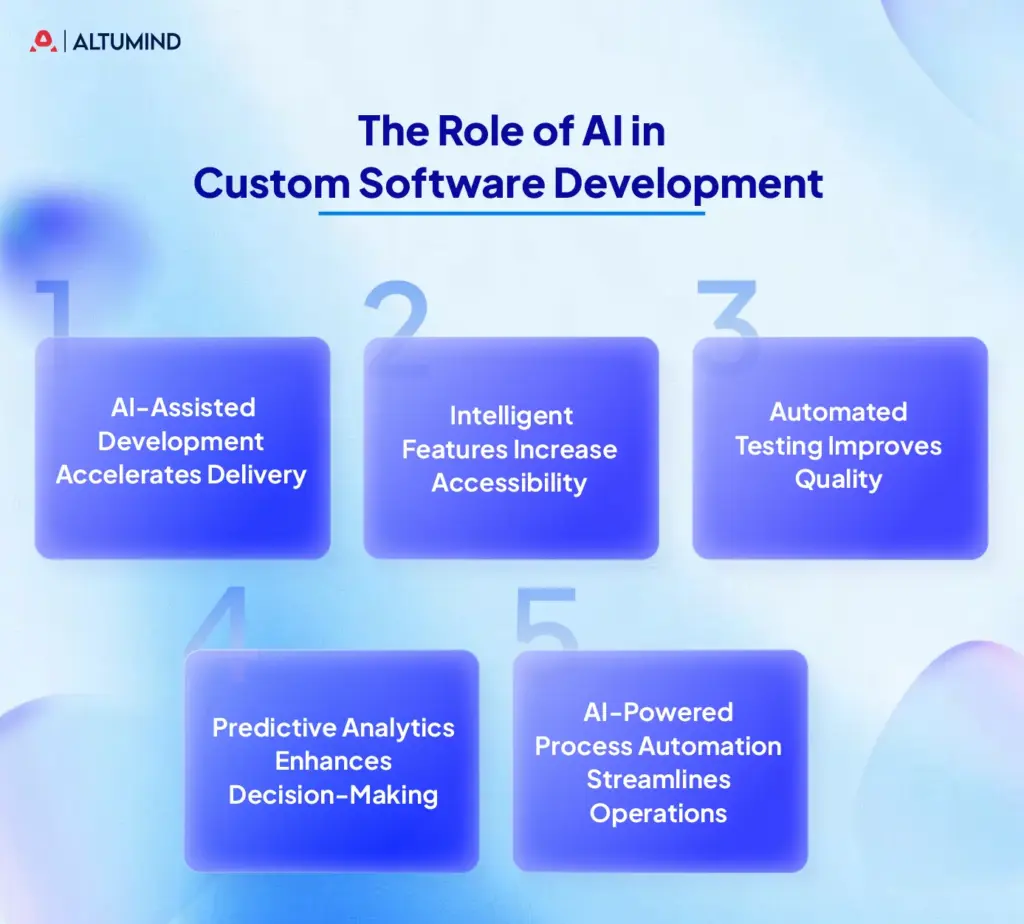
Artificial intelligence is changing how custom software gets built, what it can do, and how quickly development teams can deliver production-ready solutions.
1. AI-Assisted Development Accelerates Delivery
Development teams now use AI coding tools to generate code, identify bugs, and suggest improvements during the development process. These tools do not replace developer judgment, but they do accelerate routine tasks, allowing teams to focus skilled attention on complex architectural and business logic decisions.
2. Intelligent Features Increase Accessibility
AI capabilities that previously required specialized machine learning teams can now be integrated into custom software through APIs and pre-built models. Custom applications can incorporate natural language processing, document analysis, predictive recommendations, and anomaly detection without requiring development teams to build these capabilities from scratch.
3. Automated Testing Improves Quality
AI-driven testing tools can generate test cases, identify edge conditions, and analyze test coverage in ways that manual testing approaches cannot match in efficiency. Custom software development teams using these tools deliver higher-quality software with fewer post-deployment defects.
4. Predictive Analytics Enhances Decision-Making
Custom software increasingly incorporates predictive analytics capabilities that help organizations anticipate outcomes rather than simply reporting on historical activity. Healthcare platforms predict patient risk. Operations software identifies supply chain disruptions before they occur. Financial systems flag transactions requiring review before processing completes.
5. AI-Powered Process Automation Streamlines Operations
Custom software can incorporate intelligent automation that handles routine decision-making within defined parameters, escalating to human review only when situations fall outside established boundaries. This capability reduces manual processing volume while maintaining appropriate oversight for complex or high-stakes decisions.
Choosing a Custom Software Development Company
Selecting the right development partner is one of the most consequential decisions in a custom software project. The partner’s experience, methodology, and communication practices shape outcomes as significantly as the technical approach.
1. Relevant Industry Experience
Development teams with experience in your industry understand regulatory requirements, common integration patterns, and user expectations that general experience does not provide. A custom healthcare software development company with clinical implementation history brings different value than a general development firm working in healthcare for the first time.
Request case studies and references specific to your industry rather than accepting general portfolio evidence.
2. Defined Development Methodology
Established development partners articulate their methodology clearly. They explain how requirements get documented, how iterations are structured, how testing is conducted, and how decisions get made when requirements evolve during development.
Vague answers to methodology questions often indicate process immaturity that becomes apparent during execution. Organizations reviewing potential partners may find it useful to understand how leading development firms position their capabilities, including firms featured among top app development companies in NYC.
3. Communication and Transparency Practices
Custom software development involves continuous decision-making. Partners who communicate proactively, surface issues early, and maintain clear reporting throughout the engagement reduce the risk of late-stage surprises.
Evaluate communication practices during the sales and scoping process. How a partner communicates before signing a contract predicts how they will communicate during delivery.
4. Post-Deployment Support Commitment
Custom software requires ongoing maintenance after deployment. Partners who plan for this explicitly during the engagement structure are more reliable long-term partners than those who treat deployment as a project completion milestone.
Establish clear expectations around post-deployment support, response times for critical issues, and the process for requesting enhancements before contracts are signed.
Common Challenges and How to Manage Them
Custom software development projects encounter predictable challenges. Organizations that understand these patterns in advance are better positioned to manage them effectively.
1. Scope Definition and Change Management
Requirements that seem clear at project start frequently evolve as stakeholders engage with working software and refine their understanding of what they need. Managing this evolution without allowing it to extend timelines indefinitely requires a formal change management process.
Well-structured engagements distinguish between changes that fall within original scope and those that represent new requirements. New requirements get evaluated for timeline and budget impact before they enter the development backlog.
2. Stakeholder Alignment Across Departments
Custom software serving multiple departments often surfaces conflicting requirements between stakeholder groups. Development teams cannot resolve these conflicts independently. Organizations need internal decision-making processes that resolve requirement disagreements before they reach development.
Identifying a clear internal product owner who has authority to make final decisions on conflicting requirements significantly improves project velocity.
3. Integration Complexity With Legacy Systems
Organizations with established technology environments frequently find that integrating new custom software with legacy systems requires more effort than initially estimated. Legacy systems often lack modern APIs, have incomplete documentation, or behave differently than expected under integration conditions.
Discovery phases that include technical assessment of existing systems surface these complexities before development begins, allowing for realistic planning.
4. Timeline and Budget Management
Custom software projects that lack clear phase-level milestones and defined scope boundaries frequently experience timeline and budget pressure. Organizations that invest in thorough discovery, clear requirements documentation, and defined change management processes significantly reduce this risk.
Conclusion
Custom software development addresses the gap between what standard platforms offer and what organizations actually need to operate effectively, serve customers well, and compete in their markets.
The process requires careful partner selection, structured requirements definition, and sustained organizational engagement throughout the development lifecycle. Healthcare organizations face additional complexity around compliance, clinical workflow integration, and data security that makes domain experience in a development partner particularly important.
AI is changing what custom software can do and how quickly development teams can deliver it. Organizations that work with partners who understand both the technical and business dimensions of AI integration gain access to capabilities that were previously out of reach for standard development budgets.
Custom software creates value when it solves the right business problems. Altumind’s digital product development services help organizations across healthcare, financial services, and enterprise technology design, develop, and scale solutions built for real-world demands. By combining industry expertise with strong engineering capabilities, we deliver software that supports operational efficiency, enhances user experiences, and drives sustainable growth. Speak with our team to discuss your requirements and understand how a tailored software strategy can support your business objectives.
Table of Contents
- Introduction
- What Is Custom Software Development
- Custom vs. Off-the-Shelf Software
- The Custom Software Development Process
- Types of Custom Software Development
- Industry Expertise Drives Better Software Outcomes
- The Role of AI in Custom Software Development
- Choosing a Custom Software Development Company
- Common Challenges and How to Manage Them
- Conclusion