How Can Agentic Systems Transform Business Automation for Enterprises?
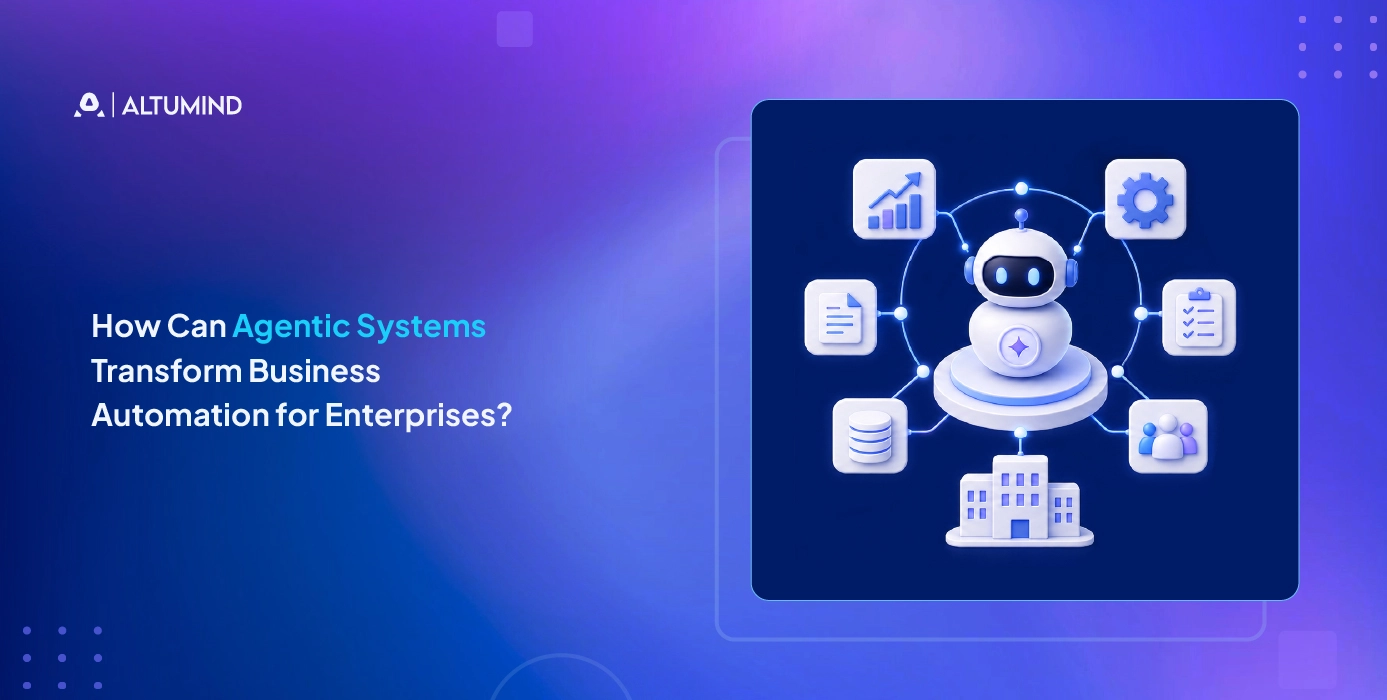
Table of Contents
- Introduction
- Understanding Agentic AI Systems
- How Does Agentic AI Change Enterprise Automation?
- Where Can Enterprises Apply Agentic AI?
- What Business Processes Can Agentic AI Automate?
- What Should Enterprises Consider Before Implementing Agentic AI?
- How Can Enterprises Measure the Business Value of Agentic AI?
- When Should Enterprises Combine Agentic AI With Other Automation Technologies?
- What Does a Practical Agentic AI Implementation Look Like?
- What Should Business Leaders Expect?
- Conclusion
Enterprise automation is moving beyond rule-based workflows and the execution of repetitive tasks. Today’s enterprises need intelligent systems that understand business context, analyze changing conditions, make decisions, coordinate complex workflows, and take appropriate actions with minimal human intervention.
For business leaders, the push toward agentic AI raises a number of strategic questions:
- • How much supervision and governance is required?
- • What business processes lend themselves to agentic automation?
- • Where do intelligent agents deliver measurable operational value?
- • How can agentic systems be integrated with legacy business applications by businesses?
- • How can organizations measure the business impact of agentic automation?
Agentic AI can help solve these challenges by linking intelligent decision-making to enterprise workflows. Agentic systems, in conjunction with data, applications, automation platforms, and defined business processes, can allow faster decisions, less manual coordination, and better operational responsiveness.
Understanding Agentic AI Systems
Agentic systems use intelligent agents that can process information, reason about goals, make choices, and take action across connected business workflows. Unlike older automation tools, these systems adapt based on context instead of following predefined rules. Altumind applies this approach to operations, customer engagement, sales intelligence, and enterprise process automation.
How Does Agentic AI Change Enterprise Automation?
Agentic systems shift certain workflows from rigid task execution to goal-driven activity. Traditional automation is linear: Receive input, apply rules and path, interface with connected systems, and adapt its next move based on what happened.
This distinction matters for enterprises because many business processes involve exceptions and contextual decisions that rigid rules cannot adequately address.
For example, an automated procurement workflow might identify a purchase request, check supplier details, compare options, validate business policies, and route the request based on its specific context. The real gain is orchestrating decisions across the entire workflow.
Process readiness is a critical prerequisite for agentic automation. A workflow should have clearly defined objectives, reliable data, established ownership, appropriate system access, and measurable outcomes before autonomous decision-making is introduced. Without these foundations, agentic capabilities can increase operational complexity rather than improve it.
Businesses can also layer agentic capabilities on top of their existing automation infrastructure. This allows rule-based automation, robotic process automation, machine learning, and intelligent agents to perform complementary roles within the same operating model.
Where Can Enterprises Apply Agentic AI?
The strongest use cases for agentic AI systems typically involve multiple steps, contextual decisions, and interaction with business systems. For digital commerce teams addressing the challenges of e-commerce, agentic systems can also help coordinate customer, pricing, inventory, and operational workflows. The following use cases illustrate where agentic systems can support enterprise workflows.
| Business area | What agentic systems can do | Why it matters |
|---|---|---|
| Operations | Coordinate multi-step workflows. | Reduce manual coordination. |
| Sales | Analyze signals and recommend next steps. | Support faster sales response. |
| Customer service | Interpret requests and coordinate resolutions. | Deliver more consistent service. |
| Finance | Review transactions and route exceptions. | Strengthen process control. |
| Supply chain | Monitor conditions and initiate actions. | Support faster operational response. |
| Marketing | Adapt campaigns based on customer behavior. | Improve relevance and engagement. |
| IT operations | Detect issues and coordinate responses. | Support faster incident handling. |
Altumind’s AI automation services already cover conversational interfaces, robotic process automation, personalization, predictive analytics, and agentic technology. The next step is to connect these capabilities to actual business goals and enterprise workflows.
Take customer-facing operations as an example. Agentic systems can work alongside conversational tools and omnichannel workflows. If businesses wants to improve customer service with omnichannel automation, intelligent agents can interpret what customers need, pull relevant information, trigger workflow actions, and loop in human teams when situations require judgment.
The business case becomes stronger when agent actions are tied to measurable outcomes. Key metrics may include processing time, resolution rates, conversion rates, cost per transaction, and team productivity.
What Business Processes Can Agentic AI Automate?
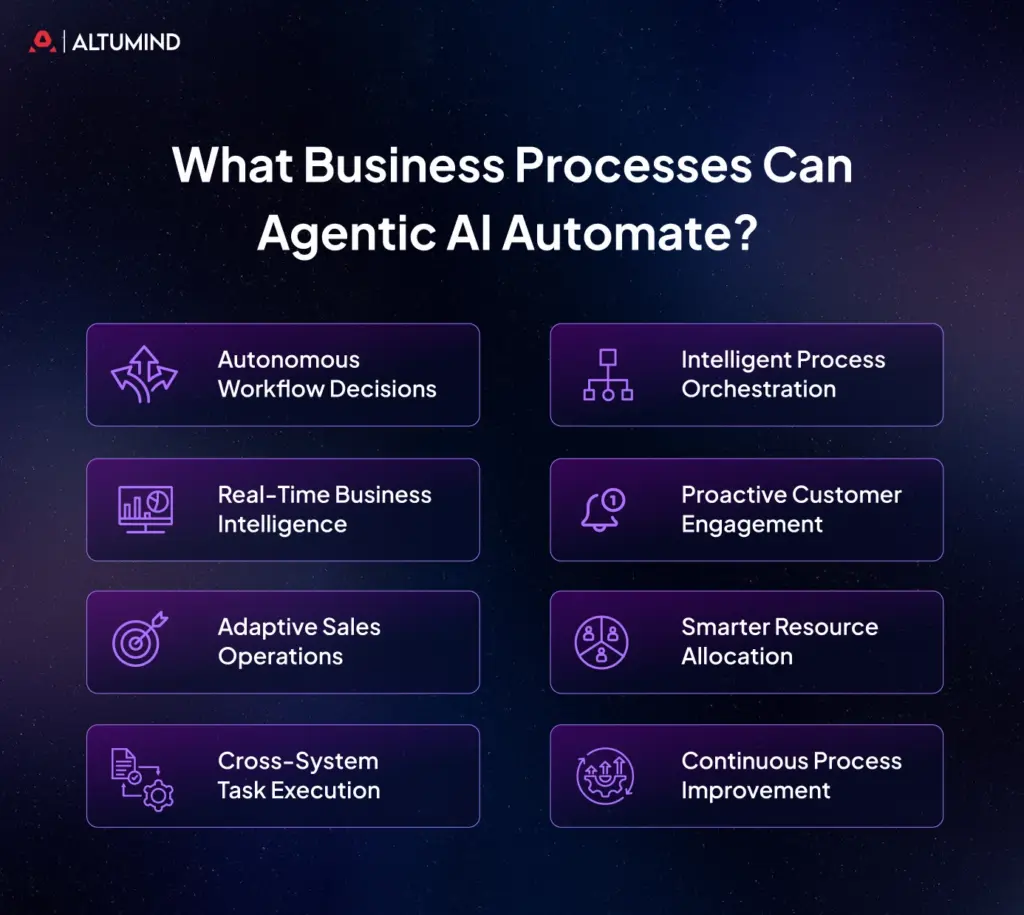
Agentic systems deliver maximum impact when a business process spans multiple systems, involves changing conditions, and requires context-based decisions. Instead of automating one isolated task, intelligent agents coordinate several actions toward a defined business goal.
1. Autonomous Workflow Decisions
Intelligent agents can evaluate incoming information, apply business context, and determine the next step in a workflow. For example, an agent might review a request, check relevant records, flag exceptions, and route it to the appropriate team or system.
This can significantly reduce the manual coordination typically required for approvals, service requests, procurement, and internal operations.
2. Intelligent Process Orchestration
Enterprise processes often cut across customer relationship management, enterprise resource planning, customer support, analytics, and other platforms. Agentic systems can coordinate actions across these systems based on the objective and current workflow state.
This is particularly valuable when automation needs to extend beyond a single application. The agent can initiate one action, evaluate the outcome, and decide what to do next. It does not have to follow a rigid sequence.
- 3. Real-Time Business Intelligence
Agentic systems can merge business data with operational context to accelerate decision-making. An agent can track sales activity, inventory signals, customer behavior, or performance metrics and flag issues that need attention.
Altumind’s data and analytics capabilities support this model by connecting predictive insights with operational workflows. The value comes when intelligence leads to action instead of remaining as information on the dashboard.
4. Proactive Customer Engagement
Customer-facing agents can analyze interaction histories, understand customer intent, and initiate relevant actions. For example, an agent might detect a service issue, retrieve account information, suggest a response, and launch a resolution workflow.
This approach complements conversational systems and personalization engines while keeping humans in the loop for complex or sensitive interactions.
- 5. Adaptive Sales Operations
Sales teams handle massive amounts of customer signals, follow-ups, account data, and pipeline activity. Agentic systems can monitor these signals and recommend or initiate appropriate actions based on defined business rules and objectives.
For instance, an agent could spot a change in customer activity, review account context, prepare a follow-up task, and update the relevant customer record. This frees sales professionals to focus on building relationships and making higher-value strategic decisions. For SaaS organizations focused on B2B SaaS growth, these capabilities can also support account prioritization, follow-up workflows, and pipeline management.
- 6. Smarter Resource Allocation
Agentic systems can help businesses respond to shifting demand by assessing available resources against current needs. In operations, this might involve workload distribution, inventory decisions, scheduling, or prioritization.
The key is not just automating resource assignment. The system needs to weigh constraints, business priorities, available data, and escalation conditions before acting.
7. Cross-System Task Execution
Many enterprise workflows become bogged down because employees manually move information between systems. Intelligent agents can execute actions across connected applications when appropriate permissions and controls are in place.
For example, an agent could receive a business request, retrieve information from an enterprise resource planning system, validate relevant customer data, update a workflow platform, and notify the responsible team. This enables coordinated execution across multiple systems with minimal manual intervention.
- 8. Continuous Process Improvement
Agentic systems can also support ongoing process refinement by analyzing workflow outcomes and identifying recurring bottlenecks, exceptions, or unnecessary steps.
However, autonomous modification of business processes should not occur without appropriate governance. A practical approach is to let intelligent systems identify improvement opportunities while designated business owners approve significant process changes.
The most effective implementations combine agentic technology with human oversight, reliable enterprise data, clear process ownership, and measurable business objectives. This creates a controlled environment where intelligent agents handle appropriate tasks while people stay accountable for judgment-intensive decisions.
What Should Enterprises Consider Before Implementing Agentic AI?
Agentic systems should be introduced to address clearly defined business objectives rather than adopted solely for technological novelty. Enterprises need to evaluate process maturity, data quality, system integration, governance, and human oversight before handing over autonomous actions to intelligent agents.
A practical implementation assessment should cover these areas.
- • Decision boundaries: Which actions can happen automatically?
- • Data quality: Can the agent access accurate and timely information?
- • Human oversight: When should an employee review or approve an action?
- • Performance measurement: Which business metrics will determine success?
- • Process complexity: Is the workflow suitable for contextual decision-making?
- • System connectivity: Can it interact with the required enterprise applications?
Organizations can place too much emphasis on the technology while overlooking the operating environment required to support it.
How Can Enterprises Measure the Business Value of Agentic AI?
A business should measure the business value of agentic systems through operational and financial outcomes. Establish a baseline before deployment and track measurable changes after implementation.
| Metric | What it can indicate |
|---|---|
| Processing time | Speed of workflow completion |
| Manual effort | Reduction in repetitive employee activity |
| Error rate | Change in process accuracy |
| Resolution time | Improvement in service operations |
| Cost per transaction | Operational efficiency |
| Conversion rate | Commercial impact |
| Exception rate | Process quality and automation maturity |
| Employee productivity | Time redirected toward higher-value work |
The right measurement framework depends on the process. A customer service agent might be assessed through resolution time and escalation rates. A finance workflow might focus on processing costs, exceptions, and accuracy.
Here is an important distinction: Automation volume versus business value. Automating hundreds of low-value tasks may produce less impact than automating a smaller number of complex workflows that consume significant employee time or directly affect customers.
Also factor in operating costs, integration expenses, monitoring requirements, and human review. This gives businesses a realistic picture of the financial value created.
When Should Enterprises Combine Agentic AI With Other Automation Technologies?
Agentic systems do not need to replace existing automation. In many enterprise environments, the strongest architecture combines intelligent agents with robotic process automation, application programming interfaces, workflow engines, predictive analytics, and traditional business rules.
| Technology | Best suited for |
|---|---|
| Robotic process automation (RPA) | Structured, repetitive system actions |
| Business rules | Predictable decisions with fixed conditions |
| Machine learning | Pattern recognition and prediction |
| Generative AI | Content generation and language-based tasks |
| Agentic AI | Contextual decisions and multi-step actions |
| Workflow platforms | Process routing and orchestration |
This distinction is especially relevant when comparing agentic systems versus generative systems. Generative systems primarily create or interpret content. Agentic systems add planning, decision-making, tool interaction, and action execution within a defined objective.
A hybrid model is often more practical than trying to make one technology responsible for an entire workflow. For example, predictive analytics could identify a demand change. An intelligent agent could determine the appropriate response. An enterprise workflow could route the action, and a robotic process automation could complete a repetitive system update.
What Does a Practical Agentic AI Implementation Look Like?
A practical implementation usually starts with one clearly defined workflow. Altumind’s automation approach follows a progression.
1. Start With One High-Value Workflow
Select a process with measurable business outcomes, sufficient data, and manageable complexity. Good candidates often involve repetitive coordination combined with contextual decisions.
- 2. Define Agent Responsibilities
Specify what the agent can observe, decide, and execute. Include clear limits on system access and actions.
3. Connect Enterprise Systems
Integrate the agent with the applications required to complete its assigned workflow. These may include customer relationship management, enterprise resource planning, support, analytics, or internal workflow platforms.
4. Establish Human Oversight
Not every decision should be autonomous. High-impact, sensitive, or ambiguous actions may require human approval.
5. Test Before Scaling
A controlled pilot can reveal unexpected workflow exceptions, data issues, integration gaps, and user adoption concerns before wider deployment.
6. Monitor Business Outcomes
Track both technical performance and business results. Monitoring should include accuracy, exceptions, latency, cost, adoption, and process-level outcomes.
7. Expand Based on Evidence
Once the initial workflow demonstrates measurable value, organizations can evaluate additional processes and departments.
This phased approach helps connect technology investment to actual business priorities along with measuring progress through deployment milestones.
What Should Business Leaders Expect?
Business leaders should view agentic systems as a new operating capability and not just another automation tool. Their strongest value comes from coordinating information, decisions, and actions across processes that previously relied heavily on manual effort.
For CEOs and operational leaders, this can mean greater process responsiveness and better use of employee capacity. CIOs and CTOs need to think about architecture, integration, security, governance, and scalability. CFOs should focus on measurable financial outcomes, total operating costs, and the sustainability of the business case.
The practical question is not whether every enterprise process should use agentic systems. It is whether a specific workflow has enough complexity, value, and reliable data to justify autonomous decision-making.
Altumind’s experience across automation, enterprise applications, data and analytics, and digital transformation supports this business-first approach. Agentic systems become more valuable when they operate as part of a connected enterprise technology ecosystem. They should not be an isolated capability.
Conclusion
Agentic systems can transform enterprise automation by connecting intelligent decision-making with real business processes. Their value goes beyond autonomous task execution. They can coordinate workflows, respond to changing conditions, connect enterprise systems, and support employees with context-aware actions.
For organizations considering agentic technology for business automation, the strongest starting point is a measurable business problem. That problem should be backed by reliable data, clear governance, and appropriate human oversight. Altumind helps businesses assess automation opportunities across operations, data, enterprise applications, and digital initiatives. For organizations planning this next step, our digital product development services can provide your business with necessary guidance and a technology foundation for a practical roadmap.
Table of Contents
- Introduction
- Understanding Agentic AI Systems
- How Does Agentic AI Change Enterprise Automation?
- Where Can Enterprises Apply Agentic AI?
- What Business Processes Can Agentic AI Automate?
- What Should Enterprises Consider Before Implementing Agentic AI?
- How Can Enterprises Measure the Business Value of Agentic AI?
- When Should Enterprises Combine Agentic AI With Other Automation Technologies?
- What Does a Practical Agentic AI Implementation Look Like?
- What Should Business Leaders Expect?
- Conclusion