How Agentic AI Use Cases Are Reshaping Enterprise Decision-Making
Table of Contents
- Introduction
- How Does Agentic AI Change Enterprise Decision-Making?
- Why Are Agentic AI Use Cases Becoming a Strategic Enterprise Priority?
- What Are the Most Valuable Agentic AI Use Cases Across the Enterprise?
- How Should Organizations Prioritize Agentic AI Use Cases?
- What Implementation Challenges Should Enterprises Plan For?
- How Does Agentic AI Differ From Generative AI?
- Conclusion
Enterprise leaders are under increasing pressure to make faster, data-informed decisions while balancing operational efficiency, governance, and long-term business growth. Traditional automation has improved repetitive processes, but many organizations now need intelligent systems capable of analyzing information, making context-aware decisions, and adapting to changing business conditions.
Before adopting agentic AI, business leaders often evaluate the following:
- • Which business functions can benefit the most from autonomous AI agents?
- • How can Agentic AI complement existing enterprise applications?
- • What governance and security measures are required?
- • How should organizations prioritize high-value implementation opportunities?
With over 10 years of experience delivering AI, automation, cloud, and enterprise technology solutions, Altumind works with organizations to design practical AI strategies that align with business objectives. This blog explains agentic AI use cases, how they are changing enterprise decision-making, implementation considerations that are often overlooked, and the business factors leaders should evaluate before adoption.
How Does Agentic AI Change Enterprise Decision-Making?
Agentic AI changes enterprise decision-making by moving beyond simple automation. Instead of waiting for human instructions at every step, AI agents can analyze situations, determine the next action, collaborate with other systems, and continuously adjust their decisions based on changing business conditions.
Unlike conventional AI models that generate recommendations or content, Agentic AI combines reasoning, planning, memory, and execution into a connected decision-making process.
For enterprise leaders, this means technology can actively support complex operational workflows instead of serving only as an analytical tool.
Traditional enterprise automation typically follows predefined rules.
| Traditional Automation | Agentic AI |
|---|---|
| Rule-based workflows | Goal-driven execution |
| Requires predefined logic | Adapts based on context |
| Limited decision capability | Multi-step reasoning |
| Executes assigned tasks | Plans and prioritizes actions |
| Static workflows | Continuously learns from interactions |
This distinction becomes increasingly important as organizations manage growing volumes of operational data across finance, supply chain, customer service, cybersecurity, and software engineering.
Instead of taking over human decision-making, agentic AI helps by managing repetitive decisions, coordinating tasks between different systems, and providing smart suggestions based on the latest business situations.
One practical consideration that is often underestimated is organizational readiness. Many enterprises invest heavily in AI capabilities before establishing clear ownership, governance policies, or cross-functional accountability. Without these foundations, even technically successful AI deployments may struggle to deliver sustainable business value.
As organizations modernize their technology ecosystems through digital transformation roadmap initiatives, AI becomes part of a broader strategy rather than an isolated technology investment.
Why Are Agentic AI Use Cases Becoming a Strategic Enterprise Priority?
Growing operational complexity
Modern enterprises operate across multiple cloud environments, enterprise applications, data platforms, customer channels, and third-party ecosystems. Managing these interconnected systems requires continuous coordination that often exceeds traditional workflow automation capabilities. Agentic AI helps bridge this gap by connecting data, business rules, and operational objectives into coordinated actions.Faster business decisions
Executive teams increasingly expect near-real-time insights rather than periodic reporting. Instead of manually reviewing dashboards before initiating actions, AI agents can monitor events continuously and recommend or initiate predefined responses within established governance frameworks.Better resource allocation
Many enterprise teams spend considerable time coordinating routine operational activities. Agentic AI allows these teams to concentrate on important projects while automated agents handle regular operational choices within set limits.Stronger cross-functional collaboration
Business decisions rarely involve a single department. For example, launching a new product may involve:- • Finance
- • Operations
- • Marketing
- • Supply Chain
- • Legal
- • Customer Support
What Are the Most Valuable Agentic AI Use Cases Across the Enterprise?
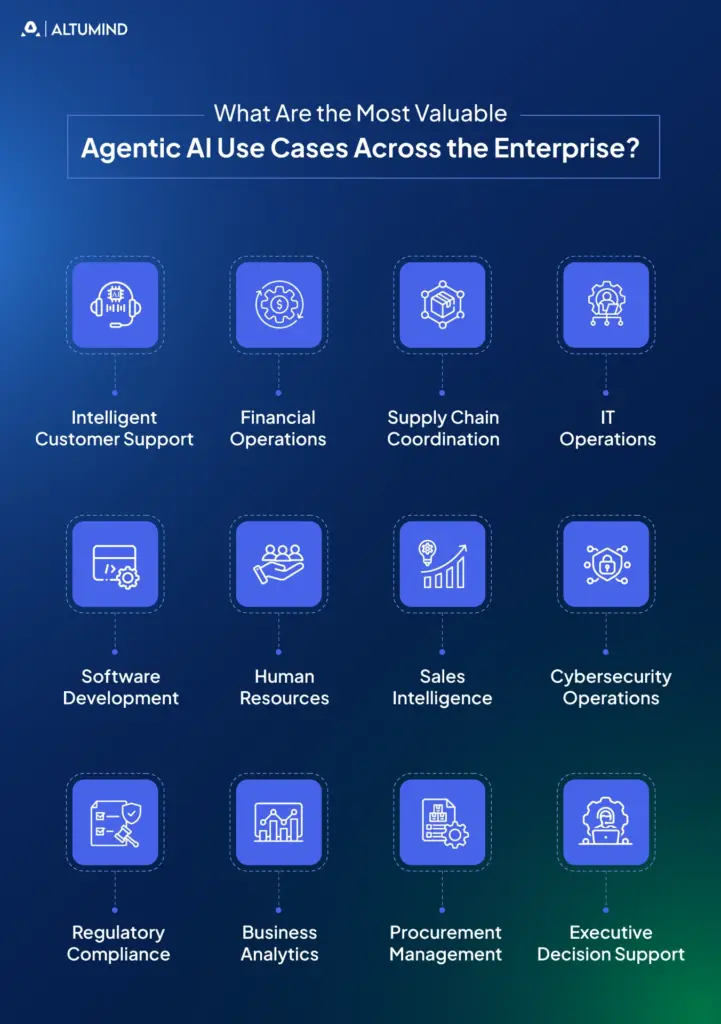
The most valuable agentic AI use cases typically involve business processes that require continuous monitoring, multi-step reasoning, collaboration across systems, and timely decision-making. Rather than replacing employees, AI agents help enterprise teams work more efficiently by handling repetitive analysis and coordinating operational activities.
Below are some of the enterprise functions where organizations are seeing the greatest potential.
Intelligent Customer Support
AI agents can understand customer context, retrieve relevant information, resolve common issues, escalate complex cases, and continuously improve future interactions through organizational knowledge.
Unlike traditional chatbots, these agents maintain context throughout the customer journey and coordinate with CRM, billing, and support platforms.
Organizations evaluating conversational AI may also benefit from understanding how AI wrapper technologies simplify the integration of multiple AI models into enterprise workflows through a unified architecture:
Financial Operations
Finance teams can use Agentic AI to monitor transactions, identify unusual spending patterns, assist with financial forecasting, coordinate approvals, and support compliance reporting across multiple systems.
Rather than generating static financial reports, AI agents help finance leaders monitor changing business conditions continuously.
Supply Chain Coordination
Supply chain environments generate enormous volumes of operational data from suppliers, warehouses, logistics providers, inventory systems, and demand forecasts.
Agentic AI helps coordinate these interconnected activities by:
- • Monitoring inventory changes.
- • Identifying potential disruptions.
- • Recommending procurement adjustments.
- • Prioritizing logistics decisions.
- • Supporting demand planning.
This allows operations teams to make informed decisions based on current business conditions instead of relying solely on periodic planning cycles.
IT Operations
Enterprise IT environments generate thousands of alerts every day.
Agentic AI assists IT teams by correlating events, identifying probable root causes, recommending remediation steps, and coordinating responses across infrastructure, cloud platforms, monitoring systems, and security tools.
Instead of responding individually to every alert, IT teams can prioritize issues based on business impact.
Software Development
Development teams increasingly use Agentic AI throughout the software lifecycle.
AI agents can assist with:
- Requirement analysis
- • Code generation
- • Documentation
- • Automated testing
- • Deployment planning
- • Performance monitoring
When combined with custom software development, Agentic AI supports faster development cycles while maintaining governance, quality standards, and long-term maintainability.
Human Resources
HR teams manage recruitment, onboarding, workforce planning, employee engagement, performance management, and policy compliance. These responsibilities often involve multiple systems and repetitive administrative activities.
Agentic AI can coordinate hiring workflows, screen applications against predefined criteria, schedule interviews, answer employee questions, recommend learning paths, and monitor workforce trends.
Rather than replacing HR professionals, AI agents reduce administrative effort and provide managers with timely workforce insights for informed decision-making.
A practical consideration that is often underestimated is change management. Employees are more likely to adopt AI-supported processes when organizations clearly define how AI assists decision-making while keeping people responsible for final employment decisions.
Sales Intelligence
Sales organizations rely on timely information to identify opportunities, prioritize prospects, and improve customer engagement.
Agentic AI continuously evaluates CRM data, customer interactions, buying signals, and market activity to recommend the next best actions for sales teams.
For example, an AI agent can:
- • Prioritize high-value leads.
- • Recommend personalized outreach.
- • Schedule follow-up activities.
- • Monitor deal progression.
- • Alert sales managers to stalled opportunities.
Instead of reviewing multiple dashboards manually, sales leaders receive contextual recommendations that support faster pipeline management.
Cybersecurity Operations
Modern cybersecurity requires continuous monitoring across endpoints, cloud environments, applications, and networks.
Agentic AI strengthens security operations by correlating alerts from multiple security tools, identifying suspicious behavior, assessing potential business impact, and recommending appropriate response actions.
Enterprise security teams can use AI agents to:
- • Investigate security alerts.
- • Prioritize incidents.
- • Coordinate response workflows.
- • Document investigation activities.
- • Support compliance reporting.
Since cyber threats continue to evolve, AI agents provide continuous monitoring while allowing security professionals to focus on higher-value investigations.
Regulatory Compliance
Compliance teams often work with changing regulations, internal policies, audit requirements, and documentation standards.
Rather than treating compliance as a periodic exercise, Agentic AI supports continuous monitoring of regulatory obligations across business operations.
Organizations evaluating governance frameworks may also find value in understanding the influence of AI in compliance, particularly as AI becomes part of enterprise risk management and operational oversight.
What many organizations overlook is that governance should be planned before deploying autonomous AI agents. Clear approval workflows, audit trails, human oversight, and accountability structures are essential for maintaining trust across regulated business environments.
Business Analytics
Enterprise analytics has traditionally focused on producing dashboards and historical reports.
Agentic AI moves beyond descriptive analytics by continuously interpreting data, identifying business trends, recommending actions, and coordinating responses with operational systems.
For example, an AI agent may detect declining customer engagement, investigate contributing factors across marketing and sales platforms, recommend corrective actions, and notify the appropriate business teams.
When combined with predictive data analytics services, organizations gain a more proactive decision-support capability that connects insights directly with business execution.
Procurement Management
Procurement teams balance supplier performance, contract obligations, inventory requirements, pricing, and operational demand.
Agentic AI assists procurement by evaluating supplier performance, monitoring contract milestones, recommending vendor selections, identifying procurement risks, and coordinating approval workflows.
Rather than replacing procurement professionals, AI agents reduce administrative effort while improving visibility across purchasing activities.
This becomes increasingly valuable for global organizations managing hundreds of suppliers across multiple business units.
Executive Decision Support
Senior executives rarely make decisions based on a single dataset.
Strategic decisions often require information from finance, operations, sales, customer experience, manufacturing, and market intelligence.
Agentic AI brings these inputs together by:
- Monitoring enterprise KPIs.
- • Identifying emerging business trends.
- • Highlighting operational dependencies.
- • Simulating possible business outcomes.
- • Recommending priority actions.
Instead of replacing executive judgment, AI agents provide contextual intelligence that helps leadership teams evaluate opportunities with greater confidence.
How Should Organizations Prioritize Agentic AI Use Cases?
Organizations should prioritize Agentic AI use cases by focusing on business value, process maturity, governance readiness, and measurable outcomes rather than selecting projects based solely on technical complexity.
A structured evaluation framework helps leadership teams identify where autonomous AI can create meaningful operational improvements.
| Evaluation Area | Key Questions |
|---|---|
| Business Value | Will this use case improve revenue, customer experience, efficiency, or decision quality? |
| Process Stability | Are existing workflows clearly documented and consistently followed? |
| Data Readiness | Is accurate, governed data available across systems? |
| Integration Complexity | Which enterprise applications need to work together? |
| Governance | What approvals, audit trails, and oversight are required? |
| Risk Level | What happens if an AI agent makes an incorrect recommendation? |
| Success Metrics | How will operational improvements be measured? |
Organizations frequently achieve stronger outcomes by starting with internal operational processes before expanding Agentic AI into customer-facing functions.
Another practical consideration that is often underestimated is system integration. Even highly capable AI agents cannot deliver meaningful business outcomes if enterprise applications remain disconnected or data quality varies across departments.
This is why many enterprises combine Agentic AI initiatives with broader enterprise IT solutions and modernization programs to establish a scalable technology foundation.
What Implementation Challenges Should Enterprises Plan For?
- Establishing clear business objectives before selecting AI technologies.
- • Defining decision boundaries for autonomous AI agents.
- • Maintaining human oversight for high-impact business decisions.
- • Integrating AI with existing enterprise applications.
- • Protecting sensitive business and customer data.
- • Monitoring AI performance through measurable KPIs.
- • Building cross-functional collaboration between business and technology teams.
How Does Agentic AI Differ From Generative AI?
Agentic AI and generative AI serve different business purposes. Generative AI focuses on creating content such as text, code, images, or summaries based on user prompts. Agentic AI extends these capabilities by planning tasks, making decisions, interacting with enterprise systems, and executing multi-step workflows with defined business objectives.
Organizations evaluating enterprise AI strategies should understand how agentic AI differs from generative AI before selecting technologies that align with their operational requirements.
Conclusion
As enterprises continue modernizing business operations, agentic AI use cases are shifting from isolated automation projects to intelligent systems that support faster, context-aware decision-making across departments. Long-term success depends on selecting the right use cases, establishing strong governance, and integrating AI into existing business processes.
With more than a decade of experience delivering enterprise technology solutions, Altumind helps organizations implement AI strategies that align with operational goals and future growth. Businesses looking to expand their AI capabilities can also consider AI automation services as part of a structured enterprise transformation strategy.
Table of Contents
- Introduction
- How Does Agentic AI Change Enterprise Decision-Making?
- Why Are Agentic AI Use Cases Becoming a Strategic Enterprise Priority?
- What Are the Most Valuable Agentic AI Use Cases Across the Enterprise?
- How Should Organizations Prioritize Agentic AI Use Cases?
- What Implementation Challenges Should Enterprises Plan For?
- How Does Agentic AI Differ From Generative AI?
- Conclusion