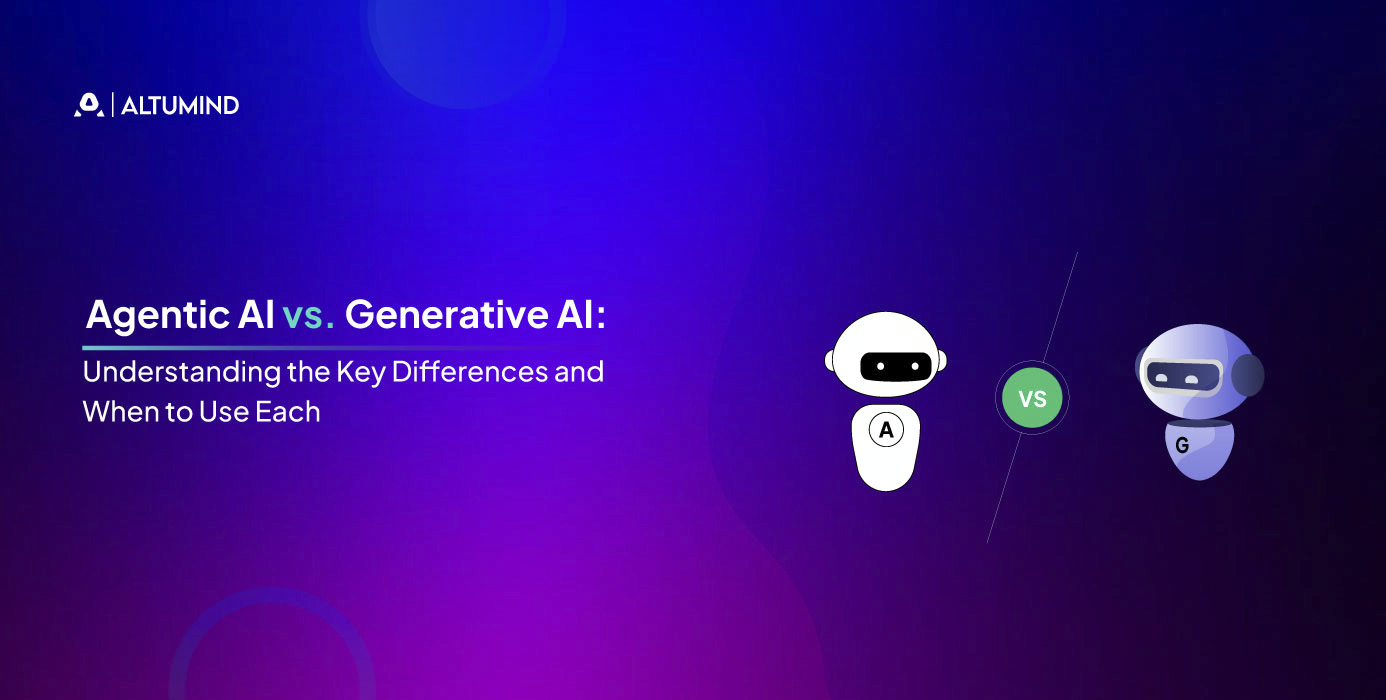
Agentic AI vs. Generative AI: Understanding the Key Differences and When to Use Each
Your business may be ready for AI, but the real impact depends on choosing the right approach. Agentic AI and generative AI serve different purposes, require different strategies, and deliver different outcomes. A clear understanding helps leaders make practical, ROI-driven decisions rather than adding unnecessary complexity.
When teams misalign AI capabilities with business priorities, it often leads to the following:
- Using generative AI where autonomous decision-making would add more value.
- Applying agentic AI to tasks that need simpler, content-focused solutions.
- Overengineering systems when a lean implementation would perform better.
- Missing opportunities to combine both approaches for stronger results.
- Investing in AI without defined outcomes or measurable success criteria.
A focused strategy starts with understanding how agentic AI vs. generative AI differ in capability, use cases, and implementation. These technologies are not competing options. Keep reading as we examine the fundamental differences between agentic and generative AI.
Understanding Generative AI
Generative AI creates new content, including text, images, code, audio, and video, based on patterns learned from training data. These systems generate outputs in response to prompts without making autonomous decisions or taking actions beyond content creation.
How Generative AI Works
Generative AI systems learn statistical patterns from massive datasets and then use those patterns to create novel content matching learned distributions. Large language models like GPT-4 predict likely next words based on context while image generators like DALL-E or Midjourney create visuals matching textual descriptions.
Core mechanisms include the following:
- Pattern Learning: Training on billions of examples to understand content structures and relationships.
- Probabilistic Generation: Creating outputs by predicting most likely continuations given inputs.
- Context Understanding: Interpreting prompts to generate relevant, coherent responses.
- Multi-Modal Capabilities: Processing and generating across different content types, like text and images.
- Fine-Tuning: Adapting general models to specific domains or styles through additional training.
Generative models excel at tasks requiring content creation, transformation, or augmentation. They respond to explicit instructions but do not initiate actions independently or handle strategic decisions.
Common Generative AI Applications
Organizations deploy generative AI across diverse functions where content creation, analysis, or transformation provides value.
Typical applications include the following:
- Content Generation: Creating marketing copy, product descriptions, blog posts, or social media content.
- Code Assistance: Generating code snippets, suggesting completions, or explaining technical concepts.
- Customer Support: Answering questions, providing information, or drafting response templates.
- Data Analysis: Summarizing reports, extracting insights, or explaining complex information.
- Creative Work: Generating images, music, video concepts, or design variations.
- Language Translation: Converting content between languages while maintaining meaning and tone.
- Personalization: Adapting content to individual preferences, contexts, or requirements.
Generative AI strengths lie in augmenting human capabilities through rapid content creation, analysis assistance, and creative exploration rather than autonomous action or decision-making. The growing influence of AI transforms how organizations approach content-intensive workflows.
Understanding Agentic AI
Agentic AI represents systems capable of autonomous goal pursuit, decision-making, and action execution without constant human instruction. These agents perceive environments, make strategic choices, take actions toward objectives, and learn from outcomes iteratively.
How Agentic AI Works
Agentic systems combine perception, reasoning, planning, and action execution in continuous loops working toward defined goals. They evaluate situations, consider options, make decisions, execute actions, observe results, and adjust strategies based on outcomes.
Core capabilities include:
- Goal Understanding: Interpreting high-level objectives and translating them into actionable plans.
- Environmental Perception: Gathering information about current states through sensors, APIs, or data feeds.
- Strategic Planning: Determining sequences of actions most likely to achieve objectives.
- Autonomous Decision-Making: Choosing actions without requiring approval for each step.
- Tool Usage: Leveraging available resources, APIs, or capabilities to accomplish tasks.
- Feedback Integration: Learning from outcomes and adapting strategies based on success or failure.
- Multi-Step Reasoning: Breaking complex goals into manageable sub-tasks and executing them sequentially.
Agentic AI operates with varying degrees of autonomy, from semi-autonomous systems confirming major decisions with humans to fully autonomous agents executing complete workflows independently.
Common Agentic AI Applications
Organizations deploy agentic AI where autonomous workflow execution, adaptive decision-making, or continuous optimization delivers value.
Typical applications include the following:
- Process Automation: Executing complete workflows across multiple systems without human intervention.
- Intelligent Assistants: Managing calendars, coordinating meetings, or handling routine communications proactively.
- Supply Chain Optimization: Adjusting inventory levels, routing shipments, or managing supplier relationships dynamically.
- Financial Trading: Making investment decisions based on market conditions within defined parameters.
- Customer Service: Resolving issues end-to-end, including investigating problems and implementing solutions.
- IT Operations: Monitoring systems, diagnosing issues, and executing remediation actions autonomously.
- Research Assistance: Gathering information, synthesizing findings, and proposing next steps for investigations.
Agentic AI excels in scenarios requiring persistence, adaptation, multi-step execution, and goal-oriented behavior rather than simple response generation.
Agentic AI vs Generative AI: Core Differences
| Aspect | Generative AI | Agentic AI |
|---|---|---|
| Autonomy & Decision-Making | Responds to prompts; does not act independently. Humans define inputs and decide how to use outputs. | Acts autonomously; decides how to achieve goals, executes actions, and adapts without step-by-step instructions. |
| Goal Orientation vs. Task Execution | Handles single, discrete tasks like content generation or answering queries. Each task is independent. | Works toward defined goals; manages multi-step workflows and maintains context until completion. |
| Environmental Interaction | Produces outputs only; does not interact with external systems or take real-world actions. | Interacts with systems via APIs and tools, observes, acts, and updates based on outcomes. |
| Feedback & Learning | Relies on pre-trained data; limited adaptation during real-time use. | Learns from outcomes; adjusts strategies based on success or failure during execution. |
| Complexity & Control | Easier to implement and manage; risks mostly relate to output quality and accuracy. | Requires stronger governance; needs guardrails, monitoring, and control over autonomous actions. |
Generative AI Benefits and Applications
Generative AI delivers substantial value across content-intensive workflows, creative processes, and analytical tasks where rapid generation or transformation provides advantages.
Key Generative AI Benefits
Organizations adopting generative AI realize multiple strategic advantages.
Primary benefits include:
- Content Creation Speed: Generating drafts, variations, or ideas in seconds versus hours or days.
- Scale and Consistency: Producing large volumes of content while maintaining quality standards.
- Creative Exploration: Rapidly testing concepts, styles, or approaches before significant investment.
- Personalization: Customizing content for individual recipients, contexts, or preferences at scale.
- Language Capabilities: Translating, summarizing, or transforming content across languages and formats.
- Code Assistance: Accelerating development through code generation, completion, or explanation.
- Accessibility: Democratizing creative and analytical capabilities beyond specialized expertise.
These benefits prove particularly valuable in marketing, content production, software development, customer service, and creative industries where content quality and production velocity provide competitive advantages.
Marketing and Content Creation
Marketing teams leverage generative AI for campaign development, content production, and audience engagement.
Applications include:
- Campaign Copy: Generating ad variations, email content, or landing page text optimized for segments.
- Social Media: Creating posts, captions, or responses that maintain brand voice and engagement goals.
- SEO Content: Producing blog posts, articles, or guides targeting specific keywords and topics.
- Product Descriptions: Writing compelling descriptions for large catalogs at scale.
- Visual Assets: Generating images, graphics, or video concepts for campaigns and content.
- Personalization: Customizing messages based on customer data, behaviors, or preferences.
Generative AI accelerates marketing workflows while enabling testing and iteration that are difficult to achieve with purely manual approaches.
Software Development and Engineering
Development teams use generative AI for code creation, documentation, and problem-solving assistance.
Applications include:
- Code Generation: Creating function implementations, test cases, or boilerplate code from descriptions.
- Code Explanation: Understanding complex codebases through natural language descriptions.
- Bug Fixing: Suggesting solutions for errors or identifying potential issues.
- Documentation: Generating technical documentation, API references, or user guides.
- Code Review: Analyzing code for quality, security, or best practice compliance.
- Learning Assistance: Explaining concepts, patterns, or technologies to developers.
These capabilities accelerate development velocity while improving code quality and developer productivity.
Customer Service and Support
Customer service teams deploy generative AI for inquiry response, information provision, and support quality.
Applications include:
- Response Generation: Creating personalized responses to common inquiries or questions.
- Knowledge Base: Summarizing documentation or policies answering specific questions.
- Ticket Classification: Analyzing and categorizing support requests for appropriate routing.
- Response Templates: Generating starting points supports agents in customizing and personalizing.
- Multi-Language Support: Translating communications, enabling service across language barriers.
- Quality Assurance: Analyzing interactions for compliance, quality, or improvement opportunities.
Generative AI enables faster, more consistent service while allowing human agents to focus on complex or sensitive situations.
Healthcare and Medical Applications
Healthcare organizations adopt generative AI for documentation, research assistance, and patient communication.
Applications include:
- Clinical Documentation: Generating visit summaries, discharge instructions, or procedure notes.
- Patient Communication: Creating personalized education materials or appointment reminders.
- Research Assistance: Summarizing medical literature or synthesizing findings from multiple studies.
- Diagnostic Support: Analyzing symptoms or test results suggesting possible diagnoses for physician review.
- Treatment Planning: Generating treatment options based on patient conditions and medical guidelines.
The digitization of healthcare using AI demonstrates how generative capabilities improve efficiency while maintaining care quality and physician oversight.
Agentic AI Benefits and Use Cases
Agentic AI delivers value in scenarios requiring autonomous workflow execution, adaptive decision-making, and persistent goal pursuit across complex multi-step processes.
Key Agentic AI Benefits
Organizations implementing agentic systems realize distinct advantages over traditional automation or generative AI alone.
Primary benefits include:
- Autonomous Execution: Completing entire workflows without constant human supervision or instruction.
- Adaptive Problem-Solving: Adjusting approaches when encountering obstacles rather than requiring reprogramming.
- Complex Orchestration: Coordinating multiple systems, tools, or processes toward objectives.
- Continuous Operation: Working persistently toward goals across extended timeframes.
- Context Maintenance: Carrying information and state across multiple steps and interactions.
- Goal Optimization: Improving strategies over time based on outcome patterns and learning.
- Human Augmentation: Handling routine workflows, freeing humans for strategic or creative work.
These benefits prove most valuable in operations, logistics, finance, IT management, and other domains where process efficiency, consistency, and scale provide competitive advantages.
Business Process Automation
Organizations deploy agentic AI for complete workflow automation across departments and systems.
Applications include:
- Invoice Processing: Extracting data, validating information, routing approvals, and updating financial systems.
- Order Fulfillment: Managing inventory, coordinating shipping, updating customers, and handling exceptions.
- Employee Onboarding: Scheduling meetings, provisioning accounts, assigning training, and tracking completion.
- Procurement: Identifying needs, requesting quotes, comparing options, and executing purchases.
- Compliance Monitoring: Checking adherence to policies, flagging violations, and initiating remediation.
Agentic automation handles end-to-end processes, including decision points, exceptions, and cross-system coordination traditional automation struggles with.
IT Operations and DevOps
IT teams leverage agentic AI for system monitoring, incident response, and operational optimization.
Applications include:
- Incident Management: Detecting anomalies, diagnosing root causes, and executing fixes autonomously.
- Performance Optimization: Monitoring systems, identifying bottlenecks, and adjusting configurations.
- Security Response: Detecting threats, analyzing patterns, and implementing countermeasures.
- Capacity Planning: Predicting resource needs and proactively scaling infrastructure.
- Deployment Automation: Managing releases, monitoring rollouts, and handling rollbacks when needed.
Agentic systems reduce incident response times, improve reliability, and optimize resource utilization beyond what reactive monitoring achieves.
Financial Services and Trading
Financial organizations implement agentic AI for market analysis, portfolio management, and trading execution.
Applications include:
- Algorithmic Trading: Executing trades based on market conditions within risk parameters.
- Portfolio Rebalancing: Adjusting holdings and maintaining target allocations as markets move.
- Risk Management: Monitoring exposures and adjusting positions to mitigate identified risks.
- Fraud Detection: Analyzing transactions, identifying suspicious patterns, and blocking potential fraud.
- Customer Onboarding: Gathering information, verifying identity, assessing risk, and opening accounts.
Agentic financial systems operate at speeds and scales impossible for human traders while maintaining risk controls and compliance.
Supply Chain and Logistics
Supply chain teams deploy agentic AI for inventory optimization, route planning, and exception handling.
Applications include:
- Demand Forecasting: Predicting needs and adjusting orders to maintain optimal inventory levels.
- Route Optimization: Planning deliveries considering traffic, weather, and priorities dynamically.
- Supplier Management: Monitoring performance, handling issues, and sourcing alternatives when needed.
- Warehouse Operations: Coordinating picking, packing, and shipping and optimizing throughput.
- Exception Handling: Resolving delays, shortages, or quality issues and maintaining flow.
Agentic logistics systems adapt to real-time conditions, optimizing efficiency while handling complexity beyond static automation.
Limitations and Challenges with AI Agents
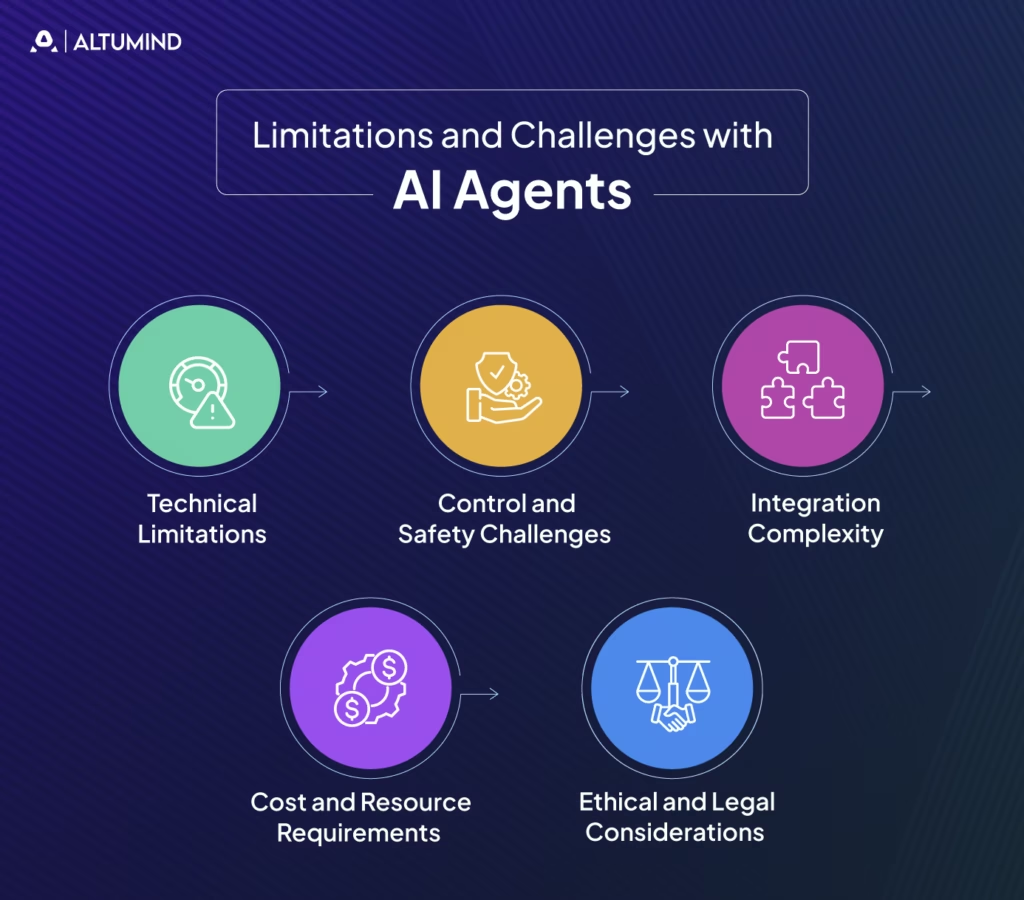
Despite significant capabilities, agentic AI faces limitations and implementation challenges organizations must understand and address for successful deployments.
Technical Limitations
Current agentic AI technology has inherent constraints affecting reliability and applicability.
Key limitations include the following:
- Reasoning Capabilities: Agents may often struggle with complex logical reasoning or causal understanding.
- Context Windows: Limited ability to maintain information across very long interactions or timeframes.
- Domain Knowledge: May lack deep expertise in specialized fields without extensive training.
- Handling Ambiguity: Struggle with unclear objectives, conflicting priorities, or vague instructions.
- Error Recovery: Don’t always recognize or recover from mistakes gracefully.
- Resource Intensity: Require significant computational resources for operation, especially at scale.
These factors indicate agentic systems work best for well-defined tasks in structured environments rather than highly ambiguous or creative scenarios.
Control and Safety Challenges
Autonomous decision-making creates governance and risk management requirements.
Challenges include:
- Unintended Actions: Agents might take unexpected actions pursuing objectives in unanticipated ways.
- Goal Misalignment: Systems may optimize for stated goals in ways misaligned with broader intentions.
- Accountability Questions: Determining responsibility when autonomous systems make poor decisions.
- Override Mechanisms: Ensuring humans can interrupt or redirect agents when necessary.
- Testing Difficulty: Challenging to anticipate all scenarios agents might encounter.
- Monitoring Requirements: Need continuous oversight to detect problematic behaviors.
Addressing these challenges requires robust governance frameworks, extensive testing, clear boundaries, and effective monitoring systems.
Integration Complexity
Implementing agentic systems across existing technology landscapes creates technical challenges.
Integration obstacles include the following:
- API Dependencies: Require reliable interfaces to systems agents must interact with.
- Authentication: Need secure access management without excessive manual authorization.
- Data Quality: Depend on accurate, complete data from source systems.
- Synchronization: Must coordinate with human workflows and other automated processes.
- Version Management: Changes to integrated systems may break agent functionality.
- Legacy Systems: Older applications may have limited integration capabilities.
Successful implementations require addressing integration systematically through well-designed architectures and change management.
Cost and Resource Requirements
Agentic AI implementations involve significant investment beyond initial development.
Resource considerations include:
- Development Costs: Building, testing, and deploying agents requires specialized expertise.
- Operational Expenses: Running agents continuously consumes computational resources.
- Maintenance Burden: Agents require ongoing monitoring, tuning, and enhancement.
- Training Investment: Teams need education to understand capabilities, limitations, and management.
- Infrastructure Upgrades: May require enhanced security, monitoring, or integration capabilities.
Organizations should evaluate the total cost of ownership, including ongoing operational expenses, when planning implementations.
Ethical and Legal Considerations
Autonomous decision-making raises ethical questions and potential legal implications.
Considerations include:
- Bias and Fairness: Agents may perpetuate or amplify biases from training data or design.
- Transparency: Explaining how agents reached decisions can prove difficult.
- Privacy: Agents processing personal data must comply with regulations.
- Liability: Legal frameworks around autonomous system decisions remain evolving.
- Employment Impact: Automation affects the workforce, requiring thoughtful transition planning.
Responsible implementation requires addressing these considerations through ethical frameworks, legal review, and stakeholder engagement.
Choosing Between Agentic and Generative AI
Selecting appropriate AI approaches requires matching capabilities to specific business needs, technical contexts, and organizational readiness rather than following trends or hype.
Decision Framework
Systematic evaluation helps determine which AI approaches fit specific use cases most effectively.
Consider these factors:
- Task Characteristics: Does the need involve creating content (generative) or executing workflows (agentic)?
- Autonomy Requirements: Should systems respond to requests or operate independently toward goals?
- Complexity Level: Simple tasks suit generative approaches while complex multi-step processes benefit from agentic capabilities.
- Risk Tolerance: Higher risk scenarios may favor generative systems with human review versus autonomous execution.
- Integration Needs: Extensive system interaction suggests agentic approaches, while standalone content generation suits generative AI.
- Scale Requirements: Repetitive workflow execution at scale benefits from agentic automation.
- Budget and Resources: Generative implementations typically cost less than agentic systems to develop and operate.
Matching technology capabilities to actual requirements produces better outcomes than deploying sophisticated solutions for simple problems or vice versa.
When to Choose Generative AI
Generative AI proves most effective in specific scenarios aligned with its strengths.
Choose generative approaches when:
- The primary need involves content creation, transformation, or analysis rather than action execution.
- Human review and editing of outputs remains practical and desirable.
- Tasks are largely independent without complex dependencies or sequencing.
- Speed and scale in content production provide competitive advantages.
- Variety and exploration matter more than optimization toward specific metrics.
- Risk of incorrect outputs remains acceptable with human oversight.
- Implementation simplicity and faster deployment provide value.
Generative AI excels at augmenting human capabilities in creative, analytical, and communication-intensive workflows.
When to Choose Agentic AI
Agentic AI delivers greatest value in scenarios requiring autonomy and persistence.
Choose agentic approaches when:
- Complete workflow automation from trigger to completion provides substantial value.
- Multi-step processes require coordination across systems or timeframes.
- Adaptive decision-making handles exceptions better than rigid rules.
- Continuous operation and goal pursuit matter more than single responses.
- Process volume makes human supervision of each step impractical.
- Optimization and learning from outcomes over time provide competitive advantages.
- Tolerance exists for autonomous decision-making within defined boundaries.
Agentic systems excel at operational efficiency, process consistency, and handling complexity at scale.
Combining Both Technologies Strategically
Rather than choosing exclusively between agentic AI vs. generative AI, organizations often benefit from combining both technologies, creating synergistic capabilities exceeding what either achieves alone.
Complementary Use Patterns
Agentic and generative AI complement each other when deployed strategically within integrated systems.
Effective combinations include:
- Agentic Orchestration with Generative Execution: Agents plan workflows and make decisions while leveraging generative AI for content creation steps within processes.
- Generative Analysis for Agentic Planning: Generative systems analyze situations and suggest options while agents make decisions and execute actions.
- Human-Agent-Generator Collaboration: Humans provide strategy, agents execute workflows, and generative AI handles content production within those workflows.
- Learning and Adaptation: Generative systems create variations while agents test them and learn which approaches work best.
These patterns leverage each technology’s strengths while mitigating individual limitations through complementary capabilities.
Implementation Examples
Real-world implementations demonstrate how combined approaches deliver superior outcomes.
Example scenarios include:
- Customer Service Automation: Agentic systems route inquiries, access customer data, and coordinate workflows while generative AI creates personalized responses, maintaining brand voice.
- Marketing Campaign Management: Agents manage campaign timing, budget allocation, and channel selection while generative systems create ad copy, visuals, and content variations.
- Software Development: Agentic orchestration manages sprint planning, task allocation, and integration workflows while generative AI assists with code creation, documentation, and testing.
- Healthcare Operations: Agents coordinate appointments, manage workflows, and handle logistics while generative systems create patient communications and documentation.
Combined implementations require thoughtful integration, ensuring technologies work harmoniously rather than creating complexity through fragmented approaches.
Conclusion
Understanding agentic AI vs. generative AI helps organizations align AI investments with real business needs. Generative AI supports content creation, analysis, and faster decision support across marketing, customer service, and development. Agentic AI focuses on autonomous execution, handling workflows, making decisions, and improving operations over time.
Each approach serves a different purpose. Generative AI delivers speed and creativity. Agentic AI drives efficiency, automation, and continuous optimization. The strongest results come from combining both, where agentic systems manage workflows and generative AI handles content and insights within those processes.
At Altumind, we deliver AI automation services that integrate both capabilities into scalable, outcome-driven solutions. We assess your business needs, implement the right mix of technologies, and build systems that improve decision-making and reduce operational effort. Ready to implement AI that delivers measurable impact? Connect with Altumind today.