How Can Retail Enterprises Build Stronger Cyber Resilience?
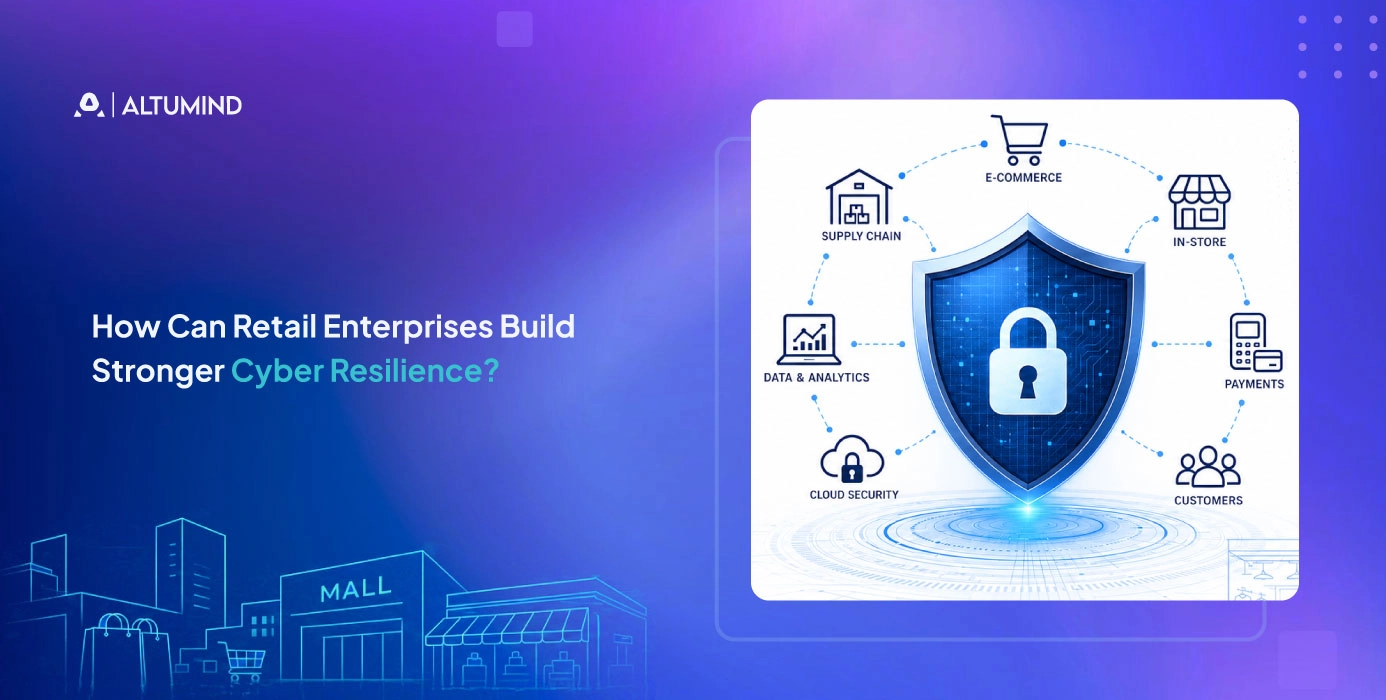
Table of Contents
- Introduction
- How Should Retail Businesses Approach Cybersecurity Across Multiple Channels?
- What Cybersecurity Controls Should Retail Businesses Prioritize?
- When Should Retail Businesses Conduct a Cybersecurity Risk Assessment?
- How Can Retail Businesses Secure Modern Applications and Digital Products?
- How Does Cybersecurity Support Business Value in Retail?
- What Should Retail Leaders Evaluate Before Investing in Cybersecurity?
- Conclusion
Retail businesses now operate across stores, e-commerce, mobile applications, payments, supply chains, cloud environments, and connected business applications. As retail environments become increasingly connected, cybersecurity has become essential to protecting customer-facing systems, payment environments, and the operational processes that support the business.
Important considerations include:
- • Protection of payment and customer data.
- • Securing connected stores and devices.
- • Third-party and SaaS access management.
- • Testing applications prior to release.
- • Cloud and data environment monitoring.
- • Establishing clear ownership and decision-making processes for security.
At Altumind, we view retail cybersecurity as an integral component of business and technology planning. This article outlines practical controls and operational practices that will assist retail businesses to enhance security while preserving customer experience, continuity, and technology investments.
How Should Retail Businesses Approach Cybersecurity Across Multiple Channels?
Retail cybersecurity should be about the whole technology ecosystem, not just the website or the payment environment. A practical approach connects identity, applications, data, cloud infrastructure, endpoints, third parties, and store operations through consistent security policies.
For retail enterprises, cybersecurity decisions also affect revenue continuity and customer experience. A security control that creates unnecessary friction at checkout, for example, can create a business problem even when it performs its security function.
A useful starting point is to map the following:
| Area | What to assess | Business value |
|---|---|---|
| Customer channels | Web, mobile, accounts, checkout | Protects customer trust |
| Payments | Payment flows and integrations | Supports secure transactions |
| Store systems | POS, devices, networks | Supports operational continuity |
| Cloud | Applications, workloads, identities | Controls access and data exposure |
| Data | Customer, product, employee, transaction data | Supports privacy and decision-making |
| Third parties | Vendors, APIs, SaaS platforms | Reduces dependency-related exposure |
What many organizations overlook is the connection between these environments. A strong security architecture should account for how data and identities move between systems, not just how each individual system is protected.
What Cybersecurity Controls Should Retail Businesses Prioritize?
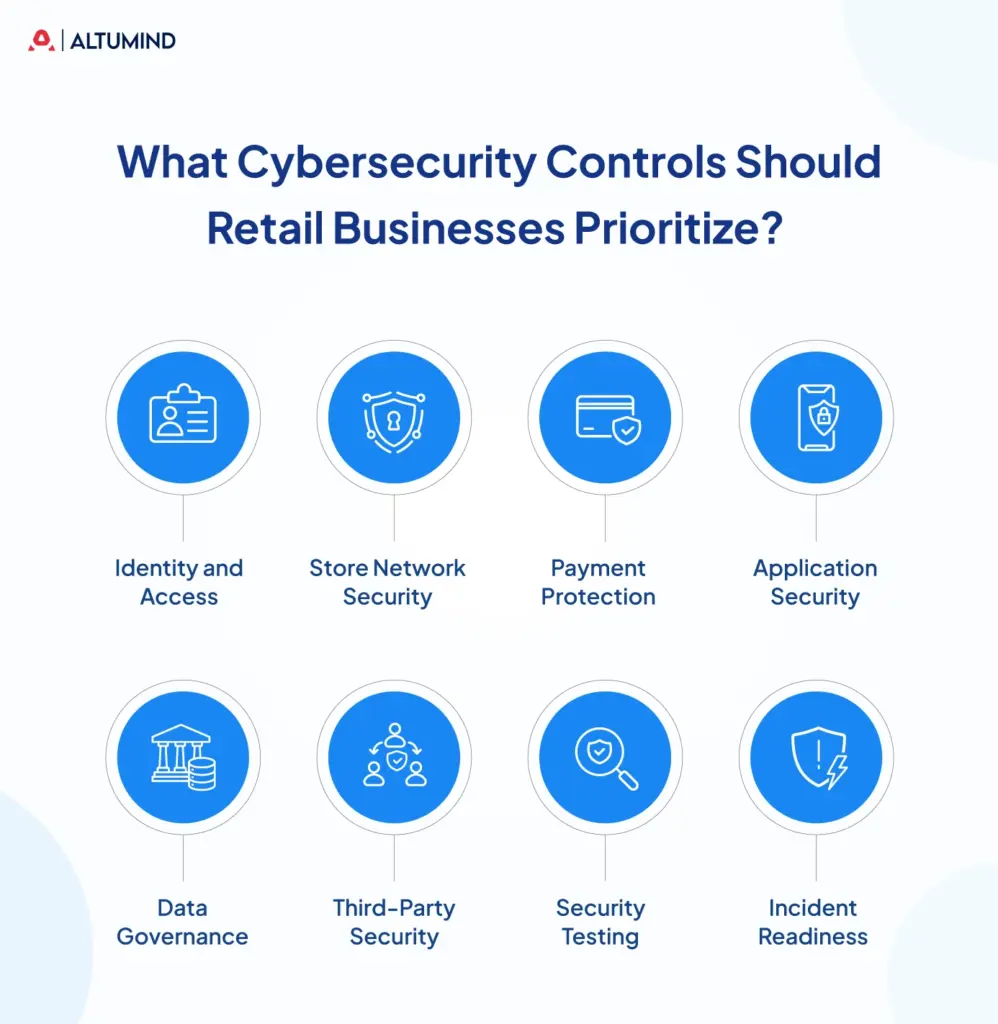
Retail businesses should prioritize controls based on business processes, data sensitivity, system dependencies, and operational impact. The following eight areas provide a practical foundation for security planning.
1. Identity and Access
Use role-based access, strong authentication, privileged-access controls, and regular access reviews. Employees, contractors, applications, and third-party users should receive only the access required for their responsibilities.
2. Store Network Security
Separate store networks and sensitive systems where appropriate. Segmentation can limit the impact of an issue affecting one environment and reduce unnecessary communication between devices.
3. Payment Protection
Payment environments require careful control over data flows, integrations, credentials, and monitoring. Security teams should understand where payment information enters the environment, where it moves, and which systems interact with it.
4. Application Security
Security should be part of software development from planning through production. Code reviews, dependency checks, vulnerability testing, and secure deployment practices can identify issues earlier.
For teams modernizing engineering workflows, AI-driven code optimization can be considered alongside secure coding practices, provided developers retain appropriate review and validation controls.
5. Data Governance
Not every dataset requires the same level of protection. Classifying customer, financial, operational, and employee information helps organizations apply appropriate access, retention, encryption, and monitoring policies.
Altumind’s predictive data & analytics services also emphasize governed data environments, privacy considerations, and connected business intelligence.
6. Third-Party Security
Retail businesses depend on payment providers, logistics platforms, SaaS applications, marketing systems, cloud services, and other vendors. Security reviews should consider vendor access, API connections, data sharing, authentication, and contractual responsibilities.
7. Security Testing
Testing should cover applications, integrations, infrastructure, performance, and security behavior. Altumind’s QA services support quality practices that can be incorporated throughout software delivery rather than limited to the final release stage.
8. Incident Readiness
Security planning should define who makes decisions when an incident affects customer-facing systems or internal operations. Teams need clear escalation paths, communication responsibilities, recovery priorities, and tested procedures.
Recovery sequencing is a practical consideration that is often underestimated. Restoring every system at once may not be the right business decision. Retail leaders should identify which systems must return first to support sales, fulfillment, customer service, and financial operations.
When Should Retail Businesses Conduct a Cybersecurity Risk Assessment?
A cybersecurity risk assessment should take place before major technology changes and at regular intervals as the environment evolves. It can help leadership connect technical findings with business priorities, rather than treating every security issue as having the same importance.
Consider an assessment when:
- • Migrating workloads to the cloud.
- • Modernizing legacy applications.
- • Adding significant third-party integrations.
- • Acquiring or integrating another business.
- • Expanding connected store infrastructure.
- • Launching a new digital commerce platform.
- • Introducing new payment or customer data systems.
The assessment should map assets, data flows, identities, dependencies, vulnerabilities, controls, and business consequences.
This is where Altumind’s broader technology capabilities can add context. For instance, repetitive operational workflows can be supported through AI automation, while appropriate access controls and monitoring should remain in place to prevent automation from bypassing established safeguards.
How Can Retail Businesses Secure Modern Applications and Digital Products?
Retail applications should be designed with security requirements from the beginning because architectural decisions made early can affect cost, performance, and maintainability later.
For new platforms, organizations should consider:
- • Identity architecture and authorization.
- • API security
- • Secrets and credential management.
- • Encryption for sensitive data.
- • Secure cloud configuration.
- • Dependency and component management.
- • Logging and security monitoring.
- • Security testing within CI/CD.
These aspects are particularly relevant when retail businesses build customer portals, mobile applications, loyalty platforms, commerce engines, or internal operational tools. Altumind’s digital product development services combine application engineering, integration, testing, and security considerations within the development lifecycle.
The same principle applies to SaaS platforms. Retail businesses using multiple SaaS products should evaluate how identities, customer information, APIs, and business processes connect across those services. This becomes particularly important as organizations expand their SaaS environments and pursue growth in B2B markets, where managing access, integrations, and data across multiple platforms becomes increasingly complex.
How Does Cybersecurity Support Business Value in Retail?
Cybersecurity creates business value when it protects the systems that support revenue, customer relationships, operational efficiency, and regulatory obligations.
The business case becomes clearer when security initiatives are connected to measurable operational outcomes:
| Cybersecurity priority | Business outcome |
|---|---|
| Identity controls | Better control over workforce and vendor access |
| Application security | Fewer avoidable defects reaching production |
| Data governance | Better control over sensitive information |
| Monitoring | Faster identification of unusual activity |
| Recovery planning | Quicker restoration of revenue-critical operations |
| Third-party controls | Better visibility into connected services |
Security should also support responsible innovation. For example, AI-driven personalization, automation, analytics, and connected commerce can create business value when organizations pair them with appropriate data governance and access controls.
Cross-industry experience can also inform security planning. Similar practices can be seen in areas such as cybersecurity in healthcare, where privacy, access controls, compliance, and data governance are considered alongside technology architecture rather than treated as post-deployment concerns.
Altumind applied this principle while developing Merxflo. Cybersecurity considerations were incorporated into the product and delivery approach instead of being treated as a final-stage activity. This reflects a broader engineering principle: security decisions should be made alongside product, architecture, data, and operational decisions.
What Should Retail Leaders Evaluate Before Investing in Cybersecurity?
Retail leaders should evaluate cybersecurity investments through both technology and business lenses. The right priorities depend on the organization’s architecture, data flows, operational model, regulatory requirements, and transformation roadmap.
Before approving a major security initiative, leadership should ask the following:
- • Which controls already exist?
- • How will security performance be measured?
- • Who owns the decision after implementation?
- • How many third-party integrations are involved?
- • Which internal and external identities have access?
- • Which business processes depend on the affected systems?
- • What customer or operational data moves through them?
- • What happens operationally if the system becomes unavailable?
A common planning mistake is purchasing tools before defining ownership and operating processes. Technology can provide alerts, controls, and visibility, but teams still need clear responsibilities for reviewing findings, responding to events, maintaining policies, and testing recovery procedures.
For enterprises with complex environments, cybersecurity should therefore sit within a broader digital transformation program involving cloud, software engineering, data, automation, and operational governance.
Conclusion
Strong retail cybersecurity connects technology protection with business priorities. Retail leaders should assess identity, applications, data, cloud environments, store systems, third parties, testing, and recovery as one connected operating model.
With more than 10 years of digital transformation experience, Altumind brings cybersecurity considerations into broader technology planning across AI, cloud, data, software engineering, and managed operations. For retailers reviewing their security architecture or planning modernization, cybersecurity can be considered alongside broader technology priorities, with specialized cybersecurity services supporting specific security requirements where needed. Connect with Altumind to discuss the security priorities that align with your business and technology roadmap.
Table of Contents
- Introduction
- How Should Retail Businesses Approach Cybersecurity Across Multiple Channels?
- What Cybersecurity Controls Should Retail Businesses Prioritize?
- When Should Retail Businesses Conduct a Cybersecurity Risk Assessment?
- How Can Retail Businesses Secure Modern Applications and Digital Products?
- How Does Cybersecurity Support Business Value in Retail?
- What Should Retail Leaders Evaluate Before Investing in Cybersecurity?
- Conclusion