Healthcare Cybersecurity: How Healthcare Organizations Can Protect Connected Healthcare Systems
Table of Contents
- Introduction
- Why Does Connected Technology Change How Healthcare Organizations Approach Cybersecurity?
- What Should Healthcare Organizations Assess Before Investing in Cybersecurity?
- How Can Healthcare Organizations Strengthen Security Across Connected Systems? (
- When Should Healthcare Organizations Use AI and Analytics in Cybersecurity?
- How Should Leaders Measure the Business Value of Healthcare Cybersecurity?
- How Can Healthcare Organizations Build a Sustainable Cybersecurity Operating Model?
- What Should Healthcare Leaders Prioritize When Building a Cybersecurity Strategy?
- Conclusion
Healthcare organizations increasingly depend on connected systems to support patient care, administrative operations, data exchange, and digital services. As applications, cloud platforms, APIs, medical devices, and third-party technologies work together, cybersecurity decisions can directly affect operational continuity and technology investment.
- • How do security decisions affect essential healthcare workflows?
- • Where do connected systems create dependencies that teams may overlook?
- • How can leaders prioritize cybersecurity spending based on business impact?
- • How can security support innovation without creating unnecessary operational friction?
With 10+ years of experience in digital transformation, Altumind works across AI, cloud, data, enterprise applications, software engineering, and managed technology operations. In this blog, we examine how healthcare organizations can approach healthcare cybersecurity as an ongoing business capability that supports secure growth, technology resilience, and informed decision-making.
Why Does Connected Technology Change How Healthcare Organizations Approach Cybersecurity?
Connected healthcare systems require a broader security approach because risk can move across applications, users, devices, integrations, cloud environments, and third parties. Protecting each component separately is not enough. Organizations need to understand how these technologies interact and how a security decision in one area can affect business workflows elsewhere.
A modern healthcare technology environment may connect the following:
- • Clinical and administrative applications.
- • Electronic health record platforms.
- • Patient-facing applications.
- • Medical and connected devices.
- • Cloud infrastructure and applications.
- • APIs and integration platforms.
- • Data and analytics environments.
- • External vendors and service providers.
- • AI-enabled applications.
The business value of this connectivity is clear: better data access, streamlined workflows, and more connected services. However, the same connectivity requires organizations to think carefully about access, data movement, system dependencies, and operational ownership.
Another important factor organizations miss is that cybersecurity exposure often follows business workflows rather than individual technologies.
In healthcare environments, we frequently find that cybersecurity risks emerge not from individual systems but from the growing number of integrations connecting clinical applications, cloud platforms, medical devices, and third-party services.
Consider a patient-facing process that connects an application, an API, a database, a cloud environment, and a third-party service. Each component may have its own security controls, but the complete workflow may still have gaps at the points where these systems interact.
This changes the question leaders should ask.
Instead of asking:
- • “Is this application secure?”
- The more useful question becomes the following:
- • “Is the complete business process secure across every system, identity, integration, and third party involved?”
This distinction can influence cybersecurity investment decisions. It helps organizations prioritize protection around workflows that have the greatest operational importance rather than distributing resources evenly across every technology asset.
For healthcare leaders, the result is a more business-focused security strategy that considers both technology risk and the potential impact on day-to-day operations.
What Should Healthcare Organizations Assess Before Investing in Cybersecurity?
Healthcare organizations should first assess their technology environment, data flows, system dependencies, identities, integrations, third parties, and operational priorities. This creates a clearer foundation for deciding where cybersecurity investment will provide the greatest business value.
A useful assessment should examine five connected areas:
| Area | Questions to Consider | Business Value |
|---|---|---|
| Systems | Which applications support essential workflows? | Helps prioritize security investment. |
| Data | What information moves between systems? | Supports better data protection. |
| Access | Who can access sensitive systems and why? | Improves accountability. |
| Dependencies | Which systems rely on each other? | Reduces hidden operational exposure. |
| Third parties | Who connects to internal systems? | Strengthens external access governance. |
This assessment should involve more than the IT or security team. Business owners understand which processes are essential. Technology teams understand architecture and dependencies. Compliance teams understand regulatory requirements. Operations teams understand how systems behave during real-world conditions.
Bringing these perspectives together can produce a more useful risk assessment. One practical consideration that is often underestimated is system dependency. A system does not need to store sensitive information to have significant business importance.
For example, an integration service might not hold large volumes of patient data, but several essential applications may depend on it. If that service becomes unavailable, multiple workflows could be affected.
This means organizations should assess systems based on both:
- • The sensitivity of the information they handle.
- • The importance of the business processes they support.
That distinction can change how leaders prioritize security controls, monitoring, redundancy, testing, and recovery planning.
For organizations reviewing broader technology requirements, enterprise IT services can be considered within a broader technology strategy that connects infrastructure, applications, data, cloud, and operational capabilities.
The business outcome is better investment discipline. Instead of treating cybersecurity as a collection of isolated technical controls, leaders can connect spending decisions to the workflows and systems that matter most to the organization.
How Can Healthcare Organizations Strengthen Security Across Connected Systems?
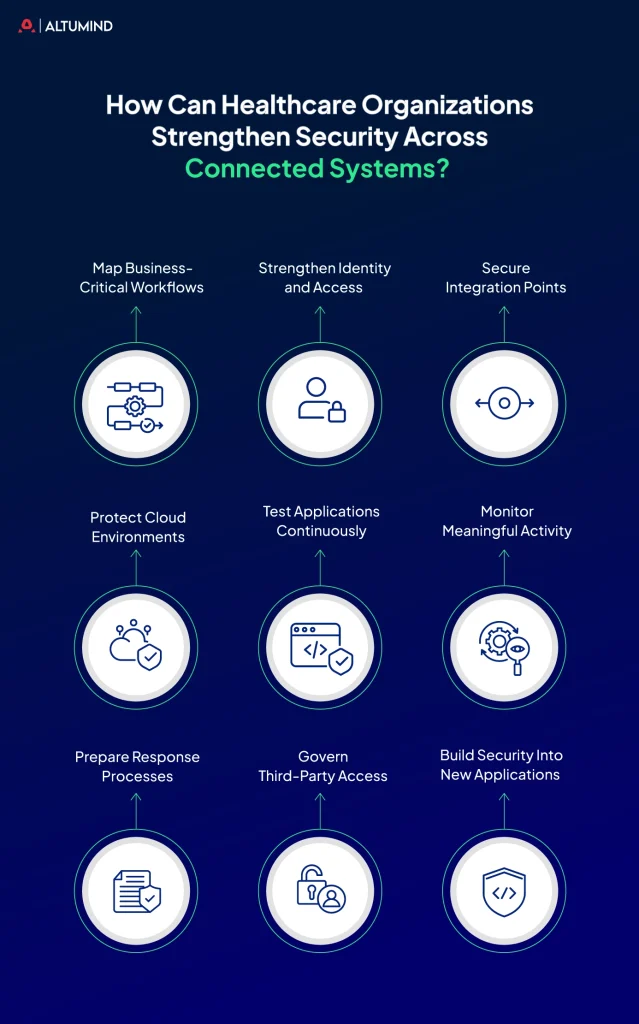
Healthcare organizations can strengthen connected systems by addressing security at the architecture, identity, integration, application, cloud, and operational levels. The key is to treat these areas as interconnected capabilities rather than separate security projects.
The following eight areas provide a practical framework for enterprise healthcare environments.
1. Map Business-Critical Workflows
Organizations should begin by mapping how important workflows operate across applications, data stores, APIs, cloud platforms, users, and external services.
This creates visibility into where data moves and which systems must work together to complete a business process.
For example, a patient service may involve several applications and external connections. Understanding this flow helps security and technology teams identify where authentication, authorization, monitoring, and data protection controls need to operate.
Business value: Workflow mapping helps leaders prioritize security investment based on operational importance. It also reduces the chance that a security decision in one technology area creates an unintended effect elsewhere.
The practical insight is simple: security architecture should reflect how the business actually operates, not only how the technology stack is organized.
2. Strengthen Identity and Access
Identity controls should give users and systems only the access they require to perform defined responsibilities.
Healthcare organizations should review the following:
- • Employee access.
- • Privileged accounts.
- • Administrative permissions.
- • Service accounts.
- • Application identities.
- • Third-party access.
- • Access changes after role transitions.
Connected environments can make identity governance more complex because one account may provide access across several systems.
A practical consideration that is often underestimated is the management of non-human identities. Applications, APIs, and automated processes may have credentials that remain active for long periods and can hold significant permissions.
Organizations should therefore include application and service identities in access governance.
Business value: Stronger identity management improves accountability, supports compliance processes, and reduces unnecessary access without requiring organizations to restrict legitimate business activity.
3. Secure Integration Points
APIs and integrations deserve the same security attention as the applications they connect to.
Organizations should assess the following:
- • Authentication.
- • Authorization.
- • Input validation.
- • Data exposure.
- • API permissions.
- • Interoperability.
- • Logging.
- • Error handling.
- • Rate controls.
A common implementation issue occurs when the primary application receives extensive security attention while the integration layer receives less scrutiny.
Yet connected systems often depend on APIs to exchange sensitive information and support business workflows.
This makes integration security an important part of the overall healthcare cybersecurity strategy.
Business value: Secure integration allows organizations to connect systems while maintaining appropriate control over data and access. It also supports future technology expansion without treating every new connection as an isolated security concern.
4. Protect Cloud Environments
Cloud security should address identity, configuration, workload protection, data controls, network security, monitoring, and shared responsibility.
Healthcare organizations should clearly define which security responsibilities belong to the following:
- • Internal IT teams.
- • Application teams.
- • Cloud providers.
- • Managed service partners.
- • Third-party vendors.
The shared responsibility model can create uncertainty if ownership is not documented.
What many organizations overlook is that cloud security is not only about the initial configuration. Permissions, workloads, integrations, and services change as technology evolves.
Configuration drift can occur when environments grow without consistent review.
For organizations managing complex cloud environments, cloud management outsourcing may form part of a broader operating model when internal teams need additional operational capacity.
Business value: Strong cloud governance supports scalability while giving leadership better visibility into security responsibilities, operational requirements, and technology costs.
5. Test Applications Continuously
Application security testing should become part of the software lifecycle rather than a final step before deployment.
Depending on the application and risk profile, organizations may use the following:
- • Vulnerability assessments.
- • Penetration testing.
- • API security testing.
- • Code analysis.
- • Security-focused QA.
- • Configuration reviews.
The objective is not simply to identify security findings but to understand how those findings could affect clinical operations, patient services, and business continuity.
This is where penetration testing services can support a broader application security approach.
Security also needs to work alongside functional and performance validation. QA services can be part of a broader quality strategy where application reliability and security receive attention throughout development and testing.
Business value: Earlier identification of security and quality issues can reduce remediation effort later and improve confidence in application releases.
6. Monitor Meaningful Activity
Monitoring should provide useful visibility across identities, applications, infrastructure, cloud services, devices, and integrations.
However, more alerts do not necessarily create better security.
A high volume of alerts can overwhelm teams if they lack the context needed to determine which events deserve attention.
A more effective approach is to identify activity that is meaningful for specific business workflows.
For example:
- • Unusual access to sensitive systems.
- • Unexpected administrative activity.
- • Changes to critical configurations.
- • Abnormal authentication patterns.
- • Unusual data movement.
Business value: Contextual monitoring can help security teams focus their time on meaningful events while giving executives better visibility into the organization’s security posture.
This is also where data analytics can support security operations. Organizations considering predictive data and analytics can apply similar analytical thinking to identify patterns and prioritize attention across large volumes of information.
7. Prepare Response Processes
Incident response should address more than technical containment.
Healthcare organizations should define the following:
- • Who makes decisions?
- • Who owns communication?
- • How do incidents escalate?
- • Which systems can be isolated?
- • Which workflows must continue?
- • How are recovery decisions made?
- • How are lessons documented afterward?
This requires collaboration across security, IT, operations, legal, compliance, communications, and business leadership.
Business value: A well-defined response process can reduce confusion and improve decision-making when an incident affects connected systems.
One practical insight is that incident response planning should include business continuity scenarios, not just technical response procedures. Leaders should understand how essential workflows will operate if a particular system becomes temporarily unavailable.
8. Govern Third-Party Access
Third-party relationships should be assessed based on actual access and business dependency.
Organizations should know:
- • What systems vendors can access?
- • What data can they access?
- • Why is access required?
- • How is access monitored?
- • How are permissions reviewed?
- • What happens when the relationship changes?
Vendor governance should continue after onboarding. A vendor may gain access to new systems over time, or an existing integration may become more important to the business. Security reviews should reflect these changes.
Business value: Strong third-party governance reduces uncertainty around external access and helps organizations maintain better control over technology dependencies.
9. Build SecurityIntoNew Applications
Cybersecurity should be considered during application architecture and development rather than introduced only after the technology is complete.
This is particularly important for healthcare organizations building cloud-based applications that connect with existing systems, APIs, data platforms, and external services.
Security decisions made early can influence:
- • Identity architecture
- • Data handling
- • API design
- • Access controls
- • Logging
- • Monitoring
- • Testing
- • Deployment processes
Organizations building or modernizing cloud-based healthcare applications may consider cloud application development services as part of a broader development approach where security and scalability are considered from the architecture stage.
Business value: Building security into application design can reduce costly changes later and create a stronger foundation for future technology expansion.
When Should Healthcare Organizations Use AI and Analytics in Cybersecurity?
Healthcare organizations should use AI and analytics when they can improve security visibility, reduce repetitive work, or help teams prioritize decisions. AI should support human judgment rather than replace governance, accountability, or expert review.
Potential applications include:
- • Identifying unusual activity.
- • Prioritizing alerts.
- • Analyzing large volumes of security data.
- • Automating repetitive workflows.
- • Supporting compliance processes.
- • Identifying patterns across systems.
However, organizations should define clear boundaries around automated decisions.
For example, automated systems may classify or prioritize alerts, while decisions involving sensitive data, major access changes, or operational disruption may require human approval.
This distinction matters because AI output can depend on data quality, system configuration, and context.
The business value comes from using AI where it improves efficiency without introducing unnecessary governance complexity.
Altumind’s work across AI automation services and data-driven technology initiatives reflects a practical principle: automation should address a defined business problem rather than exist simply because the technology is available.
Organizations also need to consider governance when applying AI to compliance and security. The influence of AI in compliance can be significant, but organizations should define how AI outputs are reviewed, documented, and validated.
The business value is strongest when AI and analytics help teams make better decisions with less repetitive effort while maintaining appropriate accountability.
How Should Leaders Measure the Business Value of Healthcare Cybersecurity?
Leaders should measure cybersecurity through a combination of security performance, operational resilience, technology risk, and business impact. The number of vulnerabilities alone does not tell executives whether cybersecurity investments are producing meaningful value.
A more useful measurement framework could include:
| Measurement Area | Example Metric | Business Relevance |
|---|---|---|
| Critical systems | Percentage with current security assessments | Shows coverage of important technology. |
| Access | Privileged access review completion | Indicates governance quality. |
| Remediation | Time to address priority findings | Shows response effectiveness. |
| Monitoring | Meaningful alerts reviewed | Indicates operational visibility. |
| Recovery | Tested recovery processes | Shows continuity readiness. |
| Third parties | High-priority vendor reviews completed | Shows external risk oversight. |
| Application security | Critical applications tested | Indicates development security maturity. |
Metrics should also connect to the organization’s technology roadmap.
If the business plans to expand cloud adoption, launch a new digital health application, introduce AI, or connect new third-party platforms, cybersecurity metrics should help leadership understand whether the organization is prepared to support those changes.
A practical consideration that is often underestimated is the difference between measuring security activity and measuring security value.
Counting the number of assessments completed tells leadership what the team did.
Understanding whether critical systems have appropriate controls, whether important findings are addressed, and whether essential workflows can continue provides a better view of what the organization gained.
Business value: This approach helps CFOs, CIOs, CTOs, and other executives make more informed decisions about cybersecurity funding and technology priorities.
How Can Healthcare Organizations Build a Sustainable Cybersecurity Operating Model?
Healthcare organizations can build a sustainable cybersecurity operating model by defining clear ownership, integrating security into technology processes, continuously reviewing controls, and aligning security operations with business priorities.
Organizations often invest heavily in preventive controls but comparatively less effort in defining ownership, recovery processes, and operational governance. Those areas frequently determine how effectively healthcare providers respond when incidents occur.
A sustainable model should include:
- • Clear accountability.
- • Ongoing monitoring.
- • Periodic testing.
- • Access reviews.
- • Third-party governance.
- • Incident response.
- • Recovery planning.
- • Security metrics.
- • Continuous improvement.
Security should not sit separately from application development, cloud management, data operations, and enterprise IT.
The operating model should clarify who owns each responsibility and how teams work together.
For example, security teams may identify a vulnerability, but application teams may own remediation. Cloud teams may manage infrastructure controls, while business owners may decide which workflows have the highest operational priority.
This is where organizations may consider managed IT services when they need ongoing operational support across parts of their technology environment.
The business value is long-term sustainability. Security becomes part of normal technology management rather than a periodic project that loses attention after implementation.
For enterprise leaders, the most important question is not whether the organization has completed a security initiative. It is whether the organization has built the capabilities, processes, and accountability required to maintain appropriate protection as technology continues to change.
What Should Healthcare Leaders Prioritize When Building a Cybersecurity Strategy?
Healthcare leaders should prioritize cybersecurity investments based on business-critical workflows, sensitive data, system dependencies, operational continuity, and the organization’s ability to sustain security controls over time.
A practical prioritization model can look like this:
| Priority | Leadership Question |
|---|---|
| Business continuity | Which workflows must remain available? |
| Data sensitivity | Which information requires stronger protection? |
| Connectivity | Which systems have the most dependencies? |
| Access | Who has privileged or external access? |
| Technology change | Which systems are being modernized or expanded? |
| Operational capability | Who will manage security after implementation? |
| Investment | Where will additional funding create the greatest value? |
This approach helps leaders avoid a common mistake: treating cybersecurity as a technology purchasing exercise. More tools do not automatically create stronger security.
The right investment depends on the organization’s architecture, workflows, risk profile, regulatory requirements, internal capabilities, and long-term technology strategy.
A common factor many organizations miss is the importance of planning for security ownership before implementation begins.
- • Every new control should have an owner.
- • Every monitoring capability should have someone responsible for reviewing it.
- • Every security finding should have a defined remediation process.
- • Every third-party connection should have an accountable business and technology owner.
Without this operational ownership, even well-designed security programs can lose effectiveness over time.
The business value is stronger accountability and more disciplined investment. Leaders can see where cybersecurity contributes to operational resilience and where additional resources may be required.
Conclusion
Strong healthcare cybersecurity is measured by how effectively it protects the clinical, operational, and technology workflows that enable high-quality patient care and organizational resilience.
With 10+ years of experience across digital transformation and enterprise technology, Altumind approaches cybersecurity as part of a broader technology operating model, where architecture, applications, cloud, data, testing, and ongoing operations work together.
For healthcare organizations seeking sustained oversight across complex environments, enterprise-managed cybersecurity services can be part of that broader strategy. The right starting point is a clear understanding of which business workflows matter most and how technology can protect them as the organization grows.
Table of Contents
- Introduction
- Why Does Connected Technology Change How Healthcare Organizations Approach Cybersecurity?
- What Should Healthcare Organizations Assess Before Investing in Cybersecurity?
- How Can Healthcare Organizations Strengthen Security Across Connected Systems? (
- When Should Healthcare Organizations Use AI and Analytics in Cybersecurity?
- How Should Leaders Measure the Business Value of Healthcare Cybersecurity?
- How Can Healthcare Organizations Build a Sustainable Cybersecurity Operating Model?
- What Should Healthcare Leaders Prioritize When Building a Cybersecurity Strategy?
- Conclusion