Cyber Security Risk Assessment: A Smarter Approach to Enterprise Security
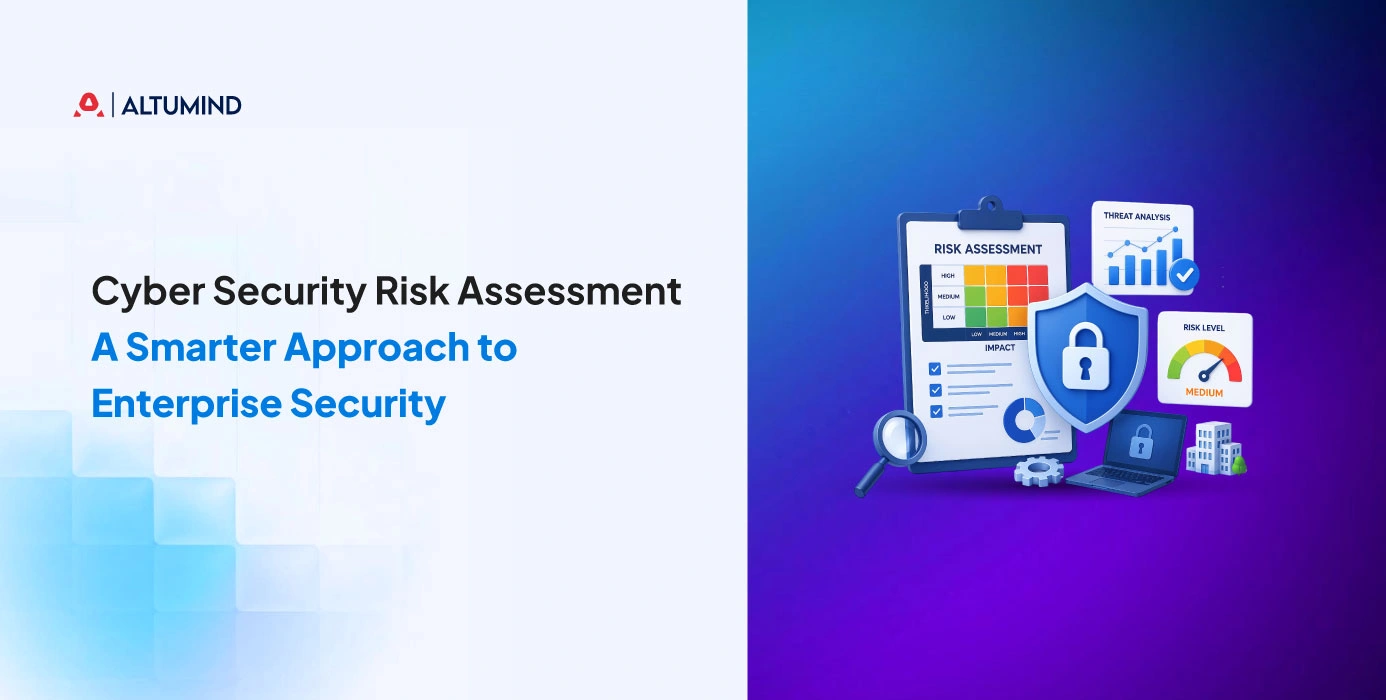
Table of Contents
- Introduction
- Why Does Cyber Security Risk Assessment Matter to Enterprise Decision-Making?
- What Should an Enterprise Cyber Security Risk Assessment Cover?
- How Can Enterprises Prioritize Cybersecurity Risks More Effectively?
- What Should Enterprises Assess Across Their Security Environment?
- How Can Enterprises Turn Security Findings Into Business Priorities?
- When Should Enterprises Reassess Cybersecurity Risk?
- How Can Enterprises Build a Cyber Security Risk Assessment Roadmap?
- What Business Value Should an Enterprise Expect From a Cyber Security Risk Assessment?
- Conclusion
Enterprise security decisions become harder when technology environments span cloud platforms, business applications, third-party systems, remote access, and sensitive data. A cybersecurity risk assessment gives leadership a structured view of where security exposure intersects with business priorities.
Key considerations include the following:
- • Which risks deserve investment first?
- • Which systems support essential business operations?
- • How do cloud and third-party dependencies change exposure?
- • Can security teams respond effectively when conditions change?
At Altumind, we approach technology transformation with more than 10 years of experience across enterprise applications, cloud, AI, data, automation, and managed operations. In our experience, organizations make better security decisions when cybersecurity findings are connected to business priorities, operational impact, and long-term technology planning rather than treated as isolated technical issues. This blog explains how organizations can connect cybersecurity risk assessment findings to practical decisions and long-term security planning.
Why Does Cyber Security Risk Assessment Matter to Enterprise Decision-Making?
A cybersecurity risk assessment matters because it helps leadership understand security exposure in business terms. Instead of treating every vulnerability as equally important, enterprises can prioritize risks based on the systems affected, potential operational consequences, regulatory obligations, and the organization’s ability to respond.
For executive teams, the value comes from connecting security decisions to broader business priorities. A vulnerability affecting a nonessential internal application may require a different response from one affecting a revenue-generating platform or a system supporting critical business operations.
The assessment should therefore answer these practical questions:
| Question | Business relevance |
|---|---|
| What could be affected? | Identifies critical business assets and processes |
| How could it be affected? | Connects threats to realistic scenarios |
| What would the impact be? | Establishes business consequences |
| How likely is the scenario? | Supports risk prioritization |
| What should happen next? | Converts findings into accountable actions |
A practical consideration that is often underestimated is the difference between technical severity and business priority. A high-severity vulnerability does not automatically represent the highest business priority. Business context ultimately determines remediation priority. The asset, exposure, exploitability, business dependency, compensating controls, and recovery capability all influence the decision.
This is where an experienced enterprise technology partner can add value: security findings should be translated into language that technology leaders, finance teams, operations leaders, and business executives can act on.
This broader perspective also helps organizations align cybersecurity decisions with their overall enterprise IT services strategy, creating stronger coordination across infrastructure, applications, and business operations.
What Should an Enterprise Cyber Security Risk Assessment Cover?
An enterprise assessment should cover more than infrastructure vulnerabilities. It should examine the relationship between business processes, technology assets, users, data, applications, cloud environments, third parties, security controls, and response capabilities.
At a minimum, the assessment should consider:
- • Business-critical applications.
- • Sensitive and regulated data.
- • Identity and access controls.
- • Network architecture.
- • Endpoint environments.
- • Application security.
- • Security monitoring.
- • Incident response capabilities.
- • Backup and recovery arrangements.
- • Regulatory and contractual obligations.
- • Cloud infrastructure and configurations.
- • Third-party and supply chain dependencies.
The scope should reflect how the organization actually operates. A technically accurate assessment can still provide limited value if it ignores the workflows that connect systems together.
For example, a customer-facing application may depend on an identity provider, payment service, cloud infrastructure, external API, data platform, and internal support workflow.
Assessing each component separately may miss the risk created by their combined dependency. That is why enterprise assessments should consider business workflows alongside individual assets.
How Can Enterprises Prioritize Cybersecurity Risks More Effectively?
Enterprises can prioritize cybersecurity risks by combining technical severity with business context, exposure, likelihood, control effectiveness, and recovery capability. This creates a risk-based priority model that helps leadership allocate resources where they have the greatest practical value.
A useful prioritization model can consider:
| Factor | Key question |
|---|---|
| Business impact | What happens if this system or process becomes unavailable? |
| Data sensitivity | What type of information could be exposed? |
| Exposure | Is the asset accessible from external or untrusted environments? |
| Control effectiveness | Are the existing controls effectively reducing exposure? |
| Dependency | Does the asset support other critical workflows? |
| Recovery capability | How quickly can the organization restore operations? |
| Ownership | Who is accountable for remediation? |
This approach helps prevent a common planning mistake: creating a long list of security findings without a clear decision framework.
What many organizations overlook is remediation ownership. A risk assessment can identify hundreds of findings, but the assessment creates limited business value if no accountable owner, target timeline, funding path, or validation process exists for the most important actions.
A mature process therefore connects each priority risk to an owner and a defined next step. Organizations frequently invest significant effort in identifying risks but comparatively less effort in establishing ownership, governance, and accountability for remediation. In our experience, closing that gap can have a greater impact on long-term security maturity than simply identifying additional vulnerabilities.
This may include:
- • Remediation.
- • Risk acceptance.
- • Risk transfer.
- • Additional monitoring.
- • Compensating controls.
- • Further security testing.
- • Architecture changes.
The right response depends on the organization’s risk appetite and business context.
What Should Enterprises Assess Across Their Security Environment?
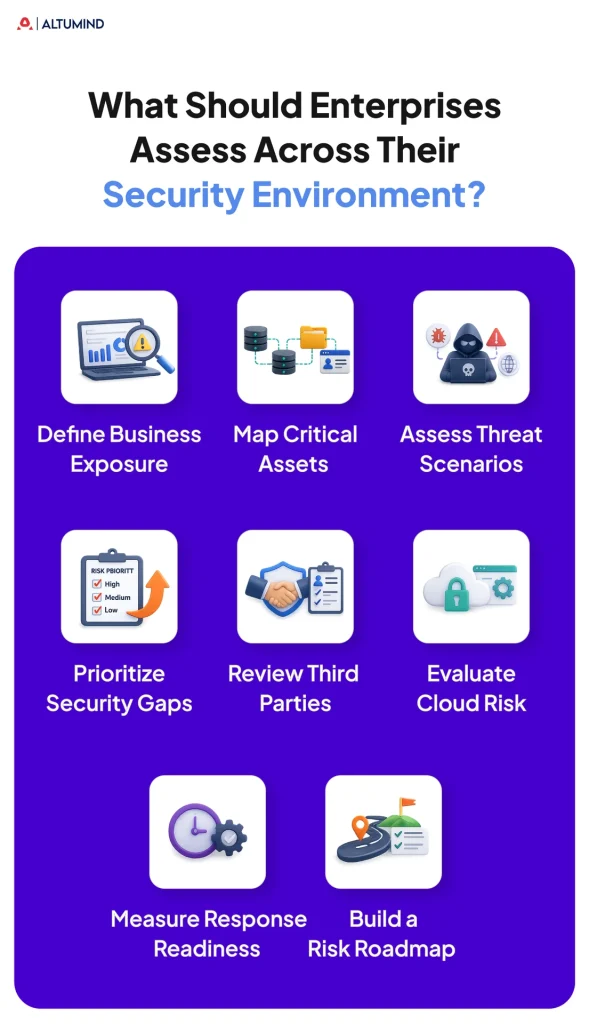
The following eight areas provide a practical framework for assessing enterprise security exposure. The objective is not simply to identify more findings. It is to understand which risks could affect business operations and what actions should follow.
1. Define Business Exposure
Start by identifying the business processes that depend on technology. This includes revenue operations, customer services, internal operations, financial processes, regulatory functions, and other essential workflows.
The assessment should establish what business disruption could occur if a supporting system becomes unavailable, compromised, or unreliable.
2. Map Critical Assets
Create a current view of applications, infrastructure, data stores, identities, endpoints, integrations, and cloud resources that support important workflows.
Asset inventories often become outdated as organizations add SaaS platforms, cloud workloads, APIs, and third-party services.
A useful assessment therefore treats asset mapping as an ongoing discipline rather than a one-time documentation exercise.
3. Assess Threat Scenarios
Risk assessment should examine realistic threat scenarios relevant to the organization’s technology and operating model.
These may include:
- • Credential compromise.
- • Unauthorized access.
- • Data exposure.
- • Application vulnerabilities.
- • Misconfigured cloud resources.
- • Third-party compromise.
- • Malicious insider activity.
- • Business email compromise.
- • Ransomware.
- • Service disruption.
The focus should remain on plausible scenarios rather than producing an unnecessarily broad list of hypothetical threats.
4. Prioritize Security Gaps
Security gaps should be ranked according to their potential business impact, exposure, likelihood, and existing controls.
This is where penetration testing can provide additional evidence. For organizations that need deeper validation of exploitable weaknesses, penetration testing services can complement the broader risk assessment by testing how identified weaknesses may behave under controlled attack conditions.
A risk assessment establishes priorities. Testing can provide additional evidence about specific weaknesses.
5. Review Third Parties
Third-party dependencies deserve direct attention because enterprise workflows increasingly rely on external platforms, vendors, APIs, cloud services, and technology partners.
An assessment should consider:
- • What data third parties can access?
- • How are incidents communicated?
- • What contractual obligations exist?
- • What security controls do they maintain?
- • What happens if the service becomes unavailable?
- • Which business processes depend on them?
One frequently overlooked consideration is the concentration risk created by shared dependencies. Several business applications may appear independent while relying on the same identity provider, cloud platform, or external service.
That shared dependency can create a single point of operational impact. In large enterprise environments, we often find that the greatest security risks emerge not from isolated vulnerabilities but from the way multiple systems, identities, and third-party services interact across critical business workflows. This is why effective risk assessment must consider relationships between assets, not just the security posture of individual systems.
6. Evaluate Cloud Risk
Cloud environments require assessment of identity, access, configurations, workloads, data, APIs, network controls, logging, and shared responsibility boundaries.
The assessment should also consider how cloud resources change over time. New workloads, configuration changes, temporary access, and infrastructure automation can alter exposure after the initial review.
For enterprises combining security assessment with broader technology modernization, cloud modernization strategies can help connect architectural decisions with security, scalability, and operational requirements.
7. Measure Response Readiness
Security controls matter, but so does the organization’s ability to act when those controls do not prevent an incident.
Assessment should examine:
- • Detection capabilities.
- • Alert escalation.
- • Incident ownership.
- • Communication procedures.
- • Decision authority.
- • Backup recovery.
- • Business continuity.
- • Post-incident review.
The goal is to understand whether teams can move from detection to coordinated action. Organizations adopting AI automation services can also automate repetitive security operations, allowing teams to focus on higher-value investigation and response activities while maintaining appropriate governance.
8. Build a Risk Roadmap
The final output should translate findings into a prioritized roadmap.
A practical roadmap should include:
- Risk description.
- Business impact.
- Priority level.
- Recommended action.
- Responsible owner.
- Target timeline.
- Required investment.
- Validation method.
This creates a direct connection between assessment findings and business planning.
The roadmap should also distinguish between immediate remediation, longer-term architecture changes, and ongoing monitoring. Not every risk requires the same response or timeline.
How Can Enterprises Turn Security Findings Into Business Priorities?
Enterprises can turn security findings into business priorities by translating technical risks into measurable business, operational, and financial implications. This allows executives to compare cybersecurity investments with other technology priorities while considering customer trust, operational continuity, regulatory obligations, and long-term strategic goals.
For example, a security finding may affect the following:
- • Revenue continuity.
- • Customer access.
- • Regulatory obligations.
- • Operational productivity.
- • Data protection.
- • Vendor relationships.
- • Insurance requirements.
- • Technology investment planning.
The strongest assessment reports therefore provide two levels of communication.
Executive level: What is the business impact, priority, and recommended decision?
Technical level: What is the vulnerability, control gap, affected asset, and remediation requirement?
This separation improves stakeholder alignment without losing technical detail.
For organizations working with large data environments, predictive data analytics services can also support broader decision-making by helping teams analyze operational patterns and identify trends that inform technology planning.
Security risk assessment remains distinct from predictive analytics, but both benefit from a structured approach to data-driven decision-making.
A key information gain is that security prioritization should account for recovery capability. Two organizations may have similar exposure but very different business consequences if one can restore operations quickly while the other depends on complex manual recovery processes. This makes resilience and recoverability important inputs into risk prioritization.
When Should Enterprises Reassess Cybersecurity Risk?
Enterprises should reassess cybersecurity risk when meaningful changes occur in technology, operations, regulations, business structure, or threat conditions. A fixed annual assessment may provide a useful baseline, but it should not be the only trigger for reassessment.
Common triggers include:
| Trigger | Why Reassessment Matters |
|---|---|
| Cloud migration | Architecture and control boundaries may change. |
| Major application launch | New attack surfaces and data flows may emerge. |
| Acquisition or merger | New systems, identities, and third parties enter the environment. |
| Regulatory change | Compliance obligations may shift. |
| Major vendor change | External dependencies may introduce new exposure. |
| Security incident | Existing assumptions may need review. |
| New AI adoption | Data flows, model access, and governance may change. |
| Significant architecture change | Security controls may need redesign. |
Organizations should also consider reassessment after major changes to business workflows. This is particularly relevant for enterprises adopting AI and automation.
New automated processes can introduce additional data flows, integrations, access permissions, and decision points. The security assessment should therefore consider how automation changes the risk profile rather than treating automation as separate from cybersecurity.
How Can Enterprises Build a Cyber Security Risk Assessment Roadmap?
A practical roadmap should move through four stages: establish the current state, prioritize the most meaningful risks, assign accountable actions, and continuously reassess the environment.
| Stage | Primary Activity | Business Outcome |
|---|---|---|
| Assess | Identify assets, threats, controls, and exposure. | Clearer risk visibility. |
| Prioritize | Rank risks using business and technical context. | Better investment decisions. |
| Act | Assign owners and implement remediation. | Greater accountability. |
| Validate | Test controls and verify improvements. | Evidence of progress. |
| Monitor | Track changes and reassess exposure. | Ongoing risk awareness. |
The roadmap should also connect cybersecurity activities with broader enterprise technology planning.
For example, a cloud architecture change may affect identity management. A new digital product may require application security testing. An ERP integration may create new data flows. An automation initiative may introduce additional system access.
This is why security assessment works best when technology, security, operations, compliance, and business stakeholders participate in the process.
At Altumind, our broader technology capabilities span cloud, AI and automation, data and analytics, enterprise applications, software engineering, QA and testing, managed operations, and digital strategy. That cross-functional perspective supports a more connected view of how technology decisions affect security and business operations.
What Business Value Should an Enterprise Expect From a Cyber Security Risk Assessment?
A cybersecurity risk assessment creates business value when it improves the quality of security and technology decisions. Its purpose is not simply to produce a risk register. It should help leaders understand where to invest, what to prioritize, who owns each action, and how security supports business continuity.
| What the Assessment Considers | Why It Matters |
|---|---|
| Business value | Helps prioritize security around operational importance. |
| Critical business processes | Identifies essential operations that require the highest level of protection. |
| Technology dependencies | Improves understanding of interconnected risks. |
| Security gaps | Supports focused remediation investment. |
| Third-party exposure | Improves vendor and dependency oversight. |
| Cloud environments | Connects architecture decisions with security requirements. |
| Response readiness | Highlights operational gaps beyond technical controls. |
| Risk ownership | Creates accountability for action. |
| Recovery capability | Adds resilience to risk prioritization. |
| Ongoing monitoring | Supports decisions as the environment changes. |
The most valuable outcome is a clearer connection between security risk and business decisions.
When leadership can see which risks affect important workflows, what actions are available, what those actions require, and who owns them, cybersecurity becomes easier to integrate into enterprise planning.
That is the practical shift from a compliance-oriented assessment to a decision-oriented security program.
Conclusion
A strong cybersecurity risk assessment helps enterprise leaders connect security exposure with business priorities, technology investments, operational resilience, and accountability. The most useful assessments move beyond vulnerability lists and provide a practical path from risk identification to action.
With more than a decade of experience across enterprise technology and digital transformation, Altumind brings together capabilities across cloud, AI, automation, data, engineering, and managed operations.
Organizations looking to strengthen their security operating model can also consider enterprise managed cybersecurity services as part of a broader, ongoing approach. Connect with Altumind to discuss your enterprise security priorities and assessment needs.
Table of Contents
- Introduction
- Why Does Cyber Security Risk Assessment Matter to Enterprise Decision-Making?
- What Should an Enterprise Cyber Security Risk Assessment Cover?
- How Can Enterprises Prioritize Cybersecurity Risks More Effectively?
- What Should Enterprises Assess Across Their Security Environment?
- How Can Enterprises Turn Security Findings Into Business Priorities?
- When Should Enterprises Reassess Cybersecurity Risk?
- How Can Enterprises Build a Cyber Security Risk Assessment Roadmap?
- What Business Value Should an Enterprise Expect From a Cyber Security Risk Assessment?
- Conclusion