Why Cloud Modernization Strategies Stall and How to Revive Them
Most cloud modernization initiatives begin with genuine momentum. Leadership aligns around a shared vision, budgets get approved, and teams get assigned to deliver. Then, somewhere between the planning deck and production deployment, progress slows considerably.
Timelines extend without clear explanation. Scope expands beyond original boundaries. The business case that justified the investment starts to diverge from the original business objectives.
Common challenges that contribute to this pattern include:
- Underestimating the complexity of legacy system interdependencies before execution begins.
- Attempting to modernize too much of the portfolio simultaneously without adequate sequencing.
- Treating cloud modernization as a migration exercise rather than an architectural transformation.
- Insufficient organizational change management alongside the technical delivery program.
- Unclear governance structures that slow decision-making when the program needs momentum most.
Cloud modernization is one of the most significant technology investments an enterprise can make. Understanding why these strategies stall, and what successful teams do differently to revive them, is the most valuable conversation that leaders in enterprise technology can have right now.
Keep reading as we examine the root causes of stalled cloud modernization and how to build a strategy that sustains momentum from planning through to delivery.
What Is Cloud Modernization?
Cloud modernization is the process of updating, re-architecting, or replacing legacy technology systems to take full advantage of cloud-native capabilities. It goes significantly beyond simply moving existing applications to cloud infrastructure.
True cloud modernization involves rethinking how applications are built, how data flows through systems, and how infrastructure is managed and scaled. It encompasses cloud application modernization, which focuses on transforming legacy applications into modern, scalable architectures.
The distinction between cloud migration and cloud modernization matters considerably. Migration moves workloads to the cloud. Modernization transforms them. An organization can complete a migration and still be running the same rigid, costly architecture it was using on-premises.
Why Cloud Modernization Matters for Enterprise Growth
Organizations that successfully modernize their cloud environments gain meaningful and compounding advantages. Development cycles accelerate when teams are no longer constrained by legacy infrastructure. New capabilities, including AI, machine learning, and advanced analytics, become accessible in ways that legacy systems simply cannot support.
Operational expenses become more predictable and manageable through cloud cost optimization practices embedded into modern architectures. Every quarter spent maintaining legacy architecture is a quarter competitors spend building capabilities that expand their competitive advantage.
Key Reasons Why Cloud Modernization Strategies Stall
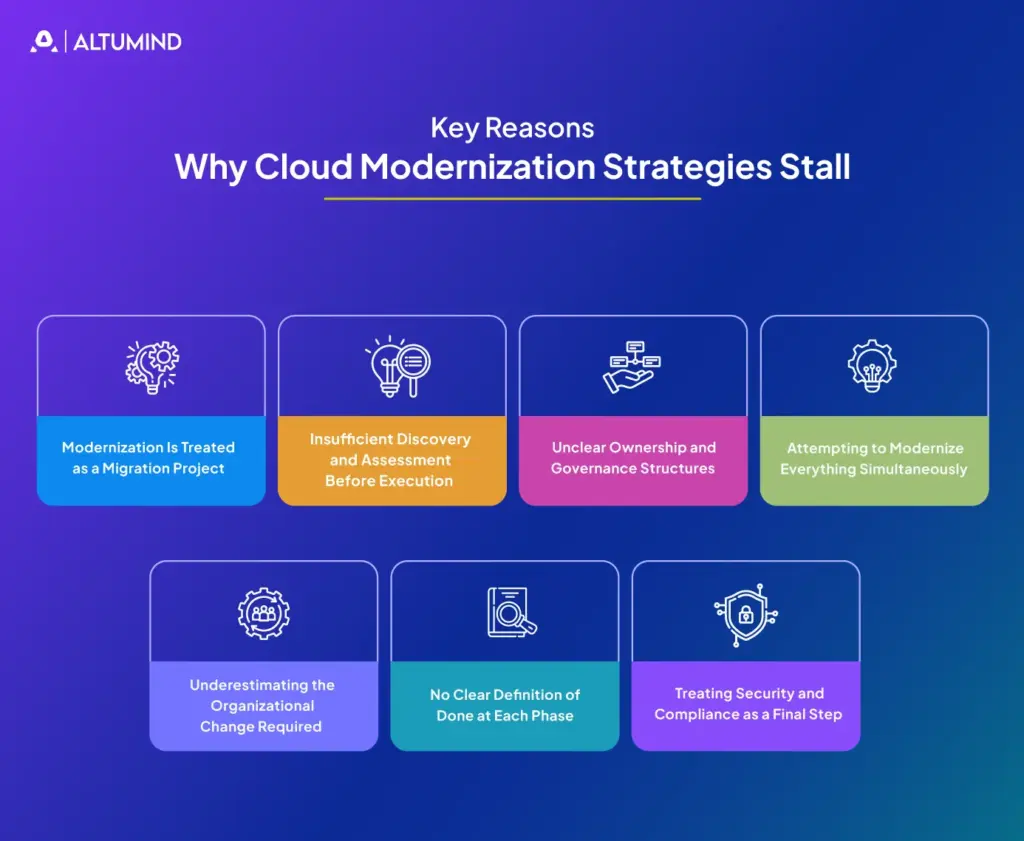
Understanding the root causes of stalled modernization is the prerequisite to building a strategy that does not repeat them. These key reasons appear consistently across enterprise modernization programs regardless of industry or organization size.
1. Modernization Is Treated as a Migration Project
The most common mistake is conflating modernization with migration. When teams treat modernization as a lift-and-shift exercise, they move legacy workloads to cloud infrastructure without addressing the underlying architectural problems those workloads carry.
The result is cloud infrastructure running legacy patterns. Costs increase because cloud pricing models are not optimized for monolithic architectures. Teams quickly realize the anticipated benefits have not materialized, and program momentum begins to slow.
Successful modernization requires architectural transformation rather than infrastructure relocation alone. This distinction must be established clearly from the first planning conversation.
2. Insufficient Discovery and Assessment Before Execution
Many modernization programs move into execution before completing a thorough assessment of the current environment. Teams underestimate the complexity of legacy interdependencies, data structures, and integration points. Surprises surface mid-execution and extend timelines significantly.
A rigorous discovery phase examines the following before any modernization work begins:
- Application Inventory: Cataloguing every application, its dependencies, its data flows, and its current performance characteristics.
- Technical Debt Assessment: Identifying where architectural debt exists and quantifying the effort required to address it systematically.
- Integration Mapping: Documenting all integration points between systems to understand the downstream impact of any architectural change.
- Organizational Readiness: Assessing whether teams have the skills, processes, and tooling to operate modernized systems once deployed.
Skipping or rushing the discovery phase is the single most common cause of mid-program surprises that slow progress considerably.
3. Unclear Ownership and Governance Structures
Cloud modernization programs span multiple teams, departments, and stakeholder groups. When ownership is unclear or governance structures are absent, decisions slow down and competing priorities create conflict across the organization.
Effective governance requires three clearly defined layers:
- Executive Sponsorship: A senior leader with authority to resolve cross-functional conflicts and maintain organizational commitment throughout the program.
- Program-Level Accountability: A dedicated program leader responsible for coordinating workstreams, tracking progress, and managing dependencies effectively.
- Team-Level Ownership: Clear accountability at the workstream level so individual teams understand their scope and decision-making authority without requiring constant escalation.
Without these three layers operating effectively, modernization programs accumulate decision debt that eventually slows execution considerably.
4. Attempting to Modernize Everything Simultaneously
Broad scope is one of the most reliable predictors of modernization program challenges. When organizations attempt to modernize the entire application portfolio at once, they stretch resources beyond sustainable capacity.
Progress becomes difficult to measure because nothing reaches completion. Teams lose confidence, and stakeholder support weakens over time.
A sequenced approach delivers measurably better outcomes. High-value, lower-complexity applications provide early wins that build organizational confidence. More complex applications benefit from the learnings accumulated during earlier phases of delivery.
5. Underestimating the Organizational Change Required
Cloud modernization is not only a technology transformation. It is an organizational one. Teams that have operated legacy systems for years need to develop new skills and adopt new ways of working in modernized environments.
When the human dimension of modernization receives insufficient investment, technology changes outpace organizational capability. Teams often struggle to fully adopt modern operating practices without structured enablement.
Successful cloud modernization strategies invest as heavily in organizational capability development as they do in technical execution. Training programs and dedicated enablement resources are prerequisites for sustained adoption of modernized systems.
6. No Clear Definition of Done at Each Phase
Modernization programs that lack clear success criteria at each phase tend to drift over time. The scope expands incrementally and previously completed work frequently requires reassessment because completion criteria were never defined before execution began.
Each phase should have explicit, measurable exit criteria established before work begins. These criteria should address technical outcomes, operational readiness, and business objectives.
When a phase meets its exit criteria, it closes. Clear phase definitions also make progress visible to stakeholders, which maintains organizational support across multi-year program horizons.
7. Treating Security and Compliance as a Final Step
Security and compliance requirements addressed at the end of a modernization program create significant rework. Architectures designed without security embedded from the beginning frequently require substantial modification to meet enterprise standards and regulatory obligations.
Cloud application modernization programs in regulated industries face particularly significant risk when security is treated as a final step. Retrofitting security controls into a completed architecture can delay deployment substantially.
Security architecture, identity and access management design, and compliance controls should be established during the architecture phase rather than after it. This approach reduces rework and produces architectures that are secure by design rather than retrofitted for compliance.
How to Revive a Stalled Cloud Modernization Strategy
Recognizing that a modernization strategy has stalled is the first and most important step toward recovery. The following framework provides a structured path from a stalled position to sustainable progress.
Step 1: Conduct an Objective Program Assessment
Before making any changes to execution, conduct an objective assessment of where the program currently stands. This assessment should cover progress against original objectives, root cause identification, stakeholder confidence levels, and resource or capability gaps.
An assessment that confirms existing assumptions rather than challenging them will not produce the insight needed to drive genuine recovery. Objectivity at this stage is essential.
Step 2: Reset Scope and Prioritize With Discipline
Stalled programs frequently carry accumulated scope that has grown beyond the organization’s capacity to deliver. Recovery requires a deliberate scope reset focused on the highest-value outcomes the program can realistically achieve within current constraints.
Prioritization should be driven by business value, technical feasibility, and strategic sequencing working together. Work that does not meet these criteria should be deferred rather than carried forward as a constraint on program velocity.
Step 3: Establish Visible Short-Term Milestones
When organizational confidence has eroded, demonstrating progress through completed deliverables is more persuasive than any revised timeline. Short-term milestones should be meaningful rather than artificially constructed to create an appearance of progress.
Completing the modernization of a specific application or deploying a new architecture pattern into production are examples of meaningful milestones that rebuild confidence. Understanding how cloud management outsourcing can accelerate delivery at this stage is worth examining carefully.
Step 4: Rebuild Governance and Decision-Making Clarity
If unclear governance contributed to the stall, recovery requires rebuilding governance structures before resuming execution at scale. This means establishing clear decision rights, accountability assignments, and escalation paths that enable the program to move forward without unnecessary friction.
A governance reset should be documented and communicated explicitly to all program participants. Everyone involved needs to understand who owns what decisions and how conflicts get resolved efficiently.
Step 5: Align Modernization With Business Outcomes
Stalled programs frequently drift away from the business outcomes that justified their original investment. Technical teams focus on architectural decisions while business stakeholders lose visibility into how those decisions connect to outcomes they care about most.
Recovery requires re-establishing explicit connections between technical decisions and business outcomes at every level of the program. Real-world examples from cloud migration case studies provide valuable reference points for maintaining this alignment throughout the recovery process.
How to Build a Cloud Modernization Strategy That Sustains Momentum?
Recovery from a stalled program is valuable. Building a strategy that maintains momentum from the outset is more valuable. The following principles consistently differentiate modernization strategies that sustain progress from those that encounter avoidable delays.
1. Define the Target Architecture Before Starting
A clear target architecture provides the guiding reference point for every subsequent technical decision in the modernization program. Without it, teams make isolated architectural decisions that create long-term integration complexity. The accumulated inconsistency eventually creates integration problems and rework that slows the program.
The target architecture should define the cloud platform strategy, application architecture patterns, data architecture, and the security and compliance framework. It needs to be sufficiently clear to guide consistent decision-making across all teams and workstreams.
2. Build Cloud Cost Awareness Into Architecture Decisions
Cloud costs that were not modeled during architecture design frequently become program-level surprises during and after deployment. Capturing cost optimization opportunities requires deliberate design choices rather than default configurations that carry unintended cost implications.
Cost should be treated as a first-class architectural concern alongside performance, reliability, and security. Teams should model the cost implications of architectural decisions before finalizing them and establish cost monitoring from the earliest stages of deployment.
3. Leverage Analytics to Measure Modernization Impact
Measurement makes modernization progress visible and enables teams to demonstrate business value to stakeholders consistently. Establishing measurement frameworks early enables teams to demonstrate impact incrementally rather than waiting until program completion to show results.
Understanding how cloud-based analytics is transforming business decision-making provides useful context for building these measurement capabilities effectively into the program from the start.
4.Plan for AI and Automation Enablement From the Start
Modernized cloud architectures create the operational foundation required for AI adoption, automation initiatives, and real-time analytics at scale. They also enable the platform agility organizations need to respond to changing business requirements without architectural constraints. AI readiness, data modernization, and automation enablement should be addressed during the architecture phase. They should not be treated as separate future initiatives. Decisions made during modernization directly shape how quickly an organization can adopt AI-powered capabilities afterward.
5. Treat Modernization as a Continuous Practice
The most successful enterprise cloud modernization strategies are not programs with defined end dates. They are continuous practices embedded into how the organization builds and operates technology over time.
Organizations that treat modernization as a destination will find themselves managing the same architectural constraints within a few years. Organizations that treat it as a continuous practice build compounding capability advantages that become more significant over time.
Conclusion
Cloud modernization strategies stall for identifiable and preventable reasons. Scope that exceeds organizational capacity, unclear governance, insufficient discovery before execution, and underinvested organizational change are the patterns that appear most consistently across stalled programs.
The path to recovery is not a new technology platform or a larger budget. It is a more disciplined approach to strategy, sequencing, and organizational alignment.
Altumind’s cloud application development services help enterprises modernize cloud environments through architecture-led transformation, scalable delivery frameworks, and cloud-native engineering expertise. Connect with our team to evaluate how your modernization strategy can move from stalled execution to measurable business outcomes.