How AI Can Reduce Software Testing Time Without Compromising Quality
Table of Contents
- Introduction
- How Can AI Reduce Software Testing Time?
- How Does Faster Testing Create Business Value?
- How Can AI Speed Up Testing While Maintaining Quality?
- What Should Enterprises Consider Before Adopting AI Testing?
- How Should Businesses Measure AI Testing Results?
- Where Does AI Testing Fit into a Broader Technology Strategy?
- Conclusion
Software teams face growing testing demands with every release. Constant code changes, new features and integrations, and increasing customer expectations can all lengthen QA cycles and compress delivery timelines.
The key priorities of enterprise teams are:
- • Reducing the effort involved in repeated testing.
- • Maintaining strong test coverage.
- • Early identification of high-risk issues
- • Aligning automation to application changes.
AI-based software testing can support these key activities through the automated generation of test cases, prioritization of tests, re-testing after changes to find new problems, diagnosing faults, and managing tests. The business value is not just in saving QA hours. Also, a more efficient testing process means you can release faster, distribute your resources better, and have a more consistent quality of software.
In this blog post, we will explore areas where AI can help to cut down on testing time, how it improves quality, and what businesses should consider before incorporating AI into their QA strategy.
How Can AI Reduce Software Testing Time?
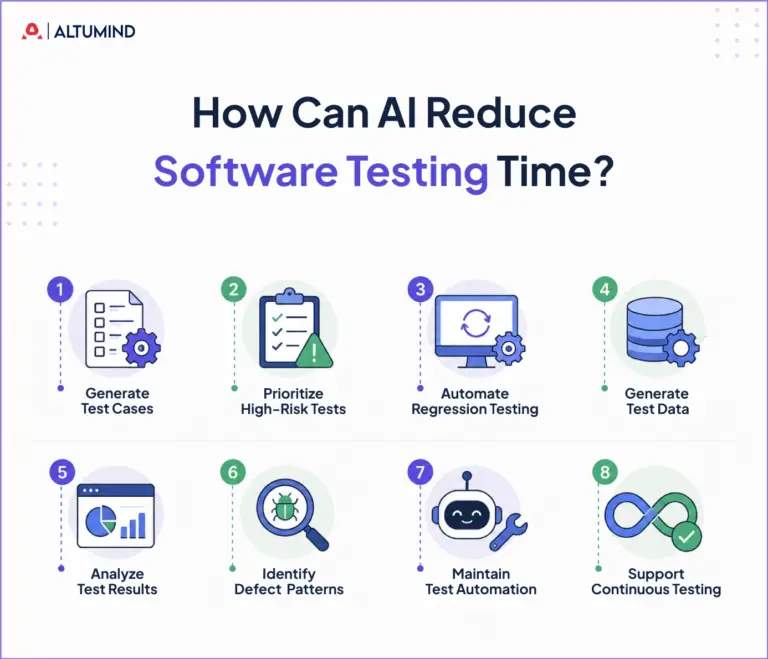
AI can reduce testing time by handling repetitive activities, analyzing large volumes of testing information, and helping QA teams focus their effort on higher-value scenarios.
1. Generate Test Cases
Deriving test cases from requirements and user stories can be time-consuming, especially for applications with complex workflows.
AI can evaluate the requirements, application behavior, and test information and suggest relevant test cases. These cases can then be reviewed and refined by QA professionals to business requirements.
This allows shorter test design cycles and more exploratory testing and more detailed judgment scenarios.
2. Prioritize High-Risk Tests
Enterprise applications may run thousands of tests. Having to run the full test suite for every code change can slow down release cycles. AI helps in prioritizing tests based on their importance by evaluating factors like code changes, previous bugs, previous test results, and application behavior.
This helps teams to prioritize their early testing efforts in areas where they can have the highest impact. It also gives release teams better information for making risk-based decisions when testing time is limited.
3. Automate Regression Testing
Regression testing is one of the most repetitive aspects of software QA. For each release, teams may need to validate existing functionality for a number of workflows and environments.
AI-assisted testing can help to identify relevant regression scenarios and work with automated testing frameworks to run them efficiently. Automation and test maintenance are key priorities of Altumind’s intelligent automation frameworks.
4. Generate Test Data
Test data preparation can become a significant part of the QA workload when teams need different datasets for various scenarios.
AI can help you to generate test data for some conditions, user profiles, workflows, and edge cases. This can cut down the amount of time it takes to prepare and provide testers more room to validate.
But organizations handling sensitive information should still apply appropriate privacy, security, and governance controls to test data.
5. Analyze Test Results
A single test cycle can generate many logs, failed cases, error messages, and execution data.
AI can aid in analyzing this data, identifying similar patterns, clustering similar failures, and flagging results requiring further attention.
This can reduce the manual effort involved in reviewing test results and enable QA teams to investigate issues earlier.
6. Identify Defect Patterns
Historical defect information can reveal recurring problems across applications.
AI can look at past defects, test results, and how the application behaves and find patterns that might mean you need to test some more. For instance, frequent failures around a particular integration can signal an area that needs more attention in the upcoming releases.
These results still need to be checked by QA professionals and evaluated for business impact.
7. Maintain Test Automation
Application interfaces are often modified. An automated test might fail due to a changed element or workflow, even if the functionality is still working correctly.
Some application changes can be detected by AI-driven automation, and test interactions can be modified in response. This can help to reduce some of the maintenance effort of automated testing.
Enterprises with fast-changing applications can improve the productivity of their QA teams over time, with lower maintenance effort.
8. Support Continuous Testing
Testing is increasingly often performed across the development lifecycle, not just at the end of a release.
Artificial intelligence can help select and run tests, interpret results, and find bugs, allowing for continuous testing in CI/CD pipelines. This gives the development and QA teams early feedback and decreases the time to validate quality after code changes.
How Does Faster Testing Create Business Value?
The delivery of the software is directly related to the efficiency of testing. When QA teams spend less time on repetitive work, they can focus more capacity on areas that affect product quality and release readiness.
Business value may include one of the following:
- • Faster time to market: Efficient testing can give development teams more flexibility around release schedules.
- • Better resource utilization: QA people can spend more time in complex and critical business scenarios.
- • Cost and operational risk: Earlier feedback reduces the likelihood that defects progress into later development stages, where remediation can require greater time and resources.
- • Greater testing capacity: Automation saves time, which can be redirected for additional scenarios and coverage.
- • More predictable delivery: Stakeholders get a more predictable testing process and better understanding of the release’s readiness.
The right measurement approach matters. Businesses should compare testing cycle time, regression duration, maintenance effort, coverage, and defect detection before and after AI adoption.
How Can AI Speed Up Testing While Maintaining Quality?
Solid quality controls are needed for fast testing. AI should be part of structured QA where human-appropriate review of automated results is done.
QA professionals continue to be vital in exploratory testing, usability assessment, business validation, risk assessment, and complex scenarios where application context is important.
AI-generated test cases also need to be validated. An automated test can produce a result that does not fully reflect the intended business outcome. Human review can help to determine if a result is a real product issue and what the next step should be.
Security needs similar attention. Functional testing can validate application behavior, and validating risk through penetration testing services can give deeper insight into potential security weaknesses.
For organizations in regulated environments, the increasing impact of AI in compliance also brings into play governance, documentation, data handling, and regulatory requirements.
Altumind’s QA approach combines functional testing, automation, security testing, performance testing, and QA consulting.
Altumind combines functional testing, automation, security testing, performance testing, and QA consulting to help organizations improve software quality while accelerating delivery.
What Should Enterprises Consider Before Adopting AI Testing?
AI testing should start with a clear understanding of the existing QA environment and the business outcome the organization wants to achieve.
1. Assess Automation Maturity
Before adding new AI capabilities, organizations should assess their current automation frameworks, test coverage, CI/CD integration, and maintenance practices.
2. Prioritize High-Risk Tests
AI can bring more value to repetitive and data-intensive activities like regression testing, test case generation, test prioritization, and result analysis.
3. Review Data Requirements
AI-assisted testing can depend on application, testing, and defect data. Businesses should assess data quality, privacy, control of access, and governance needs.
4. Maintain Human Oversight
QA professionals should continue to be involved in the test strategy, validation, risk assessment, and final quality decisions.
5. Consider Security
AI testing can interact with applications, development environments, and testing data. A cybersecurity risk assessment can help organizations evaluate security requirements before introducing AI into existing QA workflows.
6. Integrate With Development
AI testing should be integrated into current development and CI/CD practices. A disjointed testing system can generate more work rather than less.
7. Establish Baseline Metrics
Teams should record current testing performance before implementation. This creates a reference point for measuring whether AI is producing meaningful improvements.
How Should Businesses Measure AI Testing Results?
AI testing should be evaluated through measurable QA and business outcomes.
| Metric | What it measures |
|---|---|
| Testing cycle time | How long the overall QA process takes. |
| Regression execution time | Efficiency of repetitive regression testing. |
| Test coverage | The breadth of functionality being validated. |
| Defect detection rate | Effectiveness of testing activities. |
| Test maintenance effort | Time spent maintaining automated tests. |
| Release frequency | The relationship between QA efficiency and software delivery. |
| QA resource utilization | How effectively teams spend their testing capacity. |
These metrics can help technology leaders determine where AI is delivering practical value and where other testing approaches may be more appropriate.
Where Does AI Testing Fit into a Broader Technology Strategy?
AI-powered QA can form part of a wider modernization strategy when testing is connected with development, automation, and security processes.
For example, organizations implementing AI automation can extend intelligent workflows into software development and testing processes.
Similarly, AI-assisted testing can complement development practices such as AI-driven code optimization, particularly when application changes need to be validated across existing functionality.
The goal should be a connected technology environment where development, testing, automation, and security support consistent software delivery.
Conclusion
Artificial intelligence can assist in decreasing the time needed for software testing by aiding test case generation, intelligent prioritization, regression testing, test data preparation, result analysis, defect pattern identification, and automation maintenance. These capabilities can help businesses improve testing efficiency, freeing up more time for QA professionals to make complex quality decisions.
Altumind has more than 10 years of experience and combines AI, automation, security, performance, and functional testing to help you deliver quality enterprise software. Companies seeking to enhance their testing processes can find out more about our QA services and consider an approach that is right for their applications, delivery model, and business goals.
Table of Contents
- Introduction
- How Can AI Reduce Software Testing Time?
- How Does Faster Testing Create Business Value?
- How Can AI Speed Up Testing While Maintaining Quality?
- What Should Enterprises Consider Before Adopting AI Testing?
- How Should Businesses Measure AI Testing Results?
- Where Does AI Testing Fit into a Broader Technology Strategy?
- Conclusion