AI-Powered Cyberattacks in 2026: What the Global PHP Security Crisis Means for Businesses
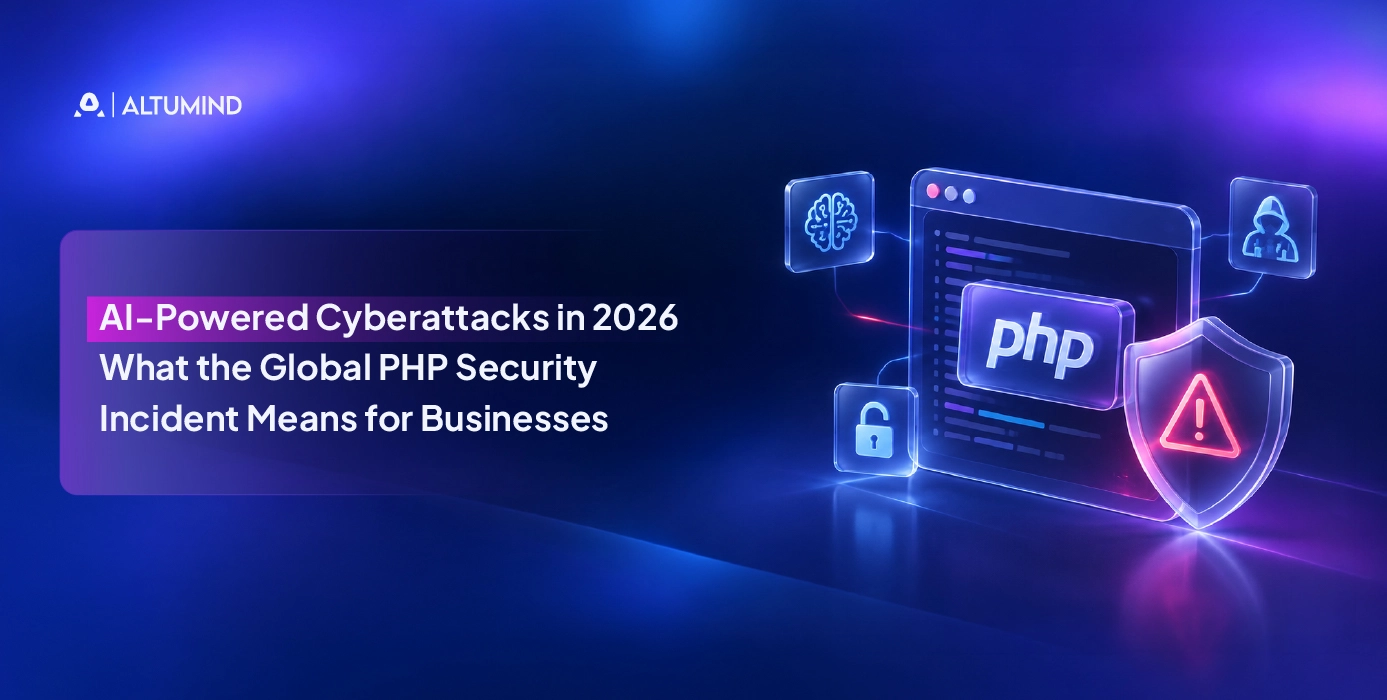
Table of Contents
- Introduction
- What Happened During the Global PHP Security Incident?
- Which Websites and Organizations Were Affected?
- How Is AI Changing the Way Cyberattacks Happen?
- Why Can One Software Vulnerability Affect So Many Businesses?
- What Should Businesses Do to Reduce AI-Related Cyber Risk?
- How Can Enterprise Leaders Build Stronger Cyber Resilience?
- Conclusion
Artificial intelligence is changing how security researchers identify software weaknesses and how attackers may exploit them. The October 2026 PHP security incident showed how a flaw in widely used software can trigger service disruptions across countries, even when organizations have no evidence of a successful breach.
For business leaders, the incident raises important questions about:
- • How quickly teams can identify vulnerable applications.
- • How software weaknesses affect business continuity.
- • How AI-assisted security testing can support faster responses.
This article examines the incident, its operational implications, and the measures businesses can take to strengthen their resilience against AI-assisted cyber threats.
What Happened During the Global PHP Security Incident?
On October 21, 2026, security updates were released for two critical PHP vulnerabilities, CVE-2026-109618 and CVE-2026-109619, collectively referred to as PHP2Shell. The vulnerabilities could allow remote code execution on affected systems under relevant conditions. This means an attacker could potentially run commands on a vulnerable server without first signing in.
PHP runs server-side code for many websites and applications, including systems built with WordPress, Drupal, Joomla, and Magento. A vulnerability in the PHP runtime can therefore affect more than one website or business application.
According to Reuters reporting, researchers used AI tools to help identify the flaws. Following the public disclosure, security teams faced pressure to patch systems before attackers could take advantage of the vulnerabilities.
The incident developed through several stages:
- Researchers identified serious weaknesses in PHP with AI assistance.
- The vulnerabilities became public, and security updates were released.
- Organizations assessed their exposure and applied fixes where available.
- Some organizations temporarily suspended affected services as a precaution.
- Security teams continued monitoring for exploitation attempts and restoring services.
The incident underscores a vital distinction: taking a website offline does not necessarily indicate a breach. Some organizations chose temporary downtime to reduce risk while they applied and verified security updates.
Which Websites and Organizations Were Affected?
The PHP2Shell incident led several organizations and public agencies to temporarily suspend websites or online services. Reuters reported precautionary measures across Europe, Japan, and other regions.
| Organization or service | Reported response |
|---|---|
| BBC | Some web portals were temporarily taken offline. |
| Wikimedia Foundation | Temporarily took down some systems until they could be safely patched. |
| Internet Archive | Briefly took its portal offline for security updates and emergency maintenance. |
| Orange | Suspended access to certain PHP-based websites and applications across several entities. |
| Port of Rotterdam | Temporarily took its public-facing website offline as a precaution. |
| Finland’s government web services | The state IT provider Valtori shut down public web services as a precaution. |
| Japan’s Ministry of Finance and Meteorological Agency | Partially suspended online services while applying safety measures. |
| Government of Canada | Warned that some websites might be temporarily unavailable or disrupted, but said there was no sign that systems or information had been compromised. |
Source: Reuters’ summary of websites and services affected by the PHP flaws.
These responses show that temporary downtime can form part of a responsible security decision. Organizations must weigh the risk of keeping a vulnerable service online against the business impact of suspending it.
The response also demonstrates why communication matters. Customers, employees, partners, and service users need timely updates when systems become unavailable. Clear communication helps reduce confusion while technical teams work on remediation.
How Is AI Changing the Way Cyberattacks Happen?
AI can support legitimate security research, but attackers can also use it to speed up parts of a cyberattack. The PHP2Shell incident illustrates how AI-assisted vulnerability research can strengthen defensive security while also raising concerns about the speed at which discovered vulnerabilities may be exploited.
AI can assist security work by helping researchers analyze code, identify suspicious patterns, and test potential weaknesses. Attackers may use similar capabilities to examine public technical information, adapt exploit code, or identify systems that appear vulnerable.
Key changes include:
- • Faster vulnerability analysis: AI tools can help examine large codebases and narrow the search for weaknesses.
- • Automated reconnaissance: Attackers can automate parts of the process used to identify exposed systems and software versions.
- • More adaptable phishing: AI can help produce convincing messages tailored to a role, company, or business process.
- • Faster exploit development: Public technical details can give attackers a starting point for testing and adapting exploit methods.
However, AI does not automatically make an attack successful. The outcome still depends on factors such as the target’s configuration, the attacker’s access, the available exploit, and the organization’s security controls.
For businesses, the practical response is to shorten the time between identifying a vulnerability, applying a fix, checking the result, and monitoring for signs of compromise.
Why Can One Software Vulnerability Affect So Many Businesses?
Businesses rarely rely on a single application. A retail company, for example, may operate an ecommerce website, customer account portal, inventory system, and order management platform. Different services may share the same programming language, runtime, hosting provider, or third-party component.
When a vulnerability affects a shared component, multiple applications may require attention at the same time.
Three factors can increase the impact:
1. Shared Software Dependencies
Applications may depend on the same runtime, framework, plugin, or external library. A security flaw in one shared component can create risk across several services.
2. Incomplete Asset Inventories
IT teams need to know which applications are exposed, which PHP versions they use, where those versions run, and who is responsible for updating them. Without this information, teams may miss systems during an urgent response.
3. Unclear Business Priorities
Not every application has the same business impact. A payment service, customer portal, or core operational system may need a different response priority from a low-impact informational website.
A current software inventory, clear ownership, and business-based risk ratings help teams determine where to act first. A cybersecurity risk assessment can help organizations identify exposure, evaluate potential consequences, and set remediation priorities.
What Should Businesses Do to Reduce AI-Related Cyber Risk?
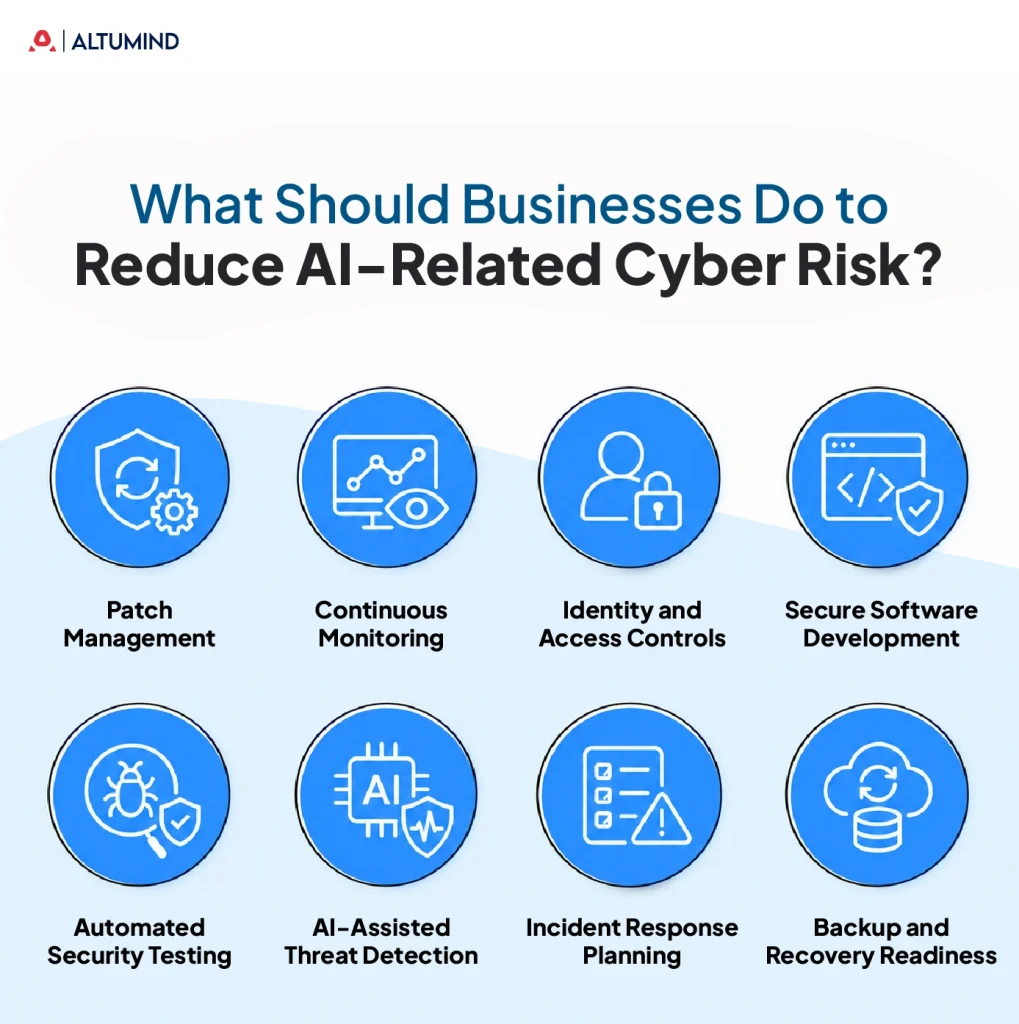
Businesses need a coordinated security program that addresses software weaknesses, unauthorized access, threat detection, and recovery. The following actions can help reduce exposure.
1. Prioritize Patch Management
Track software versions, monitor vendor security advisories, and set patching deadlines based on severity and business risk. For PHP2Shell, administrators should verify that the relevant PHP packages are patched and that affected application processes have restarted or been replaced as required.
Systems that no longer receive security updates need a supported upgrade path or appropriate isolation measures.
2. Monitor Systems Continuously
Monitor server activity, authentication events, unusual requests, application errors, and unexpected changes to files or configurations. Alert teams to suspicious patterns and establish clear procedures for investigating them.
3. Strengthen Identity and Access Controls
Apply multifactor authentication where appropriate, limit administrative privileges, and review service accounts regularly. Restricting access can reduce the damage an attacker may cause if a system is compromised.
A Zero Trust architecture can support access decisions based on identity, device status, and context rather than assuming that a user or system is trustworthy by default.
4. Build Security Into Software Development
Include security requirements in design, development, testing, and deployment. Review third-party dependencies, remove unnecessary components, and address vulnerabilities before releasing changes.
5. Use Automated Security Testing
Automated testing can help teams identify weaknesses earlier and repeat checks more consistently. Combine it with manual review and risk-based testing for critical applications.
Altumind’s AI-powered software testing services can be relevant to organizations seeking to improve testing coverage and identify software defects more efficiently.
6. Apply AI Carefully in Threat Detection
AI-based tools can help analyze large volumes of security data and flag activity that deserves investigation. Organizations should evaluate these tools against their own requirements, check alert quality, and retain human oversight for important decisions.
7. Prepare an Incident Response Plan
Define who assesses a vulnerability, who approves emergency changes, how technical teams communicate, and how business leaders receive updates. Establish clear escalation paths and rehearse the response to different types of security incidents.
8. Test Backups and Recovery Procedures
Backups are useful only when teams can restore the required systems and data within acceptable timeframes. Test restoration procedures, protect backup access, and set recovery objectives based on business needs.
How Can Enterprise Leaders Build Stronger Cyber Resilience?
Cyber resilience depends on how well security, IT operations, business teams, and leadership work together. Technical controls are essential, but organizations also need clear accountability, timely communication, and recovery plans that reflect business priorities.
A factor that often receives less attention is the connection between cybersecurity readiness and business continuity. Organizations need more than technical fixes to respond effectively to a vulnerability.
They also need clear ownership, defined escalation procedures, timely communication, and recovery plans that account for business priorities. When these elements work together, teams can make informed decisions faster, reduce confusion during an incident, and restore essential services with greater confidence.
Leaders can strengthen readiness by reviewing a small set of operational measures:
| Metric | What it tells leadership |
|---|---|
| Time to identify exposure | How quickly teams determine which systems may be affected. |
| Time to apply critical patches | How quickly vulnerable systems receive required updates. |
| Time to detect suspicious activity | How quickly teams identify possible exploitation. |
| Mean time to recovery | How long it takes to restore affected services. |
| Recovery test results | Whether teams can restore systems and data within planned timeframes. |
These measures help leadership assess cybersecurity readiness as part of operational risk management and business continuity. Reviewing them regularly helps leadership identify delays, assign resources, and assess whether the organization can respond effectively when a serious vulnerability emerges.
Conclusion
The October 2026 PHP2Shell incident shows how a vulnerability in widely used software can disrupt public and commercial services across regions. It also highlights the growing role of AI in vulnerability research and the potential for attackers to use public technical information to accelerate exploitation.
Businesses should maintain accurate software inventories, apply security updates promptly, monitor systems continuously, and test recovery plans. Stronger outcomes also depend on clear ownership, coordinated communication, and decisions that balance security risk with business continuity.
Altumind helps businesses strengthen their technology foundations through cybersecurity, secure software development, and digital transformation services, backed by more than 10 years of experience. Learn more about Altumind’s cybersecurity services and how a practical, risk-based approach can support more secure and resilient operations.

Author
Practice Head, Cybersecurity
Sujatha is a cybersecurity consultant and strategic advisor who helps global enterprises secure their digital assets, maintain compliance, and build resilient infrastructure.
Armed with an MBA with Cybersecurity, a CISM certification, and extensive experience across the UK and APAC regions, she specializes in protecting complex banking and financial services environments. By combining a strong technical background with IT Service Management (ITSM) expertise, Sujatha seamlessly integrates robust security frameworks into business operations, translating complex risks into clear, strategic corporate outcomes.
Table of Contents
- Introduction
- What Happened During the Global PHP Security Incident?
- Which Websites and Organizations Were Affected?
- How Is AI Changing the Way Cyberattacks Happen?
- Why Can One Software Vulnerability Affect So Many Businesses?
- What Should Businesses Do to Reduce AI-Related Cyber Risk?
- How Can Enterprise Leaders Build Stronger Cyber Resilience?
- Conclusion