White Label SaaS: How Smart Businesses Launch Branded Software Without Building From Scratch
Building software feels like the right move until you are deep into it. Timelines shift. Budgets expand. By the time the product is ready, the market has already moved on.
Many businesses that take this path do not struggle because of poor planning. Custom software development is genuinely complex, and the gap between what it promises and what it delivers is wider than most leadership teams anticipate.
Here is what that experience typically looks like:
- A six-month project becomes an eighteen-month commitment.
- Development costs grow as requirements and technical complexity evolve.
- Faster-moving competitors capture market share while you are still in build mode.
- Post-launch maintenance consumes a budget that should be going toward growth.
White label SaaS offers a smarter alternative. You launch on a proven, enterprise-grade platform, brand it as your own, configure it for your market, and go live in weeks rather than years. The foundational work is already completed. This article covers how white label SaaS works and how to build a scalable business around it.
Understanding White Label SaaS
White label SaaS refers to software platforms built by one company but rebranded and sold by another under their own brand identity. This model enables businesses to offer sophisticated software solutions without investing in development, maintenance, or infrastructure management.
How White Label SaaS Works
White label software operates through licensing arrangements where platform providers grant partners rights to rebrand and resell solutions to end customers. Partners customize branding, pricing, packaging, and often features while the provider maintains underlying technology, infrastructure, and core functionality.
Core components include:
- Base Platform: Foundational software providing core functionality and features.
- Customization Layer: Branding, configuration, and feature enablement capabilities.
- Infrastructure Management: Hosting, security, updates, and technical operations handled by the provider.
- Support Framework: Technical assistance, documentation, and training resources.
- Pricing Flexibility: Models allowing partners to set their pricing and packaging.
- Integration Options: APIs and connectors enabling ecosystem expansion.
- White Labeling Tools: Interfaces for applying partner branding across user experiences.
This structure allows organizations to focus on sales, customer success, and market positioning while providers handle the complexities of technical operations.
Key Reasons Businesses Choose White Label Over Building From Scratch
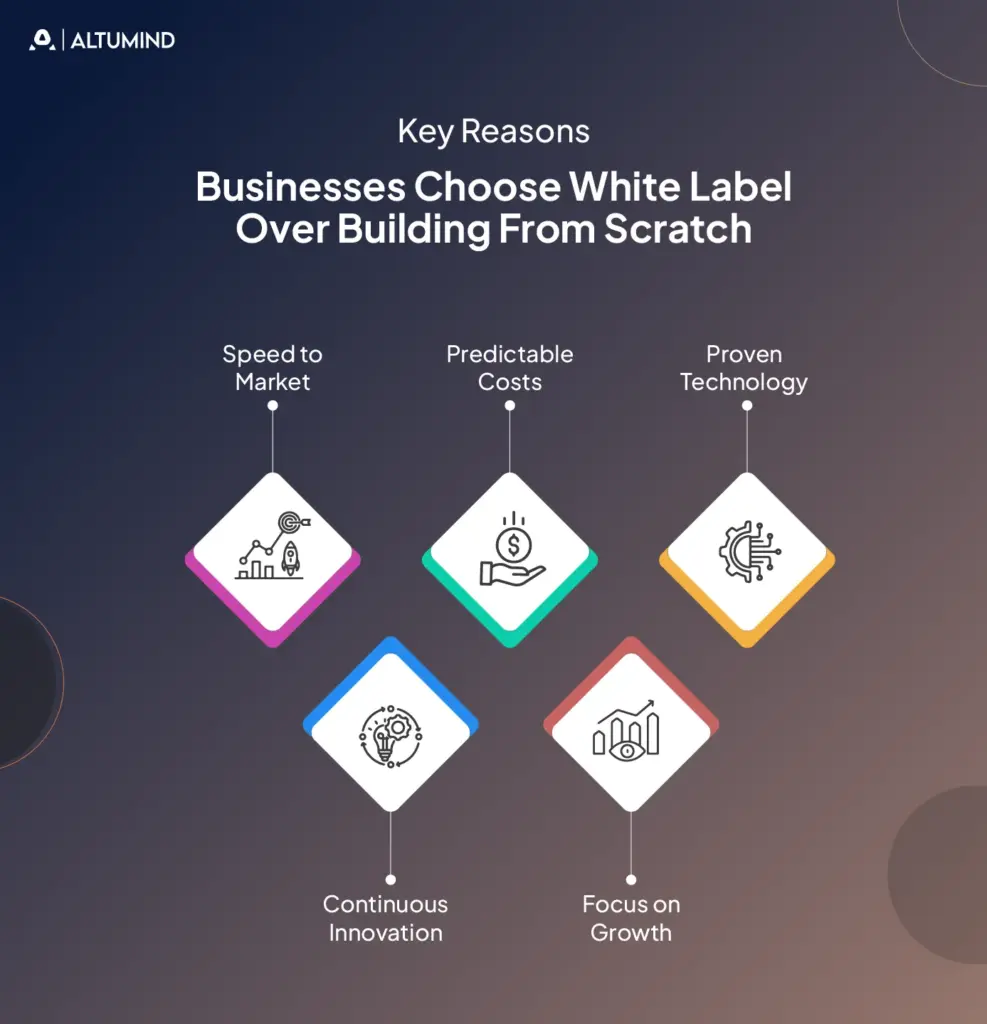
When evaluating software strategy, the decision between white label adoption and custom development comes down to five core business realities. Organizations that get this decision wrong either spend years building what they could have launched in weeks, or they invest in platforms that do not differentiate them in competitive markets. Understanding these reasons helps leadership teams make faster, better-informed decisions.
1. Speed toMarket
Time is a competitive asset, and white label solutions eliminate the longest part of the software journey. Instead of 12 to 18 months of design, development, testing, and deployment, organizations can launch a fully branded, production-ready platform in weeks. That speed advantage translates directly into earlier revenue, faster customer acquisition, and the ability to respond to market shifts before others do.
2. Predictable Costs
Custom development budgets rarely stay fixed. Scope changes, technical complexity, and evolving requirements create cost increases that are difficult to forecast. White label platforms replace that unpredictability with subscription-based pricing that stays consistent as the business scales. Infrastructure costs, security maintenance, and technical debt all sit with the provider, not the partner.
3. Proven Technology
First-version software carries inherent risk. Performance issues and architectural decisions made under time pressure often create challenges that take years to resolve. White label platforms arrive with that difficult period already behind them. Partners inherit technology that has been refined across thousands of real-world deployments, with reliability benchmarks already established in production environments.
4. Continuous Innovation
Keeping proprietary software competitive requires ongoing investment in research, development, and engineering talent. With white label platforms, that responsibility shifts to the provider. Partners benefit from regular product updates, new feature releases, AI capability enhancements, and security improvements; all delivered without additional cost or development effort on the partner’s side.
5. Focus on Growth
Every hour spent managing infrastructure or reviewing technical roadmaps is an hour not spent on sales, customer relationships, or market strategy. White label removes the operational weight of software development entirely, allowing organizations to direct their full attention toward the activities that create competitive advantage and generate revenue.
Custom development remains the right choice when proprietary capabilities are central to competitive positioning, the capital and timeline exist to execute properly, or the market need is too specific for any existing platform to serve.
Benefits of White Label Software Solutions
White label software delivers compelling advantages for organizations seeking to expand offerings, enter new markets, or provide comprehensive solutions without extensive development investment.
1. Accelerated Time to Market
Speed provides critical competitive advantages in dynamic markets. White label SaaS enables immediate deployment rather than multi-year development cycles.
- Instant Availability: Launch offerings within weeks versus 12 to 18 months for custom development.
- Proven Functionality: Leverage battle-tested features without first-version quality concerns.
- Market Testing: Validate demand quickly before committing to a custom development investment.
- Competitive Response: Match competitor offerings rapidly, preventing market share erosion.
- Revenue Generation: Start generating revenue while competitors are still in development phases.
2. Reduced Development and Maintenance Costs
Building software from scratch requires substantial capital investment, ongoing maintenance, and continuous enhancement spending. White label models shift these responsibilities to specialized providers.
- Zero Development Investment: Eliminate upfront software engineering costs.
- No Infrastructure Management: Avoid hosting, security, and operational expenses.
- Included Updates: Receive continuous improvements without additional development budgets.
- Shared R&D Costs: Benefit from provider innovation funded across a broad customer base.
- Predictable Expenses: Subscription models create budget certainty versus variable development costs.
- Reduced Technical Debt: Avoid accumulating maintenance burden that slows future enhancements.
3. Access to Advanced Capabilities
White label platforms provide sophisticated features and integrations that would require significant expertise and time to build independently.
- Enterprise Features: Access security, compliance, and scalability capabilities that require specialized expertise.
- Integration Ecosystems: Leverage pre-built connections to popular business systems.
- AI and Automation: Benefit from advanced technologies continuously incorporated by providers.
- Mobile Applications: Offer native mobile experiences without dedicated mobile development.
- Analytics and Reporting: Provide comprehensive insights through mature reporting frameworks.
- Compliance Certifications: Inherit SOC 2, HIPAA, or ISO certifications from providers.
4. Focus on Core Competencies
White label models allow organizations to concentrate resources on activities that provide genuine competitive advantage rather than technology development.
- Sales and Marketing: Invest in customer acquisition rather than engineering overhead.
- Customer Success: Build relationships and drive adoption rather than managing technical issues.
- Domain Expertise: Apply industry knowledge to positioning and customization.
- Service Delivery: Focus on implementation and support excellence.
- Strategic Partnerships: Develop channel relationships and ecosystem connections.
Key Industries and Use Cases
White label SaaS spans diverse industries, with specific sectors showing strong adoption due to recurring software needs, compliance requirements, or fragmented market structures.
1. Healthcare SaaS
Healthcare organizations face unique software requirements that balance clinical workflows, regulatory compliance, and patient experience. Healthcare SaaS white label solutions address these requirements with specialized, purpose-built platforms.
Common healthcare applications include the following:
- Practice Management: Scheduling, billing, documentation, and administrative workflows.
- Telemedicine Platforms: Virtual care delivery with video consultation and prescription management.
- Patient Engagement: Communication, education, and portal access for patient populations.
- Clinical Documentation: Electronic health records and clinical note generation.
- Revenue Cycle Management: Billing, claims processing, and payment collection.
- Compliance Tools: HIPAA, security, and regulatory requirement management.
Healthcare SaaS requires specialized knowledge around regulations, clinical workflows, and interoperability, making white label approaches particularly well suited to the sector. organizations can leverage proven platforms while focusing on provider relationships and care delivery excellence.
2. Marketing and Agency Solutions
Marketing agencies and consultants use white label software to deliver client services under their own brand without the need to build technology in-house.
Common marketing applications include:
- SEO and Analytics: Search optimization, ranking tracking, and performance reporting.
- Social Media Management: Multi-platform scheduling, monitoring, and engagement tools.
- Email Marketing: Campaign creation, automation, and performance tracking.
- Reputation Management: Review monitoring, response management, and sentiment analysis.
- Content Management: Editorial calendars, collaboration, and workflow tools.
- Reporting Dashboards: Client-facing analytics and performance visualization.
3. Financial Services and FinTech
Financial organizations adopt white label platforms to provide banking, payment, lending, or investment services without building core infrastructure independently.
Financial applications include:
- Payment Processing: Transaction handling, merchant services, and payment gateway functionality.
- Digital Banking: Account management, transfers, and financial product delivery.
- Lending Platforms: Application processing, underwriting, and loan management.
- Investment Management: Portfolio tracking, trading, and advisory tools.
- Compliance Solutions: KYC, AML, and regulatory reporting capabilities.
4. E-Learning and Training Platforms
Educational institutions and corporate training providers use white label learning management systems to deliver branded educational experiences at scale.
Learning applications include the following:
- Course Management: Content delivery, progress tracking, and completion certification.
- Assessment Tools: Quiz creation, testing, and evaluation capabilities.
- Video Hosting: Secure content delivery with access controls.
- Certification Programs: Credential issuance and verification systems.
- Corporate Training: Employee onboarding, compliance, and skill development.
Evaluating White Label SaaS Platforms
Selecting appropriate white label software requires systematic evaluation across technical capabilities, business terms, and strategic alignment to ensure long-term partnership success.
1. Technical Capabilities Assessment
Platform technical quality directly impacts customer satisfaction and support requirements. Thorough evaluation helps avoid selecting solutions that create operational challenges down the line.
Evaluation criteria include:
- Feature Completeness: Whether functionality meets customer requirements without extensive customization.
- Performance and Reliability: System speed, uptime, and scalability under load.
- Security Posture: Data protection, access controls, and compliance certifications.
- Integration Capabilities: APIs, webhooks, and pre-built connectors to essential systems.
- Mobile Experience: Native apps or responsive design quality across devices.
- Customization Options: Branding flexibility and feature configuration without code changes.
- User Experience: Interface quality, intuitiveness, and learning curve for end users.
Request demo accounts, trial periods, and customer references to validate claims about capabilities and performance before committing.
2. Business Model and Economics
Pricing structures and revenue arrangements significantly impact profitability and scalability. Understanding the full economics ensures a viable and sustainable business model.
Commercial considerations include:
- Pricing Structure: Per-user, per-transaction, revenue share, or fixed licensing fees.
- Minimum Commitments: Volume requirements or minimum monthly payments.
- Margin Opportunity: Difference between platform costs and achievable customer pricing.
- Implementation Fees: One-time setup costs versus ongoing subscription expenses.
- Support Inclusions: What technical assistance comes standard versus premium add-ons.
- Contract Terms: Length, termination clauses, and renewal conditions.
- Exclusivity Options: Geographic or vertical market protections.
Modelling long-term financial projections ensures economics support sustainable, profitable growth before signing any agreement
3. Provider Stability and Roadmap
Partner selection involves assessing provider viability and strategic direction to ensure long-term platform availability and continuous enhancement. Strong providers demonstrate a clear commitment to platform evolution and partner success. Evaluating a provider’s approach against a structured SaaS product development roadmap helps ensure their direction aligns with your long-term requirements.
Due diligence includes the following:
- Company Maturity: Years in business, customer base size, and financial stability.
- Product Roadmap: Planned enhancements and innovation commitment.
- Customer References: Existing partner satisfaction and success stories.
- Technical Support: Response times, expertise quality, and available support channels.
- Documentation Quality: Training materials, API documentation, and knowledge bases.
- Exit Strategy: Data portability and transition options if the partnership ends.
Altumind's White Label Success Stories
Altumind has developed sophisticated white label SaaS platforms serving healthcare and commerce sectors, demonstrating deep expertise in building scalable, enterprise-grade solutions that partners can brand and deploy for their own customers.
1. Clinexia: Healthcare Practice Management Platform

Clinexia is Altumind’s healthcare SaaS solution designed specifically for medical practices, clinics, and healthcare organizations that require comprehensive practice management capabilities under their own brand.
Core Capabilities:
Clinexia delivers end-to-end practice management through integrated modules covering scheduling, patient engagement, clinical documentation, billing, and analytics. The platform combines operational efficiency with patient experience excellence, enabling healthcare providers to manage practices effectively while maintaining quality care delivery.
White Label Advantages:
Healthcare organizations, medical groups, and technology vendors can rebrand Clinexia as their proprietary platform, offering comprehensive practice management under their own identity. Partners benefit from Altumind’s ongoing platform enhancement, regulatory compliance maintenance, and infrastructure management while focusing on customer acquisition, implementation services, and domain-specific customization.
2. Merxflo: Commerce and Marketplace Platform

Merxflo is Altumind’s commerce-focused white label solution that enables organizations to launch branded marketplaces, e-commerce platforms, or procurement systems rapidly and with confidence.
Core Capabilities:
Merxflo provides comprehensive commerce functionality supporting B2B marketplaces, B2C retail, procurement platforms, and multi-vendor ecosystems. The platform handles product catalogs, order management, payment processing, logistics coordination, and vendor management through a unified architecture.
White Label Advantages:
Organizations seeking to launch branded marketplaces or procurement platforms can leverage Merxflo’s proven architecture without starting from scratch. Partners receive continuously updated platform capabilities, security enhancements, and new features without managing development teams or infrastructure.
Custom White Label Development
Beyond Clinexia and Merxflo, Altumind develops custom white label SaaS solutions for organizations that require specialized platforms addressing unique market needs not served by existing products.
Custom white label projects typically serve the following:
- Industry-Specific Requirements: Vertical markets with unique workflows, compliance needs, or specialized features.
- Geographic Markets: Localized versions adapted for specific regions, languages, or regulatory environments.
- Enterprise customization: Large organizations requiring significant tailoring while maintaining clear upgrade paths.
- Competitive Differentiation: Partners needing unique capabilities that set them apart from competitors using standard platforms.
Implementation and customization Strategies
Successful white label deployments require a systematic approach that balances speed to market with proper configuration, branding, and integration to ensure a positive customer experience from day one.
Branding and Visual Identity
Effective white labeling makes platforms feel native to your brand rather than an obviously rebranded third-party product.
Branding considerations include the following:
- Visual Consistency: Applying logos, color schemes, typography, and design elements throughout the platform.
- Custom Domains: Using branded URLs rather than provider subdomains.
- Email customization: Transactional and marketing emails that reflect your brand identity.
- Documentation: Help resources, knowledge bases, and support materials branded appropriately.
- Mobile Apps: Custom app store listings, icons, and splash screens where applicable.
- User Interface: Consistent branding throughout dashboards, reports, and workflow screens.
Configuration and Feature Enablement
Most white label platforms offer configuration options that allow feature selection, workflow customization, and business rule definition without requiring code changes.
Configuration approaches include the following:
- Feature Flags: Enabling or disabling capabilities based on market needs or pricing tiers.
- Workflow customization: Adjusting processes to match your service delivery methodology.
- Role Definitions: Creating user types and permission structures that reflect organizational models.
- Integration Selection: Choosing which third-party tools to connect based on customer ecosystems.
- Pricing Models: Configuring tiers, limits, and packaging to align with your go-to-market strategy.
- Notification Preferences: Setting up alerts, reminders, and communication patterns.
Technical Integration Strategies
White label solutions rarely operate in isolation. Integration with existing systems, data sources, and workflow tools is essential for delivering a seamless customer experience.
Integration priorities include the following:
- Identity Management: Single sign-on and authentication against existing user directories.
- CRM Connectivity: Bidirectional sync with Salesforce, HubSpot, or similar platforms.
- Payment Processing: Connecting merchant accounts, payment gateways, or billing systems.
- Communication Tools: Integration with email platforms, SMS gateways, or notification services.
- Analytics Platforms: Feeding data into business intelligence or reporting systems.
- API Development: Building custom integrations where pre-built connectors are not available.
Pricing and Business Models
White label SaaS pricing structures vary significantly across providers and industries. Understanding the available models helps organizations select the right platform and structure profitable customer offerings.
Common Pricing Models
- Per-User Pricing: Partners pay based on active end-user counts with tiered rates that decline at volume. This model aligns costs with value delivery but creates variable expenses as customer bases grow.
- Revenue Share: Providers receive a percentage of revenue partners generate from end customers. This aligns interests but reduces margins and requires careful accounting.
- Flat Licensing: Fixed monthly or annual fees regardless of usage provide cost predictability but may prove expensive at small scale or underpriced at high volumes.
- Per-Transaction: Usage-based pricing that charges for each transaction or API call. Scales naturally with business activity.
- Hybrid Models: Combining base fees with usage-based components to balance predictability with scale alignment.
Evaluate models carefully, considering customer acquisition costs, expected growth trajectory, and target customer pricing before making a platform commitment.
Maximizing Margin and Profitability
- Value-Based Pricing: Price based on customer outcomes rather than cost-plus margins.
- Tiered Offerings: Create good, better, and best packages with higher-margin premium tiers.
- Usage Optimization: Monitor consumption patterns to identify opportunities for reducing platform costs.
- Annual Contracts: Encourage longer commitments that improve cash flow and reduce churn.
- Add-On Services: Layer professional services, training, or customization to generate additional revenue.
- Volume Commitments: Negotiate better provider terms based on realistic growth projections.
Successful white label businesses treat platforms as foundations for comprehensive offerings rather than standalone products. The B2B SaaS growth and scaling blueprint provides additional frameworks for structuring profitable, scalable operations at each stage of expansion.
Scaling Your White Label SaaS Business
Growing from initial customers to a substantial white label operation requires systematic approaches to customer acquisition, operational efficiency, and continuous value enhancement.
Customer Acquisition Strategies
Effective go-to-market approaches leverage existing relationships while building sustainable acquisition channels for continued growth.
Acquisition channels include the following:
- Existing Client Upsells: Introducing software to current service customers as a natural extension of existing relationships.
- Partner Networks: Leveraging reseller, referral, or integration partnerships for broader distribution.
- Industry Events: Conference presence, speaking engagements, and industry association involvement.
- Content Marketing: Thought leadership that establishes expertise and generates inbound interest.
- Direct Sales: Outbound prospecting targeting well-defined ideal customer profiles.
- Channel Partners: Recruiting resellers or implementation partners to expand market reach.
Operational Scaling Considerations
Organizations that complement their white label platform with fully managed IT services often scale support operations more efficiently, freeing internal teams to focus on customer success rather than technical upkeep.
Operational requirements include:
- Standardized Onboarding: Documented processes and automation that reduce manual effort per customer.
- Knowledge Base Development: Self-service resources that answer common questions and reduce support load.
- Support Tier Structure: Efficient routing that separates technical platform issues from business questions.
- Customer Success Programs: Proactive engagement that drives adoption and identifies expansion opportunities.
- Implementation Templates: Repeatable deployment approaches that accelerate time to value.
- Training Programs: Scalable education for customer administrators and end users.
Continuous Improvement and Feedback
Systematic feedback collection creates opportunities to influence provider roadmaps while strengthening competitive positioning over time.
Feedback strategies include:
- Feature Request Aggregation: Systematically collecting and prioritizing customer enhancement requests.
- Provider Collaboration: Regular engagement with platform vendors to share customer insights.
- Beta Participation: Testing new features early to gain competitive advantages and provide meaningful feedback.
- Customer Advisory Boards: Structured forums for gathering input from key customers.
- Usage Analytics: Monitoring feature adoption to identify underutilized capabilities or unmet needs.
Conclusion
White label SaaS provides a commercially proven path for organizations seeking to expand software offerings without the cost, complexity, or extended timelines of custom development. Success depends on choosing the right platform provider, implementing thoughtfully, and building a sustainable go-to-market strategy around a well-positioned branded solution.
organizations that succeed with white label treat the platform as a foundation, layering industry expertise, customer relationships, and service excellence on top of proven technology. When evaluated and deployed correctly, white label SaaS compresses years of development into weeks of launch readiness.
Altumind’s digital product development services support organizations at every stage of this journey, from selecting the right approach to deploying and scaling branded software solutions that deliver real business results.