GEO vs SEO: What Every Business Leader Needs to Know About the Future of Search Visibility
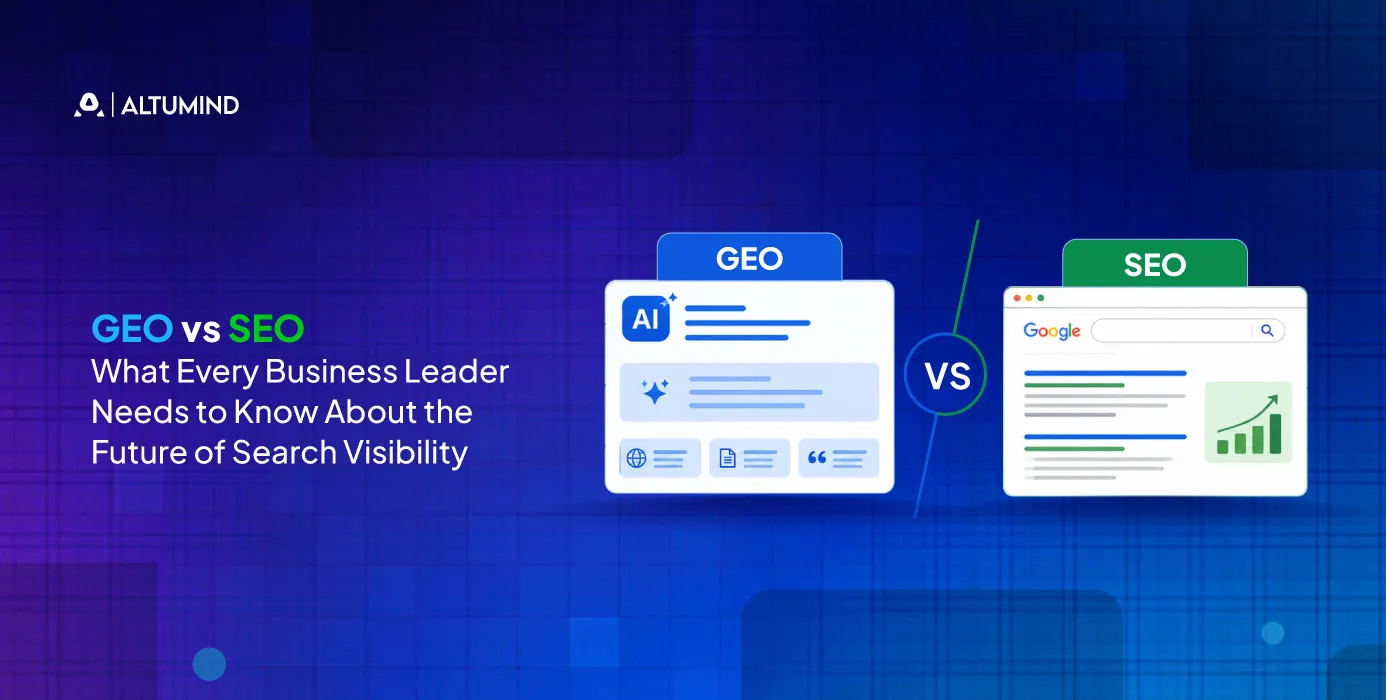
Search is no longer a single discipline. For years, SEO was the definitive framework for digital visibility. That is still true for traditional search engines, but a parallel channel has emerged that operates on entirely different rules.
Generative Engine Optimization, or GEO, addresses how brands appear inside AI-generated answers on platforms like ChatGPT, Perplexity, Gemini, and Claude. These platforms do not show a list of links. They synthesize information and present a direct response, often without the user visiting any website at all.
As AI increasingly shapes how buyers research, compare, and shortlist vendors, this visibility gap can influence buyer consideration and vendor selection long before prospects reach your website or engage with your sales team.
Business leaders who rely solely on traditional SEO are beginning to notice the gap:
- Organic traffic declining despite stable keyword rankings.
- Brand mentions absent from AI-generated responses on relevant topics.
- Competitors appearing in AI answers while their brand does not.
- Content performing well in Google but getting ignored by AI platforms.
- Limited visibility into how brands perform across AI-powered discovery platforms.
Keep reading as we break down GEO vs. SEO, how they differ from AEO, and what decision-makers should prioritize to maintain competitive visibility across both traditional and AI-powered search.
What Is SEO
Search Engine Optimization is the practice of improving a website’s visibility in traditional search engine results pages. The primary platforms are Google and Bing. When a user types a query, these engines return a ranked list of pages based on relevance, authority, and technical quality.
SEO’s core pillars that have remained consistent for decades:
1. Technical SEO
Technical SEO addresses how search engines crawl, index, and understand a website. This includes site speed, mobile responsiveness, structured data markup, URL structure, and internal linking. Without a sound technical foundation, even high-quality content can struggle to rank.
2. On-Page Optimization
On-page SEO focuses on content relevance. This includes keyword placement, heading structure, meta titles, meta descriptions, and content depth. The goal is to signal clearly to search engines what each page is about and why it should rank for specific queries.
3. Off-Page Authority
Off-page SEO refers to signals that come from outside the website, primarily backlinks from other authoritative domains. When credible websites link to your content, search engines interpret that as a signal of trustworthiness and relevance.
4. Content Quality and Depth
Search engines reward content that comprehensively addresses user intent. Thin content that skims a topic tends to rank lower than detailed, well-structured content that genuinely answers what users are searching for.
5. E-E-A-T Signals
Google’s quality evaluator guidelines center on Experience, Expertise, Authoritativeness, and Trustworthiness. These signals influence how content is evaluated and ranked, particularly for topics in the healthcare, finance, legal, and technology sectors.
6. User Experience Metrics
Core Web Vitals, bounce rate patterns, and engagement metrics feed into how search engines assess whether users find value in a page. A technically sound, well-written page that users leave immediately sends a negative signal.
SEO remains essential. Billions of searches happen daily on Google alone. The channel is not going anywhere. However, it no longer represents the full scope of how decision-makers discover information and evaluate options.
What Is GEO
Generative Engine Optimization is the practice of optimizing content so that AI-powered platforms retrieve, cite, and accurately represent a brand when generating responses to user queries.
When someone asks ChatGPT which enterprise software companies specialize in ERP integration or asks Perplexity to compare cloud migration service providers, GEO determines whether your brand appears in that response.
GEO does not operate through ranked lists. It operates through synthesis. AI platforms pull from multiple sources, combine the information, and generate a coherent answer. Brands are more likely to be cited when their content is well-structured, credible, and contextually aligned with the user’s query.
How GEO Works in Practice
AI platforms use large language models combined with retrieval mechanisms. Some platforms like Perplexity retrieve content in real time from the web. Others draw from training data, licensed content, or knowledge graphs. Most use a combination.
To appear in AI-generated responses, content needs to meet specific criteria:
- Clarity and directness: AI systems extract content that answers questions concisely. Buried answers reduce citation likelihood.
- Factual accuracy: AI platforms favor content that can be verified against other sources.
- Structured formatting: Headings, lists, tables, and defined sections make extraction more reliable.
- Entity recognition: Clear associations between a brand, its expertise, and relevant topics help AI systems understand when to cite it.
- External references: Brands mentioned consistently across credible third-party sources carry stronger citation signals.
Why GEO Matters for Business Leaders
Decision-makers increasingly turn to AI platforms for research, vendor evaluation, and problem framing. If your brand does not appear in those conversations, it is far less likely to influence buyers during that stage of their research journey.
This is not a future concern. It is a present one. Improving brand visibility in AI search engines requires deliberate, structured effort that goes beyond what traditional SEO addresses.
1. Content Strategy
GEO changes how content should be written. Comprehensive topic coverage matters more than keyword frequency. Direct answers to specific questions matter more than general overviews. Author credentials and organizational expertise signals matter more than domain authority scores alone.
2. Entity Building
AI platforms build understanding of brands through entity recognition. Consistent representation across the website, press coverage, directories, and social profiles strengthens the entity signal that tells AI systems what your brand represents and which queries it should appear in.
3. Performance Measurement
Measuring GEO performance requires different approaches than traditional SEO analytics. Organizations track brand mentions in AI-generated responses, share of voice relative to competitors across AI platforms, and which content pieces receive citations. Standard traffic analytics do not capture this dimension.
GEO vs SEO: Core Differences
Understanding GEO vs SEO requires examining how each discipline operates across every meaningful dimension. These are not competing frameworks. They are parallel disciplines serving overlapping but distinct visibility goals.
| Dimension | SEO | GEO |
|---|---|---|
| Primary platform | Google, Bing | ChatGPT, Perplexity, Gemini, Claude |
| Output format | Ranked list of links | Synthesized answer with citations |
| User behavior | Clicks through to website | Receives answer without visiting site |
| Ranking signal | Backlinks, keywords, technical factors | Content clarity, entity strength, citation breadth |
| Content goal | Rank for target keywords | Be cited as an authoritative source |
| Measurement | Rankings, organic traffic, CTR | Brand mentions, citation frequency, share of voice |
| Traffic outcome | Direct referral to website | Influence buyer consideration, possible follow-up visit |
| Update cycle | Algorithm updates from search engines | Model updates, retrieval mechanism changes |
| Structured data | Schema markup for rich results | Schema markup for entity and content type recognition |
| Geographic targeting | Location-based ranking factors | Entity localization and regional content relevance |
| Speed of impact | Weeks to months | Gradual, compounds with authority growth |
| Content format priority | Long-form, keyword-optimized pages | Answer-oriented, extractable, structured content |
The most significant practical difference is intent. SEO optimizes for a click. GEO optimizes for a citation. Both ultimately serve brand visibility, but the path from content to outcome is structurally different.
A brand can rank on page one of Google and still be entirely absent from AI-generated responses on the same topic. Both channels require deliberate, separate investment. A well-constructed digital transformation roadmap should address both dimensions rather than treating search visibility as a single workstream.
What Is AEO
Answer Engine Optimization (AEO) focuses on structuring content so that it appears in direct answer features within search engines. The primary context for AEO is Google’s featured snippets, People Also Ask boxes, and voice search responses.
AEO emerged as Google began surfacing direct answers at the top of results pages, reducing the need for users to click through to websites. Optimizing for these positions requires content structured around specific question formats with concise, direct answers immediately following the question.
AEO is most relevant for:
- FAQ pages with clearly formatted question and answer pairs.
- How-to content structured with numbered steps.
- Definition content that opens with a clear, concise explanation.
- Comparison content organized in tables or structured lists.
- Local information that surfaces in voice search responses.
AEO remains within the traditional search ecosystem. It is about winning specific real estate within Google’s results rather than appearing in a separate AI platform entirely.
GEO vs AEO: Key Distinctions
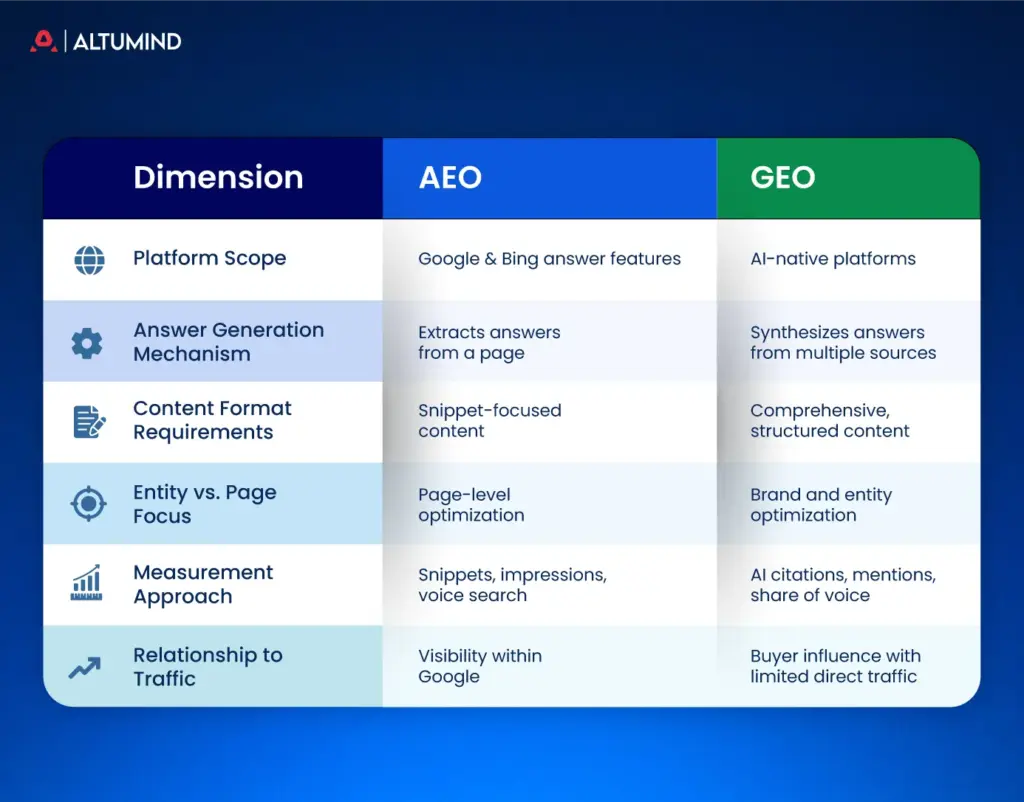
GEO and AEO share surface similarities. Both involve optimizing content to appear in direct answers rather than traditional ranked results. The distinctions become clear when examining where, how, and why each operates.
1. Platform Scope
AEO targets answer features within Google and Bing. GEO targets AI-native platforms like ChatGPT, Perplexity, Gemini, and Claude that operate independently of traditional search engines. These are separate ecosystems with separate retrieval and evaluation mechanisms.
2. Answer Generation Mechanism
AEO answers are extracted directly from content, often word for word or with minimal modification. GEO answers are synthesized from multiple sources into a new response. AEO requires a single page to contain the ideal answer. GEO requires a brand to be consistently represented across multiple credible sources.
3. Content Format Requirements
AEO content is optimized for specific snippet types: paragraph snippets, list snippets, or table snippets. GEO content needs to be comprehensive, well-structured, and answer-oriented across entire topic clusters rather than individual pages optimized for single queries.
4. Entity vs. Page Focus
AEO optimization focuses on the page level. A single well-optimized page can win a featured snippet. GEO optimization focuses on the brand and entity level. A single page is rarely sufficient. Consistent representation across the website, external publications, and authoritative references collectively determines citation likelihood.
5. Measurement Approach
AEO performance is measurable through standard tools. Featured snippet tracking, impression data in Google Search Console, and voice search visibility can be monitored with existing analytics infrastructure. GEO performance requires manual query testing across AI platforms and emerging brand monitoring tools that track mentions within AI-generated responses.
6. Relationship to Traffic
AEO wins can reduce click-through rates by answering queries without clicks, but they maintain visibility within Google’s interface. GEO operates entirely outside the traditional click model. Brand mentions in AI responses build awareness and influence decision-making without generating measurable referral traffic in most cases.
A complete AI search engine optimization strategy addresses SEO, AEO, and GEO as distinct but complementary disciplines rather than treating them as interchangeable.
Is GEO Replacing SEO?
This question comes up consistently in conversations about search strategy. The direct answer is no. GEO is not replacing SEO. It is expanding the definition of what search visibility means.
1. Traditional Search Still Dominates Volume
Google processes billions of queries daily across every industry, geography, and intent type. Organic search remains the primary channel through which users find websites, evaluate vendors, and make purchase decisions. That dynamic is not shifting in the near term.
2. The Research Journey Is Changing Shape
What is changing is where buyers start. Decision-makers are increasingly using ChatGPT or Perplexity to frame a problem, understand a category, or compare solution types before conducting any traditional search. That early research stage is moving into AI platforms, and it is growing. Organizations that establish visibility at this stage can shape buyer perception before formal vendor evaluations begin, creating advantages that extend into later pipeline opportunities.
3. Where Organizations Are Most Exposed
Organizations that have invested heavily in traditional SEO but built no GEO presence face a specific risk: they rank well in Google but are absent from the AI-generated responses their buyers encounter earlier in the research process. The brand simply does not exist in that part of the conversation.
In our work with enterprise organizations, we frequently see brands investing heavily in traditional SEO while overlooking entity development and external authority signals. As AI-powered discovery grows, those gaps increasingly affect how buyers encounter, evaluate, and shortlist vendors.
The Strongest Position Combines Both
Organizations best positioned are those treating GEO and SEO as parallel workstreams built on a shared content and authority foundation:
- Authoritative content that directly answers buyer questions performs across both channels.
- External citations and third-party references strengthen GEO while supporting off-page SEO.
- Structured data and semantic clarity benefit traditional indexing and AI entity recognition simultaneously.
- Topical depth signals expertise to both search engines and AI retrieval systems.
GEO and SEO are not in competition. They serve different moments in the same buyer journey, and both require deliberate, sustained investment.
How to Build Visibility Across Both Channels
Building a presence in both traditional search and AI-generated responses requires coordinated effort across content, technical optimization, and external authority development.
1. Build Answer-Oriented Content at Topic Depth
Content that directly answers the questions your buyers ask performs well across SEO, AEO, and GEO simultaneously. Each piece should open with a direct answer before expanding into supporting context. Topic clusters that cover a subject comprehensively signal authority to both traditional search engines and AI platforms.
2. Implement Structured Data Consistently
Schema markup helps both search engines and AI systems understand what content represents, who created it, and how it relates to specific topics. Organization schema, author schema, FAQ schema, and article schema each contribute to clearer content interpretation across platforms.
3. Strengthen External Citation Signals
AI platforms weigh how consistently a brand is referenced across authoritative external sources. Digital PR, thought leadership contributions to industry publications, and partner ecosystem references all build the external citation footprint that GEO requires.
4. Maintain Consistent Entity Representation
Brand name, description, service categories, and expertise areas should be described consistently across the website, social profiles, press coverage, and directory listings. Inconsistent representation weakens the entity signals that AI platforms use to understand what a brand does and which queries it should appear in.
5. Develop Author and Organizational Credibility
E-E-A-T signals benefit both traditional SEO and GEO. Author bios with demonstrated credentials, organizational about pages that clearly establish expertise, and content that cites primary research or recognized sources all reinforce credibility signals that AI platforms evaluate when selecting sources to cite.
6. Monitor and Adjust Based on AI Platform Performance
Track brand mentions in AI-generated responses through systematic query testing across ChatGPT, Perplexity, Gemini, and Claude. Identify which content earns citations and which topics show competitive gaps. Use that data to guide content investment and authority-building efforts.
7. Integrate Visibility Strategy With Business Objectives
Search visibility, whether in traditional or AI channels, should connect to qualified pipeline and revenue rather than existing as a standalone metric. Aligning content and visibility strategy with buyer journey stages produces stronger commercial outcomes than optimizing for impressions or mentions in isolation.
Conclusion
GEO vs. SEO is not a question of which channel to choose. It is a question of how to build coordinated visibility across both. Traditional search remains the dominant discovery channel for most organizations. AI-powered search is growing its share of the research journey, particularly in the early stages where buyers frame problems and evaluate categories.
Organizations that treat GEO and SEO as separate silos miss the compounding benefits of a unified content and authority strategy. The inputs that strengthen one channel, including credible content, structured data, and external citations, tend to reinforce the other.
The clearest risk is inaction. Competitors who build GEO presence now will accumulate authority advantages that become increasingly difficult to close over time.
Altumind’s digital strategy services help organizations build search visibility strategies designed for the full search environment, covering traditional SEO, AEO, and GEO within a single coordinated framework. Connect with our team to evaluate where your current presence stands and where targeted investment will produce the strongest returns.