LLM SEO: How Large Language Models Decide Which Brands to Mention
Table of Contents
- Introduction
- How Do Large Language Models Decide Which Brands to Mention?
- What Signals Help an LLM Recognize a Brand as Relevant?
- Why Does E-E-A-T Matter for LLM Brand Mentions?
- How Can Enterprises Improve Their Chances of Being Mentioned by LLMs?
- How Should Enterprises Measure LLM SEO Performance?
- What Are the Most Common LLM SEO Mistakes Enterprises Make?
- Conclusion
When a business appears in an AI-generated answer, the outcome is different from earning a traditional search ranking. A large language model may mention a company because its name is strongly associated with a topic, because trusted sources describe it in a relevant context, or because retrieved content gives the model enough evidence to include it.
For enterprise teams, the important considerations include:
- • How clearly the brand is associated with its areas of expertise.
- • How consistently the brand is represented across trusted sources.
- • Whether important business information is available in accessible, extractable formats.
- • Whether third-party sources support the brand’s claims and positioning.
- • Whether AI visibility is measured through business outcomes, not mentions alone.
Altumind works across digital transformation initiatives involving AI, data, software engineering, cloud, automation, and enterprise technology.
That practical perspective matters because LLM SEO connects technical accessibility, brand authority, content quality, and business relevance.
In this article examines how LLMs select brands, which signals influence those selections, what enterprises should improve, and how to measure the business value of AI-driven brand visibility.
How Do Large Language Models Decide Which Brands to Mention?
LLMs generally draw on two broad sources of information: knowledge learned during model training and information retrieved when an AI system performs a live search or grounding process. The exact process varies by platform, model, query, and product configuration, so there is no single public ranking formula for brand mentions.
For businesses, this situation means a brand needs more than strong keyword rankings. It needs a clear and credible relationship with the topics, products, services, and problems that users ask AI systems about.
Several signals can contribute to that relationship:
- • Query relevance: A meaningful connection to the question being asked is essential for the brand.
- • Entity clarity: The system needs to distinguish the company from similarly named entities and understand what it does.
- • Topical associations: The brand should repeatedly appear alongside the subjects it wants to be known for.
- • Source credibility: Independent, reputable sources can provide supporting evidence about the brand.
- • Content accessibility: Important information needs to be available in formats search and AI systems can retrieve and interpret.
- • Freshness: Current information can matter when users ask about products, services, capabilities, pricing, or recent developments.
Industry discussions around LLM visibility increasingly emphasize retrieval and entity signals, but an important business distinction is often lost: being retrieved does not automatically mean being mentioned.
A system may retrieve a company’s page but choose another brand because another source provides clearer evidence, stronger relevance, or a more useful answer for the specific query.
That creates two separate questions for enterprise teams:
- Can the AI system find information about the brand?
- Does the available information give the system a reason to mention the brand?
Those questions should be measured separately.
What Signals Help an LLM Recognize a Brand as Relevant?
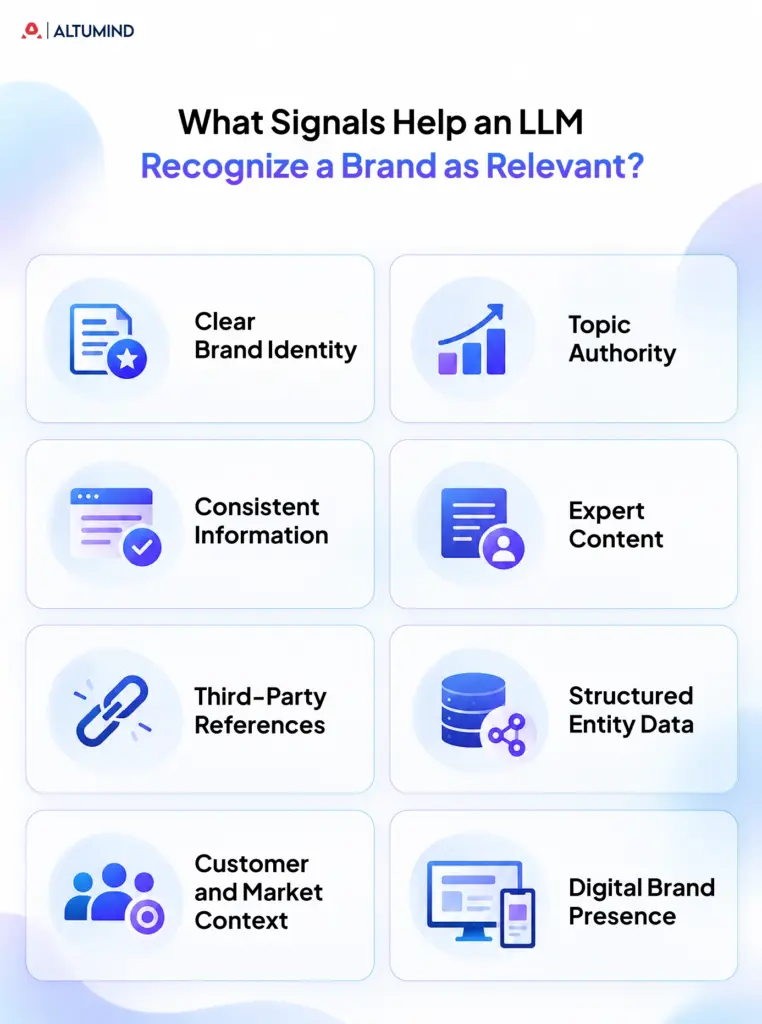
A brand becomes easier for AI systems to associate with a subject when its identity, expertise, evidence, and digital presence remain consistent. The following eight areas provide a practical framework for evaluating that visibility.
1 . Entity Clarity
Entity clarity means that a company has a recognizable and consistent identity across its website and external sources.
Consider an e-commerce company that sells home appliances. Its website describes the business as a home appliance retailer, while its marketplace profiles call it a consumer electronics brand and several third-party directories categorize it as a general online store. These descriptions create a fragmented picture of what the company actually specializes in.
A clearer entity profile would consistently communicate its core category, product range, target customers, geographic markets, and areas of specialization.
Clear entity signals can include:
- • Consistent company name and descriptions.
- • Clear product or service categories.
- • Consistent industry associations.
- • Accurate company, leadership, and location information.
- • Structured data where appropriate.
- • Consistent descriptions across reputable external sources.
The business value extends beyond AI visibility. Consistent positioning can also help customers understand what a company offers and when it is relevant to their needs.
2. Topic Associations
AI systems need contextual relationships, not just isolated keywords.
Consider a fintech company that wants to be recognized for fraud detection solutions. Repeating phrases such as “fraud detection” across service pages is unlikely to provide enough context on its own.
Instead, its content can demonstrate expertise across connected subjects such as transaction monitoring, identity verification, payment security, anomaly detection, financial risk management, regulatory considerations, and real-time analytics.
This creates a broader association between the company and the problems it helps solve.
This is where modern enterprise search behavior becomes important. Enterprise buyers increasingly ask detailed questions such as “How can fintech companies reduce false positives in fraud detection?” or “What should banks consider when implementing real-time transaction monitoring?”
A company that consistently discusses the business problems surrounding its services creates a stronger topical relationship than one that simply repeats a service name.
3. Source Authority
A company’s own website is only one part of its digital evidence.
Independent publications, industry websites, professional communities, customer reviews, interviews, research publications, conference appearances, and other reputable sources can contribute to how the company is perceived online.
Competitor research repeatedly places third-party references among the strongest themes in LLM visibility discussions.
This does not mean that businesses should pursue mentions indiscriminately. The context matters.
A relevant mention from a respected industry publication can be more useful than numerous low-quality pages that repeat the company name without meaningful context.
4. Content Extractability
AI systems need usable information. A company’s strongest differentiator can have limited value if it exists only inside an image, an interactive element, or a page structure that makes the information difficult to retrieve.
Important business information should therefore be presented in clear text where appropriate.
This includes:
- • Service capabilities.
- • Product specifications.
- • Industry expertise.
- • Methodologies.
- • Research findings.
- • Customer questions and answers.
- • Definitions and comparisons.
- • Implementation considerations.
For businesses that rely on digital experiences, clear information architecture and accessible interfaces also matter. Professional UI/UX services can help structure complex product, service, and customer information in ways that are easier for users and digital systems to interpret.
The objective is not to prioritize machines over people but to make useful information clear for both.
5. Fresh Evidence
A company can have strong historical authority and still present outdated information. This becomes particularly important for technology businesses because services, integrations, platforms, standards, and product capabilities change quickly.
A practical content review should identify pages containing:
- • Old service descriptions.
- • Retired technologies.
- • Outdated statistics.
- • Former leadership information.
- • Old product capabilities.
- • Expired customer references.
- • Claims that no longer match the company’s current offering.
Freshness should support accuracy, not become a reason to repeatedly rewrite pages without adding useful information.
6. Brand Consistency
AI systems encounter company information across multiple sources. Inconsistent descriptions across websites, directories, partner pages, and industry profiles can make the brand’s identity and expertise less clear.
Consistency should cover:
- • Company name.
- • Core services.
- • Industries served.
- • Locations.
- • Leadership.
- • Product names.
- • Technology capabilities.
- • Company history.
For enterprise brands, this is also a governance issue. Marketing, sales, product, communications, and technology teams should work from accurate core descriptions rather than creating disconnected versions of the brand.
7. Author Credibility
Strong content needs identifiable expertise behind it. For enterprise technology content, this can mean involving:
- • Solution architects.
- • Data specialists.
- • AI practitioners.
- • Cloud architects.
- • Product leaders.
- • Enterprise consultants.
- • Industry specialists.
Marketing teams can translate expert input into accessible business language while preserving technical accuracy.
This approach provides stronger evidence of subject-matter expertise than relying solely on anonymous corporate bylines.
8. Technical Access
Content cannot contribute to AI visibility if relevant systems cannot access it.
Technical teams should review:
- • Indexability.
- • Robots directives.
- • Canonicalization.
- • Rendering.
- • Internal links.
- • Structured data.
- • Page accessibility.
- • Crawl controls.
- • Content availability.
For ChatGPT search specifically, OpenAI states that websites need to allow OAI-SearchBot to crawl the site for inclusion in search results. Technical access is therefore a prerequisite, not a substitute for strong content and authority.
Why Does E-E-A-T Matter for LLM Brand Mentions?
E-E-A-T matters because AI visibility depends on information that users and systems can trust. Experience, expertise, authoritativeness, and trustworthiness help establish why a company or person should be considered a credible source.
Google describes trust as the most important element of E-E-A-T and states that its systems use multiple signals associated with these qualities.
For enterprise brands, each element has a practical role.
- • Experience: Shows that the organization has worked with the subject in real settings.
- • Expertise: Demonstrates knowledge and technical competence.
- • Authoritativeness: Reflects recognition from relevant external sources.
- • Trustworthiness: Depends on accuracy, transparency, reliable information, and honest representation.
The distinction between experience and expertise is especially useful for technology content. A senior implementation professional may provide valuable first-hand insight into migration planning, integration problems, data quality, or workflow automation. A formally qualified specialist may be better positioned for highly technical or regulated subjects. Strong enterprise content can combine both.
A page can contain technically correct information but still provide little evidence that the company has genuine experience with the subject. Adding an expert perspective, methodology, implementation observation, original analysis, or verifiable business context can materially improve the quality of the content.
How Can Enterprises Improve Their Chances of Being Mentioned by LLMs?
Enterprises should treat LLM SEO as a cross-functional digital program rather than a standalone content activity.
The first step is to identify the questions that matter commercially. Rather than tracking only broad queries such as “healthcare software,” businesses can monitor questions that reflect how their target customers actually evaluate solutions.
For example:
- • Healthcare: “Which healthcare technology providers offer AI solutions for patient engagement?”
- • EdTech: “What platforms help universities personalize online learning with AI?”
- • Fintech: “Which companies provide real-time fraud detection for financial institutions?”
- • Retail: “What AI solutions can retailers use to improve product recommendations?”
- • Manufacturing: “Which technologies help manufacturers use predictive maintenance to reduce equipment downtime?”
These questions provide more context than a broad keyword because they reflect a specific business problem, industry requirement, or purchasing consideration.
The next step is to assess whether the brand has credible, relevant evidence for these questions.
This can include first-party content, expert perspectives, customer evidence, research, and reputable third-party sources that demonstrate relevant expertise and capabilities.
A practical workflow includes:
- Define priority buyer questions. Connect FAQs to products, services, industries, and commercial decisions.
- Record current mentions. Test relevant prompts across the AI platforms that matter to the target audience.
- Separate mentions from citations. Track whether the brand is named and whether the AI system links to or cites a source.
- Review competing brands. Identify which companies appear and what sources support their inclusion.
- Map evidence gaps. Identify missing expertise, third-party references, product information, case evidence, or technical content.
- Strengthen first-party content. Publish useful material that answers specific enterprise questions with original insight.
- Build external authority. Develop relevant industry references, expert contributions, partnerships, media coverage, and professional recognition.
- Repeat measurement. AI responses vary by query, platform, date, and available sources, so one test is not a reliable performance measure.
This connects GEO and SEO rather than treating them as competing disciplines.
Traditional SEO still matters because technical accessibility, relevant content, internal linking, and strong information architecture support search visibility. At the same time, AI search introduces a broader visibility question.
How Should Enterprises Measure LLM SEO Performance?
Mentioning volume alone is not enough. A brand may appear frequently because AI systems reference it as an example, while another company receives fewer mentions but appears consistently in high-intent recommendation queries. A useful measurement framework separates visibility into several layers.
| Measurement | What it tells the business | Why it matters |
|---|---|---|
| Brand mention rate | How often the company is named | Measures AI visibility. |
| Recommendation rate | How often the company is actively suggested | Indicates commercial relevance. |
| Citation rate | How often supporting sources are cited | Shows evidence of association. |
| Owned citation rate | How often the company’s own pages are cited | Shows first-party content strength. |
| Competitor share | Which brands appear alongside the company | Provides competitive context. |
| Sentiment and framing | How the company is described | Indicates brand perception. |
| Query coverage | Which buyer questions produce mentions | Connects visibility to intent. |
| AI referral traffic | Visits from AI platforms | Connects visibility with engagement. |
| Lead or revenue impact | Commercial activity influenced by AI | Connects AI visibility to business value. |
This distinction between mentions and citations is receiving increasing attention in current industry research. Some recent studies report substantial gaps between the two, reinforcing the need to report them as separate metrics rather than combining them into a single AI visibility score.
The business objective should therefore move beyond:
“How often did AI mention us?”
A stronger question is:
“Are AI systems mentioning us when buyers ask commercially meaningful questions, and is that visibility contributing to qualified engagement?”
That shift makes LLM SEO more useful to decision makers, and revenue teams.
What Are the Most Common LLM SEO Mistakes Enterprises Make?
The most common mistakes come from treating AI search as traditional SEO with different keywords.
1. Keyword-First Thinking
Adding phrases such as “AI search optimization” to existing pages does not automatically create stronger AI visibility.
AI systems consider context, relevance, source quality, and the relationship between entities and topics.
2. Generic AI Content
Generative AI can help with research, structure, and drafting, but large volumes of generic text provide limited differentiation.
3. Ignoring External Sources
A company cannot fully control how other sources describe it.
Industry coverage, reviews, partner pages, professional communities, interviews, and other credible references contribute to the broader information environment around the brand.
4. Measuring One Prompt
An AI answer is not a fixed SERP position. Different wording, user context, platform, retrieval sources, and timing can produce different results.
Enterprise measurement should therefore use a defined prompt set and repeated testing.
5. Confusing Visibility With Business Value
A mention or citation does not necessarily translate into leads or revenue. Effective measurement programs connect AI visibility with commercial intent, referral activity, lead quality, assisted conversions, and sales conversations where attribution is available.
6. Publishing Without Governance
Large organizations often have many teams publishing information. Without governance, different pages can create inconsistent descriptions of services, capabilities, products, and expertise.
A central entity and content governance model can reduce that inconsistency while allowing individual teams to publish for their audiences.
Conclusion
LLM SEO is becoming an important part of how enterprise brands think about digital visibility. Large language models do not simply reproduce traditional search rankings.
Brand mentions can depend on relevance, entity clarity, source credibility, accessible information, current evidence, and the broader digital presence surrounding a company. For business leaders, the priority should be measurable commercial relevance rather than mention volume alone.
Altumind brings 10+ years of experience across enterprise technology and digital transformation, helping organizations connect AI, data, technology, and customer experience.
Our professional digital strategy services can bring these capabilities together into a practical, measurable AI visibility program. Get in touch with us to discuss your business goals and identify practical opportunities to strengthen your visibility across AI-driven search experiences.

Author
Web Practice Lead
He is a Web Practice Lead at Altumind with 9+ years of experience in web development, digital engineering, and enterprise web solutions. His expertise spans Drupal, CodeIgniter, PHP, backend development, ERP application development, Acquia Cloud, Pantheon Cloud, and AWS.
With a strong focus on building scalable, high-performing, and user-centric digital experiences, he brings extensive experience in website development, cloud platforms, CMS architecture, and enterprise application solutions. He has also worked on complex platform migrations, including Acquia-to-Pantheon migrations, and has hands-on experience developing HubSpot web pages and integrating modern digital technologies.
Beyond web development, his expertise extends to SEO, AEO, AI Search Visibility, digital marketing, and search optimization.
Table of Contents
- Introduction
- How Do Large Language Models Decide Which Brands to Mention?
- What Signals Help an LLM Recognize a Brand as Relevant?
- Why Does E-E-A-T Matter for LLM Brand Mentions?
- How Can Enterprises Improve Their Chances of Being Mentioned by LLMs?
- How Should Enterprises Measure LLM SEO Performance?
- What Are the Most Common LLM SEO Mistakes Enterprises Make?
- Conclusion