How to Improve Brand Visibility in AI Search Engines and Stay Ahead of the shift
Search behavior is changing faster than most organizations have adapted. Decision-makers are no longer scrolling through pages of results to find answers. They are asking AI platforms directly and acting on what those platforms surface.
If your brand is absent from AI-generated responses, it may be missing opportunities to influence how buyers discover and evaluate solutions. The challenge is that most organizations are still optimizing for a search landscape that no longer represents how decisions get made.
Common gaps that contribute to limited AI search visibility include:
- Relying solely on traditional SEO practices that do not account for how AI platforms retrieve and cite information.
- Publishing content that ranks in Google but lacks the structure required for AI extraction and citation.
- Failing to establish clear entity associations that help AI platforms understand what the brand does and who it serves.
- Underinvesting in expert-led, answer-oriented content that AI systems actively surface in response to decision-maker queries.
- Treating AI search visibility as a future concern rather than an immediate strategic priority.
Understanding how to improve brand visibility in AI search engines requires a different approach from conventional SEO. The strategies that follow address both Google AI overviews and conversational AI platforms. They cover what decision-makers need to implement now to build durability.
Why Is Traditional SEO Alone Is No Longer Sufficient?
Traditional SEO was built around a specific model. Pages earned rankings through backlinks, keyword optimization, and technical performance. Users clicked through to websites and converted from there. Today, brands compete for inclusion within AI-generated recommendations and buying conversations
AI search platforms operate on a fundamentally different model. They retrieve information from multiple sources and synthesize it into a direct response. The user receives an answer without needing to click through to a website. The brand that provided the underlying information may or may not receive attribution.
This shift has significant implications for how organizations approach buyer discovery, category visibility, and competitive positioning. Ranking on page one of Google remains important. Appearing in AI-generated responses across these platforms requires a separate and deliberate set of strategies. These strategies work in parallel with traditional search optimization rather than replacing it.
How AI Platforms Decide What to Surface
AI platforms do not rank pages the way traditional search engines do. They evaluate content based on several factors that differ meaningfully from conventional ranking signals.
Relevance to the query remains important, but the evaluation goes deeper. AI platforms assess whether content directly answers the question being asked. They evaluate whether the source demonstrates credible expertise on the topic. They also consider whether the brand is consistently referenced across credible sources. Frequent visibility reinforces buyer trust and strengthens perceived category leadership.
Organizations that understand these evaluation criteria are better positioned to build content and brand strategies that align with how AI platforms make citation decisions. A well-structured AI search engine optimization strategy addresses all of these dimensions simultaneously rather than treating them as separate workstreams.
7 Strategies to Improve Brand Visibility in AI Search Engines
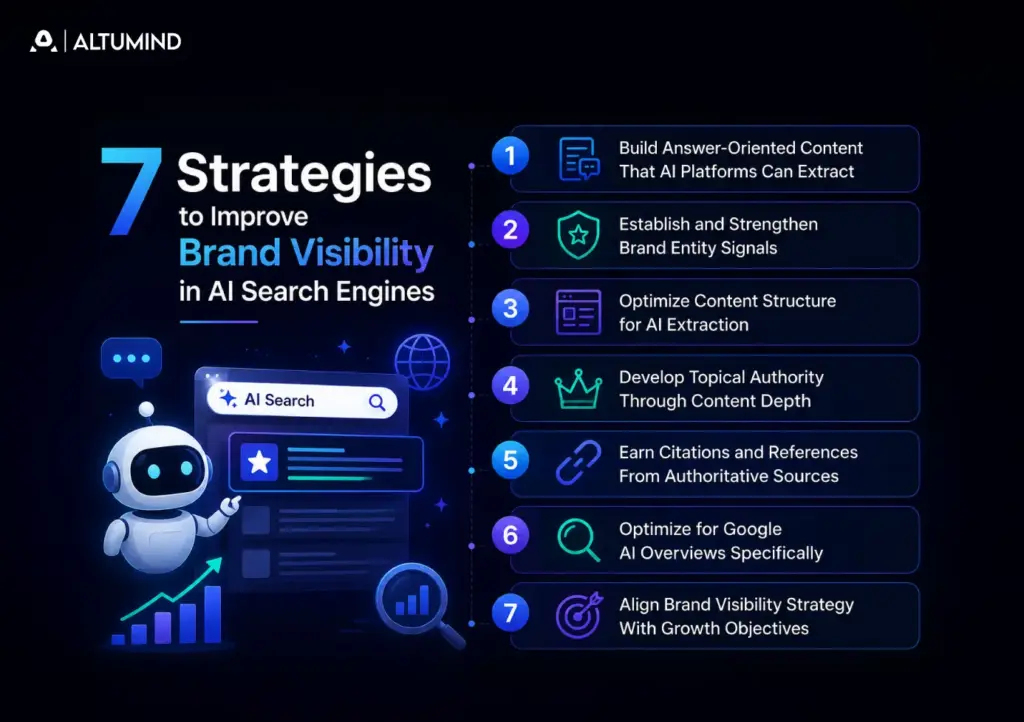
The following strategies address both Google AI overviews and conversational AI platforms. Each one contributes to building the kind of sustained AI search visibility that compounds over time as brand authority grows.
1. Build Answer-Oriented Content That AI Platforms Can Extract
The most fundamental shift required for AI search visibility is moving from content that ranks to content that answers. AI platforms are specifically designed to surface direct, authoritative responses to user queries. Content that delays addressing the user’s question is less likely to be cited. This holds true regardless of its traditional SEO performance.
Answer-oriented content is structured around the questions decision-makers are actively asking. Each piece of content should open with a direct, concise response to its primary question before expanding into supporting context, evidence, and practical guidance. This structure serves human readers who want immediate answers. It also serves AI platforms that extract and synthesize information from multiple sources. This improves discoverability during high-intent research and solution comparison moments.
Content should also address the full range of related questions surrounding a topic rather than a single query in isolation. AI platforms frequently surface content that demonstrates comprehensive topical coverage rather than narrow keyword targeting.
2. Establish and Strengthen Brand Entity Signals
AI platforms build understanding of brands, organizations, and topics through entity recognition. An entity is a clearly defined concept, person, organization, or product that AI systems can identify, categorize, and associate with related topics and queries.
Organizations that have strong entity signals are more likely to be surfaced by AI platforms when users ask questions relevant to their domain. Stronger entity recognition improves visibility across relevant buyer discovery journeys. Building entity strength requires consistency across multiple dimensions:
Consistent brand representation: The organization’s name, description, services, and positioning should be described consistently across the website, social profiles, press coverage, and third-party directories.
Knowledge panel presence: Ensuring the organization has accurate and complete representation in Google’s Knowledge Graph strengthens entity recognition across both traditional and AI search.
Topic association: The brand should be consistently associated with the specific topics, industries, and capabilities it wants to be recognized for across all published content and external references.
Structured data implementation: Schema markup that clearly identifies the organization, its services, its expertise, and its relationships to relevant topics helps AI platforms understand what the brand represents.
Entity strength is not built quickly. It is the product of consistent, sustained effort across content, PR, and digital presence over time.
3. Optimize Content Structure for AI Extraction
AI platforms extract information from content in ways that differ from how human readers consume it. Content that is structured to support AI extraction is more likely to be cited accurately and attributed correctly in AI-generated responses.
Structural optimization for AI extraction involves several specific practices:
Clear heading hierarchy: H1, H2, and H3 headings should accurately describe the content that follows them. AI platforms use heading structure to understand content organization and identify relevant sections for specific queries.
Concise, standalone paragraphs: Each paragraph should communicate a complete idea that makes sense independently. AI platforms frequently extract individual paragraphs rather than full articles, so each paragraph needs to be self-contained and accurate in isolation.
Definition-first formatting: When introducing concepts, lead with a clear definition before expanding into detail. AI platforms frequently surface definitional content in response to “what is” queries.
Bulleted and numbered lists: Structured lists are highly extractable and frequently appear in AI-generated responses. Use them for steps, criteria, factors, and comparisons where appropriate.
FAQ sections: Dedicated FAQ sections with clear question and answer formatting are among the most frequently cited content types across AI search platforms.
4. Develop Topical Authority Through Content Depth
AI platforms consistently favor sources that demonstrate deep, sustained expertise on a topic over sources that cover many topics superficially. Building topical authority requires a deliberate content strategy that develops comprehensive coverage of the subjects most relevant to the brand’s positioning. Sustained topical expertise strengthens category positioning and buyer confidence over time.
Topical authority is built through content clusters. A content cluster organizes related content around a central topic. Individual pieces address specific aspects and subtopics that collectively demonstrate depth of expertise. Each piece within the cluster reinforces the brand’s authority on the central topic while addressing the specific queries decision-makers bring to AI platforms.
The principles behind topical authority development align closely with those that underpin a well-structured digital transformation roadmap. Both require a systematic approach to building capability over time rather than expecting immediate results from isolated efforts.
5. Earn Citations and References From Authoritative Sources
AI platforms place significant weight on how frequently and consistently a brand is referenced across authoritative external sources. A brand that appears only on its own website has limited entity strength. A brand referenced in industry publications, research reports, and credible directories builds distributed authority that AI platforms recognize.
Earning authoritative citations requires a deliberate and sustained effort across several channels:
Digital PR: Securing coverage in industry publications, trade media, and authoritative news sources builds external reference signals that AI platforms recognize.
Thought leadership contributions: Publishing bylined articles, contributing to industry reports, and participating in recognized research initiatives creates citation-worthy content associated with the brand.
Partner and ecosystem references: Being referenced by credible partners, platform ecosystems, and industry associations strengthens the brand’s authority signals across the topics it wants to be recognized for.
Awards and recognition: Industry recognition and awards create authoritative third-party references that contribute to entity strength and citation likelihood.
The goal is to appear consistently across credible external references when AI platforms evaluate sources to cite. Relying solely on owned properties limits entity strength considerably.
6. Optimize for Google AI Overviews Specifically
Google AI Overviews operate differently from other AI platforms in one important respect. They draw primarily from content that Google has already indexed and evaluated for quality. Traditional SEO performance and AI Overview visibility is more closely connected for Google than for other platforms. ChatGPT and Perplexity use broader retrieval mechanisms that extend beyond Google’s index.
Strategies that specifically improve visibility in Google AI Overviews include:
E-E-A-T signal development: Experience, Expertise, Authoritativeness, and Trustworthiness (EEAT) signals remain critical for Google AI Overviews. Content should clearly demonstrate the credentials and experience behind the claims it makes.
Featured snippet optimization: Content that earns featured snippets in traditional Google search is more likely to be surfaced in AI Overviews. Optimizing for featured snippets through concise, direct answers to specific questions remains a valuable practice.
Page experience signals: Core Web Vitals, mobile performance, and page loading speed continue to influence Google’s evaluation of content quality, which in turn affects AI Overview citation likelihood.
Internal linking structure: A well-structured internal linking architecture helps Google understand the topical relationships between content pieces and strengthens the site’s overall trust signals on relevant topics.
Organizations that want to improve visibility in Google AI Overviews should treat it as an extension of their existing SEO practice rather than a completely separate discipline. The fundamentals remain relevant, with additional emphasis on answer-oriented structure and E-E-A-T signal development.
7. Align Brand Visibility Strategy With Growth Objectives
AI search visibility does not operate in isolation from broader business performance. The brands that build the strongest AI search presence align their visibility strategy with clear business growth objectives. They do not treat visibility as an end in itself.
For B2B organizations, AI search visibility should be evaluated in terms of its contribution to qualified pipeline and competitive positioning. The strategies that improve AI search visibility, authoritative content, entity strength, topical expertise, and external citation are the same strategies that build brand credibility with the buyers who matter most.
Organizations building for sustainable growth understand that brand visibility in AI search is one dimension of a broader digital growth strategy. The principles that drive effective B2B SaaS growth apply equally to AI search visibility. Consistency, depth, authority, and a clear understanding of the decision-maker’s journey all matter.
How to Measure Brand Visibility in AI Search Engines
Measuring AI search visibility requires different approaches from traditional SEO analytics. Standard metrics like organic traffic and keyword rankings do not capture the full picture of how a brand is performing across AI platforms.
Tracking Brand Mentions in AI Responses
The most direct measurement of AI search visibility is monitoring how frequently the brand appears in AI-generated responses across platforms. This requires systematic query testing across ChatGPT, Perplexity, Gemini, Claude, and Google AI Overviews. The queries tested should reflect the questions most relevant to the brand’s positioning.
Query testing should cover the full range of questions decision-makers ask at different stages of their research process. Informational queries, comparison queries, and solution-specific queries should all be tested to understand where the brand appears and where it does not.
Monitoring Share of Voice in AI Platforms
Share of voice in AI search measures how often the brand appears relative to competitors when AI platforms respond to relevant queries. This metric provides a competitive context that brand mention frequency alone does not capture.
Tracking share of voice over time reveals whether visibility strategies are gaining ground relative to competitors. It also identifies where competitors are building stronger citation signals. This competitive intelligence informs content prioritization and entity-building investment decisions.
Evaluating Content Citation Rates
Understanding which specific content pieces are being cited by AI platforms provides actionable insight into what is working and what requires improvement. Content that earns frequent citations shares structural and substantive characteristics worth replicating across other content in the portfolio.
Content that is not being cited despite strong SEO performance may need structural optimization or deeper topical coverage. Stronger entity associations may also be required.
What Strategies Improve Brand Visibility in AI Search Engines Over Time
The strategies that deliver sustained AI search visibility share a common characteristic. They build compounding authority rather than producing short-term results that require constant reinvestment to maintain.
Credible content accumulates citation value over time as AI platforms recognize the brand as a reliable source. This recognition grows as the brand’s coverage deepens. Entity signals that are consistently maintained across multiple channels become stronger as the brand’s presence grows across authoritative external references.
Topical authority that is built systematically through content clusters creates a defensible position that is difficult for competitors to replicate quickly. And brand visibility that is aligned with clear business growth objectives delivers measurable returns rather than vanity metrics disconnected from commercial performance.
The transition from traditional search optimization to AI search visibility is not a replacement of existing practices. It is an evolution that requires new disciplines layered onto proven foundations. Organizations that begin building these capabilities now will be significantly better positioned as AI platforms grow. AI platforms continue to expand their share of how decision-makers discover and evaluate solutions.
Conclusion
Improving brand visibility in AI search engines is one of the most strategically important investments a decision-making team can make in the current environment. The platforms buyers use to find answers and evaluate options are shifting rapidly toward AI-generated responses. This shift spans Google AI Overviews, ChatGPT, Perplexity, Gemini, and Claude.
The organizations that build visibility on these platforms now will compound that advantage over time. Those that delay will find the gap increasingly difficult to close as competitors establish stronger entity signals, category expertise, and citation presence across the AI search landscape.
Building this visibility requires a coordinated strategy across content, technical optimization, entity development, and external credibility development. It also requires alignment with broader business objectives so that visibility translates into measurable commercial outcomes rather than awareness without conversion.
Altumind’s helps digital strategy services organizations adapt their digital strategy for an AI-first discovery environment, strengthening visibility, market credibility, and influence across the platforms buyers increasingly rely on. Connect with our team to evaluate how your current digital presence can be optimized for sustained visibility across the platforms your decision-makers are already using.
Let's Connect
Reach out and explore how we can co-create your digital future!