How to Build a Cloud Migration Strategy for Enterprise Success
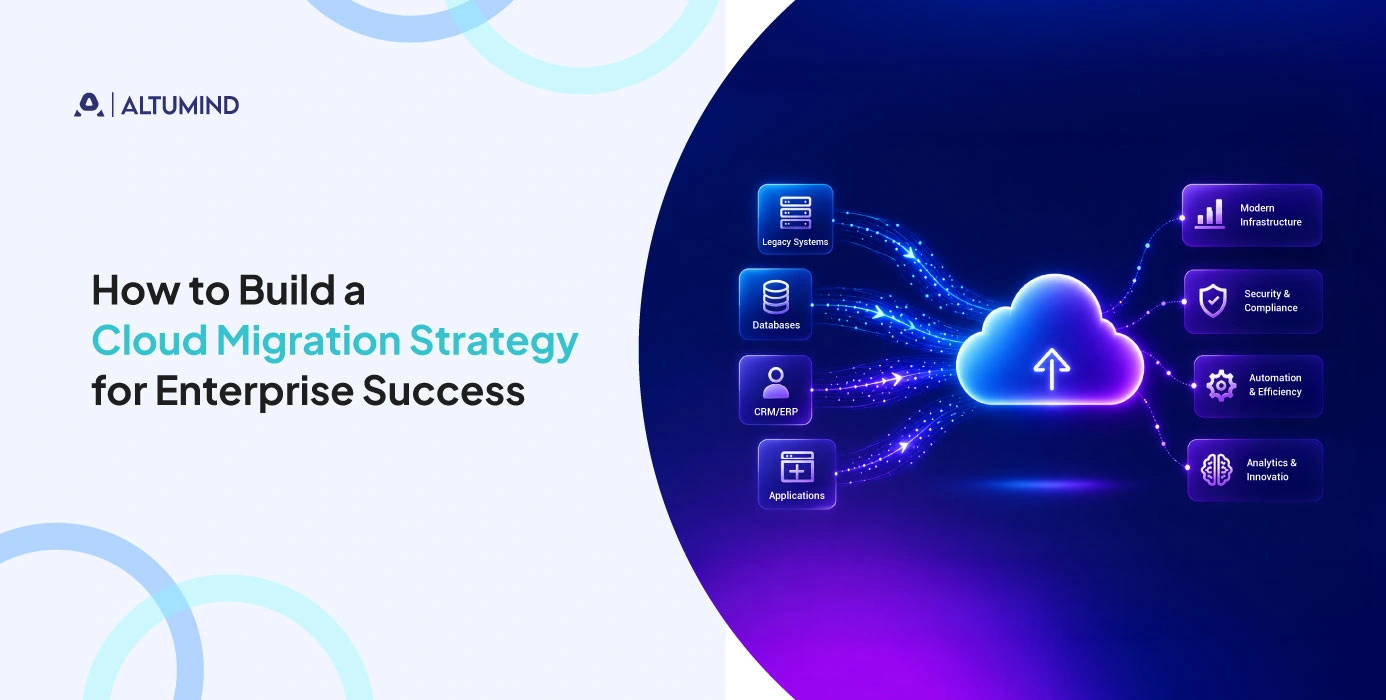
Table of Contents
- Introduction
- Why Is a Cloud Migration Strategy Important for Enterprise Success?
- What Should Organizations Evaluate Before Building a Cloud Migration Strategy?
- How Can Enterprise Leaders Build a Cloud Migration Strategy?
- How Should Enterprises Choose the Right Cloud Migration Approach?
- How Can Security and Governance Strengthen a Cloud Migration Strategy?
- Why Should Cloud Cost Planning Begin Before Migration?
- What Happens After Cloud Migration Is Complete?
- How Can Enterprises Measure the Success of a Cloud Migration Strategy?
- How Does Altumind Support Enterprise Cloud Migration?
- Conclusion
Moving enterprise workloads to the cloud is no longer only about replacing on-premises infrastructure. Organizations are looking for cloud environments that support business growth, improve operational flexibility, strengthen resilience, accelerate product delivery, and create more responsive customer experiences. A successful cloud migration begins with a well-defined plan rather than technology decisions alone.
Before developing a cloud migration strategy, enterprise leaders often evaluate:
- Business priorities and expected outcomes.
- • Existing application dependencies.
- • Security and compliance requirements.
- • Budget planning and long-term cloud costs.
- • Internal skills and operating models.
At Altumind, we have more than 10 years of experience helping organizations modernize enterprise environments through cloud, AI, automation, and digital engineering. In our experience, migration outcomes improve when business priorities, governance, and operating models are established before platform decisions are made. This blog shares practical insights to help enterprise leaders build a structured cloud migration strategy and make informed decisions for long-term business goals.
Why Is a Cloud Migration Strategy Important for Enterprise Success?
A cloud migration strategy provides the structure needed to move enterprise workloads with clear business objectives, defined governance, and measurable outcomes. Without a structured approach, organizations often encounter unexpected dependencies, inconsistent migration decisions, and operational inefficiencies that become significantly more expensive to address after deployment.
Cloud migration influences multiple business functions beyond IT, including finance, operations, security, compliance, customer experience, and product delivery. Because of these factors, migration planning should align with broader business priorities rather than infrastructure upgrades alone.
At Altumind, migration planning typically begins with understanding how cloud adoption supports business goals such as operational efficiency, faster product delivery, improved customer experience, AI adoption, geographic expansion, or digital product innovation. This creates a roadmap that balances technology investments with measurable business outcomes.
A well-planned cloud migration can also give organizations greater competitive agility by helping teams respond faster to changing market demands, launch new digital capabilities, and adapt technology investments as business priorities evolve.
Enterprise Objectives Commonly Supported By Cloud Migration
| Business Objective | Cloud Migration Contribution |
|---|---|
| Improve scalability | Expand infrastructure based on business demand |
| Modernize legacy systems | Support cloud-native architectures and modernization |
| Improve operational efficiency | Reduce manual infrastructure management |
| Strengthen resilience | Improve disaster recovery and business continuity |
| Support AI initiatives | Provide scalable computing and data platforms |
| Improve global performance | Deploy workloads closer to customers |
A practical consideration that is often underestimated is that migration planning should also account for the organization’s future operating model. Decisions made during migration influence governance, monitoring, automation, security, and cloud costs for years after the workloads. Migration decisions shape governance, monitoring, automation, security, and cloud costs for years after deploying workloads.
What Should Organizations Evaluate Before Building a Cloud Migration Strategy?
Before selecting cloud platforms or migration tools, organizations should understand their current technology environment, business priorities, operational processes, and organizational readiness. These factors determine whether migration delivers long-term value or simply relocates existing complexity.
A structured assessment typically covers five areas.
1. Current Infrastructure
Evaluate servers, storage, databases, networking, virtualization platforms, and application hosting environments.
2. Application Portfolio
Identify business-critical applications, technical debt, integration complexity, and modernization opportunities.
3. Data Landscape
Review data sensitivity, regulatory obligations, retention policies, recovery requirements, and integration dependencies.
4. Business Priorities
Define measurable business outcomes such as faster product delivery, improved customer experience, greater competitive agility, product innovation, or technology investments that support new revenue opportunities.
5. Organizational Readiness
Assess internal cloud skills, governance maturity, operational support models, and stakeholder alignment.
Many organizations focus heavily on technical readiness while spending less time evaluating operational readiness. Cloud platforms introduce new responsibilities around governance, monitoring, identity management, financial accountability, and platform operations that require preparation before migration begins.
In enterprise migration programs, application dependencies and governance challenges often introduce more complexity than the migration technology itself. Identifying these factors early can have a greater impact on project success than selecting a specific cloud platform.
How Can Enterprise Leaders Build a Cloud Migration Strategy?
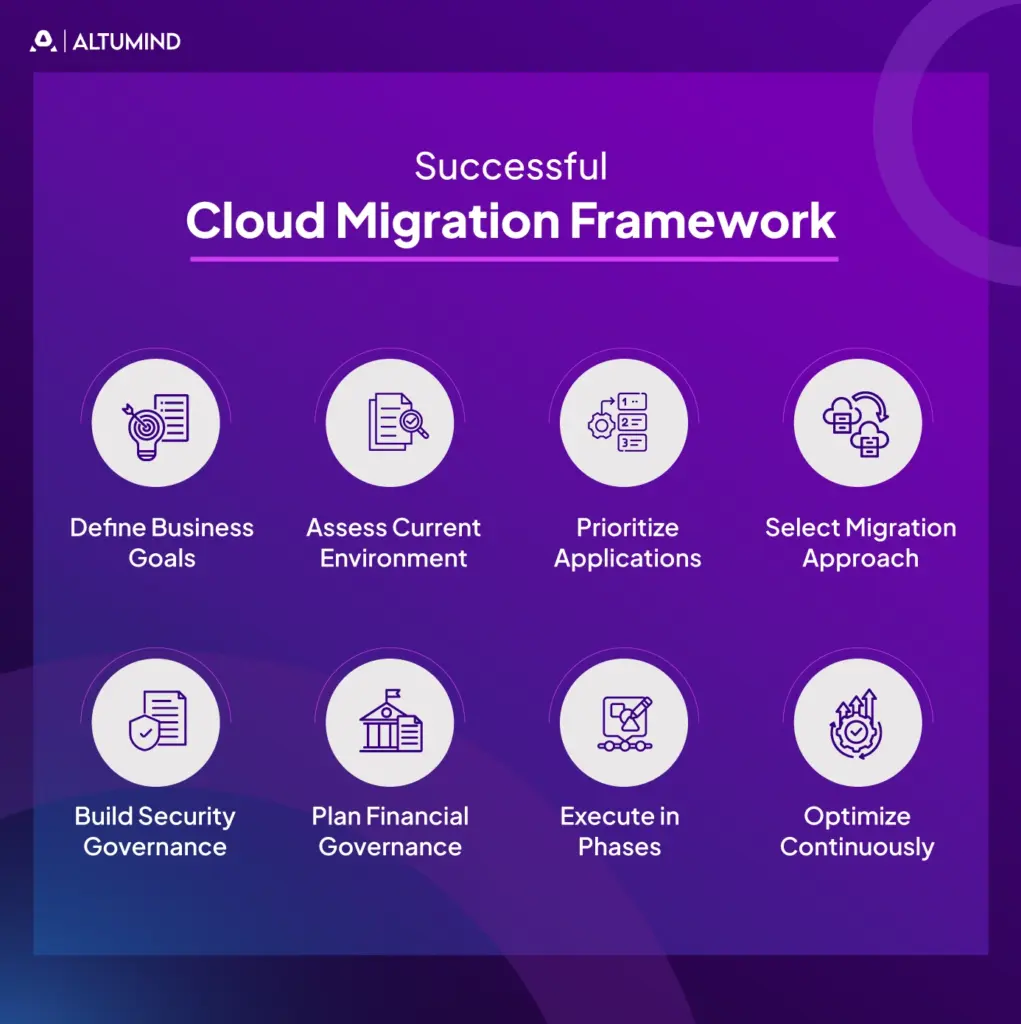
A successful cloud migration strategy combines technical planning with business governance, operational readiness, and long-term optimization. Rather than treating migration as a single project, enterprise leaders should view it as a phased transformation program.
The framework below summarizes the major planning decisions involved before migration execution begins.
Successful Cloud Migration Framework
1. Define Business Goals
Identify measurable business outcomes that cloud adoption should support.
2. Assess Current Environment
Document infrastructure, workloads, dependencies, and operational constraints.
3. Prioritize Applications
Classify workloads based on business value, technical complexity, and migration readiness.
4. Select Migration Approach
Determine whether workloads should be rehosted, replatformed, refactored, repurchased, retired, or retained.
5. Build Security Governance
Establish identity management, compliance policies, risk controls, and security standards before migration begins.
6. Plan Financial Governance
Develop cloud budgeting, cost allocation, forecasting, and FinOps practices to maintain financial visibility.
7. Execute in Phases
Organize workloads into migration waves to reduce operational disruption and simplify validation.
8. Optimize Continuously
Review performance, cloud costs, security posture, and operational efficiency after deployment.
9. Measurable Success Metrics
Define KPIs to track migration outcomes, including application performance, availability, cloud costs, security, and business impact.
Unlike many migration plans that focus primarily on infrastructure, this framework emphasizes governance, operational sustainability, and business outcomes. These areas frequently determine whether cloud investments continue delivering value through faster product delivery, better customer experiences, greater competitive agility, and new revenue opportunities.
How Should Enterprises Choose the Right Cloud Migration Approach?
The right migration approach depends on an application’s architecture, business criticality, technical complexity, and long-term modernization goals. Rather than applying a single strategy across all workloads, enterprise organizations often use multiple approaches within the same migration program.
The following comparison can help decision-makers determine which approach aligns with their business and technical requirements.
| Migration Approach | Best Used When | Business Consideration |
|---|---|---|
| Rehost (Lift and Shift) | Applications require quick migration with minimal code changes | Faster migration, limited modernization |
| Re-platform | Applications need small optimizations for cloud environments | Balances speed and performance improvements |
| Refactor | Long-term modernization is a priority | Higher investment with greater scalability and flexibility |
| Repurchase | Existing SaaS platforms can replace legacy applications | May simplify operations while changing business processes |
| Retire | Applications are no longer required | Reduces operational overhead and cloud costs |
| Retain | Certain workloads must remain on-premises temporarily | Supports phased migration and regulatory requirements |
The decision should balance business priorities, technical feasibility, operational impact, and future scalability rather than focusing solely on migration speed.
In practice, the most difficult workloads are not always the largest ones. Applications with extensive integrations, tightly coupled databases, or undocumented dependencies can require more planning than larger but self-contained systems.
A technically simple application may still depend on databases, APIs, or legacy systems that require coordinated migration planning. Organizations planning application modernization alongside migration may also benefit from reviewing cloud modernization strategies.
How Can Security and Governance Strengthen a Cloud Migration Strategy?
Security and governance should be integrated into migration planning from the beginning rather than added after workloads are deployed. Establishing governance early creates consistent operational practices while helping organizations meet regulatory, security, and compliance expectations.
Enterprise governance generally includes:
- • Identity and Access Management (IAM).
- • Role-based access controls.
- • Data classification policies.
- • Regulatory compliance requirements.
- • Backup and disaster recovery planning.
- • Infrastructure monitoring.
- • Resource tagging standards.
- • Change management processes.
Organizations operating in regulated industries should also evaluate application security throughout the migration lifecycle. Security validation before production deployment reduces operational risks while supporting compliance objectives. Many enterprises include penetration testing services as part of migration readiness assessments:
Another practical consideration that is often underestimated is ownership after migration. Governance is most effective when ownership is assigned before migration waves begin. When teams know who is responsible for security, cost management, application performance, and cloud operations, decisions can be made faster and accountability remains clear after deployment.
Why Should Cloud Cost Planning Begin Before Migration?
Cloud spending is heavily influenced by architectural decisions made during migration planning. Cost optimization is therefore most effective when incorporated into the migration strategy instead of being treated as a post-deployment activity.
Enterprise cost planning typically includes:
- • Resource sizing.
- • Reserved capacity planning.
- • Storage lifecycle policies.
- • Network traffic considerations.
- • Licensing assessments.
- • Cost allocation by business unit.
- • Budget forecasting.
- • Continuous FinOps monitoring.
A structured financial governance model provides visibility into cloud spending while helping teams make informed resource allocation decisions. Cloud costs are also shaped by architecture, workload behavior, and operating practices.
A workload that appears cost-effective during initial migration may require different resource sizing or usage policies as demand changes, making ongoing cost reviews an important part of financial governance. Organizations interested in improving long-term cloud spending can also review these cloud cost optimization strategies.
What Happens After Cloud Migration Is Complete?
Cloud migration is not the final objective. Once workloads are operational, organizations should focus on improving performance, operational efficiency, security, and business value through continuous optimization.
Post-migration activities commonly include:
- • Performance monitoring.
- • Infrastructure optimization.
- • Security reviews.
- • Backup validation.
- • Disaster recovery testing.
- • Cost optimization.
- • Automation opportunities.
- • Capacity planning.
As organizations continue their cloud journey, the focus often shifts from migration to improving application performance, operational efficiency, and long-term maintainability. Modernizing applications during this phase helps organizations take full advantage of cloud-native capabilities while reducing technical debt. Incorporating AI-driven code optimization into modernization initiatives can improve code quality, simplify ongoing maintenance, and support faster application enhancements.
As cloud environments expand, managing infrastructure, governance, security, and performance across multiple workloads can place additional demands on internal IT teams. Organizations looking to strengthen day-to-day cloud operations often consider cloud management outsourcing to supplement internal expertise, improve operational consistency, and maintain visibility across evolving cloud environments.
How Can Enterprises Measure the Success of a Cloud Migration Strategy?
A cloud migration strategy should deliver measurable business and operational outcomes long after workloads are moved to the cloud. Defining success metrics before migration begins helps organizations evaluate progress, identify optimization opportunities, and demonstrate business value to stakeholders.
The most effective cloud migration programs monitor both technical performance and business impact.
| Key Metric | Why It Matters |
|---|---|
| Application availability | Measures service reliability after migration |
| Performance improvements | Evaluates response times and user experience |
| Cloud cost efficiency | Tracks resource utilization and spending trends |
| Deployment frequency | Indicates operational agility and release efficiency |
| Security posture | Assesses compliance and vulnerability management |
| Infrastructure utilization | Helps optimize cloud resources |
| Business continuity | Validates disaster recovery and resilience capabilities |
A practical consideration that is often underestimated is that migration success should not be measured solely by project completion. Continuous monitoring, governance reviews, and optimization activities provide a clearer picture of whether cloud investments continue to support evolving business goals.
Organizations can further improve operational visibility by combining cloud environments with cloud-based analytics to monitor infrastructure performance, business metrics, and resource utilization through centralized dashboards.
How Does Altumind Support Enterprise Cloud Migration?
Building a successful cloud migration strategy requires balancing business priorities, technical architecture, governance, security, and long-term operational planning. Every enterprise has unique workloads, compliance requirements, and modernization goals, making a structured and phased approach essential.
Altumind helps organizations plan and execute cloud initiatives through consulting, cloud engineering, automation, AI, software development, and enterprise modernization services. Our multidisciplinary approach combines cloud consulting, engineering, AI, automation, application modernization, and managed services to help organizations maximize long-term value from cloud investments.
Conclusion
Building a successful cloud migration strategy requires more than selecting the right cloud platform. It involves aligning business objectives, application readiness, governance, security, financial planning, and operational excellence throughout the migration journey. Organizations that take a structured, phased approach are better positioned to build cloud environments that support long-term growth, innovation, and resilience.
With more than a decade of experience delivering cloud transformation, AI, automation, and enterprise technology solutions, Altumind helps organizations develop migration strategies tailored to their business goals and technology landscape. If you’re evaluating your cloud roadmap or preparing for an upcoming migration initiative, connect with our cloud consulting team to evaluate your cloud roadmap and build a strategy that delivers measurable business value.
As your cloud journey progresses, our cloud application development services can help you modernize existing applications and build scalable cloud-native solutions that support future business growth.
Table of Contents
- Introduction
- Why Is a Cloud Migration Strategy Important for Enterprise Success?
- What Should Organizations Evaluate Before Building a Cloud Migration Strategy?
- How Can Enterprise Leaders Build a Cloud Migration Strategy?
- How Should Enterprises Choose the Right Cloud Migration Approach?
- How Can Security and Governance Strengthen a Cloud Migration Strategy?
- Why Should Cloud Cost Planning Begin Before Migration?
- What Happens After Cloud Migration Is Complete?
- How Can Enterprises Measure the Success of a Cloud Migration Strategy?
- How Does Altumind Support Enterprise Cloud Migration?
- Conclusion