What Is the Difference Between Cyber Essentials and Cyber Essentials Plus?
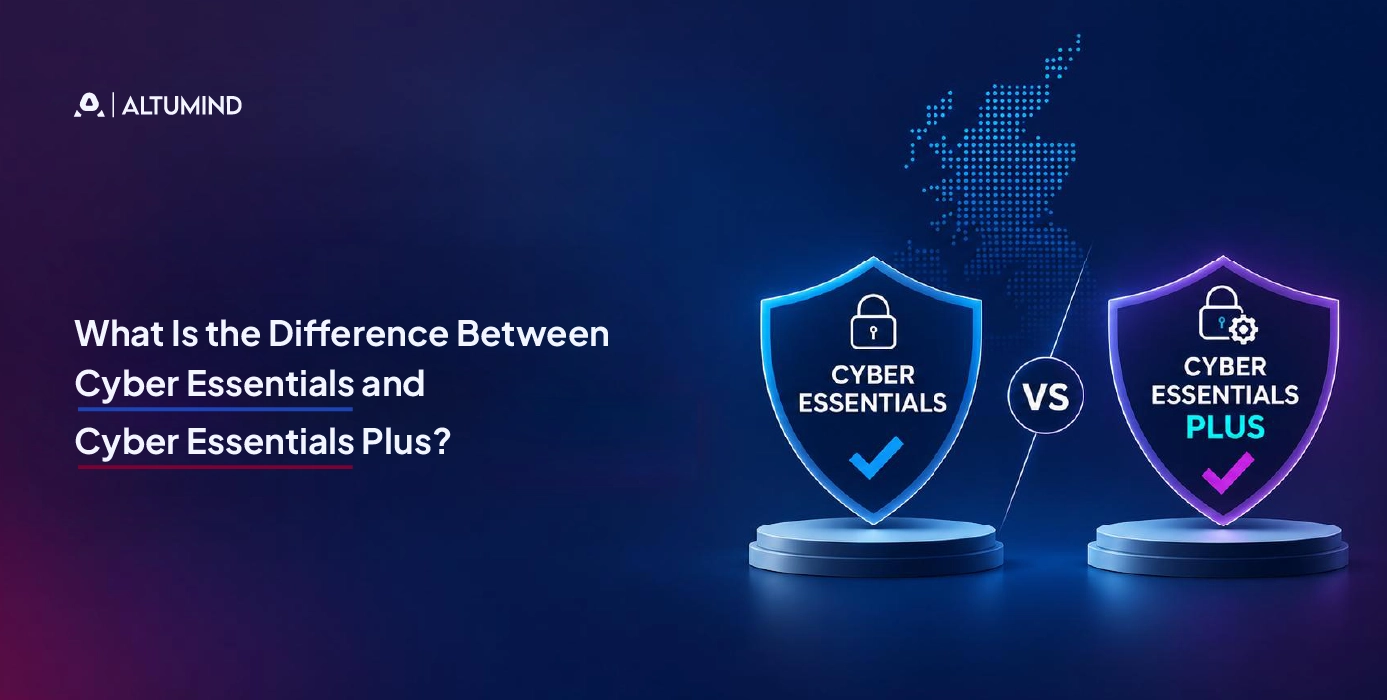
Table of Contents
- Introduction
- Cyber Essentials vs Cyber Essentials Plus: Key Differences
- What Does Cyber Essentials Certification Involve?
- What Additional Testing Does Cyber Essentials Plus Include?
- Which Certification Should Your Business Choose?
- Why Do Businesses Fail Cyber Essentials Assessments?
- Do Cyber Essentials and Cyber Essentials Plus Cost the Same?
- Can a Business Move from Cyber Essentials to Cyber Essentials Plus?
- How Can Altumind Support Your Cybersecurity Readiness?
- Conclusion
Choosing between Cyber Essentials and Cyber Essentials Plus depends on how much independent verification your business needs. Both certifications follow the same five technical security controls, but they differ in how assessors verify compliance. Understanding these differences can help businesses select the right certification for their security needs, customer expectations, and contractual obligations.
Cyber Essentials vs Cyber Essentials Plus: Key Differences
Cyber Essentials is based on a verified self-assessment: a questionnaire the organisation completes and an assessor reviews. Cyber Essentials Plus adds independent, hands-on technical testing. Both demonstrate that an organisation has addressed common cybersecurity risks, but Plus provides additional evidence that its security controls work in practice.
| Comparison | Cyber Essentials | Cyber Essentials Plus |
|---|---|---|
| Assessment method | Self-assessment questionnaire | Self-assessment plus independent technical testing |
| Technical testing | No additional hands-on technical audit | Includes technical tests of relevant systems and devices |
| Security verification | Assessor reviews questionnaire responses | Assessor verifies security controls through testing |
| Cost | Lower certification fee | Higher cost due to additional testing |
| Preparation | Requires accurate IT records and control checks | Requires the same preparation, plus technical readiness |
| Best suited for | Organisations seeking baseline certification | Organisations needing stronger independent assurance |
| Certificate validity | 12 months | 12 months |
The main distinction is the level of verification. Cyber Essentials assesses the information submitted by the organisation, whereas Cyber Essentials Plus checks whether relevant security controls operate as reported.
What Does Cyber Essentials Certification Involve?
Cyber Essentials provides a recognised baseline for protecting an organisation against common internet-based threats. Businesses complete an online assessment covering five technical control areas:
- • Firewalls.
- • Secure configuration.
- • Security update management.
- • User access control.
- • Malware protection.
A certification assessor reviews the submitted questionnaire. The organisation must provide accurate information about its IT environment and demonstrate that it meets the applicable requirements.
This option may suit businesses that want to demonstrate baseline cybersecurity practices without undergoing the additional technical testing required for Plus.
However, a completed questionnaire does not automatically mean an organisation meets the requirements. Its answers must reflect actual system configurations and security arrangements.
Businesses preparing for Cyber Essentials certification in the UK should first understand the assessment requirements and the security controls they need to meet.
What Additional Testing Does Cyber Essentials Plus Include?
Cyber Essentials Plus includes the same baseline requirements, but adds independent technical verification. An assessor tests relevant systems and devices to check whether the organisation’s security controls work as expected.
Depending on the assessment scope, testing may cover:
- • User devices and endpoint security.
- • Malware protection arrangements.
- • Security update status.
- • User access and authentication controls.
- • Internet-facing systems and infrastructure.
The purpose is to identify gaps that a questionnaire alone may not reveal. For example, a business may have a documented patch management policy, but technical testing could identify devices that have not received the required updates.
This additional verification can provide customers, partners, and procurement teams with greater confidence in an organisation’s security arrangements.
Cyber Essentials Plus is not a replacement for wider security testing. Businesses with complex applications or software environments may also need independent quality assurance and software testing to assess risks outside the certification’s scope.
Which Certification Should Your Business Choose?
The right option depends on your organisation’s contractual obligations, risk exposure, customer expectations, and available resources.
Choose Cyber Essentials if:
- • Your organisation needs baseline cybersecurity certification.
- • Your customers or contracts require Cyber Essentials.
- • You want to demonstrate that the five technical controls are in place.
- • Your organisation is preparing for its first certification.
- • You need a lower-cost certification route.
Choose Cyber Essentials Plus if:
- • Your customers or business partners expect independent technical verification.
- • Your organisation handles sensitive business or customer information.
- • You operate a larger or more complex IT environment.
- • You want additional evidence that security controls work in practice.
- • Your organisation needs stronger assurance for procurement or supply-chain requirements.
Some public-sector contracts specify Cyber Essentials or an accepted equivalent. Requirements depend on the contract, so businesses should check the relevant procurement terms before selecting a certification level.
For a UK business, the choice should also reflect the security expectations of its industry and customers. For example, organisations operating in retail may need to consider payment environments, customer information, and third-party platforms as part of their wider security planning.
Why Do Businesses Fail Cyber Essentials Assessments?
Businesses can face assessment problems when their documented security policies do not match their actual IT configurations. These issues can affect both certification routes, although Plus may identify additional technical gaps during its independent testing.
Common problem areas include:
| Assessment issue | Why it matters |
|---|---|
| Incomplete IT scope | Relevant devices, cloud services, or systems may be overlooked |
| Unsupported software | Outdated systems can fall outside the scheme’s requirements |
| Inconsistent MFA | Authentication controls may not cover all relevant accounts |
| Excessive permissions | Unnecessary administrator access increases security exposure |
| Poor patch management | Devices may miss required security updates |
| Inaccurate questionnaire answers | Responses may not reflect actual technical configurations |
| Weak cloud service ownership | Unclear responsibility can lead to configuration and access gaps |
Businesses should review these areas before applying. A cyber security risk assessment can also help identify wider technical and operational risks that may need attention.
The threat environment continues to change. Businesses should also consider how AI powered cyberattacks can affect exposed applications and systems. Reviewing vulnerabilities and application security practices can help organisations address risks beyond the Cyber Essentials baseline.
Do Cyber Essentials and Cyber Essentials Plus Cost the Same?
No. Cyber Essentials Plus generally costs more because it includes independent technical testing in addition to the assessment process.
The Cyber Essentials fee is based on the organisation’s employee-size category. Plus pricing depends on factors such as the number of systems, devices, and the complexity of the IT environment being tested.
Businesses should request a current quotation from an IASME-approved certification body before budgeting. They should also account for any internal remediation work needed before assessment.
The lowest initial certification cost may not represent the lowest overall cost. Addressing unsupported software, configuration gaps, and access issues before applying can reduce avoidable delays and additional work.
Can a Business Move from Cyber Essentials to Cyber Essentials Plus?
Yes, within a fixed window. An organisation must hold a valid Cyber Essentials certificate first, then complete the Plus assessment within three months of that certificate’s issue date. If it misses that window, it has to repeat the standard Cyber Essentials certification at full cost before attempting Plus again.
Staging the two makes sense for businesses that want the baseline in place before committing to independent testing. But treat them as one timeline. Get the technical controls ready (patch status, device configuration, access controls) before the standard assessment, so the three-month window isn’t spent on remediation.
How Can Altumind Support Your Cybersecurity Readiness?
Preparing for either certification requires more than completing a questionnaire. Businesses need an accurate understanding of their IT environment, consistent security configurations, and clear ownership of technical controls.
Altumind supports organisations with cybersecurity, IT, cloud, and software-related services. Its technical support can help businesses review security gaps, improve system configurations, and address application-level risks as part of wider cybersecurity readiness.
The right support depends on the organisation’s existing systems and certification objectives. Businesses should also work with an appropriately licensed certification body for the formal assessment and award.
Conclusion
Cyber Essentials and Cyber Essentials Plus address the same key technical security controls, but they offer different levels of verification. Cyber Essentials provides baseline certification through a self-assessment, while Plus adds independent technical testing.
UK businesses should consider their contractual requirements, IT complexity, customer expectations, and security objectives before choosing. Whichever option they select, maintaining effective security controls throughout the year matters more than treating certification as a one-time exercise.

Author
Practice Head, Cybersecurity
Sujatha is a cybersecurity consultant and strategic advisor who helps global enterprises secure their digital assets, maintain compliance, and build resilient infrastructure.
Armed with an MBA with Cybersecurity, a CISM certification, and extensive experience across the UK and APAC regions, she specializes in protecting complex banking and financial services environments. By combining a strong technical background with IT Service Management (ITSM) expertise, Sujatha seamlessly integrates robust security frameworks into business operations, translating complex risks into clear, strategic corporate outcomes.
Table of Contents
- Introduction
- Cyber Essentials vs Cyber Essentials Plus: Key Differences
- What Does Cyber Essentials Certification Involve?
- What Additional Testing Does Cyber Essentials Plus Include?
- Which Certification Should Your Business Choose?
- Why Do Businesses Fail Cyber Essentials Assessments?
- Do Cyber Essentials and Cyber Essentials Plus Cost the Same?
- Can a Business Move from Cyber Essentials to Cyber Essentials Plus?
- How Can Altumind Support Your Cybersecurity Readiness?
- Conclusion