Sales Forecasting with Predictive AI: How Enterprises Can Improve Forecast Accuracy
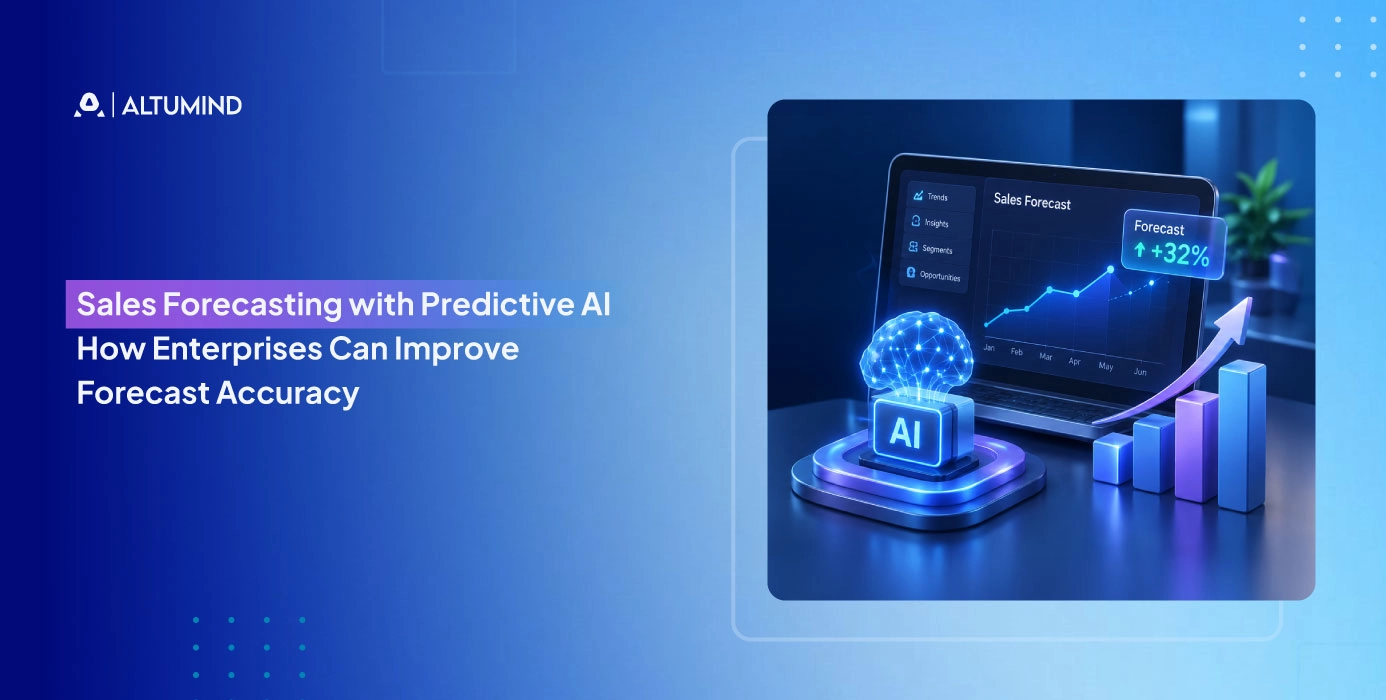
Table of Contents
- Introduction
- How Does Predictive AI Change Enterprise Sales Forecasting?
- What Data Does Predictive AI Need for Sales Forecasting?
- Which Sales Forecasting Use Cases Deliver the Most Business Value?
- When Should Enterprises Combine Predictive AI with Predictive Lead Scoring?
- What Should Enterprises Consider Before Implementing Predictive AI?
- How Does Predictive AI Create Business Value Beyond Forecast Accuracy?
- Conclusion
Sales teams and finance leaders rely on forecasts for revenue planning, resource allocation, inventory decisions, and pipeline management. But enterprise sales data is usually present across CRM, ERP, commerce, marketing, and operational systems, making consistent forecasting more difficult.
Organizations employing predictive AI for sales forecasting should assess the following:
- • Model accuracy.
- • Current model performance.
- • Availability and quality of data.
- • Integration into existing workflows.
- • Decision ownership and human review.
- • Business definitions and projection objectives.
Altumind’s predictive AI capabilities are part of a broader business and technology system. In this article, we’ll discuss how predictive AI can assist with sales forecasting, where it can provide quantifiable business value, and what enterprises should consider before implementation.
How Does Predictive AI Change Enterprise Sales Forecasting?
Predictive AI changes sales forecasting by combining historical performance with multiple business signals to estimate future sales more dynamically. Instead of relying mainly on historical averages or manual adjustments, machine learning models can analyze pipeline activity, customer behavior, seasonality, product demand, pricing, and other relevant variables.
Traditional forecasting still has value because sales leaders often possess context that data cannot fully capture. Predictive AI gives teams another way to validate business assumptions against emerging patterns in the data.
For enterprises, the important question is not simply whether an AI model can predict sales. It is whether the forecast reaches the right decision-maker at the right time and at the right level of detail.
| Business function | Forecasting requirement |
|---|---|
| Finance | Revenue by month, quarter, business unit, or region |
| Sales leadership | Pipeline conversion and expected bookings |
| Operations | Product and demand expectations |
| Supply chain | Expected demand by product or location |
| Marketing | Expected response and revenue contribution |
| Executive leadership | Revenue scenarios and planning assumptions |
A useful forecasting system therefore connects prediction with business planning.
Altumind’s capabilities span data and analytics, AI, enterprise applications, cloud, automation, and software engineering, allowing predictive use cases to connect with broader enterprise systems rather than operate as isolated analytical tools.
What Data Does Predictive AI Need for Sales Forecasting?
Predictive AI requires consistent, relevant, and sufficiently detailed data to generate useful sales forecasts. The model is only one part of the system; the data’s quality and structure affect its usefulness.
Common enterprise data sources include:
| Data source | Relevant signals | Forecasting application |
|---|---|---|
| CRM | Opportunities, stages, close dates, activities | Pipeline and revenue forecasting |
| ERP | Orders, invoices, product information | Revenue and demand forecasting |
| Commerce platforms | Transactions and customer behavior | Demand and customer forecasting |
| Marketing platforms | Engagement, leads, conversions | Pipeline and revenue signals |
| Customer systems | Purchase history and account activity | Account-level forecasting |
| Inventory systems | Stock levels and availability | Demand planning |
This is where predictive data & analytics become important. Forecasting models need data with consistent definitions and sufficient historical context.
For example, an opportunity marked as closed in a CRM may not represent the same business event as an order recorded in an ERP system. If these definitions are inconsistent, the model can learn relationships that do not reflect actual business processes.
Cloud-based analytics can also bring sales and operational information into a more accessible analytical environment, particularly when organizations work with large and distributed datasets. It can also support this broader analytical architecture.
The goal should not be to collect every available data point. Enterprises should identify the signals that directly support the business decision the forecast is intended to improve.
Which Sales Forecasting Use Cases Deliver the Most Business Value?
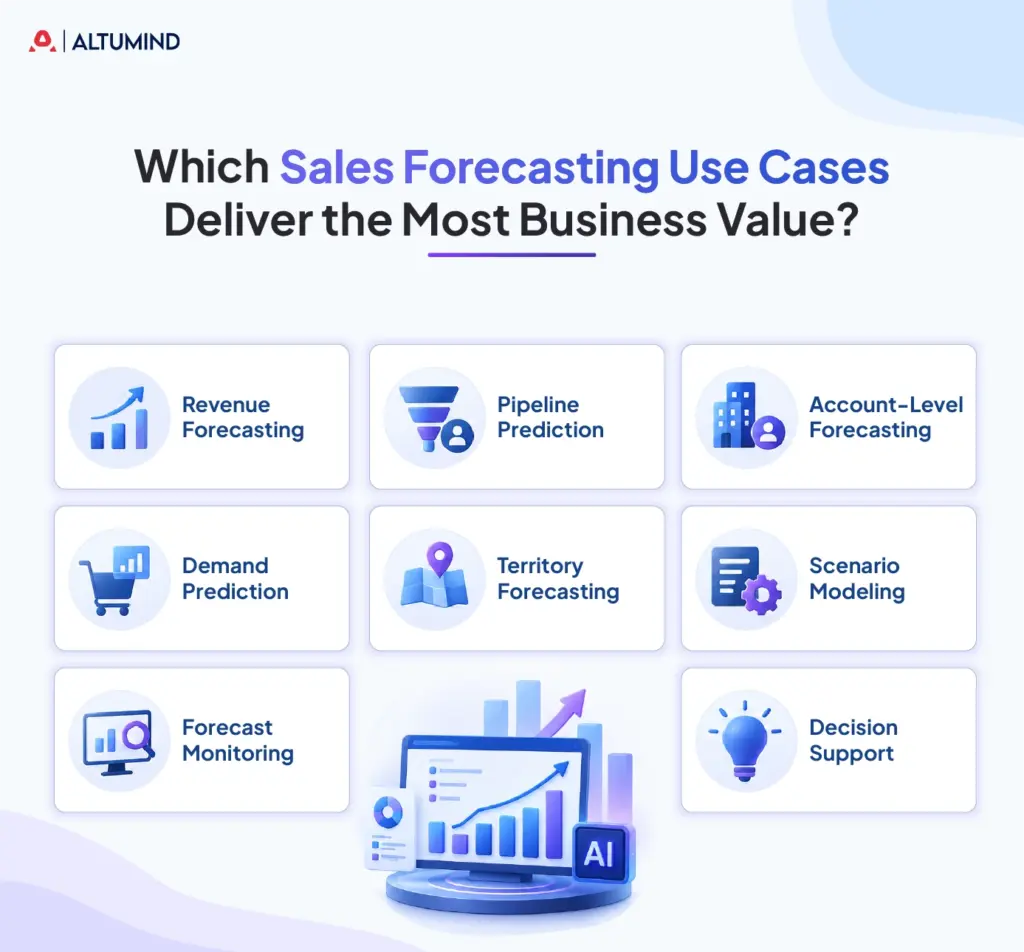
The strongest impact use cases for an enterprise are those that directly link forecasts to decisions about revenue, customers, inventory, capacity, and resources.
Revenue Forecasting
Predictive AI is able to forecast expected revenue based on past sales, pipeline movement, customer behavior, seasonality, and other business signals.
These forecasts can inform budgets and revenue scenarios for finance teams while providing sales leaders with a systematic view of expected performance across teams, regions, products, or accounts.
Its value comes from connecting the forecast to planning and operational decisions.
Pipeline Prediction
Pipeline prediction focuses on the likelihood that opportunities will progress and contribute to revenue.
Models can consider:
- • Opportunity age.
- • Stage progression.
- • Historical conversion rates.
- • Customer engagement.
- • Deal size.
- • Sales cycle duration.
- • Account characteristics.
This helps sales leaders separate pipeline volume from pipeline quality.
A large pipeline does not present equal revenue potential. Predictive analytics gives sales teams greater context when assessing expected bookings and revenue contribution.
Account-Level Forecasting
Enterprise sales organizations often manage strategic accounts with different purchasing patterns, contract structures, product mixes, and sales cycles.
Forecasting at the account level can identify the behavior of individual customers, instead of applying one average to an entire segment. It can assist with planning accounts, preparing for renewals, cross-selling, engaging customers, and setting expectations for revenue.
Altumind’s data and analytics capabilities include Customer 360 approaches that bring together information across customer touchpoints to support predictive insights and customer decisions.
Demand Prediction
Sales forecasting and demand forecasting often intersect. A sales forecast can give signals for procurement, inventory, staffing, fulfillment, and production planning. This is especially true for businesses where sales demand and physical inventory are tightly coupled.
Digital commerce companies can integrate AI-based demand forecasting with data on inventory and customer behavior. Our digital commerce capabilities include demand forecasting, AI-powered recommendations, personalized journeys, and real-time inventory capabilities.
Territory Forecasting
Organizations with regional sales teams can use predictive models to compare expected sales across territories.
This can support:
- • Sales capacity planning.
- • Territory planning.
- • Regional targets.
- • Account allocation.
- • Resource planning.
Territory-level forecasts can also reveal differences that an enterprise-wide forecast may hide.
Scenario Modeling
Forecasting becomes more useful when leadership can examine different assumptions.
For example, teams can compare scenarios based on:
- • Higher or lower conversion rates.
- • Changes in average deal size.
- • Different sales capacity levels.
- • Pricing changes.
- • Seasonal demand.
- • Customer retention assumptions.
Scenario modeling does not predict one guaranteed outcome. It gives decision-makers a structured way to assess possible outcomes before committing resources.
Forecast Monitoring
A predictive model should be monitored after deployment because customer behavior, products, sales processes, and business conditions change.
Useful monitoring areas include:
- • Forecast error.
- • Forecast bias.
- • Model performance by segment.
- • Prediction stability.
- • Data quality.
- • Manual overrides.
- • Changes in sales processes.
Altumind’s data and analytics capabilities include real-time dashboards, AI and machine learning predictions, and continuous optimization approaches that support ongoing analytical performance.
Decision Support
Predictive AI should support sales managers, finance leaders, and commercial teams rather than automatically replace their judgment.
Its role can be to provide evidence, identify patterns, compare scenarios, and surface changes that deserve attention.
This distinction matters because business decisions often depend on information that a model cannot fully capture.
When Should Enterprises Combine Predictive AI with Predictive Lead Scoring?
Predictive lead scoring and sales forecasting can work together when an organization wants to connect early customer signals with downstream revenue expectations.
Predictive lead scoring asks: Which leads are more likely to convert?
Sales forecasting asks: What revenue or sales volume is likely to occur?
AI sales intelligence can connect these stages by bringing customer, pipeline, behavioral, and operational signals into a broader decision framework.
The relationship can be represented as follows:
Lead behavior → predictive lead scoring → opportunity creation → pipeline progression → sales forecast → revenue planning
The connection is useful because lead quality can influence future pipeline quality. However, organizations should maintain clear definitions between leads, opportunities, conversions, and revenue.
If marketing defines a qualified lead differently from sales, predictive models may learn from inconsistent outcomes. The technology should therefore support a shared commercial data model rather than simply add another AI layer to disconnected processes.
Altumind’s sales intelligence capabilities include predictive lead scoring alongside conversational AI and embedded analytics to help sales teams identify relevant opportunities and support more informed actions.
What Should Enterprises Consider Before Implementing Predictive AI?
Enterprises should assess the business objective, data foundation, integration model, governance requirements, and operating process before selecting a predictive AI solution.
Define the Forecasting Objective
Start with the decision the forecast must support.
Is the objective to improve quarterly revenue planning, opportunity forecasting, inventory planning, account management, territory planning, or resource allocation?
A clear objective makes it easier to identify the appropriate data, forecast horizon, model, and performance metrics.
Assess Data Readiness
Review:
- • Data completeness.
- • Historical depth.
- • Data consistency.
- • CRM hygiene.
- • ERP integration.
- • Product and customer identifiers.
- • Timestamp accuracy.
- • Changes in sales processes.
Data preparation can require substantial organizational work because forecasting models depend on reliable historical relationships.
Select the Right Forecasting Approach
Different forecasting problems may require different modeling approaches, including time-series forecasting, regression, classification, ensemble approaches, or machine learning.
The model should match the business problem rather than being selected because it is technically sophisticated.
Connect the Model to Enterprise Systems
A forecast has limited value if users must manually export data, interpret a separate dashboard, and re-enter decisions into another system.
Integration with CRM, ERP, business intelligence, commerce, and planning systems can make forecasts more actionable.
This is also where digital product development services can support connected enterprise applications, API integrations, dashboards, and commerce systems.
For organizations looking beyond forecasting alone, agentic systems focused on business automation can connect predictive outputs with workflows that trigger actions across business functions.
Establish Human Review
Sales forecasts contain uncertainty. Enterprise teams should define when human review is appropriate and how forecast overrides are recorded.
A useful process can distinguish between:
- • Model prediction.
- • Human adjustment.
- • Reason for adjustment.
- • Final approved forecast.
This creates transparency and gives teams useful feedback about model performance.
Address Security and Compliance
Sales forecasting systems may process customer, financial, employee, and commercial information.
Security considerations can include access controls, encryption, API security, identity management, audit trails, data residency, privacy requirements, and application security testing.
For systems that expose customer or enterprise data through APIs and connected applications, penetration testing services can form part of a broader security testing strategy.
AI-enabled forecasting also requires appropriate compliance controls. The influence of AI in compliance can extend to how organizations monitor data, document decisions, and apply internal policies.
How Does Predictive AI Create Business Value Beyond Forecast Accuracy?
Predictive AI creates business value when better forecasts lead to better decisions.
Forecast accuracy remains important, but enterprises should also measure what changes after forecasts become available.
| Business area | Potential value |
|---|---|
| Revenue planning | Better planning based on current signals |
| Sales management | Better prioritization of opportunities |
| Inventory | More informed demand and replenishment decisions |
| Staffing | Better alignment between capacity and expected demand |
| Finance | More structured scenario planning |
| Customer management | Better account-level planning |
| Operations | Better response to changing demand |
A forecasting system can have strong technical performance but limited business impact if sales and finance teams continue relying on disconnected spreadsheets or separate planning processes.
The broader operating model matters as much as the prediction itself. Forecasts need clear ownership, accessible reporting, defined decision points, and integration with the systems teams already use.
For example, a revenue forecast can inform finance planning, while pipeline predictions can influence sales capacity decisions. Demand forecasts can inform inventory planning, while customer-level predictions can support account strategies.
The business case should therefore connect forecasting metrics with operational outcomes such as:
- • Planning-cycle time.
- • Forecast variance.
- • Resource allocation.
- • Inventory decisions.
- • Manual reporting effort.
- • Forecast adoption.
- • Sales productivity.
- • Decision consistency.
Altumind’s data and analytics portfolio includes AI and machine learning predictions, real-time dashboards, Customer 360, sales intelligence, and cloud-ready analytics.
Forecasting can also contribute to broader customer operations when sales, service, commerce, and customer data work across multiple channels. Omnichannel automation approaches can support connected customer workflows where predictive insights need to inform activity across different touchpoints.
Conclusion
Sales forecasting with predictive AI can give enterprise leaders a more data-driven view of expected revenue, pipeline movement, demand, and customer behavior. Its business value depends on more than model performance: data quality, integration, governance, human review, security, and ongoing measurement all shape the outcome. With more than 10 years of digital transformation experience, Altumind combines AI, data, engineering, and enterprise systems to support practical forecasting initiatives. Organizations looking to strengthen forecasting and decision-making can also consider data & analytics services as part of their broader technology strategy.

Author
Team Altumind brings together perspectives from across the organization to explore the evolving intersection of AI, digital transformation, technology, and business growth.
Our collective insights cover emerging technology trends, enterprise transformation, digital strategies, and practical approaches to creating measurable business value in a rapidly changing digital landscape.
Table of Contents
- Introduction
- How Does Predictive AI Change Enterprise Sales Forecasting?
- What Data Does Predictive AI Need for Sales Forecasting?
- Which Sales Forecasting Use Cases Deliver the Most Business Value?
- When Should Enterprises Combine Predictive AI with Predictive Lead Scoring?
- What Should Enterprises Consider Before Implementing Predictive AI?
- How Does Predictive AI Create Business Value Beyond Forecast Accuracy?
- Conclusion