How Predictive Analytics Strengthen the Supply Chain Risk Management and Resilience
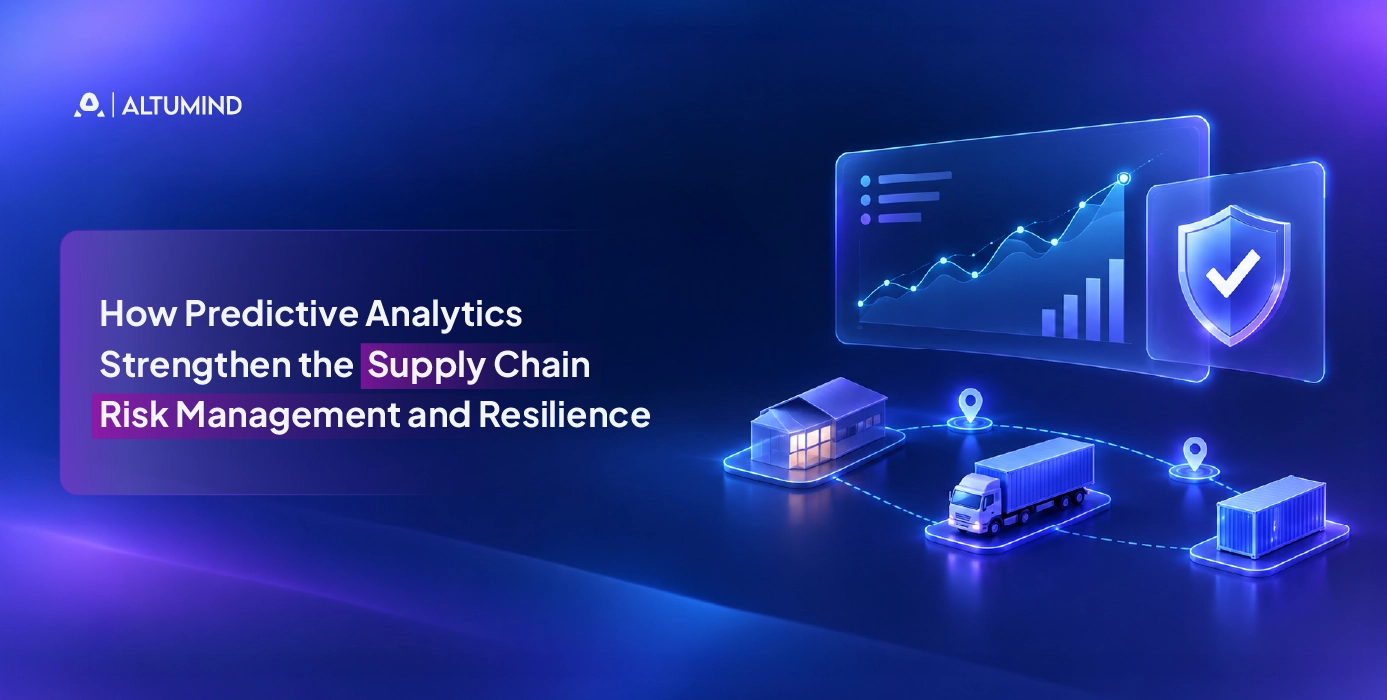
Table of Contents
- Introduction
- What Is Predictive Analytics in Supply Chain Risk Management?
- Why Do Businesses Need Predictive Analytics for Supply Chain Resilience?
- What Are the Key Applications of Predictive Analytics in Supply Chain Risk Management?
- What Role Do AI, Machine Learning, and Data Integration Play in Supply Chain Analytics?
- What Challenges Can Businesses Face When Adopting Predictive Analytics?
- How Can Businesses Implement Predictive Analytics in Supply Chain Operations?
- Conclusion
Supply chain disruptions can affect revenue, customer satisfaction, production schedules, and operating expenses. A delayed shipment, an unreliable supplier, or an unexpected change in demand can create problems across multiple business functions. Traditional planning methods often rely on historical reports, making it difficult to respond before issues affect operations.
Predictive analytics in supply chain management helps businesses identify potential risks early by analyzing historical and real-time data. It enables organizations to anticipate challenges related to the following areas:
- • Demand fluctuations: Identify changing customer needs and prepare inventory accordingly.
- • Supplier delays: Recognize potential delivery issues and assess alternative sourcing options.
- • Inventory shortages: Predict stockout risks and improve replenishment planning.
- • Transportation disruptions: Identify possible shipping delays and evaluate alternative routes.
- • Cost fluctuations: Anticipate changes in material, freight, and procurement costs.
In this article examines how predictive analytics helps businesses manage supply chain risks, improve operational resilience, and make informed decisions to maintain continuity in an increasingly uncertain business environment.
What Is Predictive Analytics in Supply Chain Risk Management?
Predictive analytics in supply chain risk management uses historical and current data, statistical techniques, and machine learning models to estimate future events that could affect supply chain performance.
Rather than relying solely on reports about past performance, businesses can use predictive models to estimate demand changes, identify suppliers at risk of delays, forecast inventory shortages, and assess transportation problems.
For example, a manufacturer may combine supplier delivery records, production schedules, weather alerts, and shipment updates to estimate whether a component will arrive late. The procurement team can then evaluate alternative suppliers or adjust production plans before the delay causes a shortage.
Predictive analytics typically uses several types of information:
- • Historical data: Previous orders, delivery times, stock levels, and demand patterns.
- • Operational data: Production schedules, warehouse activity, purchase orders, and shipment status.
- • External data: Weather conditions, market prices, economic indicators, and transportation disruptions.
- • Supplier data: Delivery reliability, lead times, quality issues, and financial risk indicators.
The quality and relevance of these inputs influence the accuracy of predictions. Predictive analytics estimates possible outcomes, but it cannot eliminate uncertainty or guarantee that every disruption will be predicted.
Why Do Businesses Need Predictive Analytics for Supply Chain Resilience?
Businesses need predictive analytics because supply chain risks can develop quickly and affect several connected operations. Early risk signals give decision-makers more time to assess alternatives, adjust plans, and reduce potential losses.
Supply chain resilience means the ability to prepare for disruptions, respond effectively, and restore operations with limited damage. Predictive analytics supports this ability by helping organizations move from reactive responses toward earlier, evidence-based action.
Consider a retailer preparing for a seasonal sales period. If demand rises faster than expected, the business could face stockouts, urgent replenishment costs, and missed sales. Predictive models can combine sales trends, promotions, inventory data, and regional demand patterns to flag potential shortages earlier.
The main business benefits include:
- • Better operational continuity: Teams can identify possible interruptions and prepare alternatives.
- • Improved inventory decisions: Forecasts help balance product availability against holding costs.
- • Stronger supplier planning: Procurement teams can identify recurring delays and assess supplier reliability.
- • More controlled spending: Early warnings can reduce the need for expensive last-minute shipments.
- • Faster decision-making: Teams can act on relevant signals instead of waiting for periodic reports.
Operational resilience depends on how effectively teams respond to forecasts, supported by clear escalation rules, assigned responsibilities, and viable contingency plans.
What Are the Key Applications of Predictive Analytics in Supply Chain Risk Management?
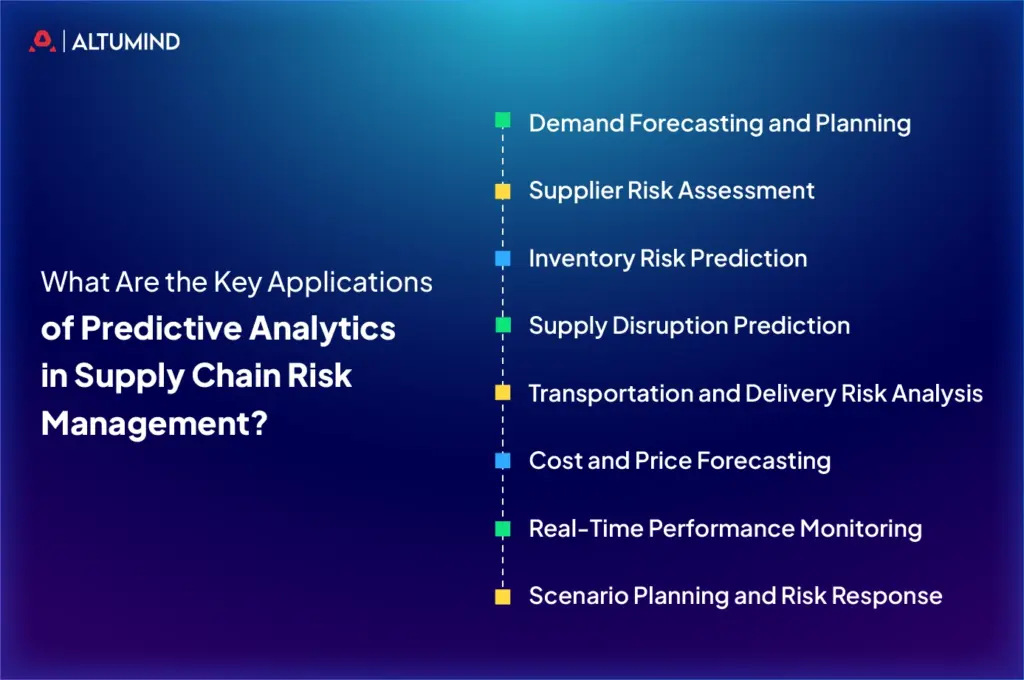
Predictive analytics supports supply chain risk management by helping businesses anticipate demand changes, supplier problems, inventory shortages, delivery delays, and cost fluctuations. These applications become more useful when teams connect operational data and translate model predictions into specific actions.
1. Demand Forecasting and Planning
Demand forecasting helps businesses estimate future product requirements using historical sales, seasonal patterns, promotions, customer behavior, and market conditions.
Predictive models can identify changes that simple averages may miss. A retailer, for instance, may anticipate increased demand in a particular region and adjust replenishment schedules before shelves run empty.
Businesses can also connect supply chain planning with sales forecasting using predictive AI to align sales expectations with purchasing, production, and inventory decisions.
2. Supplier Risk Assessment
Supplier delays, inconsistent product quality, financial instability, and limited sourcing options can disrupt operations.
Predictive models can assess supplier delivery history, lead-time variability, quality records, and other relevant indicators to identify suppliers that may require closer monitoring. Procurement teams can use these signals to review orders, seek alternative sources, or adjust purchasing schedules.
Predictions should support supplier assessments rather than replace them. Human review remains important when evaluating financial, contractual, or geopolitical risks.
3. Inventory Risk Prediction
Excess inventory ties up working capital, while insufficient stock can interrupt production and lead to lost sales. Predictive analytics helps estimate future stock requirements based on demand forecasts, replenishment lead times, and inventory movement.
Businesses can use these estimates to identify products at risk of stockouts, review safety stock levels, and prioritize replenishment.
A practical consideration that is often underestimated is that inventory policies should differ by product. Critical components with long lead times may need different stock thresholds from products with stable demand and readily available alternatives.
4. Supply Disruption Prediction
Weather events, port congestion, geopolitical developments, and sudden supplier capacity changes can affect material availability and delivery schedules.
Predictive systems can combine relevant external signals with supplier and logistics records to flag shipments, regions, or sourcing routes that may face higher risk.
These alerts give teams time to assess alternative routes, shift orders, or adjust production schedules. External signals are not always complete or reliable, so teams should validate alerts before making costly operational changes.
5. Transportation and Delivery Risk Analysis
Transportation problems can increase costs and affect customer commitments. Predictive analytics can estimate arrival delays by analyzing route history, traffic patterns, weather conditions, carrier performance, and shipment milestones.
Logistics teams can use these estimates to prioritize time-sensitive shipments, communicate potential delays, or compare alternative routes.
The value comes from acting early. A predicted delay is more useful when the team knows which customer orders, production schedules, or warehouse operations may be affected.
6. Cost and Price Forecasting
Fuel prices, raw material costs, freight rates, and currency movements can affect supply chain budgets.
Predictive models help businesses estimate potential cost changes using historical prices, market indicators, purchasing patterns, and supplier agreements. Finance and procurement teams can use these estimates to evaluate purchasing schedules, review contracts, and compare sourcing options.
For businesses that sell physical products, pricing decisions may also benefit from AI price optimization. The aim is to assess pricing decisions alongside demand, margins, and supply costs rather than treating them as separate concerns.
7. Real-Time Performance Monitoring
Periodic reports may identify a problem only after it has affected operations. Analytics connected to current operational data can provide more timely visibility into delivery performance, inventory movement, order backlogs, and supplier lead times.
Dashboards and automated alerts can flag unusual changes against defined thresholds. Teams can then investigate the cause and determine whether action is necessary.
Real-time monitoring works best when alerts focus on meaningful exceptions. Too many low-value notifications can overwhelm teams and delay responses to important risks.
8. Scenario Planning and Risk Response
Predictive analytics can help businesses compare possible outcomes under different operating conditions.
For example, a company can estimate how a supplier delay, a sudden increase in demand, or a transportation cost rise might affect inventory, delivery commitments, and profitability. Teams can then compare responses such as holding additional stock, switching suppliers, or adjusting order quantities.
Scenario analysis does not predict every future event. It helps decision-makers prepare for plausible situations and understand the trade-offs associated with each response.
What Role Do AI, Machine Learning, and Data Integration Play in Supply Chain Analytics?
AI, machine learning, and data integration help businesses turn disconnected operational records into useful predictions. Each serves a different purpose, and their value depends on how well they work together.
- • Artificial intelligence: Supports pattern recognition, anomaly detection, and decision support across complex operations.
- • Machine learning: Uses historical examples and relevant features to estimate outcomes such as demand, delivery delays, and stockout risk.
- • Data integration: Connects information from ERP systems, warehouse management platforms, procurement tools, transport systems, and external sources.
- • Business intelligence: Presents findings through dashboards, reports, and performance indicators that business teams can interpret.
Without reliable data integration, teams may receive conflicting information about stock availability, supplier lead times, or order status. Data preparation and governance help reduce these inconsistencies.
Businesses should also monitor model performance over time. Demand patterns, supplier behavior, and market conditions change, so models may need updates and periodic validation.
For a broader view of these capabilities, predictive data and analytics can help organizations connect data preparation, forecasting, and operational decision-making.
What Challenges Can Businesses Face When Adopting Predictive Analytics?
Predictive analytics can improve planning, but implementation requires attention to data quality, integration, cost, and team readiness.
Common challenges include:
- • Fragmented data: Information stored across disconnected systems can limit the completeness of predictions.
- • Poor data quality: Missing records, outdated entries, and inconsistent formats can weaken model results.
- • Legacy system limitations: Older platforms may require integration work before analytics can access relevant information.
- • Limited internal expertise: Teams may need support with data engineering, model development, and ongoing monitoring.
- • Resistance to change: Employees may hesitate to act on predictions if the reasoning is unclear or conflicts with established processes.
- • Unclear return on investment: Businesses may struggle to justify spending when they have not defined measurable outcomes.
Organizations should start with a specific business problem and establish baseline performance before implementation. They can then measure outcomes such as forecast error, supplier delay frequency, stockout rates, or emergency freight spending.
How Can Businesses Implement Predictive Analytics in Supply Chain Operations?
A phased approach helps businesses test the value of predictive analytics before expanding it across the supply chain.
Step 1: Define the Business Problem
Choose a specific issue, such as frequent stockouts, unreliable supplier deliveries, or high emergency shipping costs. Define the operational and financial outcomes that matter.
Step 2: Assess Available Data
Identify the relevant data sources, assess data quality, and determine which systems need to share information. Resolve major data gaps before relying on model outputs.
Step 3: Select a Focused Use Case
Start with an area where data is available and improvements can be measured. Demand forecasting or supplier delay prediction may be suitable starting points, depending on business needs.
Step 4: Develop and Validate the Model
Build a model using relevant historical data, test it against records that were not used during training, and compare its predictions with existing methods. Review errors and limitations before operational use.
Step 5: Connect Predictions to Workflows
Make risk alerts available to the people responsible for purchasing, inventory, logistics, or production. Define who reviews alerts and what actions they can take.
Step 6: Monitor and Optimize
Track model accuracy and business outcomes regularly. Update models as demand, suppliers, routes, and operating conditions change.
Businesses should also define access controls, data retention practices, and human review requirements, particularly when predictions affect important purchasing or customer commitments.
Conclusion
Predictive analytics in supply chain management helps businesses identify potential disruptions earlier, improve inventory planning, assess supplier risks, and make more informed operational decisions. Its value depends on reliable data, appropriate models, and clear processes that connect predictions to action.
Businesses should start with a measurable challenge, validate results, and expand only when predictive analytics delivers practical benefits. With the right combination of data integration, AI, and operational expertise, organizations can anticipate supply chain risks, improve resilience, and make more informed decisions.
Ready to make your supply chain more resilient and data-driven? Connect with Altumind to discuss how our predictive and data analytics services can help your business turn supply chain data into actionable insights and stronger operational outcomes.

Author
Founder & CEO
Bhargava Ghatty is the Founder and CEO of Altumind, leading the company’s vision at the intersection of AI, technology, and digital transformation.
He brings a strategic perspective to enterprise transformation, innovation, and the practical adoption of emerging technologies, with a focus on helping businesses translate technology investments into meaningful and sustainable business outcomes.
Table of Contents
- Introduction
- What Is Predictive Analytics in Supply Chain Risk Management?
- Why Do Businesses Need Predictive Analytics for Supply Chain Resilience?
- What Are the Key Applications of Predictive Analytics in Supply Chain Risk Management?
- What Role Do AI, Machine Learning, and Data Integration Play in Supply Chain Analytics?
- What Challenges Can Businesses Face When Adopting Predictive Analytics?
- How Can Businesses Implement Predictive Analytics in Supply Chain Operations?
- Conclusion