The Role of Product Discovery in Building a Strong, Insight-Led Digital Strategy
Table of Contents
- Introduction
- What is Product Discovery?
- Why Product Discovery Matters More Today
- Core Aspects of a Strong Product Discovery Process
- How Do AI and Data Shape Modern Product Discovery?
- Understanding the Product Discovery Phase
- Product Discovery Methods
- Templates and Frameworks That Support Product Discovery
- Mistakes Companies Make During Product Discovery
- Product Discovery Benefits for Digital Growth
- Conclusion
Many products face challenges long before development begins. The failure begins when teams rush into development with unclear goals, weak insight, and no validation. This is where product discovery changes everything.
When companies give the discovery phase the attention it deserves, they cut waste, shorten cycles, and achieve clarity about what their users value. Senior leaders see sharper budgets. Product teams see fewer revisions. Engineering teams build with confidence. In a market shaped by rapid shifts, new technologies, and high user expectations, this early phase has become the strongest predictor of product success.
This detailed guide brings clarity to product discovery and why it is now a must-have for modern businesses aiming for measurable and sustainable digital growth.
What is Product Discovery?
Product discovery is a structured approach that helps teams understand a problem before they commit resources to a solution. It brings together business goals, user needs, technical judgement, and data-backed insight.
This phase works as a safety net for leadership. Instead of placing early bets on assumptions, it highlights what truly matters. Product discovery creates alignment among all decision-makers so that investment decisions are based on real insight rather than instinct.
Many organizations confuse product discovery with general planning. Planning documents the path. Discovery reveals the right path. That difference shapes the long-term direction of any product inside an enterprise environment.
Why Product Discovery Matters More Today
Modern products are complex. They span mobile apps, web applications, cloud-powered systems, integrations, automations, and AI-backed components. Leadership teams must deal with rising security demands and multiple privacy constraints.
At the same time, users expect seamless experiences that feel personal and intuitive. The pressure on product teams has never been higher. Much of this pressure comes from ongoing digital transformation, where leaders balance modernization with rising user expectations.
A weak start leads to spiraling costs. Small assumptions turn into large problems. Missed user needs cause expensive rework. These problems appear months later during development. By then, recovery becomes difficult and expensive.
Product Discovery removes this blind start. It gives teams a realistic view of what is feasible, valuable, scalable, and aligned with future growth plans. When decision makers see early clarity, they build stronger trust across the entire delivery chain.
Core Aspects of a Strong Product Discovery Process
A great product discovery practice consists of consistent components. Each supports the next. Together, they create a complete picture that keeps teams aligned and informed.
Business Insight
This step brings clarity to goals, constraints, metrics, and desired impact. Leaders use this moment to set direction with precision.
User Insight
Teams gather real conversations, pain points, motivations, and behavior patterns. These practical insights shape better decisions.
Technical Review
Architects and engineers assess feasibility, integrations, scalability, and performance expectations. Their early input prevents later friction.
Validation
Ideas are tested through quick prototypes, concept tests, or small experiments. Teams learn what has value before committing to full-scale development.
Alignment
Stakeholders form a shared understanding of the product vision. This alignment reduces revisions and brings clarity to prioritization decisions.
How Do AI and Data Shape Modern Product Discovery?
AI has become a powerful partner during product discovery. It reduces guesswork and increases precision across early-stage analysis. When applied correctly, it enhances insight without replacing human judgment.
Below are the most impactful uses of AI and data inside the discovery phase.
Pattern Recognition
AI reveals hidden connections in user behavior and business metrics. This helps teams identify opportunities and risks early. Its AI is now part of compliance reviews as well, with AI in compliance driving early regulatory insight.
Predictive Analysis
Machine learning models forecast adoption trends, cost outcomes, or performance expectations. These forecasts guide stronger budgeting decisions.
Persona and Segment Insight
AI analyzes large datasets to reveal microsegments and behavioral groups. Teams gain clarity on who benefits most and why.
Rapid Concept Testing
AI assists with quick prototype simulation and user feedback modeling. Teams learn faster without waiting for lengthy research cycles.
Understanding the Product Discovery Phase
The product discovery phase sits between idea generation and formal product planning. Many executives treat it as optional. High-performing organizations treat it as nonnegotiable because they have seen the cost of missing it.
The aim is simple. Product discovery intends to reduce risk while enhancing clarity. It also produces a foundation for design, engineering, data teams, and business leaders to work from one shared source of truth.
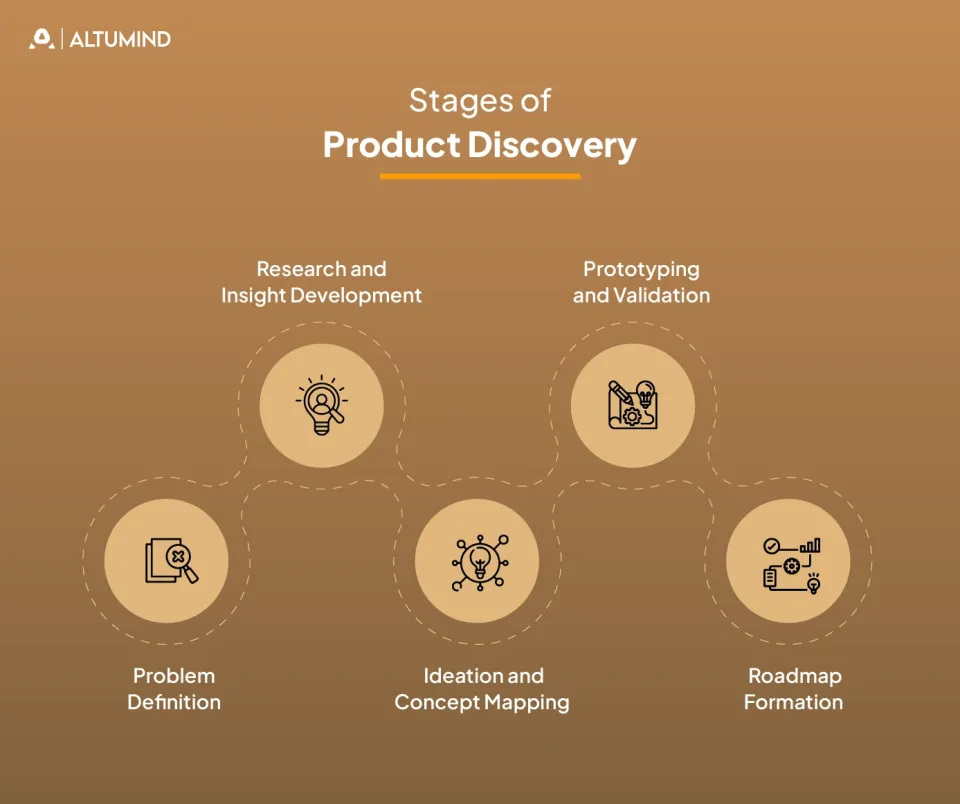
Stage 1: Problem Definition
Product discovery starts by establishing a clear and shared understanding of the problem. Teams identify the business outcome, the user need, and the constraints that influence early decisions. This clarity shapes every step that follows and prevents misalignment between leadership, design, engineering, and product teams.
Key Actions
- Identify the primary business goal.
- Confirm the user problem that needs attention.
- Clarify operational limits and technical constraints.
- Review existing data and previous attempts.
- Define measurable success for the initiative.
Stage 2: Research and Insight Development
This stage uncovers the realities behind the problem. Teams gather evidence from users, systems, analytics, and market behavior. Insight replaces assumptions and gives decision-makers a documented base of truth.
Research Focus Areas
- User interviews.
- Targeted surveys.
- Journey reviews.
- Analytics review.
- Competitor and market patterns.
- Feedback from operational teams.
Outputs of This Stage
- A clear list of user needs.
- Behavior patterns backed by evidence.
- Gaps that limit user or business value.
- Opportunities supported by data.
Stage 3: Ideation and Concept Mapping
Teams convert insight into practical concepts. This is a structured step that blends creativity with feasibility. Product managers, designers, and engineers examine multiple ways to address the problem and score each concept based on impact and complexity.
Core Activities
- Translate user needs into solution ideas.
- Map multiple options for each need.
- Review feasibility with engineering.
- Score concepts based on value and effort.
- Shortlist concepts for early testing.
Typical Outputs
- Ranked concepts.
- Early sketches.
- Notes on value and feasibility.
- A set of ideas ready for validation.
Stage 4: Prototyping and Validation
This stage provides evidence. Teams test assumptions with real users, real scenarios, and real constraints. Instead of building a full solution, they create quick models that reveal what works and what needs refinement.
Prototyping Approaches
- Low-fidelity screens.
- Simple click flows.
- Narrative workflows.
- Controlled experiments.
Validation Methods
- Short user sessions.
- Usability checks.
- Value testing.
- Engineering review.
- Early risk review.
What This Stage Produces
- Confirmation of ideas with strong potential.
- Identification of ideas with low value.
- Early insight into friction points.
- Feasibility notes from engineering.
- More accurate estimates.
Stage 5: Roadmap Formation
All insights come together to form a structured and prioritized roadmap. This roadmap becomes the reference point for design, engineering, cloud planning, data modeling, AI considerations, and delivery sequencing. A well-defined roadmap also supports smoother digital product development during upcoming phases.
Roadmap Components
- Prioritized features.
- Clear phases of work.
- Value ratings for each item.
- Complexity notes.
- Dependencies.
- Early architecture guidance.
- Success measures.
When executed with discipline, these stages give decision makers a clear and defensible path. The team avoids waste. Engineering receives direction. Design works with real insight. Leadership sees a plan that reflects both value and feasibility. The result is a product that moves from early idea to real market impact with confidence instead of guesswork.
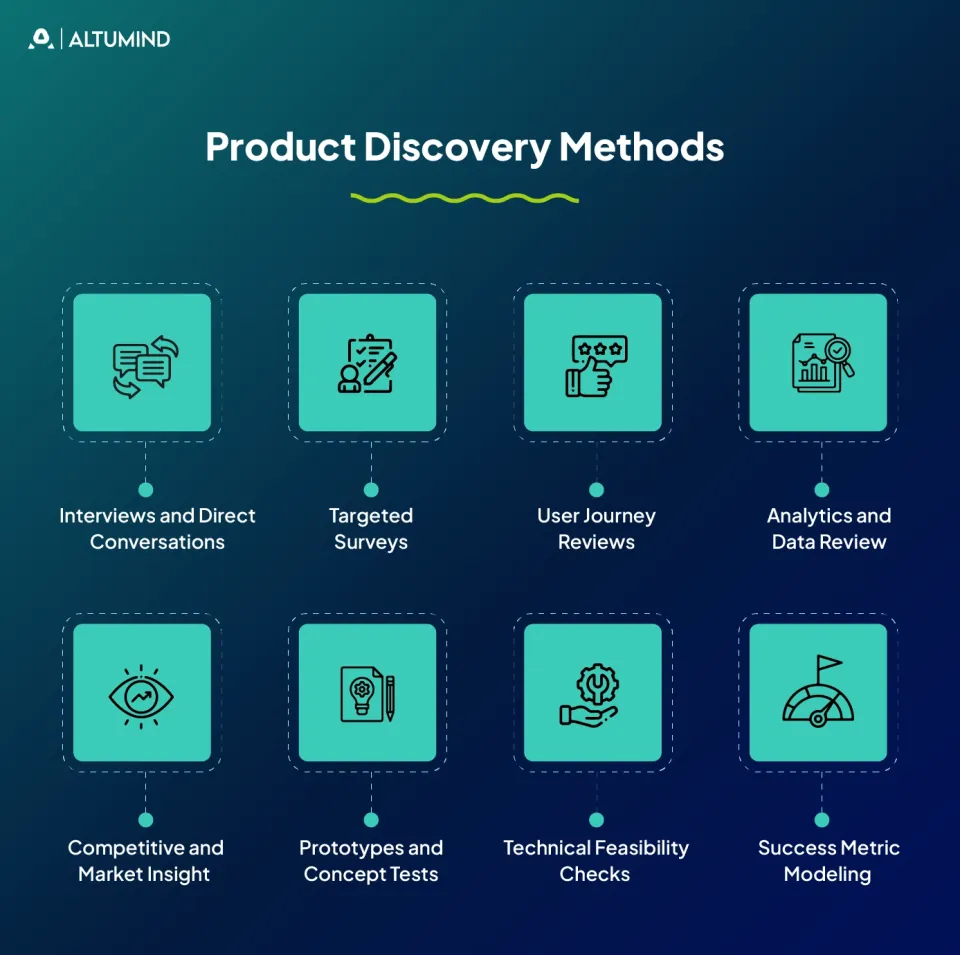
Product Discovery Methods
High-performing teams rely on methods that bring structure, clarity, and evidence to early decision-making. Each method supports a different part of the product discovery process. When used together, they form a complete picture of user needs, business goals, and technical feasibility.
Interviews and Direct Conversations
These are the strongest ways to understand real user behavior.
Teams learn what motivates users, what slows them down, and what they expect.
Interviews reveal context that analytics alone cannot show.
What these conversations deliver:
- Detailed user stories
- Pain points explained in the user’s own words.
- Real-world examples of friction,
- Clarity on what users value and what they ignore.
Targeted Surveys
Surveys gather quantifiable insight at scale. They help validate early patterns that emerge from interviews.
What surveys deliver
- Broad confirmation of common needs.
- Volume-based insight that supports decision-making.
- Preferences across user groups.
- Signals that guide feature importance.
User Journey Reviews
A journey review tracks the steps a user takes to complete a task. It highlights every moment of friction, delay, or confusion. This method works well for digital products that involve multiple screens, flows, or integrations.
What journey reviews deliver
- A map of current user behavior.
- Clear friction points.
- Moments where users drop out.
- Opportunities to streamline the flow.
Analytics and Data Review
Teams examine usage patterns, support tickets, performance logs, CRM data, and conversion paths. Data reveals real behavior without interpretation or bias.
What analytics deliver:
- High-level trends.
- Drop-off points.
- Common errors.
- Time-based patterns.
- Differences between user groups.
Competitive and Market Insight
Examining similar products gives context. Teams understand what the market already offers and where gaps exist.
What this method delivers:
- Feature patterns.
- Industry norms.
- Opportunities for differentiation.
- Clarity on user expectations shaped by competitors.
Prototypes and Concept Tests
Prototypes convert ideas into simple models that users can react to. This stage gives real evidence of value before development begins.
What prototypes deliver:
- Fast feedback.
- Early usability insight.
- Evidence of interest.
- Rejection of weak concepts.
Technical Feasibility Checks
Engineering teams assess complexity, scalability, integrations, data flow, security posture, and performance implications. This prevents unrealistic commitments.
What feasibility checks deliver:
- Early warnings on complex features.
- Input on architecture.
- Integration considerations.
- Realistic delivery plans.
Success Metric Modeling
Teams define the outcomes that matter. Metrics shape decisions and align stakeholders on measurable goals.
What metric modeling delivers:
- Clarity on what progress means.
- A shared definition of success.
- Data points for ongoing evaluation.
Templates and Frameworks That Support Product Discovery
Templates and frameworks give structure to product discovery. They help teams gather information, evaluate ideas, and form decisions without confusion.
These tools build consistency and support faster progress across complex digital projects. Below are the most useful frameworks for enterprise-scale product discovery.
Value Effort Matrix
This matrix helps teams identify which ideas provide strong value compared to the effort required. It supports early prioritization and prevents teams from pursuing high-cost ideas with limited return.
Useful for:
- Early feature ranking
- Release planning
- Resource alignment
Risk Priority Grid
This grid highlights risks across user behavior, technology, operations, and compliance. Teams spot issues early and plan mitigation steps before development begins.
Useful for:
- Identifying problem areas.
- Guiding feasibility reviews.
- Setting realistic expectations.
Persona Sheets
Persona sheets represent key user groups. They capture motivation, expectations, frustration, and behavior patterns. These sheets keep the team aligned on who they are building for.
Useful for:
- User-focused decision-making.
- UX planning.
- Clarifying value propositions.
Problem Statement Grid
This grid gives a structured way to define the problem. Teams capture what the problem is, who faces it, when it occurs, why it matters, and what constraints shape the solution.
Useful for:
- Setting clarity at the start.
- Aligning stakeholders.
- Avoiding early misdirection.
Concept Evaluation Scorecard
A scorecard helps teams compare multiple concepts using consistent criteria. Criteria often include value, complexity, user impact, technical feasibility, cost, and operational fit.
Useful for:
- Choosing the strongest idea.
- Reducing bias.
- Supporting leadership decisions.
Success Metric Model
This framework defines the benchmarks that signal progress. Teams identify leading and lagging indicators to track throughout delivery.
Useful for:
- Measuring product performance.
- Setting KPIs.
- Tracking adoption and engagement.
Discovery Checklists
Checklists ensure that each step of product discovery is completed with care. They help teams remain thorough even under tight timelines.
A typical checklist covers:
- Research steps.
- Validation activities.
- Technical reviews.
- Stakeholder involvement.
- Documentation needs.
Useful for:
- Maintaining quality,
- Avoiding missed steps.
- Keeping the team aligned.
Prioritized Roadmap Template
This template organizes all validated insights into a clear release plan. It breaks features into phases, dependencies, and complexity levels.
Useful for:
- Final term off to design and engineering.
- Long-term planning.
- Investment approval.
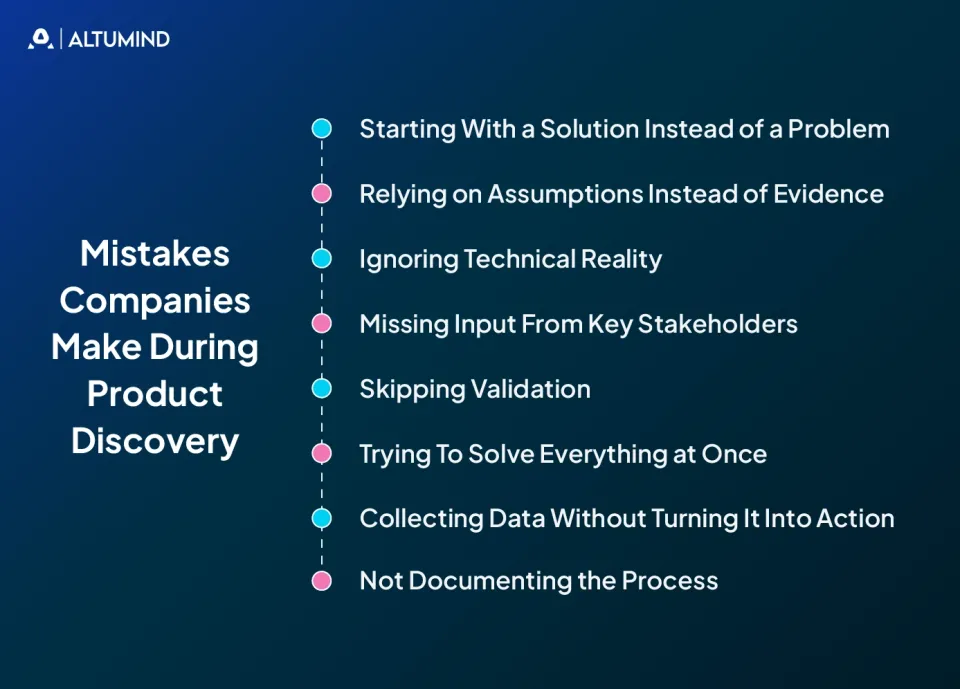
Mistakes Companies Make During Product Discovery
Many teams move quickly at the start of a product initiative. That urgency often leads to gaps that cause delays, rework, and budget stretch. These are the most common mistakes that hold companies back.
Starting With a Solution Instead of a Problem
Teams often begin with a preferred idea. This blocks objective thinking. A solution-first approach hides the real problem and causes misalignment later.
Impact
- Misplaced priorities.
- Features that don’t align with user needs.
- Revisions in later stages.
Relying on Assumptions Instead of Evidence
Teams sometimes skip research because they believe they already understand the user. This creates blind spots that appear during development.
Impact
- Surprises during testing.
- Misjudged user behavior.
- Weak adoption.
Ignoring Technical Reality
Without early engineering involvement, ideas appear simple but carry hidden complexity. This results in unrealistic timelines and stretching budgets.
Impact
- Architectural rework.
- Missed deadlines.
- Tension between teams.
Missing InputFromKey Stakeholders
When teams leave out operations, sales, support, compliance, or data teams, they overlook important constraints. Each group provides insight that affects feasibility and success.
Impact
- Missed dependencies.
- Unexpected bottlenecks.
- Incomplete solution paths.
Skipping Validation
One of the most costly mistakes is moving to development without testing ideas. Teams assume that early concepts will work without validation.
Impact
- Rebuilding features that fail user tests.
- Unproductive use of time.
- Product delays.
- Reduced confidence from leadership.
Trying To Solve Everything at Once
Teams sometimes attempt to create a perfect solution in the first release. This slows momentum and spreads resources too thin.
Impact
- Bloated scope.
- Confused priorities.
- Less effective first version.
Collecting Data Without Turning ItIntoAction
Some teams gather research but do not translate it into decisions; insight becomes static, and discovery loses its purpose.
Impact
- Repeated loops.
- Slow progress.
- Difficulty forming a roadmap.
Not Documenting the Process
When insights stay inside individual minds rather than structured documentation, teams drift.
Impact
- Lost context.
- Repeated debates.
- Lack of clarity for engineering and design.
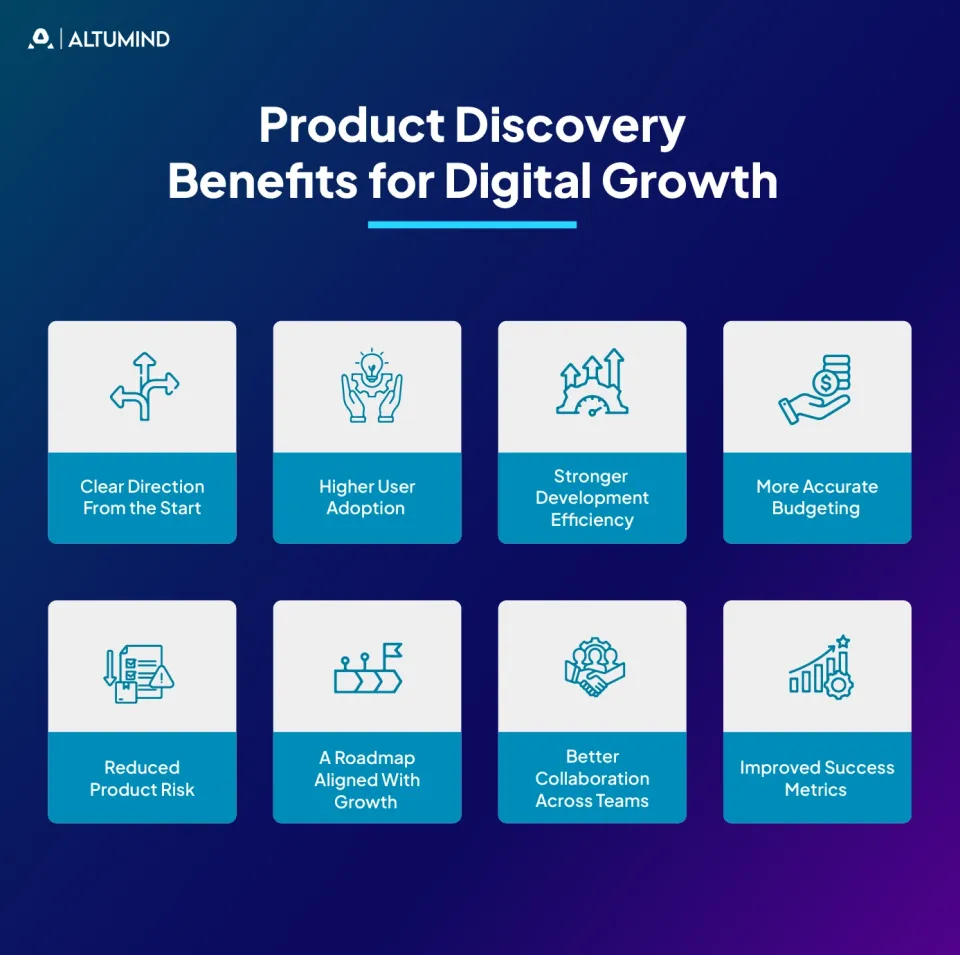
Product Discovery Benefits for Digital Growth
Product discovery creates a foundation that supports consistent and predictable digital growth. When teams follow a disciplined discovery approach, the organization reduces risk and gains stronger direction before any development begins.
This advantage becomes more important as products expand across cloud systems, mobile platforms, enterprise integrations, and AI-driven features.
Below are the most meaningful benefits that shape long-term digital growth.
Clear Directionfromthe Start
Discovery helps teams understand the problem, user needs, and business goals with precision. This clarity helps leadership set expectations and make informed investment decisions.
Value gained:
- Reduced ambiguity.
- Stronger alignment across teams.
- A shared view of desired outcomes.
Higher User Adoption
User behavior and real feedback guide early decisions. Teams shape solutions that match user needs instead of internal assumptions. This leads to higher adoption and faster product traction.
Value gained:
- Improved user satisfaction.
- Lower abandonment.
- Better first-version performance.
Stronger Development Efficiency
Engineering teams operate with a clear roadmap and validated concepts. This reduces revisions and prevents wasteful development cycles.
Value gained:
- Shorter delivery cycles.
- Consistent quality.
- Fewer scope conflicts.
More Accurate Budgeting
Discovery identifies the level of complexity and the technical realities behind each feature. Leaders avoid unrealistic budgets because they see the truth before development begins.
Value gained:
- Predictable spending.
- Lower financial risk.
- Realistic timeline planning.
Reduced Product Risk
Teams catch issues early through research, validation, and feasibility checks. The discovery phase reveals risks that would otherwise surface during development.
Value gained:
- Early resolution of blockers.
- Fewer last-minute changes.
- Higher confidence in the solution.
A Roadmap AlignedWithGrowth
Discovery does not only focus on the first release. It sets the direction for future phases. This supports long-term digital growth and makes scaling easier.
Value gained:
- Flexible planning.
- Clear phases.
- Features that support future expansion.
Better Collaboration Across Teams
Product Discovery brings together product, UX, engineering, data, and business teams. Each group contributes insight from its domain. This builds collective ownership.
Value gained:
- Stronger team cohesion.
- Shared decision-making.
- Fewer conflicting priorities.
Improved Success Metrics
Discovery defines measurable outcomes early. These metrics help teams track progress and make informed decisions throughout the product lifecycle.
Value gained:
- Clarity in performance tracking.
- Data-backed decisions.
- Stronger long-term planning.
Conclusion
A great product begins long before development begins. The early decisions shape everything that follows. Product discovery brings discipline, clarity, and confidence to those decisions. It protects budgets, steers alignment, reduces rework, and gives leaders a clear line of sight into what matters most.
When organizations slow down at the start, they speed up dramatically later. This simple truth has transformed the success rate of countless digital initiatives.
Product discovery is not a phase teams skip. It is the foundation that supports the entire product journey. Altumind brings the expertise, insight, and engineering depth needed to make this phase strong, structured, and future-ready.
We’re here to support you with end-to-end digital product development services that translate early clarity into scalable, high-performance solutions.
Table of Contents
- Introduction
- What is Product Discovery?
- Why Product Discovery Matters More Today
- Core Aspects of a Strong Product Discovery Process
- How Do AI and Data Shape Modern Product Discovery?
- Understanding the Product Discovery Phase
- Product Discovery Methods
- Templates and Frameworks That Support Product Discovery
- Mistakes Companies Make During Product Discovery
- Product Discovery Benefits for Digital Growth
- Conclusion
Let's Connect
Reach out and explore how we can co-create your digital future!