Predictive Data & Analytics: Transform Business Intelligence into Strategic Foresight
Table of Contents
- Introduction
- What Is Predictive Data & Analytics
- Descriptive vs Predictive vs Prescriptive Analytics
- What is Descriptive Analytics?
- SaaS Predictive Analytics: Accelerating Adoption
- Predictive Analytics Consulting: Accelerating Success
- Building Predictive Analytics Capabilities
- Common Predictive Analytics Challenges
- Measuring Predictive Analytics Success
- Conclusion
Your business generates massive amounts of data daily. Your teams compile reports showing what happened last quarter. Yet competitors somehow anticipate market shifts before they occur, optimize operations proactively, and allocate resources with uncanny accuracy.
The difference lies not in data volume but in analytical sophistication. While most organizations continue to rely on outdated reporting methods, leading companies utilize predictive data and analytics to anticipate future developments and take action before opportunities disappear or problems worsen.
In this blog, we will examine how predictive analytics transforms raw data into strategic foresight, the distinctions between descriptive, predictive, and prescriptive approaches, and practical frameworks for implementing analytics that actually drive decisions rather than gathering dust in dashboards.
What Is Predictive Data & Analytics?
Predictive data & analytics applies statistical algorithms and machine learning techniques to historical data to forecast future outcomes with quantified probability. Unlike reporting that tells you what happened, predictive analytics estimates what will happen next based on patterns discovered in your data.
This approach transforms data from historical records into strategic assets. Organizations use predictions to anticipate customer behavior, forecast demand, identify risks before they materialize, and optimize resource allocation based on expected future conditions rather than past performance.
How Predictive Analytics Works
The process follows several systematic steps:
- Data Collection and Integration: Gather relevant data from across business systems, including transactions, customer interactions, operational metrics, and external sources. Quality predictions require comprehensive data representing factors influencing outcomes.
- Data Preparation and Cleaning: Transform raw data into analysis-ready formats through cleaning, normalization, and feature engineering. Poor data quality produces unreliable predictions regardless of model sophistication.
- Pattern Discovery: Apply statistical techniques and machine learning algorithms to identify relationships between variables. Models learn which factors predict outcomes and how they interact.
- Model Development: Build predictive models using techniques like regression analysis, decision trees, neural networks, or ensemble methods. Different algorithms suit different prediction challenges.
- Validation and Testing: Evaluate model accuracy using held-out data not used in training. Validation confirms that models generalize beyond training data to make reliable real-world predictions.
- Deployment and Monitoring: Integrate models into business processes where predictions inform decisions. Continuous monitoring detects when model accuracy degrades, requiring retraining.
Common Predictive Analytics Use Cases
Organizations apply predictive analytics across diverse functions:
- Customer Churn Prediction: Identify customers likely to cancel before they leave. Early warnings enable retention interventions, saving revenue that would otherwise disappear.
- Demand Forecasting: Predict future product demand to optimize inventory, production scheduling, and resource planning. Accurate forecasts reduce both stockouts and excess inventory costs.
- Credit Risk Assessment: Estimate the likelihood of loan defaults or payment delays. Risk predictions inform lending decisions and pricing strategies.
- Predictive Maintenance: Forecast equipment failures before they occur based on sensor data and usage patterns. Proactive maintenance minimizes unplanned downtime while optimizing service costs.
- Sales Opportunity Scoring: Rank prospects by likelihood to convert. Prioritization focuses on sales efforts on highest-probability opportunities, improving win rates and efficiency.
- Fraud Detection: Flag suspicious transactions in real-time based on deviation from normal patterns. Predictions catch fraud faster than rule-based systems while reducing false positives.
Modern cloud-based analytics platforms make these sophisticated capabilities accessible to organizations without massive infrastructure investments or specialized data science teams.
Descriptive vs Predictive vs Prescriptive Analytics
Understanding the distinctions between analytical approaches helps organizations match methods to their maturity level and business needs.
| Aspect | Descriptive Analytics | Predictive Analytics | Prescriptive Analytics |
|---|---|---|---|
| Focus | What happened and why | What will happen next | What should we do about it |
| Time Orientation | Historical, backward-looking | Forward-looking forecasts | Future-focused recommendations |
| Techniques | Reporting, dashboards, aggregation | Statistical models, machine learning | Optimization, simulation, AI |
| Question Answered | "What were last quarter's sales?" | "What will next quarter's sales be?" | "How should we allocate the budget to maximize sales?" |
| Complexity | Low to moderate | Moderate to high | High |
| Business Value | Understanding past performance | Anticipating future outcomes | Optimizing decisions and actions |
| Data Requirements | Historical transactional data | Historical data with outcome labels | Historical data plus business rules and constraints |
| Example Output | "Revenue decreased 15% last month." | "Revenue will likely decrease 20% next month." | "Increase marketing spend by 30% in segment A to minimize revenue decline." |
What is Descriptive Analytics?
Descriptive analytics examines historical data to understand what happened and why. This foundational analytical approach includes reporting, dashboards, data visualization, and basic statistical summaries that characterize past performance.
Most business intelligence falls into this category. Monthly sales reports, website traffic dashboards, customer segmentation analyses, and financial statements all represent descriptive analytics. These tools help organizations understand historical patterns and the current state.
While descriptive analytics doesn’t predict the future, it provides essential context for decision-making. Understanding what happened and identifying contributing factors informs strategy even without explicit forecasting. Organizations typically master descriptive analytics before advancing to predictive approaches.
Moving from Descriptive to Predictive Analytics
The transition from describing the past to predicting the future requires several capabilities:
- Predictive Modeling Skills: Teams need statistical knowledge and machine learning expertise to build reliable forecast models. This often means hiring data scientists or partnering with specialists.
- Advanced Analytics Infrastructure: Predictive work demands more computational power and sophisticated tools than basic reporting. Investment in analytics platforms and data engineering becomes necessary.
- Cultural Acceptance: Organizations must become comfortable making decisions based on probabilistic predictions rather than certainty. This cultural shift challenges leaders accustomed to definitive answers.
- Data Maturity: Predictions require higher data quality, completeness, and historical depth than descriptive reporting. Organizations often discover data gaps when attempting predictive projects.
What Is Prescriptive Analytics?
Prescriptive analytics go beyond predicting outcomes to recommend specific actions that optimize results. These systems don’t just forecast what will happen but suggest what you should do about it.
Prescriptive approaches use optimization algorithms, simulation, and decision analysis to evaluate multiple scenarios and recommend optimal choices. They consider constraints, trade-offs, and business rules to suggest actions that best achieve defined objectives.
Examples include supply chain optimization that recommends production schedules and inventory levels, pricing engines that suggest optimal prices across thousands of products, or marketing systems that prescribe budget allocation across channels to maximize ROI.
Prescriptive analytics represents the most sophisticated analytical tier, building on both descriptive understanding and predictive forecasting. Organizations typically evolve through descriptive and predictive stages before attempting prescriptive systems.
SaaS Predictive Analytics: Accelerating Adoption
SaaS predictive analytics platforms democratize advanced analytics by providing sophisticated capabilities without requiring massive upfront investment or specialized infrastructure.
Benefits of SaaS-Based Predictive Analytics
Cloud delivery models offer several advantages over traditional analytics implementations:
- Faster Time to Value: Pre-built models and templates accelerate deployment from months to weeks. Organizations start generating predictions quickly rather than building everything from scratch.
- Lower Upfront Investment: Subscription pricing eliminates large capital expenditures for software licenses and infrastructure. Pay-as-you-go models align costs with usage and value received.
- Automatic Updates: Vendors continuously enhance platforms with new algorithms, features, and best practices. Users benefit from improvements without upgrade projects.
- Scalable Capacity: Cloud infrastructure scales automatically to handle varying analytical workloads. Organizations avoid over-provisioning peak demand or suffering performance issues during heavy usage.
- Embedded Intelligence: Many SaaS platforms include pre-trained models for common use cases like churn prediction or demand forecasting. Organizations customize these foundations rather than starting from zero.
Selecting SaaS Predictive Analytics Solutions
Evaluation should consider several factors:
- Domain Specialization: Platforms built for specific industries or functions often outperform general-purpose tools. Specialized solutions understand unique requirements and include relevant pre-built models.
- Integration Capabilities: Predictions only create value when integrated into business processes. Evaluate how easily platforms connect with existing systems and workflows.
- Customization Flexibility: Pre-built models provide quick starts, but organizations need the ability to customize unique situations. Balance
- Explainability Features: Black-box predictions that don’t explain reasoning face adoption resistance. Platforms that make model logic transparent help stakeholders trust and act on predictions.
- Support and Training: Vendors offering implementation guidance, training programs, and ongoing support to accelerate success. Analytics sophistication requires both technology and knowledge transfer.
Organizations implementing SaaS predictive analytics often partner with specialists offering predictive data analytics services to accelerate deployment and maximize returns from platform investments.
Predictive Analytics Consulting: Accelerating Success
While technology enables predictive analytics, successful implementation requires expertise many organizations lack internally. Predictive analytics consulting bridges capability gaps and accelerates time to value.
What Consultants Provide
Specialized partners contribute across the analytics lifecycle:
- Strategy and Use Case Identification: Consultants help prioritize which predictions create the most business value. Experience across industries reveals opportunities organizations might miss.
- Data Architecture and Engineering: Building prediction-ready data foundations requires specialized skills. Consultants design data pipelines, implement quality processes, and create feature stores supporting model development.
- Model Development and Validation: Data scientists build custom models tailored to specific business problems. Expert modelers select appropriate algorithms, engineer features, and validate accuracy rigorously.
- Deployment and Integration: Getting models into production where they inform decisions requires engineering expertise. Consultants build APIs, integrate with business systems, and create monitoring infrastructure.
- Change Management: Technology alone doesn’t change how organizations make decisions. Consultants facilitate adoption through training, process redesign, and stakeholder engagement.
When to Engage Consultants
Several situations benefit particularly from external expertise:
- Limited Internal Capabilities: Organizations lacking data science teams or analytics engineering skills need external support to execute predictive initiatives.
- First Predictive Projects: Initial implementations carry higher risk due to inexperience. Consultants reduce failure probability and accelerate learning.
- Complex or High-Stakes Use Cases: Critical predictions requiring sophisticated techniques or involving significant business risk to justify expert involvement.
- Scaling Analytics Capabilities: Organizations moving from pilot projects to enterprise-wide programs need guidance building sustainable analytics practices.
- Technology Selection: Consultants provide independent perspectives on platform options based on experience across vendors and implementations.
Maximizing Consulting Value
Smart organizations extract maximum value from consulting engagements:
- Knowledge Transfer Focus: Insist on capability building alongside delivery. Consultants should develop internal skills, not create permanent dependencies.
- Clear Success Metrics: Define concrete outcomes like prediction accuracy, business impact, or adoption rates. Vague goals produce vague results.
- Executive Sponsorship: Analytics initiatives fail without leadership commitment. Ensure executives actively support rather than passively approve projects.
- Incremental Delivery: Structure engagements for iterative value delivery. Quick wins build momentum while proving concepts before major investments.
Building Predictive Analytics Capabilities
Organizations serious about predictive analytics must develop sustainable internal capabilities rather than depending solely on vendors or consultants.
Assembling the Right Team
Effective analytics organizations combine several specialized roles:
- Data Scientists: Build and validate predictive models using statistical and machine learning techniques. Data scientists translate business problems into analytical frameworks and interpret results.
- Data Engineers: Create infrastructure for collecting, storing, and transforming data for analysis. Engineering builds pipelines that keep models fed with fresh, quality data.
- Analytics Translators: Bridge business and technical teams by understanding both domains. Translators identify valuable use cases and help stakeholders interpret predictions.
- Business Stakeholders: Domain experts contribute to problem understanding and validate that predictions make business sense. Models built without business input often solve the wrong problems.
- Executive Sponsors: Senior leaders provide resources, remove obstacles, and ensure organizational adoption. Analytics initiatives need visible executive commitment.
Developing Analytics Infrastructure
Technology foundations enable scalable analytics:
- Unified Data Platform: Consolidate data from disparate sources into accessible repositories. Fragmented data across silos prevents comprehensive analysis.
- Model Development Environment: Provide tools data scientists need, including programming languages, libraries, and collaboration platforms. Standardized environments improve productivity and reproducibility.
- Model Deployment Infrastructure: Build systems that take models from development into production reliably. Deployment automation prevents models from languishing unused after development.
- Monitoring and Governance: Implement tracking of model performance, data quality, and prediction accuracy. Monitoring catches degradation before predictions become unreliable.
Establishing Analytics Processes
Sustainable analytics requires disciplined processes:
- Use Case Prioritization: Systematically evaluate potential analytics projects based on business value, feasibility, and strategic alignment. Clear prioritization focuses limited resources on highest-impact opportunities.
- Model Development Lifecycle: Standardize how models progress from ideation through deployment. Consistent processes improve quality and accelerate delivery.
- Performance Monitoring: Regularly review prediction accuracy and business impact. Monitoring identifies when models need retraining or when underlying patterns change.
- Ethical Guidelines: Establish principles governing how predictions are used and ensure fairness. Analytics without ethical guardrails creates risks and damages trust.
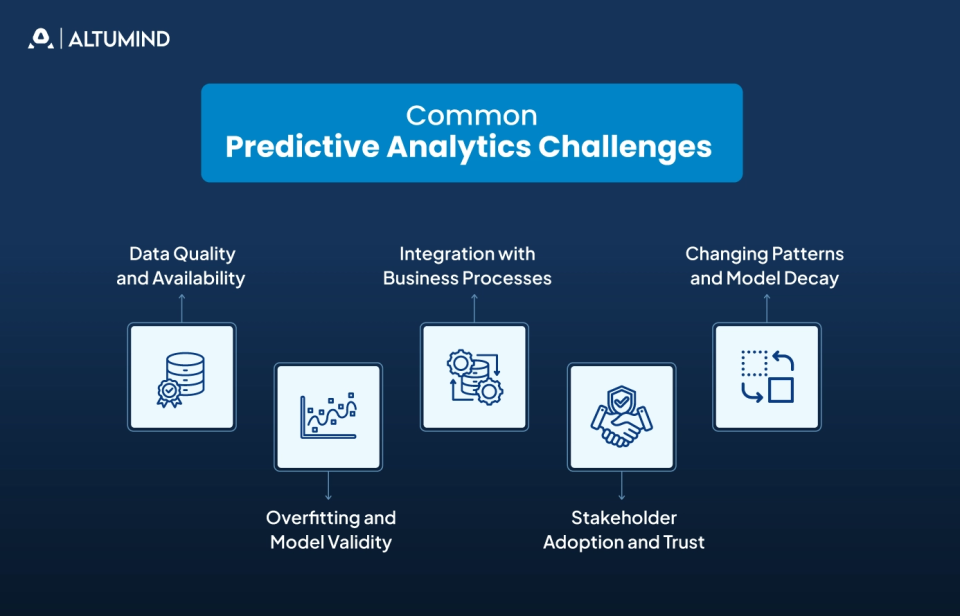
Common Predictive Analytics Challenges
Understanding frequent obstacles helps organizations prepare rather than react when problems emerge.
Data Quality and Availability
Predictions are only as good as underlying data. Missing values, errors, inconsistencies, and gaps undermine model accuracy. Many organizations discover data problems only when attempting predictive projects, requiring significant cleanup before analysis proceeds.
Overfitting and Model Validity
Models that perform brilliantly on historical data often disappoint in production. Overfitting occurs when models memorize training data noise rather than learning generalizable patterns. Rigorous validation using separate test data catches overfitting before deployment.
Integration with Business Processes
Predictions create no value sitting in notebooks or dashboards. Organizations must integrate predictions into workflows where they inform actual decisions. Integration challenges often exceed model development difficulty.
Stakeholder Adoption and Trust
Business users resist predictions they don’t understand or trust. Black-box models face skepticism regardless of accuracy. Building confidence requires explainability, validation against stakeholder intuition, and demonstrated results over time.
Changing Patterns and Model Decay
Models assume future patterns resemble historical training data. When underlying relationships change, prediction accuracy degrades. Market shifts, competitive actions, or operational changes can invalidate models, requiring retraining or rebuilding.
Organizations addressing why users leave within seconds of landing on digital properties often discover that user experience optimization requires predictive analytics to identify at-risk sessions before abandonment occurs.
Measuring Predictive Analytics Success
Effective measurement requires tracking both model performance and business impact.
Model Performance Metrics
Technical accuracy measures evaluate prediction quality:
- Prediction Accuracy: Percentage of predictions that prove correct. Simple but meaningful measure of overall model performance.
- Precision and Recall: Precision measures what percentage of positive predictions are actually correct. Recall measures what percentage of actual positives the model catches. Different use cases prioritize different metrics.
- Mean Absolute Error: For numerical predictions, the average difference between predictions and actual values. Lower error indicates better forecasting accuracy.
- ROC Curve and AUC: Visualization and metric showing trade-offs between true positive and false positive rates across different probability thresholds.
Business Impact Metrics
Ultimate success depends on business outcomes:
- Revenue Impact: Quantify revenue generated or protected through predictions. Churn prediction value equals retained customer revenue that would have been lost.
- Cost Reduction: Measure operational savings from predictive optimization. Maintenance prediction value includes avoided downtime costs and optimized service scheduling.
- Process Efficiency: Track how predictions improve workflow speed, resource utilization, or decision quality. Efficiency gains compound across repetitions.
- Risk Mitigation: Quantify losses prevented through early warning predictions. Fraud detection value includes preventing fraudulent transactions.
Adoption Metrics
Technology and accuracy mean nothing without usage:
- User Engagement: Track how frequently stakeholders access predictions and incorporate them into decisions. Low engagement indicates adoption problems regardless of technical success.
- Decision Quality: Measure whether prediction-informed decisions outperform alternatives. Compare outcomes when predictions are followed versus ignored.
- Time to Insight: Monitor how quickly predictions become available after relevant events. Real-time use cases require near-instant predictions, while strategic planning tolerates longer latency.
Conclusion
Predictive data & analytics transforms information from historical records into strategic foresight that drives proactive decisions. Organizations that master the progression from descriptive reporting through predictive forecasting to prescriptive optimization gain competitive advantages that compound over time as analytical capabilities deepen.
Success requires more than technology investment. Building sustainable analytics capabilities demands the right combination of talent, infrastructure, processes, and culture that values data-driven decision-making. Organizations that systematically develop these elements outperform those treating analytics as isolated technology projects.
Altumind helps companies accelerate their analytics journey through comprehensive support spanning strategy, implementation, and capability development. Our predictive data analytics services combine deep technical expertise with industry knowledge to deliver predictions that actually inform business decisions rather than gathering dust in dashboards. We work collaboratively to identify high-value use cases, build robust models, and integrate predictions into workflows where they drive measurable business impact.
Table of Contents
- Introduction
- What Is Predictive Data & Analytics
- Descriptive vs Predictive vs Prescriptive Analytics
- What is Descriptive Analytics?
- SaaS Predictive Analytics: Accelerating Adoption
- Predictive Analytics Consulting: Accelerating Success
- Building Predictive Analytics Capabilities
- Common Predictive Analytics Challenges
- Measuring Predictive Analytics Success
- Conclusion
Let's Connect
Reach out and explore how we can co-create your digital future!