B2B SaaS Growth: The Complete Framework for Scaling Revenue in 2026
Table of Contents
Your B2B SaaS product solves real problems, and your engineering team ships features users request. Yet growth stalls, customer acquisition costs climb, and churned revenue cancels out new sales.
The challenge lies not in product capability but in how you attract, convert, and retain enterprise customers. B2B SaaS growth demands different strategies than consumer products or traditional software. Long sales cycles, multiple stakeholders, and complex implementations require specialized approaches to achieve sustainable scaling.
In this blog, we will examine what defines successful B2B SaaS companies, how to build high-performing sales funnels, effective lead generation strategies, and growth frameworks that compound returns over time.
What is B2B SaaS?
B2B SaaS refers to business-to-business software as a service, where companies sell cloud-based applications to other organizations through subscription models. Unlike traditional software sold through one-time licenses, B2B SaaS delivers continuous value through recurring access to hosted applications.
This model fundamentally changed how businesses buy and use software. Companies no longer purchase expensive licenses requiring local installation and maintenance. Instead, they subscribe to services accessible from anywhere, with automatic updates, scalable capacity, and predictable monthly or annual costs.
Key Characteristics of B2B SaaS
Several attributes distinguish B2B SaaS from other business models:
- Subscription Revenue Model: Customers pay recurring fees for ongoing access rather than one-time purchases. This creates predictable revenue streams but requires continuous value delivery to prevent churn.
- Cloud-Based Delivery: Applications run on vendor infrastructure accessible via web browsers or APIs. Users avoid installation, maintenance, and infrastructure management responsibilities.
- Rapid Deployment: Implementation timelines compress from months to weeks or days. Customers can trial products quickly and scale usage as needs evolve.
- Continuous Updates: Vendors push improvements automatically without requiring customer action. Features improve constantly rather than through major version releases every few years.
- Usage-Based Scaling: Pricing often ties to metrics like users, transactions, or data volume. Customers pay for what they use, aligning costs with value received.
- Multi-Tenancy Architecture: Single application instances serve multiple customers simultaneously. Shared infrastructure reduces costs while maintaining data isolation and security.
B2B SaaS vs Traditional Software
Understanding these differences shapes effective growth strategies:
| Aspect | B2B SaaS | Traditional Software |
|---|---|---|
| Revenue Recognition | Spreads revenue over subscription periods, affecting cash flow and valuation metrics | Recognizes revenue upfront at time of purchase |
| Customer Relationships | Requires ongoing engagement to prevent churn and drive retention | Limited contact after initial sale unless support needed |
| Sales Cycles | Faster initial decisions through free trials or freemium tiers | Extensive evaluation required before six-figure commitments |
| Success Metrics | Optimizes for MRR, LTV, and net revenue retention | Focuses on license sales volume and maintenance renewals |
| Pricing Model | Subscription-based with monthly or annual payments | One-time license fees plus optional maintenance |
Understanding the B2B SaaS Sales Funnel
The B2B SaaS sales funnel differs significantly from consumer funnels due to longer cycles, multiple decision makers, and higher deal values. Successful companies engineer each funnel stage to move prospects efficiently toward purchase while filtering poor-fit customers early.
Top of Funnel: Awareness and Interest
The journey begins when potential customers first recognize problems your solution addresses:
- Problem Recognition: Prospects realize current approaches create inefficiencies, risks, or missed opportunities. Content marketing, thought leadership, and industry presence trigger this awareness.
- Solution Exploration: Once aware of problems, buyers research potential solutions. They consume content comparing approaches, reading case studies, and evaluating vendor capabilities.
- Initial Qualification: Marketing automation and lead scoring identify which prospects match ideal customer profiles. Early filtering prevents sales teams from pursuing poor-fit opportunities.
- Educational Content: Top-funnel content should educate rather than sell. Blog posts, white papers, webinars, and tools help prospects understand problems and evaluation criteria before considering specific vendors.
Middle of Funnel: Consideration and Evaluation
Qualified prospects enter active evaluation comparing vendors:
- Product Demonstrations: Sales teams showcase how solutions address specific prospect needs. Effective demos focus on outcomes relevant to that buyer rather than feature dumps.
- Free Trials or Pilots: Hands-on experience accelerates evaluation and builds conviction. Prospects validate whether solutions actually solve their problems before committing budgets.
- Stakeholder Alignment: Multiple people influence B2B purchasing decisions. Sales processes must identify all stakeholders and address each person’s unique concerns and success criteria.
- ROI Justification: Buyers need business cases proving investment value. Providing ROI calculators, case studies with quantified results, and implementation timelines helps prospects build internal support.
- Competitive Differentiation: Prospects compare multiple vendors during evaluation. Clear positioning on unique value prevents commoditization and price-focused decisions.
Bottom of Funnel: Decision and Purchase
Final stages convert evaluation into committed customers:
- Proposal and Negotiation: Formal proposals detail pricing, terms, implementation plans, and success metrics. Negotiation addresses remaining concerns while protecting deal economics.
- Contract Execution: Legal review, security assessments, and procurement processes extend cycles in enterprise sales. Streamlining these administrative steps accelerates closure.
- Onboarding Preparation: The sales-to-implementation handoff determines whether customers achieve quick wins or struggle initially. Clear expectations and planning during sales prevent onboarding friction.
Post-Purchase: Retention and Expansion
The funnel continues beyond the initial sale:
- Customer Onboarding: First experiences shape whether customers achieve value quickly or churn before renewal. Structured onboarding programs drive adoption and early success.
- Value Realization: Ongoing engagement ensures customers continuously derive value, justifying subscription costs. Customer success teams proactively address issues before they cause churn.
- Expansion Opportunities: Existing customers represent the highest-value growth channel. Upselling additional users, modules, or services expands account revenue with minimal acquisition cost.
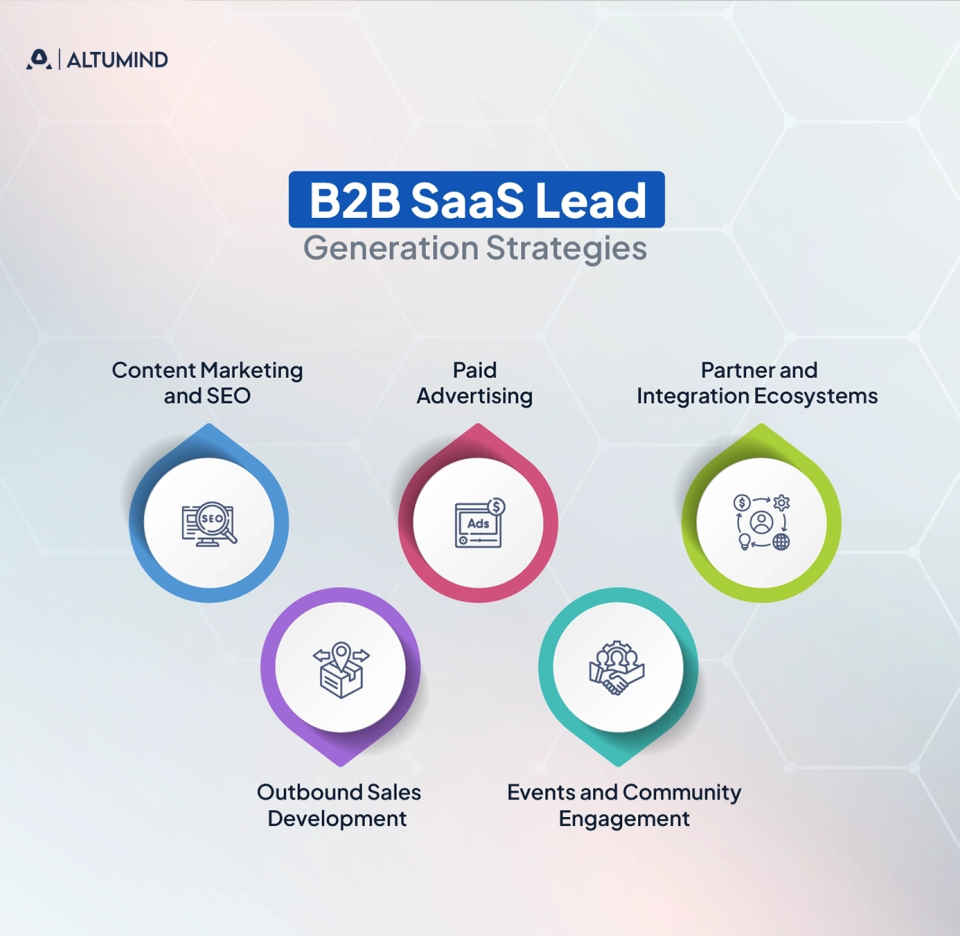
B2B SaaS Lead Generation Strategies
Sustainable B2B SaaS growth requires predictable lead generation across multiple channels. The most successful companies build diverse pipelines that don’t depend on any single source.
Content Marketing and SEO
Educational content attracts prospects researching solutions:
- Bottom-Funnel Content: Create comparison pages, buyer’s guides, and solution-focused content targeting prospects actively evaluating options. These high-intent keywords convert better than top-funnel topics.
- Industry-Specific Resources: Develop content addressing unique challenges in target verticals. Generic content gets ignored, while specialized insights demonstrate deep understanding.
- Search Optimization: Technical SEO, keyword targeting, and authoritative backlinks drive organic traffic. SEO provides compounding returns as content accumulates and rankings improve.
- Gated Assets: Whitepapers, templates, and research reports capture contact information from engaged prospects. Balance gating high-value assets against friction that reduces consumption.
Paid Advertising
Advertising accelerates awareness and demand generation:
- Search Advertising: Target high-intent keywords where prospects actively seek solutions. Search ads capture existing demand rather than creating new awareness.
- LinkedIn Advertising: B2B audiences concentrate on LinkedIn, making it effective despite higher costs. Precise targeting by job title, company, and industry reaches decision makers.
- Retargeting Campaigns: Re-engage website visitors who didn’t convert initially. Retargeting keeps your brand visible as prospects continue evaluation across multiple sessions.
- Display and Programmatic: Reach prospects across premium business publications and industry sites. Programmatic buying optimizes placement and targeting based on performance data.
Partner and Integration Ecosystems
Partnerships multiply reach through complementary audiences:
- Technology Integrations: Connect with tools your prospects already use. Integration marketplaces provide discovery channels, while interoperability reduces adoption friction.
- Referral Programs: Incentivize customers, partners, or affiliates to recommend your solution. Referrals convert at higher rates with lower acquisition costs than cold outreach.
- Channel Partnerships: Resellers, agencies, and consultants extend sales capacity into markets you can’t efficiently cover directly. Partners bring established relationships and industry credibility.
- Co-Marketing Initiatives: Joint webinars, content, or events with complementary vendors expose your solution to relevant audiences. Co-marketing shares costs while expanding reach.
Outbound Sales Development
Proactive outreach generates a pipeline when inbound volume proves insufficient:
- Targeted Prospecting: Research identifies companies and individuals matching ideal customer profiles. Personalized outreach based on specific triggers or signals increases response rates.
- Multi-Channel Sequences: Combine email, phone, social media, and direct mail in coordinated campaigns. Multi-touch approaches reach prospects through preferred channels.
- Value-First Messaging: Lead with insights or resources rather than product pitches. Providing value before asking for meetings builds credibility and reciprocity.
- Sales Intelligence Tools: Technology platforms provide contact data, buying signals, and company insights. Intelligence reduces research time and improves targeting accuracy.
Events and Community Engagement
Face-to-face and virtual interactions build relationships and credibility:
- Industry Conferences: Sponsor, exhibit, or speak at events where target buyers gather. Conference participation demonstrates market presence and thought leadership.
- Virtual Events and Webinars: Host educational sessions addressing prospect challenges and industry trends. Webinars generate qualified leads while positioning your expertise.
- User Communities: Build engaged communities where prospects and customers connect, share best practices, and learn. Active communities become lead generation engines as members invite colleagues.
- Executive Roundtables: Facilitate intimate gatherings of senior leaders discussing shared challenges. High-level engagement with decision-makers accelerates enterprise sales cycles.
B2B SaaS Growth Metrics That Matter
Measuring the right metrics separates sustainable growth from vanity metrics that mask underlying problems.
Revenue Metrics
Financial health indicators guide strategic decisions:
- Monthly Recurring Revenue (MRR): Track predictable subscription revenue excluding one-time fees. MRR growth rate indicates overall business momentum and health.
- Annual Recurring Revenue (ARR): Annualized version of MRR used for longer-term planning and valuation. ARR matters more for enterprise SaaS with annual contracts.
- Customer Lifetime Value (LTV): Total revenue expected from average customer relationship. LTV determines how much you can spend on acquisition while maintaining profitability.
- Net Revenue Retention (NRR): Measures revenue retention, including expansion minus churn. NRR above 100% means existing customers generate growth even without new acquisition.
Customer Acquisition Metrics
Efficiency indicators reveal whether growth is sustainable:
- Customer Acquisition Cost (CAC): Total sales and marketing expense divided by new customers acquired. Rising CAC signals efficiency problems requiring attention.
- LTV:CAC Ratio: Compares customer value to acquisition cost. Healthy B2B SaaS targets ratios above 3:1, meaning customers generate triple their acquisition cost.
- CAC Payback Period: Time required to recover acquisition costs through customer revenue. Shorter payback periods improve cash flow and growth capacity.
- Sales Cycle Length: Average time from first contact to closed deal. Lengthening cycles indicate qualification problems or market resistance requiring investigation.
Engagement and Retention Metrics
Product usage predicts customer health:
- Product Adoption Rate: Percentage of customers actively using core features. Low adoption signals onboarding problems or product-market fit issues.
- Feature Usage Depth: Track engagement with advanced capabilities beyond basic functionality. Deep usage indicates customers extracting significant value.
- Customer Health Score: A composite metric combining usage, support interactions, payment status, and engagement. Health scores predict churn risk before cancellations occur.
- Gross Churn Rate: Percentage of customers or revenue lost each period. High churn undermines growth and signals product or service quality problems.
Strategies for Accelerating B2B SaaS Growth
Sustainable scaling requires systematic approaches across multiple growth levers simultaneously.
Product-Led Growth
Let product experience drive acquisition and expansion:
- Self-Service Onboarding: Enable prospects to trial products without sales involvement. Removing friction accelerates evaluation while reducing acquisition costs for smaller deals.
- Freemium Models: Offer limited functionality free to build a user base and prove value. Convert free users to paid tiers as needs exceed free limitations.
- Viral Mechanics: Build features encouraging users to invite colleagues or share outputs. Product-driven distribution scales faster than sales-led approaches.
- Usage-Based Upsells: Make expansion natural as customer usage grows. Automatic upgrades based on consumption reduce sales friction for expansion revenue.
Enterprise Sales Optimization
Improve efficiency in complex, high-value sales:
- Ideal Customer Profile Refinement: Continuously improve targeting based on which customers close fastest and retain best. Focus effort on highest-probability prospects.
- Sales Enablement: Equip teams with content, tools, and training that accelerate deals. Consistent messaging and proven assets increase win rates.
- Champion Development: Identify and empower internal advocates within prospect organizations. Champions navigate internal politics and build consensus for purchases.
- Proof of Value Programs: Structured pilots demonstrate results before full commitment. Time-boxed POVs with clear success criteria reduce buyer risk and accelerate decisions.
Customer Success and Expansion
Maximize revenue from existing relationships:
- Proactive Success Management: Don’t wait for customers to request help. Regular check-ins, business reviews, and optimization recommendations prevent churn while surfacing expansion opportunities.
- Expansion Playbooks: Systematize identification and pursuit of upsell opportunities. Clear processes for adding users, modules, or services drive consistent expansion.
- Community Building: Foster peer connections through user groups, forums, or events. Communities increase engagement while customers help each other succeed.
- Product Roadmap Transparency: Share development plans to maintain customer confidence in long-term partnership. Visibility into future capabilities reduces churn from perceived stagnation.
Strategic Positioning
Differentiation determines pricing power and win rates:
- Vertical Specialization: Deep expertise in specific industries commands premium pricing. Specialists understand unique workflows better than horizontal competitors.
- Category Creation: Define new problem categories where you’re the obvious solution. Category leaders capture disproportionate market share and mindshare.
- Unique Point of View: Articulate distinctive perspectives on industry challenges. Thought leadership attracts prospects seeking innovation rather than commodity solutions.
- Value Metric Innovation: Tie pricing to customer outcomes rather than traditional metrics. Outcome-based pricing aligns vendor success with customer results.
Building Your B2B SaaS Growth Engine
Sustainable growth requires systems that compound returns over time rather than linear effort-to-result relationships.
Creating Predictable Pipeline
Revenue predictability starts with consistent lead generation:
- Channel Diversification: Build multiple lead sources so no single channel represents over 30% of the pipeline. Diversification protects against algorithm changes or market shifts.
- Investment Allocation: Continuously test new channels while optimizing proven performers. Balance experimentation with doubling down on what works.
- Attribution Modeling: Understand which touchpoints contribute to conversions across multi-touch journeys. Attribution informs budget allocation across channels and campaigns.
- Lead Quality Standards: Define qualification criteria preventing poor-fit prospects from consuming sales capacity. Quality over quantity improves conversion rates and customer retention.
OptimizingConversion Rates
Small improvements compound across funnel stages:
- Experimentation Programs: Test messaging, offers, page designs, and processes systematically. Structured testing identifies what resonates with prospects.
- Friction Reduction: Eliminate unnecessary steps, unclear language, or complex requirements. Every bit of friction costs conversions that compound over time.
- Objection Handling: Document common concerns and develop proven responses. Equipping teams with effective answers accelerates deals while maintaining consistency.
- Buying Process Alignment: Map your sales process to how prospects actually evaluate and purchase. Misalignment between vendor and buyer processes creates unnecessary friction.
Scaling Operations
Growth outpaces operations without deliberate scaling:
- Process Documentation: Codify repeatable processes before they break under volume. Documentation enables delegation and maintains quality during growth.
- Technology Infrastructure: Invest in CRM, marketing automation, analytics, and communication tools before they’re desperately needed. Playing catch-up with infrastructure distracts from growth initiatives.
- Team Structure: Design organizational structures supporting your stage and growth trajectory. Flat structures work initially but become bottlenecks as teams expand.
- Performance Management: Establish metrics, reviews, and development processes. Clear expectations and feedback accelerate individual and organizational improvement.
Following a structured digital transformation roadmap helps B2B SaaS companies scale operations without sacrificing quality or customer experience.
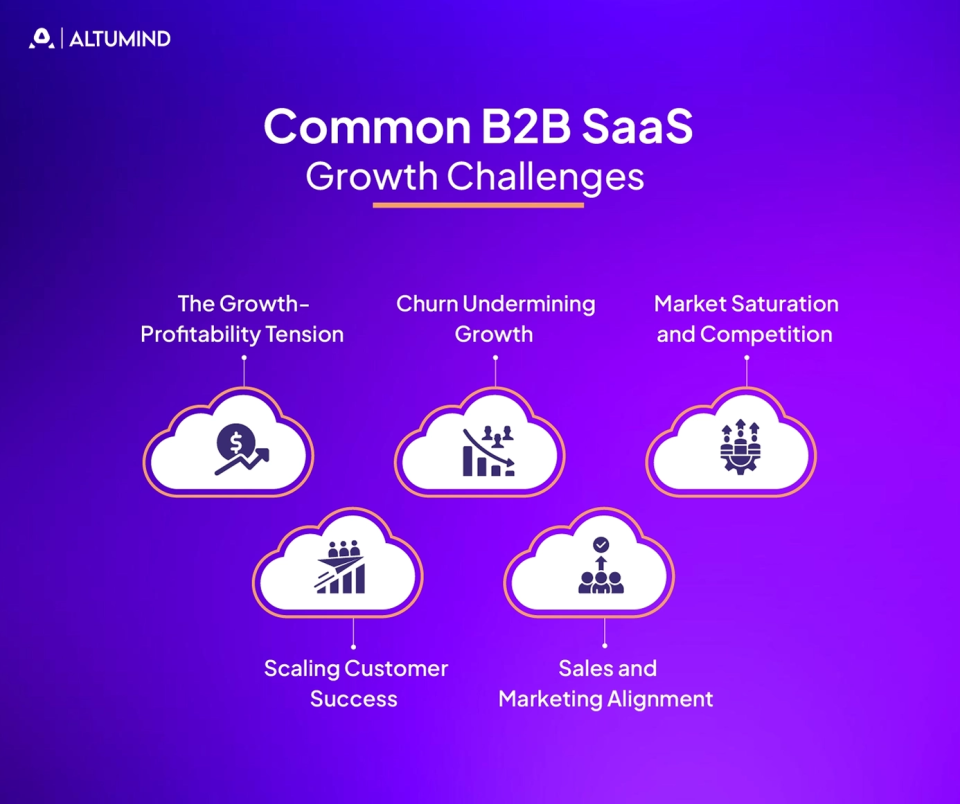
Common B2B SaaS Growth Challenges
Understanding frequent obstacles helps organizations prepare rather than react when problems emerge.
The Growth-Profitability Tension
Aggressive growth often conflicts with profitability goals. Customer acquisition costs remain high while revenue recognition spreads across subscription periods. Balancing investment in growth against the path to profitability requires careful planning and investor alignment on priorities.
Churn Undermining Growth
New customer acquisition means little if existing customers leave at similar rates. High churn indicates product-market fit problems, service quality issues, or targeting the wrong customer segments. Fixing churn often matters more than increasing acquisition.
Market Saturation and Competition
Successful categories attract competition that commoditizes solutions and pressures pricing. Differentiation becomes harder as competitors copy features and messaging. Continuous innovation and positioning evolution maintain competitive advantages.
Scaling Customer Success
High-touch success models that work early don’t scale economically. Automating success without losing personalization requires technology investment and process evolution. Finding the right balance between efficiency and effectiveness challenges growing companies.
Sales and Marketing Alignment
Disconnects between marketing and sales waste resources and frustrate both teams. Marketing generates leads that sales considers unqualified, while sales complains about insufficient volume. Alignment on definitions, processes, and goals eliminates destructive finger-pointing.
Conclusion
B2B SaaS growth requires mastering multiple disciplines simultaneously: product development, marketing that generates qualified demand, sales processes that convert efficiently, and customer success that drives retention. Success depends on understanding your B2B SaaS sales funnel deeply, investing in effective B2B SaaS lead generation across diverse channels, and obsessively measuring what matters.
Altumind partners with B2B SaaS companies to accelerate growth through strategic guidance and execution support. Our digital product development services combined with deep SaaS expertise help companies scale efficiently while maintaining quality and customer satisfaction. We work collaboratively to identify growth bottlenecks, implement proven frameworks, and build systems that create compounding returns rather than linear relationships between effort and results.
Table of Contents
Let's Connect
Reach out and explore how we can co-create your digital future!