11 Cloud Cost Optimization Strategies for Business Companies Scaling Globally
Your cloud bill arrives each month with numbers that demand explanation. What began as a scalable, cost-efficient infrastructure decision has become one of your largest operational expenses. Resources are provisioned on demand, unused instances run unnoticed, and sudden cost spikes raise uncomfortable questions in finance meetings.
The pay-as-you-go model offers flexibility, but without disciplined cloud cost optimization strategies, spending often grows faster than business value. As organizations expand globally, multi-region deployments, compliance requirements, and limited visibility compound the problem.
In this blog, we outline practical cloud cost optimization strategies that help enterprises scale internationally while maintaining financial control, performance, and operational discipline.
Understanding Cloud Cost Optimization
Cloud cost optimization is the strategic practice of minimizing cloud infrastructure spending while maintaining or improving performance, security, and reliability. This discipline goes beyond simple cost cutting to ensure every dollar spent delivers maximum business value.
Why Cloud Costs Escalate
Several factors drive unexpected cloud cost growth:
- Resource Over-Provisioning: Teams request more capacity than necessary to avoid performance issues, leaving expensive resources underutilized.
- Forgotten Resources: Development and testing environments remain running long after projects are complete, accumulating charges indefinitely.
- Storage Accumulation: Data grows continuously without cleanup policies, driving storage costs higher each month.
- Inefficient Architecture: Applications designed without cost considerations use expensive services when cheaper alternatives would work equally well.
- Lack of Visibility: Teams cannot optimize what they cannot measure, and many organizations lack clear visibility into where cloud spending occurs.
- Regional Expansion: Each new geographic region requires infrastructure duplication, multiplying costs without equivalent business value increases.
The Cost Optimization Mindset
Effective optimization requires cultural change beyond technical adjustments. Organizations must develop cost awareness across engineering, product, and business teams. Engineers need to understand cost implications of their architectural decisions. Product managers must balance feature velocity against infrastructure efficiency. Finance teams require real-time visibility rather than monthly surprises.
This mindset treats cloud costs as a first-class metric alongside performance, reliability, and security. Just as teams monitor application uptime and response times, they should track cost per transaction, cost per user, and cost trends over time. Making cost visible and tying it to business outcomes drives better decisions at every level.
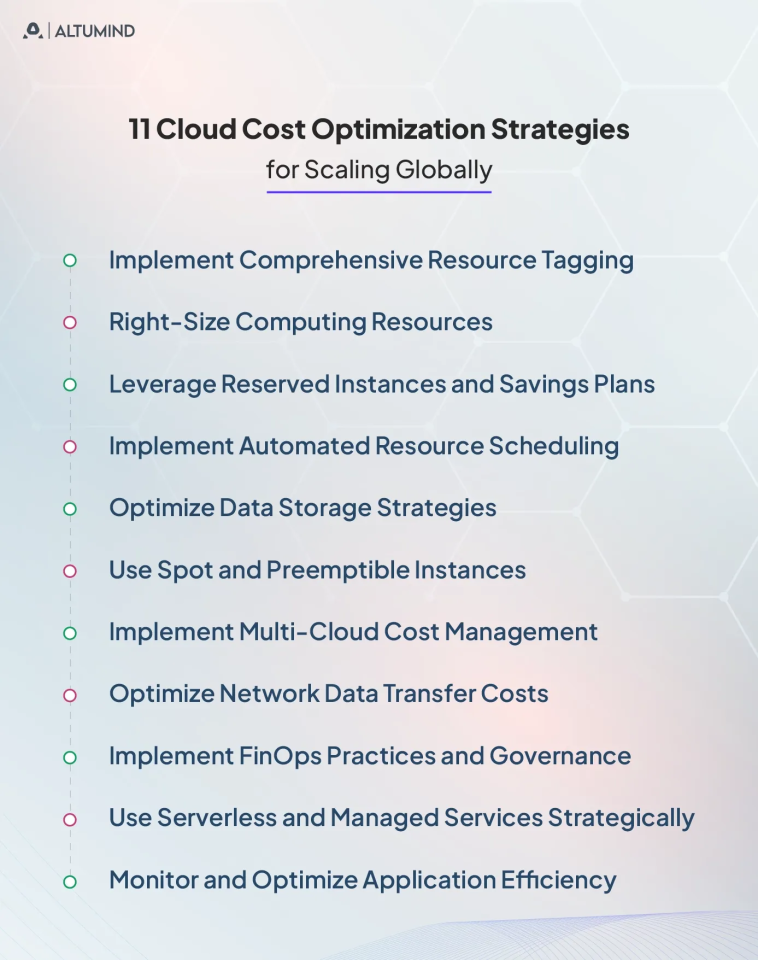
11 Cloud Cost Optimization Strategies for Scaling Globally
These proven strategies help companies control cloud spending while expanding internationally.
Implement Comprehensive Resource Tagging
Resource tagging assigns metadata labels to every cloud resource, enabling detailed cost tracking and accountability. Without consistent tagging, organizations cannot determine which teams, projects, or customers drive spending.
Effective tagging strategies include:
- Environment Tags: Distinguish production, staging, development, and testing resources to identify non-production waste.
- Cost Center Tags: Assign resources to departments or business units for chargeback and accountability.
- Project Tags: Track spending for specific initiatives to measure project costs accurately.
- Owner Tags: Identify responsible individuals for orphaned resource cleanup.
- Expiration Tags: Mark temporary resources with planned termination dates.
Enforce tagging through policies that prevent resource creation without required tags. Regularly audit compliance and clean up untagged resources. Consistent tagging transforms opaque cloud bills into actionable insights about where money flows.
Right-Size Computing Resources
Right-sizing matches resource capacity to actual workload requirements, eliminating waste from over-provisioned instances. Most organizations provision based on peak capacity needs, leaving resources underutilized during normal operations.
Right-sizing involves:
- Usage Analysis: Monitor CPU, memory, network, and storage utilization to identify underused resources.
- Instance Recommendations: Use cloud provider tools suggesting smaller instance types meeting actual requirements.
- Gradual Optimization: Test smaller instances in non-production environments before production changes.
- Continuous Monitoring: Regularly review utilization as workloads change over time.
Start with the most expensive, least utilized resources to maximize immediate impact. Development and testing environments often present easy wins with minimal risk.
Leverage Reserved Instances and Savings Plans
Reserved instances and savings plans provide cost advantages in exchange for long-term usage commitments. Organizations with stable, predictable workloads can significantly improve cost efficiency through these structured pricing models.
Commitment strategies include:
- Baseline Coverage: Purchase commitments covering minimum consistent usage across all workloads.
- Regional vs. Zonal: Choose appropriate flexibility levels to balance discount rates against operational needs.
- Term Optimization: Select one-year or three-year terms based on confidence in workload stability.
- Portfolio Management: Regularly review and adjust commitments as usage patterns evolve.
Combine reserved capacity with on-demand resources for variable workloads. This hybrid approach optimizes both predictable baseline and flexible burst capacity.
Implement Automated Resource Scheduling
Automated scheduling stops resources during periods of no use, eliminating costs for idle infrastructure. Development environments running 24/7 waste money during nights, weekends, and holidays when nobody uses them.
Scheduling automation includes:
- Development Environment Schedules: Automatically stop instances outside business hours.
- Test Environment Controls: Terminate resources immediately after test completion.
- Geographic Time Zones: Adjust schedules for distributed teams across regions.
- Exception Handling: Allow on-demand overrides for urgent work outside normal hours.
Optimizing runtime schedules reduces idle capacity and improves overall utilization. Aligning infrastructure availability with actual workload demand creates sustained cost control without impacting performance.
OptimizeData Storage Strategies
Storage costs accumulate invisibly as data volumes grow continuously. Most organizations never delete data, leading to massive stores of information with minimal business value.
Storage optimization includes:
- Lifecycle Policies: Automatically move aging data to cheaper storage tiers.
- Deletion Schedules: Remove temporary data after defined retention periods.
- Compression: Reduce storage requirements through efficient compression algorithms.
- Deduplication: Eliminate redundant copies of identical data.
- Snapshot Management: Clean up old backups and snapshots no longer needed.
Audit storage regularly to identify candidates for archiving or deletion. Question whether keeping everything forever provides value justifying the cost.
Use Spot and Preemptible Instances
Spot instances provide access to unused cloud capacity at significantly lower pricing in exchange for potential interruptions. Workloads that can tolerate disruption are well-suited to this cost-efficient model.
Appropriate spot instance workloads include:
- Batch Processing: Jobs that can restart from checkpoints if interrupted.
- Big Data Analysis: Distributed processing systems designed for node failures.
- CI/CD Pipelines: Build and test jobs that can retry if preempted.
- Rendering and Transcoding: Media processing workloads are easily parallelized.
Combine spot instances with on-demand capacity to balance cost savings against availability requirements. Implement graceful handling of interruptions to maximize reliability.
Implement Multi-Cloud Cost Management
Organizations using multiple cloud providers face additional complexity tracking and optimizing spending across platforms. Unified cost management provides visibility across AWS, Azure, Google Cloud, and other providers.
Multi-cloud optimization includes:
- Centralized Dashboards: Aggregate spending data from all providers into single views.
- Cross-Platform Comparison: Evaluate equivalent services across clouds to identify the best value.
- Workload Placement: Run each workload on the most cost-effective platform.
- Commitment Optimization: Manage reserved capacity across multiple providers strategically.
Third-party tools often provide better multi-cloud visibility than individual provider tools. Investment in unified platforms pays dividends through improved decision-making. Organizations pursuing cloud management outsourcing can access expertise across all major platforms without building capabilities internally.
Optimize Network Data Transfer Costs
Data transfer between regions, availability zones, and out to the internet generates substantial costs that organizations often overlook. Global operations with distributed users and infrastructure face particularly high transfer expenses.
Network optimization strategies include:
- Regional Architecture: Place resources in regions closest to users to minimize inter-region transfers.
- Content Delivery Networks: Cache static content near users to reduce origin data transfer.
- Compression: Reduce transferred data volumes through efficient compression.
- Private Connectivity: Use direct connects or VPNs for high-volume transfers between clouds and on-premises.
- Traffic Engineering: Route traffic efficiently to minimize expensive transfer patterns.
Model data transfer costs when designing architectures. Small architectural changes can eliminate expensive cross-region or cross-cloud transfers.
Implement FinOps Practices and Governance
FinOps combines financial accountability with operational practices to drive a cost-aware culture. This discipline unites finance, engineering, and business teams around cloud cost management.
FinOps implementation includes:
- Cost Allocation: Accurately assign cloud spending to responsible teams and projects.
- Budgets and Alerts: Set spending limits and notify teams when approaching thresholds.
- Showback and Chargeback: Make teams aware of their spending through reporting or actual chargebacks.
- Regular Reviews: Hold recurring cost optimization meetings reviewing spending and opportunities.
- Optimization Targets: Set cost reduction goals and track progress over time.
FinOps succeeds when engineers understand the cost implications of their decisions and have incentive to optimize. Transparency and accountability drive better outcomes than centralized control alone.
Use Serverless and Managed Services Strategically
Serverless computing and managed services eliminate infrastructure management overhead while often reducing costs for appropriate workloads. These services scale automatically and charge only for actual usage.
Serverless optimization includes:
- Function-Based Computing: Replace always-on servers with functions executing only when needed.
- Managed Databases: Use provider-managed databases, eliminating operational overhead.
- Queues and Event Systems: Leverage managed messaging services instead of self-hosted alternatives.
- API Gateways: Use managed API infrastructure scaling automatically.
Serverless works best for variable workloads with unpredictable traffic. Steady, high-volume workloads often cost less on traditional infrastructure. Analyze total cost, including operational overhead, not just infrastructure spending.
Monitor and Optimize Application Efficiency
Application code efficiency directly impacts cloud costs. Inefficient algorithms, unnecessary database queries, and poor caching strategies consume expensive resources, delivering minimal value.
Application optimization includes:
- Performance Profiling: Identify expensive code paths and database queries.
- Caching Strategies: Reduce redundant work through intelligent caching.
- Database Query Optimization: Improve query performance to reduce compute requirements.
- Asynchronous Processing: Move long-running tasks to background workers.
- Code Reviews: Include cost considerations in code review processes.
Application optimization requires collaboration between engineering and infrastructure teams. Developers need visibility into infrastructure costs their code decisions create. Success stories from companies implementing these practices, like those documented in cloud migration success stories, demonstrate the substantial savings possible through systematic optimization.
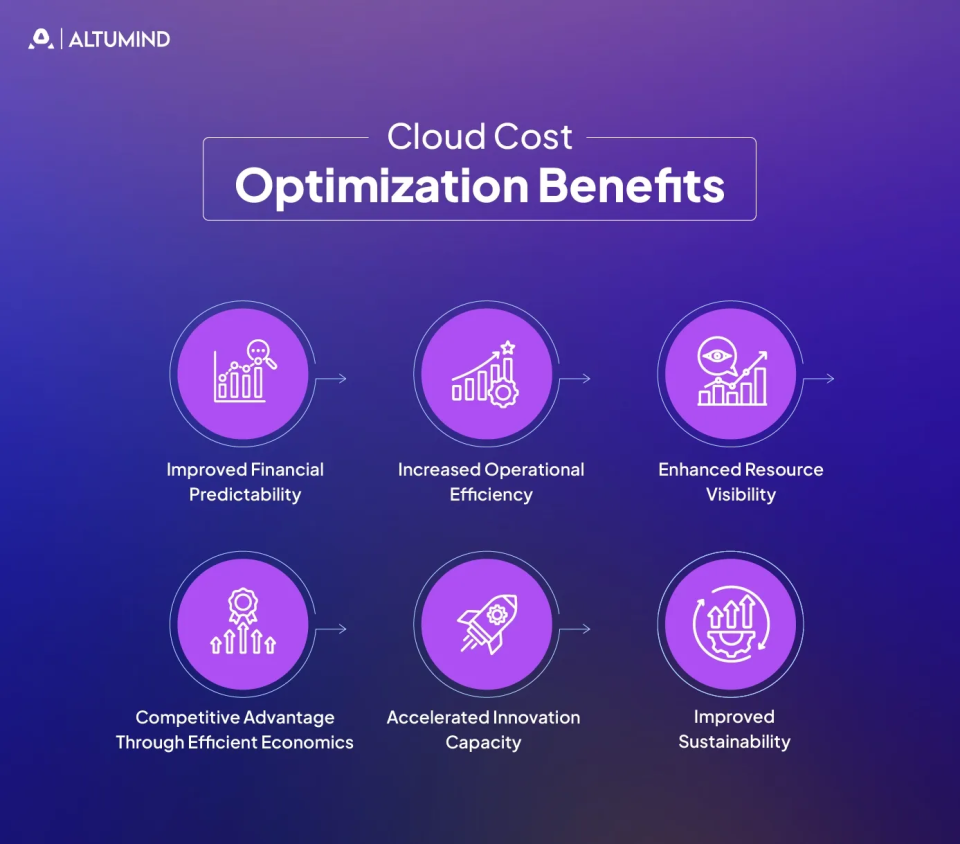
Cloud Cost Optimization Benefits
Organizations implementing systematic cloud cost optimization strategies realize multiple benefits beyond reduced spending.
Improved Financial Predictability
Optimized cloud environments with effective governance produce more predictable monthly costs. Understanding spending drivers and having controls in place prevents unexpected bill surprises that complicate financial planning.
Predictability enables better budgeting for future growth. When organizations understand cost per user, cost per transaction, or cost per service, they can accurately model financial implications of business expansion.
Increased Operational Efficiency
Cost optimization efforts often reveal operational inefficiencies beyond just wasted spending. Resources running unnecessarily indicate poor cleanup processes. Oversized instances suggest inadequate capacity planning. Storage accumulation points to missing data lifecycle management.
Addressing these issues improves operations broadly. Automated scheduling improves reliability through consistent environment management. Rightsizing IT prevents data accumulation that complicates compliance and security.
Enhanced Resource Visibility
Implementing tagging, monitoring, and cost allocation creates unprecedented visibility into cloud resource usage. Organizations understand which teams, projects, and customers drive spending in ways previously impossible.
This visibility enables data-driven decisions about resource allocation. Leadership can evaluate project costs against business value. Teams can prioritize optimization efforts based on actual spending patterns rather than assumptions.
Competitive Advantage Through Efficient Economics
Companies operating more efficiently than competitors can price more aggressively or invest savings in innovation. Cloud cost optimization improves unit economics, making businesses more competitive and sustainable.
This advantage compounds over time as efficient practices become embedded in culture. Organizations that build cost awareness into engineering practices maintain efficiency as they scale rather than seeing costs spiral out of control.
Accelerated Innovation Capacity
Spending less on existing workloads frees up budget for new initiatives. Organizations recapture wasted spending and redirect it toward innovation, customer features, and market expansion.
Cost optimization becomes an enabler of growth rather than just an expense reduction exercise. Teams can experiment with new technologies and enter new markets knowing their existing infrastructure runs efficiently. Leveraging insights from cloud-based analytics helps organizations identify optimization opportunities and measure improvement over time.
Improved Sustainability
Efficient cloud usage reduces environmental impact. Fewer resources mean less energy consumption and a lower carbon footprint. Organizations increasingly care about sustainability, making efficiency both financially and environmentally responsible.
Cloud providers invest heavily in renewable energy and efficient data centers. By using only the resources you need, you maximize the efficiency benefits providers offer while minimizing environmental impact.
Implementing Cost Optimization Across Global Operations
Global scale introduces unique challenges requiring thoughtful implementation approaches.
EstablishRegional Cost Centers
Treat each geographic region as a cost center with clear ownership and accountability. Regional teams understand local requirements and can optimize within context, while corporate teams ensure consistency and share best practices.
Regional autonomy balanced with central governance produces better outcomes than purely centralized or completely distributed approaches. Local teams optimize for their specific needs while benefiting from enterprise-wide tools, commitments, and expertise.
Standardize Architectures Across Regions
Architecture standardization simplifies cost management across regions. Similar workloads deployed consistently enable centralized optimization, reserved instance planning, and troubleshooting.
Standardization must balance consistency with local requirements. Regional differences in compliance, latency needs, or customer preferences may require architectural variations. Document and justify exceptions rather than allowing unconstrained variation.
Implement a Centralized FinOps Team
Centralized FinOps teams provide expertise, tools, and governance supporting regional operations. These teams establish policies, provide training, build automation, and track organization-wide optimization progress.
Central teams should enable rather than dictate. Provide tools, best practices, and support while letting regional teams execute optimization appropriate for their context.
Leverage Automation and Tooling
Manual cost optimization does not scale across global operations. Automation handles routine optimization while humans focus on strategic decisions and exceptions.
Key automation areas include:
- Resource Scheduling: Automatically start and stop resources based on usage patterns.
- Right-Sizing Recommendations: Generate and track right-sizing opportunities automatically.
- Anomaly Detection: Alert teams to unusual spending increases requiring investigation.
- Commitment Management: Optimize reserved instance purchases based on usage patterns.
- Policy Enforcement: Prevent costly mistakes through preventive controls.
Investment in automation pays back quickly through reduced manual effort and faster optimization cycles.
Create Optimization Feedback Loops
Regular review cycles ensure optimization remains continuous rather than one-time. Monthly or quarterly reviews assess progress, identify new opportunities, and adjust strategies based on business changes.
Share successes and learnings across regions. Optimization techniques working in one region often apply elsewhere. Creating communities of practice accelerates improvement across the organization.
Conclusion
Global scale introduces unique challenges requiring thoughtful implementation approaches.
EstablishRegional Cost Centers
Treat each geographic region as a cost center with clear ownership and accountability. Regional teams understand local requirements and can optimize within context, while corporate teams ensure consistency and share best practices.
Regional autonomy balanced with central governance produces better outcomes than purely centralized or completely distributed approaches. Local teams optimize for their specific needs while benefiting from enterprise-wide tools, commitments, and expertise.
Standardize Architectures Across Regions
Architecture standardization simplifies cost management across regions. Similar workloads deployed consistently enable centralized optimization, reserved instance planning, and troubleshooting.
Standardization must balance consistency with local requirements. Regional differences in compliance, latency needs, or customer preferences may require architectural variations. Document and justify exceptions rather than allowing unconstrained variation.
Implement Centralized FinOps Team
Centralized FinOps teams provide expertise, tools, and governance supporting regional operations. These teams establish policies, provide training, build automation, and track organization-wide optimization progress.
Central teams should enable rather than dictate. Provide tools, best practices, and support while letting regional teams execute optimization appropriate for their context.
Leverage Automation and Tooling
Manual cost optimization does not scale across global operations. Automation handles routine optimization while humans focus on strategic decisions and exceptions.
Key automation areas include:
- Resource Scheduling: Automatically start and stop resources based on usage patterns.
- Right-Sizing Recommendations: Generate and track right-sizing opportunities automatically.
- Anomaly Detection: Alert teams to unusual spending increases requiring investigation.
- Commitment Management: Optimize reserved instance purchases based on usage patterns.
- Policy Enforcement: Prevent costly mistakes through preventive controls.
Investment in automation pays back quickly through reduced manual effort and faster optimization cycles.
Create Optimization Feedback Loops
Regular review cycles ensure optimization remains continuous rather than one-time. Monthly or quarterly reviews assess progress, identify new opportunities, and adjust strategies based on business changes.
Share successes and learnings across regions. Optimization techniques working in one region often apply elsewhere. Creating communities of practice accelerates improvement across the organization.
Let's Connect
Reach out and explore how we can co-create your digital future!