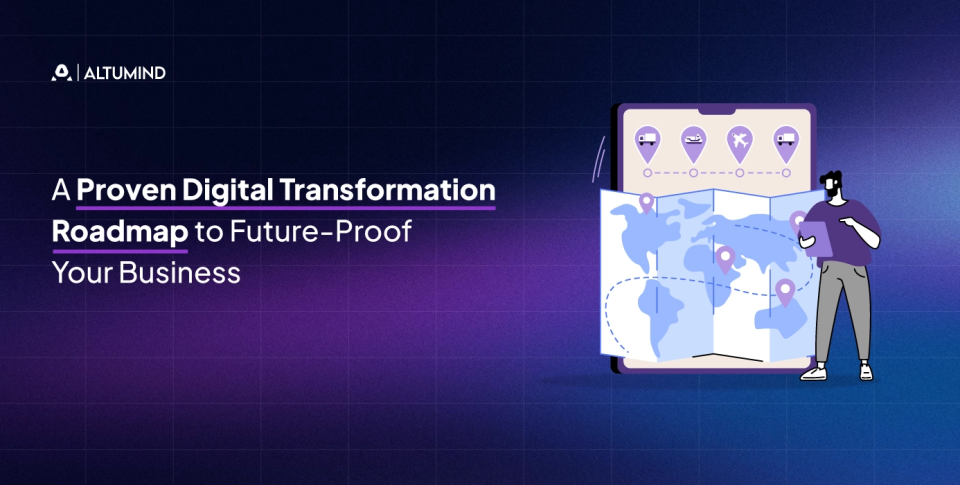
A Proven Digital Transformation Roadmap to Future-Proof Your Business
Digital transformation has become a business imperative, yet most companies struggle to translate ambition into measurable outcomes. The challenge lies not in recognizing the need for change but in creating a structured path forward that aligns technology investments with strategic business goals.
A digital transformation roadmap serves as your strategic blueprint, connecting current capabilities to future aspirations through clear, actionable steps. Without this framework, organizations risk scattered efforts, wasted resources, and transformation initiatives that fail to gain traction.
In this blog, we will examine what makes an effective roadmap, how to structure implementation phases, and the frameworks that turn strategic vision into operational reality through systematic planning and disciplined execution.
What is a Digital Transformation Roadmap?
A digital transformation roadmap is a strategic document that outlines how an organization will adopt new technologies, processes, and cultural practices to achieve specific business objectives. It functions as both a planning tool and a communication device that aligns stakeholders around a shared vision of change.
The roadmap differs fundamentally from traditional IT project plans. While project plans focus on technical delivery, transformation roadmaps address the broader organizational change required to achieve strategic business outcomes. They connect technology initiatives to revenue growth, customer experience improvements, operational efficiency gains, and competitive positioning.
Effective roadmaps balance ambition with pragmatism. They set bold directions while acknowledging resource constraints, skill gaps, and organizational change capacity. The document evolves as market conditions shift and as teams learn from early implementation experiences.
Core Components of an Effective Roadmap
Every digital transformation roadmap should contain several essential elements that provide clarity and direction:
- Strategic Vision and Objectives: The roadmap must articulate what success looks like in concrete business terms. This includes specific outcomes like revenue targets, cost reduction goals, customer satisfaction improvements, or market share expansion. Vague aspirations about becoming more digital fail to provide the focus needed for execution.
- Current State Assessment: A thorough evaluation of existing capabilities, systems, processes, and organizational readiness establishes the starting point. This baseline reveals gaps between current and desired states, informing which initiatives take priority.
- Prioritized Initiatives: The roadmap identifies specific projects, capabilities, and changes needed to achieve the vision. Each initiative should connect directly to strategic objectives with clear value propositions. Prioritization considers both strategic importance and practical execution factors like complexity, cost, and dependencies.
- Phased Implementation Timeline: Breaking the transformation into phases creates manageable increments while maintaining momentum. Each phase should deliver tangible value within a reasonable timeframe, typically three to 12 months.
- Resource Requirements: Comprehensive roadmaps detail the investments needed across technology, talent, training, and change management. This transparency helps secure necessary commitments and prevents underfunding that dooms initiatives.
- Governance Structure: Clear decision-making processes, accountability assignments, and escalation paths keep execution aligned with strategy. Governance ensures initiatives remain coordinated rather than creating siloed efforts.
- Success Metrics: Roadmaps define how progress and impact will be measured. This includes both implementation metrics like schedule and budget performance and business impact metrics like revenue growth or customer satisfaction improvements.
- Risk Management Approach: Identifying potential obstacles and mitigation strategies acknowledges that transformation involves uncertainty. Proactive risk management increases the likelihood of successful navigation through challenges.
Tools Required for Roadmap Development and Execution
Creating and executing a digital transformation roadmap requires several categories of tools that support different aspects of the work:
- Assessment and Analysis Tools: Maturity assessment frameworks help evaluate your starting point across dimensions like technology, data, skills, and culture. Competitive analysis tools provide context about where your industry is heading. Customer research platforms gather insights about unmet needs and pain points that transformation should address.
- Planning and Visualization Software: Roadmapping platforms like Aha!, ProductPlan, or Roadmunk help create visual timelines that communicate plans clearly. Project management tools such as Jira, Asana, or Monday.com track initiative execution. Strategic planning software helps model scenarios and evaluate trade-offs between different paths forward.
- Collaboration Platforms: Transformation requires coordination across many teams and stakeholders. Tools like Microsoft Teams, Slack, or Confluence provide spaces for shared documents, discussions, and decision-making that keep everyone aligned.
- Data and Analytics Platforms: Understanding current performance and measuring impact requires robust analytics capabilities. Business intelligence tools, customer data platforms, and performance dashboards provide visibility into both baseline metrics and transformation progress.
- Change Management Tools: Specialized platforms support communication campaigns, training delivery, feedback collection, and adoption tracking. These tools help manage the human side of transformation that often determines success or failure.
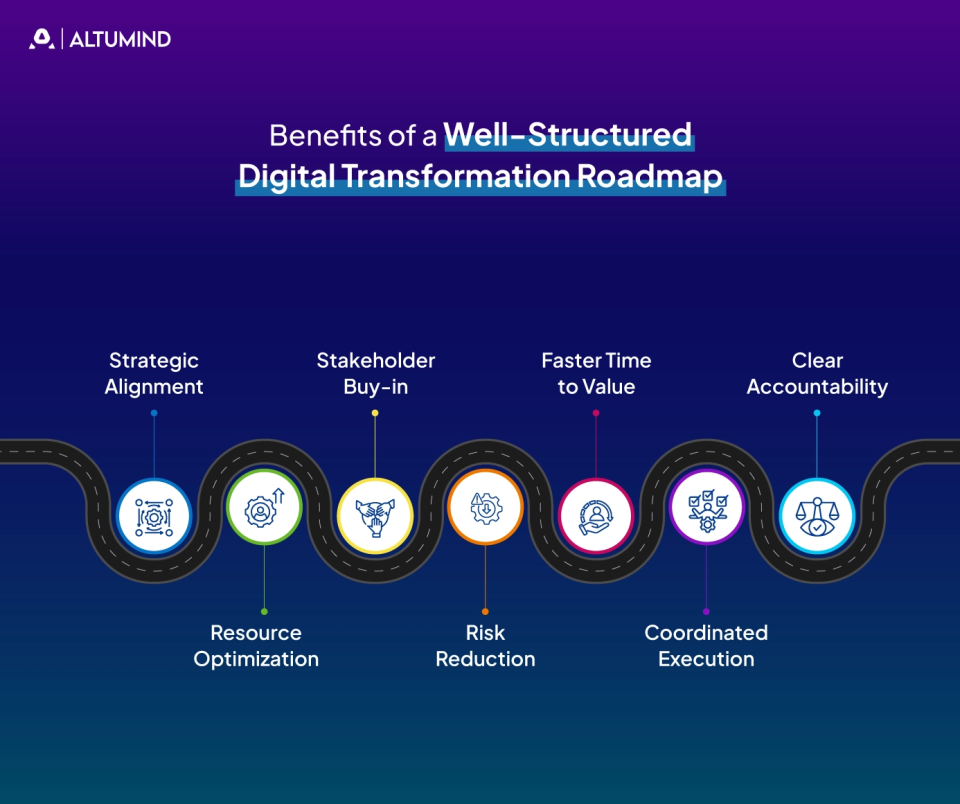
Benefits of a Well-Structured Digital Transformation Roadmap
Organizations that invest in comprehensive roadmaps realize multiple benefits that compound throughout the transformation journey.
Strategic Alignment
A clear roadmap ensures all initiatives support overarching business objectives rather than pursuing technology for its own sake. Every team understands how their work contributes to larger strategic goals, creating shared purpose across the organization. When executives, middle management, and frontline employees work toward the same vision, organizations move forward with unified momentum rather than pulling in different directions.
Resource Optimization
Detailed planning reveals total resource requirements early, allowing organizations to secure necessary funding and talent before initiatives begin. This prevents the stop-start execution that results from insufficient resources. Organizations can make informed trade-offs between competing priorities based on a comprehensive understanding of what each initiative requires. Finance teams appreciate the predictability that roadmaps provide, making it easier to allocate budgets and justify investments through clear connections to business outcomes.
Stakeholder Buy-in
Roadmaps provide a tangible artifact that communicates vision and plans to diverse audiences, from board members to employees to external partners. This transparency builds confidence and commitment across all stakeholder groups. When people understand where the organization is heading and how their role contributes to success, resistance decreases and collaboration increases. Executive teams can articulate transformation strategy with confidence, while managers explain upcoming changes with clarity.
Risk Reduction
Systematic planning identifies potential obstacles before they derail initiatives, shifting organizations from reactive firefighting to proactive risk management. Early risk identification allows for contingency planning and mitigation strategies that reduce both the probability and impact of problems. Organizations can test assumptions before major commitments and build flexibility into designs that accommodate changing requirements. Technical risks get addressed in architecture rather than discovered during implementation.
Faster Time to Value
Phased approaches that prioritize quick wins generate early returns that fund subsequent initiatives while building organizational confidence. This creates positive momentum that carries programs through inevitable challenges. Quick wins demonstrate that transformation delivers real benefits rather than just consuming resources, converting skeptics into supporters. Revenue from early initiatives can fund later phases, reducing the burden on operating budgets.
Coordinated Execution
Roadmaps reveal dependencies between initiatives, preventing conflicts and enabling proper sequencing that maximizes efficiency. This coordination becomes increasingly important as organizations scale transformation across multiple business units and functional areas. Teams understand how their work connects to other efforts, facilitating collaboration and preventing duplication. Shared services like data platforms or cloud infrastructure get built once and reused across multiple initiatives.
Clear Accountability
Explicit ownership assignments and governance structures establish who is responsible for what outcomes, eliminating ambiguity that allows problems to fester unaddressed. This clarity reduces confusion about decision rights and accelerates problem resolution. When everyone knows their role, initiatives move forward without constant negotiation. Performance can be measured objectively against defined expectations, supporting both recognition of success and course correction when needed.
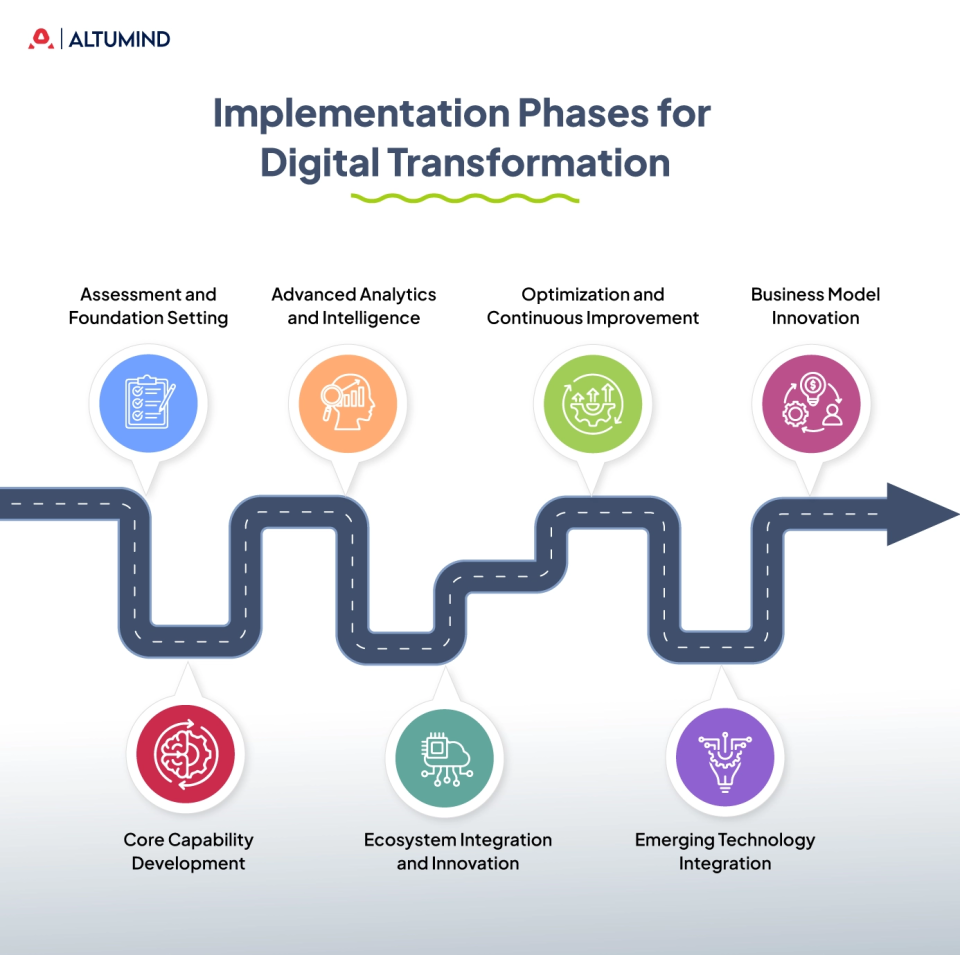
Implementation Phases for Digital Transformation
Phase 1: Assessment and Foundation Setting
Transformation begins with understanding your current state and establishing the foundational capabilities needed for success. This initial phase typically spans three to six months and sets the stage for all subsequent work.
1. Conducting a Comprehensive Digital Maturity Assessment
Start by evaluating your organization across multiple dimensions to establish a baseline:
- Technology Infrastructure: Examine existing systems, platforms, and technical architecture. Identify legacy technologies that create bottlenecks, integration challenges that limit data flow, and technical debt that constrains agility. Assess cloud adoption status, API capabilities, and security posture.
- Data Capabilities: Review how well your organization collects, manages, and uses data. Evaluate data quality, accessibility, governance practices, and analytical capabilities. Understand what data exists, where it lives, and how effectively it informs decisions.
- Digital Skills and Talent: Assess the digital competencies present across your workforce. Identify critical skill gaps in areas like data science, cloud engineering, agile methodologies, or user experience design. Understand whether you can build needed capabilities internally or must acquire them externally.
- Process Maturity: Analyze core business processes for efficiency, automation potential, and customer impact. Identify manual workarounds, redundant steps, and handoffs that slow execution or introduce errors.
- Organizational Culture: Evaluate cultural attributes that affect transformation, like risk tolerance, innovation mindset, collaboration patterns, and change readiness. Culture often determines whether new capabilities actually get adopted and used.
- Customer Experience: Map current digital touchpoints and customer journeys. Identify friction points, gaps in experience, and opportunities where digital capabilities could significantly improve satisfaction or loyalty.
This assessment reveals not just where you are but highlights the specific areas requiring the most attention. Different organizations will have different starting points, and your roadmap must reflect your unique situation.
2. Defining Your Transformation Vision
With assessment complete, articulate a clear vision for what transformation will achieve. This vision provides the north star guiding all subsequent decisions. Your vision statement should address several elements:
- Business Impact: Describe tangible outcomes you aim to achieve with specificity about metrics like revenue growth, cost reduction, or market share expansion. Avoid generic statements about becoming more digital or innovative.
- Customer Value: Explain how transformation will improve customer experiences and relationships. Connect technical capabilities to customer benefits in clear terms.
- Operational Excellence: Outline how new capabilities will enhance efficiency, agility, and innovation capacity across the organization.
- Competitive Position: Clarify how digital transformation strengthens competitive advantage and positions you for future market demands.
For example, a retail company might envision creating seamless omnichannel experiences that blend physical and digital shopping to increase customer lifetime value by 30 percent over three years. A manufacturing firm might focus on using IoT and AI to create predictive maintenance capabilities that reduce unplanned downtime by 40 percent while extending equipment lifespan.
3. Building Foundational Capabilities
Phase one includes establishing essential capabilities that enable subsequent transformation work:
- Data Infrastructure: Create unified data platforms that break down silos and make information accessible across the organization. This foundation supports all data-driven initiatives that follow.
- Cloud Foundation: Migrate core infrastructure to cloud environments that provide scalability, flexibility, and access to advanced services. This typically involves hybrid approaches that balance cloud benefits with on-premise requirements.
- API Layer: Develop integration capabilities that allow different systems to communicate effectively. APIs create the connective tissue enabling new applications to leverage existing data and functionality.
- Agile Operating Model: Introduce agile practices that allow faster iteration and learning. This includes both technical practices like continuous integration and deployment and organizational practices like cross-functional teams and iterative planning.
- Digital Literacy Programs: Launch training initiatives that build basic digital fluency across the workforce. Universal baseline skills accelerate adoption of new tools and processes.
- Quick Win Projects: Select one or two initiatives that deliver visible value quickly while demonstrating transformation potential. These early successes build confidence and momentum.
This phase focuses on creating stable foundations while proving that transformation can deliver real benefits.
Phase 2: Core Capability Development
With foundations in place, phase two scales initial successes and introduces more substantial capabilities that transform core business processes. This phase typically spans six to 12 months and represents the period where transformation gains substantial momentum.
1. Scaling Successful Pilots
Take initiatives that proved successful in phase one and expand them across broader parts of the organization:
- Refinement: Use lessons from initial implementations to improve approaches before scaling. Address pain points, simplify processes, and enhance training based on early user feedback.
- Gradual Rollout: Implement in waves rather than attempting enterprise-wide deployment all at once. This controlled approach allows you to manage change more effectively and adjust based on each wave’s experiences.
- Local Adaptation: Recognize that different business units or regions may have unique requirements. Allow for customization within a common framework rather than forcing identical implementations everywhere.
2. Implementing Process Automation
Phase two often focuses heavily on automating repetitive tasks and streamlining workflows:
- Robotic Process Automation: Deploy software bots that handle high-volume, rules-based tasks like data entry, report generation, or transaction processing. RPA delivers quick returns and frees employees for higher-value work.
- Workflow Automation: Implement platforms that orchestrate complex processes across multiple systems and teams. This reduces handoff delays, eliminates manual routing, and improves process visibility.
- Intelligent Document Processing: Apply AI to extract information from unstructured documents, reducing manual data entry and accelerating processing times for contracts, invoices, or customer applications.
3. Enhancing Customer Engagement Capabilities
Introduce digital capabilities that transform how you interact with customers:
- Omnichannel Platforms: Create unified systems that provide consistent experiences across web, mobile, physical locations, and emerging channels. Customers should move seamlessly between touchpoints without losing context.
- Personalization Engines: Implement recommendation systems and content personalization that adapt experiences based on individual customer behavior, preferences, and context. This increases relevance and engagement.
- Self-Service Portals: Build comprehensive self-service capabilities that allow customers to handle routine transactions independently. This improves convenience while reducing service costs.
- Conversational AI: Deploy intelligent chatbots and virtual assistants that provide 24/7 support, answer common questions, and route complex issues appropriately. These systems continuously learn and improve from interactions.
This phase begins changing how work actually gets done across the organization.
Phase 3: Advanced Analytics and Intelligence
Phase three introduces sophisticated analytical capabilities that move organizations from descriptive reporting to predictive and prescriptive analytics. This phase typically runs six to 12 months and fundamentally changes how organizations understand their business and make decisions.
1. Building Advanced Analytics Capabilities
Develop systems that generate actionable insights from data:
- Predictive Analytics: Implement models that forecast future outcomes like customer churn, equipment failures, or demand patterns. These predictions enable proactive interventions rather than reactive responses.
- Customer Intelligence: Create comprehensive views of customers that unify data across all touchpoints and interactions. These 360-degree profiles enable personalized engagement and informed decision-making about customer strategies.
- Operational Analytics: Deploy real-time monitoring and analysis of business operations that identify bottlenecks, inefficiencies, or anomalies as they occur. This immediate visibility enables rapid optimization.
2. Introducing Artificial Intelligence
Phase three often marks the introduction of AI capabilities that augment human decision-making:
- Machine Learning Models: Develop custom models trained on your specific data and use cases. These might include demand forecasting, fraud detection, quality prediction, or recommendation systems.
- Natural Language Processing: Apply NLP to analyze customer feedback, support tickets, or market intelligence. Extract insights from unstructured text that would be impossible to process manually.
- Computer Vision: For relevant industries, implement visual inspection systems, shelf monitoring, or document analysis that automate previously manual visual tasks.
3. Creating a Data-Driven Culture
Technology alone does not create data-driven organizations. Phase three includes cultural initiatives that embed analytics into decision-making:
- Self-Service Analytics: Deploy intuitive tools that allow business users to explore data and generate insights without depending on specialized analysts. This democratizes access to information.
- Decision Frameworks: Establish processes that require data analysis to support major decisions. Move from decisions based primarily on experience and intuition to those informed by both judgment and evidence.
- Analytics Training: Expand digital literacy programs to include statistical reasoning, data interpretation, and critical evaluation of analytical outputs. Universal analytical fluency amplifies the impact of analytical tools.
Phase 4: Ecosystem Integration and Innovation
Phase four extends digital capabilities beyond organizational boundaries to create ecosystem-wide value networks and establishes permanent innovation capabilities. This phase typically runs six to 12 months and positions the organization for sustained competitive advantage.
1. Building Ecosystem Platforms
Move beyond optimizing internal operations to creating platforms that enable ecosystem participation:
- API Ecosystems: Expose capabilities through developer-friendly APIs that allow partners, customers, or third parties to build on your platform. This creates new value propositions and revenue streams.
- Partner Integration: Establish seamless connections with key partners, suppliers, or distributors that improve coordination and unlock mutual value. These integrations might include shared inventory visibility, automated ordering, or collaborative planning.
- Marketplace Capabilities: For relevant business models, create digital marketplaces that connect multiple parties and facilitate transactions or interactions. Platforms create network effects where value increases with participation.
2. Establishing Innovation Functions
Phase four includes creating permanent capabilities for continuous innovation:
- Innovation Labs: Establish dedicated teams focused on exploring emerging technologies and identifying new opportunities. These groups experiment with innovations that may not yet be ready for mainstream deployment but show long-term promise.
- Venture Partnerships: Develop relationships with startups, accelerators, or venture capital firms that provide early visibility into disruptive innovations. Strategic investments or partnerships can secure access to capabilities your organization cannot build internally.
- Customer Co-Creation: Involve customers directly in the ideation and development of new products or services. This approach surfaces unmet needs while building customer commitment to resulting solutions.
- Continuous Experimentation: Embed rapid experimentation capabilities across the organization so teams can test hypotheses quickly and cheaply. This increases the innovation pipeline while reducing risk through validation before major commitments.
3. Advanced Personalization and Experience
Push customer experience capabilities to sophisticated levels:
- Hyper-Personalization: Move beyond segmentation to individual-level customization that adapts in real time based on behavior, context, and predicted preferences. This might include dynamic pricing, individualized product configurations, or personalized content journeys.
- Augmented Reality Experiences: For relevant industries, implement AR capabilities that allow customers to visualize products in their environment, access additional information through physical products, or receive contextual guidance.
- Proactive Service: Use predictive analytics to identify and address customer needs before they arise. This might include preventive maintenance notifications, proactive restocking of consumables, or anticipatory support.
Phase 5: Optimization and Continuous Improvement
The fifth phase focuses on refining implemented capabilities and establishing mechanisms for ongoing evolution. This phase blends into permanent operations as transformation becomes the normal way of working.
1. Performance Optimization
Systematically improve the efficiency and effectiveness of deployed solutions:
- Technical Optimization: Refine system performance through improved algorithms, infrastructure tuning, or architectural enhancements. Even small improvements compound significantly at scale.
- Process Refinement: Analyze how implemented capabilities are actually being used and identify opportunities to streamline workflows, eliminate unnecessary steps, or improve handoffs between automated and human work.
- Cost Optimization: Review the total cost of ownership for digital capabilities and identify opportunities to reduce expenses without sacrificing value. This might include cloud resource optimization, license consolidation, or vendor renegotiation.
2. Scaling Innovation Capabilities
Expand innovation practices that proved successful:
- Distributed Innovation: Push innovation capabilities into business units so they can continuously adapt to their specific market conditions rather than relying solely on central functions.
- Innovation Metrics: Establish clear measurements of innovation output, velocity, and impact. What gets measured gets managed, and explicit metrics signal that innovation is valued.
- Cross-Pollination: Create mechanisms for sharing learnings across different parts of the organization so successful innovations in one area can be adapted and applied elsewhere.
3. Building Continuous Learning
Establish practices that capture and apply lessons from transformation experiences:
- Retrospectives: Conduct regular reviews that examine what worked, what did not, and why. Document insights so they inform future decisions.
- Knowledge Management: Create repositories of best practices, lessons learned, and reusable assets that accelerate subsequent initiatives.
- Skill Development: Maintain ongoing training programs that keep pace with evolving technologies and practices. Digital skills require continuous updating as capabilities advance.
Phase 6: Emerging Technology Integration
Forward-looking organizations include phases focused on technologies that are still maturing but show transformative potential. This phase typically emerges 12 to 18 months into the transformation as foundational capabilities mature.
1. Exploring Generative AI Applications
Generative AI represents one of the most significant technology shifts in recent years:
- Content Generation: Deploy AI that creates marketing copy, product descriptions, customer communications, or code. This amplifies human creativity and productivity while maintaining quality standards.
- Conversational Interfaces: Implement advanced chatbots and assistants that engage in natural dialogue, understand context, and handle complex inquiries with minimal human intervention.
- Decision Support: Use generative AI to synthesize information, generate options, or provide recommendations that augment human decision-making in complex situations.
2. Investigating Web3 and Blockchain
For specific use cases, distributed ledger technologies offer unique value:
- Supply Chain Transparency: Implement blockchain-based tracking that provides immutable records of product origins, handling, and authenticity. This builds trust in industries where provenance matters.
- Digital Assets: Explore tokenization of physical or digital assets that enable new business models, fractionalized ownership, or automated royalty distribution.
- Smart Contracts: Deploy self-executing agreements that reduce friction, eliminate intermediaries, and increase transaction speed for appropriate use cases.
3. Advancing Internet of Things Capabilities
Connected devices create entirely new sources of data and control:
- Predictive Maintenance: Instrument assets with sensors that monitor condition and predict failures before they occur. This minimizes downtime while optimizing maintenance spending.
- Smart Products: Embed connectivity in products that enables usage monitoring, remote updates, or value-added services that strengthen customer relationships.
- Operational Intelligence: Deploy environmental sensors throughout facilities that optimize energy usage, space utilization, or environmental conditions based on real-time data.
Phase 7: Business Model Innovation
The ultimate expression of digital transformation involves reimagining fundamental business models rather than just digitizing existing operations. This represents the highest-impact application of digital capabilities.
1. Subscription and Service Models
Many organizations shift from transactional sales to ongoing service relationships:
- Product-as-a-Service: Transform one-time product sales into subscription services where customers pay for outcomes or usage rather than ownership. This requires capabilities to monitor usage, manage subscriptions, and deliver ongoing value.
- Freemium Strategies: Offer basic capabilities free while charging for premium features. Success requires understanding which features drive upgrade conversions and creating smooth paths from free to paid.
- Platform Revenue: Generate income by enabling transactions or interactions between third parties rather than just selling your own products. This demands building and managing marketplace or platform ecosystems.
2. Data Monetization
Organizations rich in data explore ways to extract value beyond improving internal operations:
- Data Products: Package insights derived from your data into products sold to customers, partners, or third parties. This requires strong data governance and privacy practices.
- Benchmarking Services: Aggregate anonymized data to provide industry benchmarks or comparative insights that help customers understand their performance relative to peers.
- Embedded Intelligence: Incorporate insights into existing products or services that increase their value rather than selling data separately.
3. Ecosystem Orchestration
Some organizations evolve into orchestrators that coordinate networks of partners rather than delivering all value internally:
- Platform Business Models: Shift from linear value chains to platforms that facilitate interactions between multiple parties. This creates network effects where value grows exponentially with participation.
- Collaborative Innovation: Develop capabilities to co-create with partners, sharing risks and rewards of developing new offerings.
- Open Innovation: Selectively open internal capabilities to external innovators who build complementary solutions that increase the value of your platform or offerings.
How to Measure Progress and Success
Effective measurement requires tracking both implementation progress and business impact across multiple dimensions.
Implementation Metrics
Monitor execution health through operational metrics:
- Schedule Performance: Track initiatives that are completed on planned timelines. Consistent delays signal resource constraints, scope creep, or unrealistic planning that requires correction.
- Budget Performance: Monitor spending against approved budgets. Significant variances in either direction indicate planning problems or changed conditions requiring attention.
- Scope Management: Measure how well teams deliver planned capabilities without excessive additions or reductions. This indicates alignment between planning and execution.
- Quality Metrics: Track defect rates, rework requirements, or user-reported issues. Quality problems create technical debt that slows future progress.
- Adoption Rates: Monitor how quickly employees adopt new tools and processes. Low adoption rates indicate change management problems regardless of how well technical implementation progressed.
Business Impact Metrics
More importantly, measure actual business outcomes generated by transformation:
- Financial Performance: Track revenue growth, cost reductions, profit margin improvements, or return on investment directly attributed to transformation initiatives. Connect financial outcomes to specific capabilities so you understand what drives value.
- Customer Metrics: Monitor changes in satisfaction scores, Net Promoter Score, customer lifetime value, retention rates, or acquisition costs. These indicators reveal whether transformation improves customer relationships as intended.
- Operational Efficiency: Measure process cycle time reductions, error rate decreases, productivity improvements, or resource requirement changes. Quantify how transformation makes operations more efficient.
- Innovation Capacity: Track time to market for new products, number of experiments conducted, percentage of revenue from new offerings, or speed of response to market changes. These metrics show whether transformation increases organizational agility.
- Employee Impact: Monitor employee satisfaction, retention, digital skill levels, or productivity. Successful transformation should improve the employee experience, not just customer outcomes.
- Competitive Position: Assess market share changes, win rates against competitors, or industry leadership indicators. Ultimate success shows up in improved competitive standing.
Creating Transformation Dashboards
Consolidate metrics into accessible dashboards that provide visibility to stakeholders:
- Executive Dashboard: Show high-level business impact metrics and overall program health. Executives need to understand progress toward strategic objectives without implementation details.
- Program Management Dashboard: Provide detailed views of individual initiatives, resources, risks, and dependencies. This operational view supports day-to-day management.
- Team Dashboards: Give individual teams visibility into their specific metrics, progress, and how they contribute to overall objectives. This maintains focus and motivation.
Update dashboards regularly and ensure broad access. Transparency builds accountability and allows early identification of problems requiring intervention.
Conclusion
Digital transformation roadmaps convert strategic vision into systematic action that creates measurable business value. Organizations that invest in comprehensive planning avoid the scattered efforts and wasted resources that plague reactive approaches to technology adoption. Success requires equal attention to technology, process, and people dimensions, with phased approaches that balance quick wins against foundational investments that enable long-term capabilities.
Altumind partners with organizations to build and execute transformation roadmaps grounded in proven methodologies and deep technical expertise across emerging technologies. Our teams support digital product development from strategy through implementation, combining strategic planning with hands-on execution across technology development, change management, and capability building.
We help leadership teams translate ambitious goals into executable plans that drive real outcomes while developing internal capabilities for sustained evolution beyond initial engagements, ensuring transformation becomes embedded in organizational DNA rather than remaining dependent on external support.
Let's Connect
Reach out and explore how we can co-create your digital future!