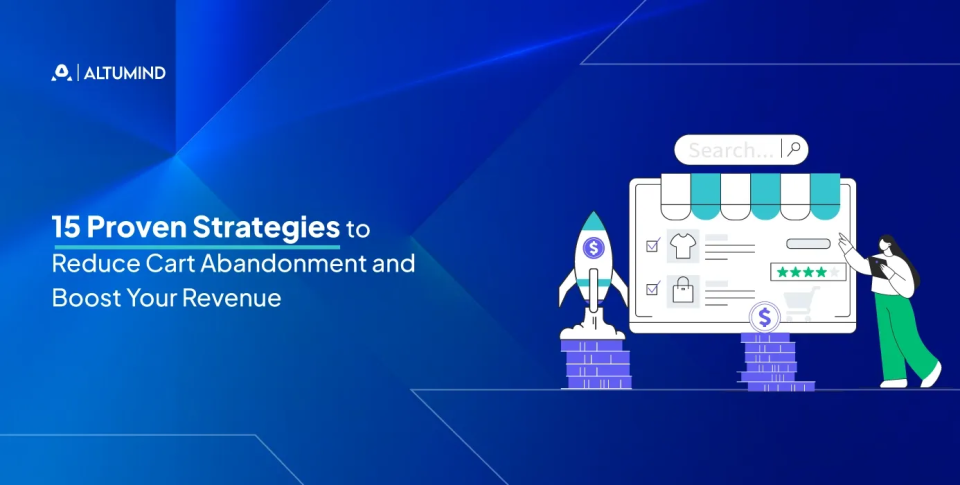
15 Proven Strategies to Reduce Cart Abandonment and Boost Your Revenue
Your customers browse through hundreds of products, add their favorites to the cart, and head to checkout. Everything seems perfect until they hit that final step and suddenly disappear. No purchase, no follow-through, just an abandoned cart and lost revenue slipping through your fingers.
Cart abandonment represents one of the most costly challenges in e-commerce. Recent data shows that online shopping cart abandonment reached 70.22%, meaning the initiated purchases never convert to revenue.
Each abandoned cart represents lost revenue, wasted marketing spend, and a customer who walked away at the critical moment. The good news is that cart abandonment is not inevitable.
Understanding why customers leave and implementing strategic solutions can dramatically improve your conversion rates. In this blog, we will examine proven strategies to reduce cart abandonment and how technology, including AI, transforms the checkout experience.
Understanding Cart Abandonment Rate
Cart abandonment rate measures the percentage of shoppers who add items to their cart but leave without completing the purchase. This metric reveals how effectively your checkout process converts interested browsers into paying customers.
Understanding this metric helps identify where your checkout process loses customers and quantifies the revenue impact of improvements. By tracking abandonment rates over time, you can measure whether optimization efforts successfully convert more browsers into buyers and recover revenue that would otherwise disappear.
Why Cart Abandonment Matters
Every abandoned cart represents revenue left on the table. If your average order value is $100 and you have 1,000 cart abandonments monthly, that represents $100,000 in potential revenue walking away each month.
Beyond immediate revenue loss, high abandonment rates indicate deeper problems:
- User Experience Issues: Friction in the checkout process frustrates customers and damages brand perception.
- Competitive Disadvantage: Customers abandoning your checkout often complete purchases with competitors offering smoother experiences.
- Marketing Waste: Acquisition costs spent bringing customers to your site generate no return when they abandon at checkout.
- Customer Lifetime Value Impact: Poor checkout experiences reduce the likelihood customers return for future purchases.
Common Reasons for Cart Abandonment
Understanding why customers abandon carts guides effective solutions. Research reveals several primary abandonment triggers:
- Unexpected Costs: Hidden fees, shipping charges, or taxes appearing late in checkout surprise customers who assume different total costs.
- Complex Checkout Process: Studies show that 18% of US online shoppers abandon orders specifically because the checkout process is excessively long or complicated.
- Forced Account Creation: Data indicates that 26% of shoppers abandon their carts when forced to create an account before completing their purchase.
- Payment Security Concerns: Customers hesitate to enter payment information on sites that don’t clearly demonstrate security measures.
- Technical Issues: More than 17% of cart abandonment occurs when websites crash or malfunction during the checkout process.
- Lack of Preferred Payment Methods: Customers expect their preferred payment options and may abandon them if unavailable.
- Poor Mobile Experience: Mobile shoppers face unique frustrations with forms, buttons, and navigation that don’t work well on smaller screens.
Each of these factors creates friction that gives customers pause and opportunity to reconsider their purchase. The longer and more complicated the checkout becomes, the more time customers have to change their minds.
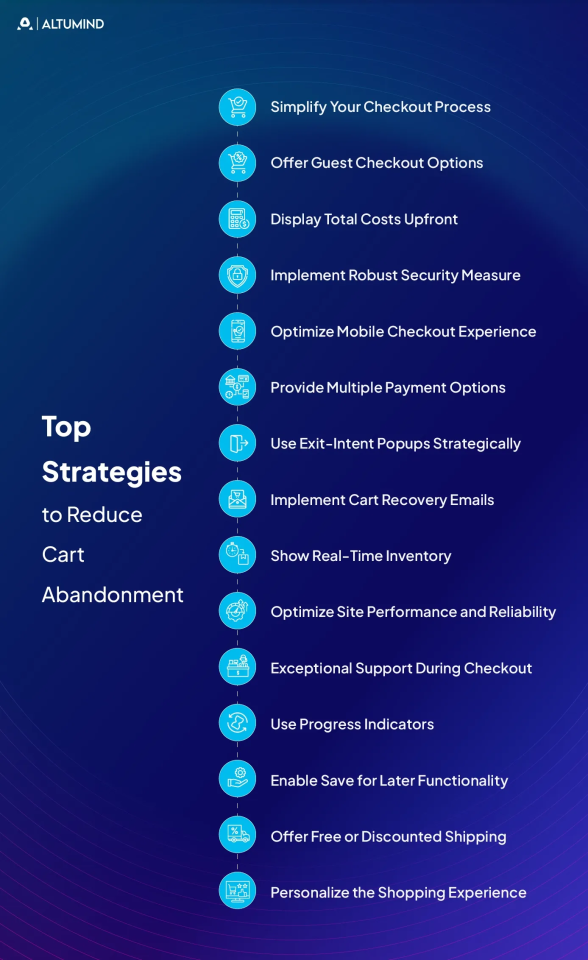
Top Strategies to Reduce Cart Abandonment
Implementing these proven strategies helps decrease cart abandonment and increase checkout conversion rates systematically.
1. Simplify Your Checkout Process
Complexity kills conversions. Research confirms that 22% of shoppers abandon carts due to long or complicated checkout processes. Every additional field, page, or decision point increases the likelihood customers will give up. Streamline your checkout by:
- Reducing form fields to only essential information.
- Implementing single-page checkout when possible.
- Auto-filling known information for returning customers.
- Using progress indicators showing customers how close they are to completion.
- Removing unnecessary distractions from checkout pages.
The goal is making purchase completion feel effortless rather than laborious.
2. Offer Guest Checkout Options
Forcing account creation before purchase drives away more than a quarter of potential customers. Many shoppers want to complete their purchase quickly without committing to another account they must remember.
Provide guest checkout while still capturing customer information needed for order fulfillment. You can always invite customers to create accounts after purchase completion, when they’ve already experienced your service quality and are more likely to see value in an account.
3. Display Total Costs Upfront
Sticker shock at checkout represents one of the most common abandonment triggers. Customers who believe they’re buying a $50 product but discover the total is actually $75 after shipping, taxes, and fees often abandon in frustration. Build trust by:
- Showing shipping costs early, ideally before checkout begins.
- Clearly displaying all fees and taxes.
- Offering shipping calculators on product pages.
- Highlighting when free shipping thresholds are reached.
- Never surprising customers with unexpected charges.
Transparency about total costs prevents the negative surprise that drives abandonment.
4. Implement Robust Security Measures
Security concerns prevent many customers from completing online purchases, especially on unfamiliar sites. Visible security measures and trust signals reassure hesitant shoppers. To build customer confidence, prominently display the following trust indicators throughout your checkout:
- SSL certificates and secure connection indicators.
- Trust badges from recognized security providers.
- Payment card security logos.
- Clear privacy policies.
- Money-back guarantees.
- Customer reviews and testimonials.
These elements demonstrate that your site protects customer information and delivers on promises.
5. Optimize Mobile Checkout Experience
Mobile commerce continues growing, making mobile-optimized checkout essential rather than optional. Checkout processes designed for desktop often frustrate mobile users with tiny buttons, difficult form fields, and layouts that don’t work on smaller screens. Mobile optimization includes:
- Large, easily tapped buttons and links.
- Mobile-friendly form fields.
- Digital wallets like Apple Pay and Google Pay.
- Simplified navigation and fast loading times.
- Responsive design that adapts to different screen sizes.
Test your checkout extensively on actual mobile devices, not just desktop browser emulators.
6. Provide Multiple Payment Options
Payment flexibility accommodates diverse customer preferences. Some customers prefer credit cards while others want digital wallets, buy now pay later options, or alternative payment methods. Expand your payment acceptance by offering these popular options:
- Major credit and debit cards.
- PayPal and other digital wallets.
- Apple Pay and Google Pay.
- Buy Now Pay Later services.
- Bank transfers for high-value purchases.
- Cryptocurrency where appropriate for your market.
The more payment options you provide, the less likely payment method availability becomes an abandonment trigger.
7. Use Exit-Intent Popups Strategically
Exit-intent technology detects when customers are about to leave your site and triggers targeted messages. These popups provide last-chance opportunities to address objections or offer incentives that retain customers. Effective exit-intent popups:
- Offer discount codes or free shipping.
- Address common concerns.
- Remind customers of items they’re leaving behind.
- Provide customer service contact options.
- Ask about abandonment reasons.
Balance persistence with user experience to avoid annoying customers with excessive popups.
8. Implement Cart Recovery Emails
Automated cart recovery emails remind customers about abandoned purchases and encourage them to return. These emails represent one of the highest-ROI retention tactics available. Effective cart recovery email sequences:
- Send the first email within an hour of abandonment.
- Follow up with additional emails at 24 and 72 hours.
- Include product images and details.
- Make returning to cart effortless with direct links.
- Consider offering time-limited incentives in later emails.
- Personalize messages based on cart contents and customer behavior.
Well-executed cart recovery campaigns can recover 10-15% of abandoned carts.
9. Show Real-Time Inventory and Shipping Estimates
Uncertainty about product availability or delivery timing creates hesitation. Real-time information about inventory status and shipping estimates reduces this uncertainty. Make the following information clearly visible to your customers:
- Current stock levels or low inventory warnings.
- Expected delivery dates based on customer location.
- Shipping method options with corresponding timeframes.
- Estimated delivery windows rather than vague “3-5 business “
- Alerts about items that might sell out soon.
This transparency helps customers make confident purchase decisions.
10. Optimize Site Performance and Reliability
Technical problems during checkout cause significant abandonment. When sites crash, load slowly, or malfunction at critical moments, customers lose confidence and often don’t return to retry. Maintain checkout reliability by ensuring these technical standards:
- Fast page load times throughout checkout.
- Reliable uptime, especially during peak shopping periods.
- Error-free form validation and submission.
- Mobile responsiveness.
- Browser compatibility across major browsers.
- Regular testing of checkout functionality.
Technical excellence in checkout processes separates professional e-commerce from amateur operations. Understanding why users leave within seconds helps identify and fix critical performance issues.
11. Provide Exceptional Customer Support During Checkout
Questions or concerns arising during checkout can stop purchases completely if customers can’t get immediate help. Accessible support options remove this barrier. Implement these support channels to assist customers at critical moments:
- Live chat readily available during checkout.
- Prominent customer service phone numbers.
- FAQ sections addressing common concerns.
- Chatbots that handle basic questions instantly.
- Clear return and refund policies.
- Support hours clearly displayed.
Make customers confident they can get help if something goes wrong.
12. Use Progress Indicators
Multi-step checkouts benefit from clear progress indicators showing customers where they are in the process and how much remains. This reduces the feeling of endless forms and helps customers commit to completion.
Effective progress indicators:
- Show all steps upfront.
- Highlight current position.
- Display completed steps.
- Use simple, clear language.
- Make indicators prominent but not distracting.
Knowing “2 more steps” feels manageable, while an unknown number of steps ahead feels daunting.
13. Enable Save for Later Functionality
Not every shopping session ends in an immediate purchase. Some customers need time to think, compare options, or wait for payday. Save for later features accommodate this reality while keeping customers engaged. Save for later allows customers to:
- Bookmark items without committing to purchase.
- Return easily when ready to buy.
- Share wishlists with others.
- Build collections over time.
- Receive notifications about saved items.
This feature particularly benefits high-consideration or high-value purchases requiring more deliberation.
14. Offer Free or Discounted Shipping
Shipping costs represent one of the top abandonment triggers. While free shipping on all orders may not be economically viable, strategic approaches to shipping costs can dramatically improve conversion. Explore these shipping strategies to reduce cost-related abandonment:
- Free shipping thresholds that encourage larger orders.
- Free shipping promotions during key periods.
- Flat-rate shipping for predictability.
- Free shipping for loyalty program members.
- Transparent shipping cost calculations upfront.
Even when charging for shipping, transparency and reasonable costs matter more than free shipping alone.
15. Personalize the Shopping Experience
Generic experiences ignore what you know about individual customers. Personalization makes customers feel understood and increases the relevance of their shopping experience. Personalization includes:
- Product recommendations based on browsing history.
- Remembered preferences and settings.
- Customized promotions based on past behavior.
- Personalized email content.
- Tailored search results.
- Relevant cross-sell and upsell suggestions.
The more personalized the experience, the more invested customers become in completing their purchase.
Role of AI in Reducing Cart Abandonment
Artificial intelligence transforms how businesses address cart abandonment by enabling personalization, prediction, and automation at scales impossible through manual effort.
1. Predictive Analytics for Abandonment Prevention
AI analyzes customer behavior patterns to predict which customers are likely to abandon carts before they actually do. These predictions enable proactive interventions.
Predictive models consider:
- Time spent on checkout pages
- Mouse movement and scrolling patterns
- Previous abandonment history
- Device type and browser
- Time of day and session duration
- Cart value and product types
When models identify high abandonment risk, systems can trigger interventions like live chat offers, special promotions, or simplified checkout flows.
2. Dynamic Pricing and Promotions
AI optimizes pricing and promotion strategies in real time based on individual customer behavior, competitive pricing, and inventory levels. This dynamic approach maximizes both conversion and margin.
AI-powered pricing:
- Adjusts discounts based on abandonment likelihood
- Offers personalized promotions to high-value customers
- Tests different pricing strategies automatically
- Optimizes shipping costs and free shipping thresholds
- Balances conversion goals against profitability
This sophistication exceeds what manual pricing management can achieve.
3. Intelligent Chatbots and Virtual Assistants
AI-powered chatbots provide instant, personalized support during checkout without requiring human agents. These assistants answer questions, resolve concerns, and guide customers through purchase completion.
Advanced chatbots:
- Understand natural language questions
- Provide contextual answers based on customer situation
- Escalate complex issues to human agents
- Offer proactive help based on behavior signals
- Available 24/7 without staffing costs
This immediate assistance removes friction that would otherwise cause abandonment.
4. Personalized Product Recommendations
AI recommendation engines analyze vast amounts of data to suggest products individual customers are most likely to want. These suggestions increase average order value while improving customer satisfaction.
Recommendation systems consider:
- Purchase history
- Browsing behavior
- Similar customer preferences
- Trending products
- Seasonal patterns
- Complementary product relationships
Relevant recommendations feel helpful rather than pushy, enhancing rather than detracting from the shopping experience.
5. Automated Cart Recovery Campaigns
AI optimizes cart recovery email timing, content, and offers based on what works best for different customer segments. This automation improves recovery rates while reducing manual effort.
AI-driven recovery:
- Determines optimal sending times for each customer
- Personalizes email content and offers
- Tests different messaging approaches
- Decides which customers receive discounts
- Learns from results to improve future campaigns
This continuous optimization significantly improves recovery rates compared to static email sequences.
Conclusion
Cart abandonment represents a solvable problem rather than an inevitable aspect of e-commerce. By understanding why customers abandon carts and systematically implementing strategies to reduce cart abandonment, businesses can significantly increase checkout conversion and recover substantial revenue.
The strategies outlined here address the primary friction points that cause customers to abandon purchases. Success in reducing cart abandonment requires continuous optimization rather than one-time fixes.
Regular testing, measurement, and refinement ensure your checkout experience evolves with customer expectations and competitive pressures. Organizations seeking to increase checkout conversion rates often benefit from partnering with specialists who bring expertise in conversion optimization, user experience, and technical implementation.
Altumind provides comprehensive digital strategy services that help e-commerce businesses systematically improve conversion rates through data-driven optimization, technical excellence, and customer-focused design. Our approach combines strategic guidance with hands-on implementation to deliver measurable improvements in checkout performance and overall e-commerce success.
Let's Connect
Reach out and explore how we can co-create your digital future!